You hear the name Rafa and immediately think of healing, strength, or maybe a famous tennis champion.
But there’s a deeper story behind this short, powerful name, one that reaches into Hebrew Scripture itself.
Rafa is most often a nickname for Raphael, a name carrying one of the Bible’s most meaningful roots: “God heals.”
This article explains Rafa’s Hebrew meaning, its biblical connections, and an honest look at where the archangel Raphael actually appears in Scripture.
Did You Know? 🔍
The modern Hebrew word for “doctor,” rophe (רוֹפֵא), comes from the exact same Hebrew root as the name Rafa, directly linking the name to the concept of healing in everyday Israeli speech today.
Quick Answer 🎯
What Does Rafa Mean in the Bible?
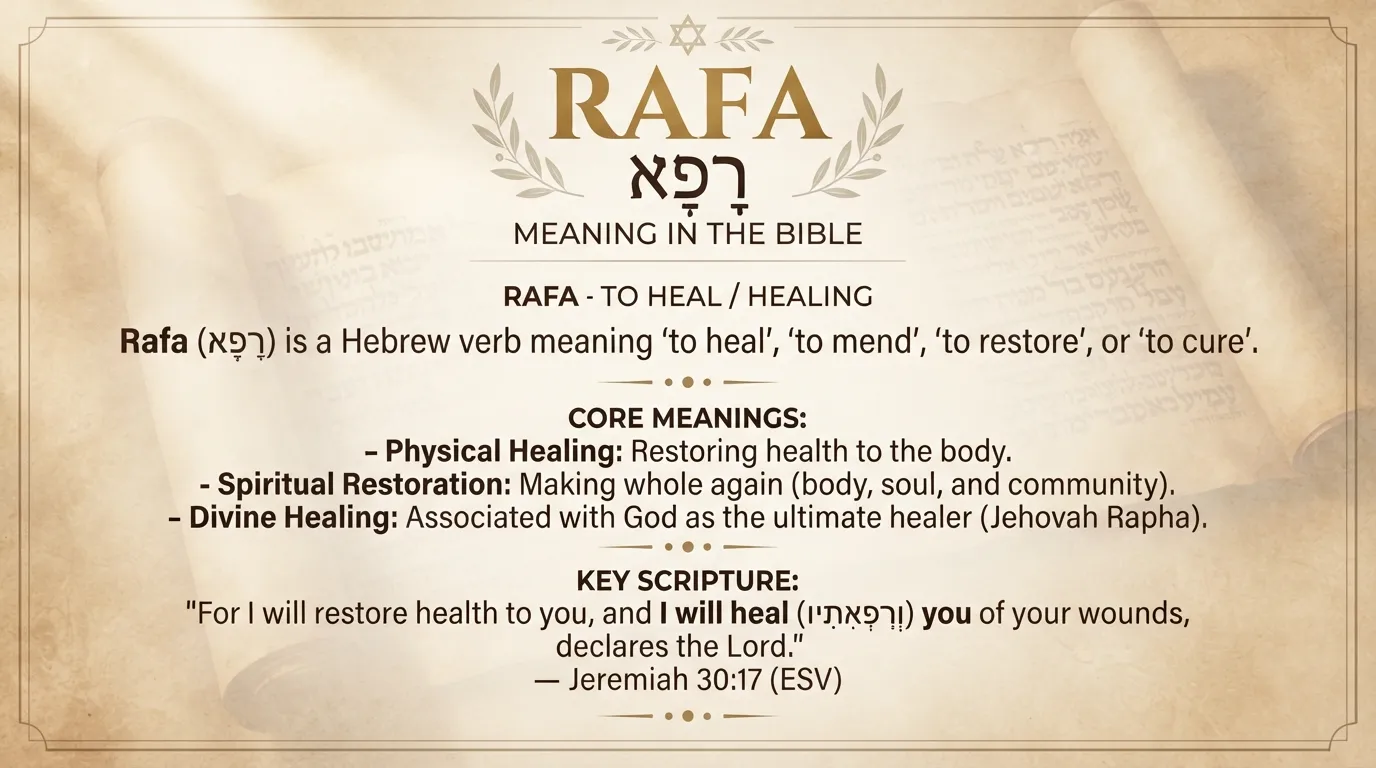
Rafa is a short form of Rafael (Raphael), from the Hebrew Rafa’el, meaning “God heals” or “God has healed.” It combines rapha (“to heal”) with El (“God”). A minor figure named Rephael appears in 1 Chronicles 26:7, while the archangel Raphael appears in the deuterocanonical Book of Tobit, not included in the Protestant Old Testament.
Biblical Meaning of Rafa 📖
Understanding Rafa’s meaning starts with its Hebrew roots, shared with the fuller name Raphael.
Hebrew Meaning
The name comes from Hebrew רָפָאֵל (Rafa’el), combining rapha (רָפָא), meaning “to heal,” with El (אֵל), meaning “God.”
Together, this forms “God heals” or “God has healed,” one of the clearest healing-centered names in all of Scripture.
Literal Meaning
Literally, Rafa points to divine healing itself, God as the active source of restoration and wholeness.
Spiritual Meaning
Spiritually, the name connects directly to God’s consistent character as healer throughout both the Old and New Testaments.
Biblical Significance
While the shortened form “Rafa” itself doesn’t appear in Scripture, its full form Raphael carries genuine, if limited, biblical weight.
Key Scripture Reference
Exodus 15:26 declares, “I am the Lord, your healer,” using the same Hebrew root, rapha, that forms the foundation of Rafa’s meaning.
Historical & Biblical Context 🏛️
Understanding Rafa’s full biblical context requires distinguishing between canonical Scripture and later Jewish and Christian tradition.
Old Testament Usage
The Hebrew root rapha appears throughout the Old Testament, describing God’s healing power in contexts ranging from physical illness to national restoration.
A minor figure named Rephael appears in 1 Chronicles 26:7, listed among the sons of Shemaiah, a gatekeeper’s family serving in the Temple.
This is a brief genealogical mention, without any narrative detail beyond his name and family line.
New Testament Relevance
The archangel Raphael is never mentioned anywhere in the New Testament text itself.
Some later Christian tradition has associated him with the unnamed angel who stirred the healing waters in John 5:4, though this connection isn’t stated directly in Scripture.
Deuterocanonical Context
The angel Raphael appears prominently in the Book of Tobit, guiding Tobias and healing his father’s blindness.
Tobit is considered canonical Scripture by Catholic and Eastern Orthodox traditions, but is classified as apocryphal, outside the Old Testament, by Protestant tradition.
This distinction matters for accuracy: Raphael’s angelic role comes primarily from Tobit, not from texts every Christian tradition considers Scripture.
Is Rafa Mentioned in the Bible? 📜
The answer depends on which form of the name and which biblical canon you’re asking about.
Where It Appears
Rephael appears once in 1 Chronicles 26:7 within the Protestant, Catholic, and Orthodox Old Testament alike.
The angel Raphael appears extensively throughout the Book of Tobit, recognized as Scripture by Catholic and Orthodox Christians.
Why It Matters
This distinction matters for honest, accurate content: Rafa’s connection to Scripture is real, but its strength depends on which biblical tradition is in view.
What It Teaches
It teaches the importance of being precise about biblical sources, especially with names carrying rich extended traditions beyond the core text.
Spiritual Meaning & Symbolism 🕊️
Rafa’s meaning, “God heals,” offers rich spiritual symbolism throughout Scripture, regardless of the angel debate.
Physical Healing vs. Spiritual Restoration
The Hebrew root rapha covers both physical healing and deeper spiritual restoration throughout the Old Testament.
Jeremiah 17:14 prays, “Heal me, O Lord, and I shall be healed,” using this same root for both bodily and spiritual renewal.
Human Effort vs. Divine Source
Scripture consistently presents healing as something God provides, not something people achieve purely through their own effort.
This theme runs directly through Rafa’s core meaning: healing originates with God, not human strength alone.
God’s Perspective
Throughout Scripture, God repeatedly identifies Himself as healer, a role central to His covenant relationship with His people.
Lessons for Today
Someone named Rafa can find genuine encouragement in Scripture’s consistent portrayal of God as an active, present healer.
📊 Quick Comparison: Canonical vs. Deuterocanonical Sources
| Rephael (1 Chronicles 26:7) | Raphael (Book of Tobit) |
|---|---|
| Recognized by all Christian traditions | Recognized by Catholic and Orthodox traditions |
| Brief genealogical mention, no narrative | Extended narrative role as healing angel |
| A human Temple gatekeeper’s family member | An archangel disguised as a human traveler |
| Old Testament, universally canonical | Deuterocanonical, apocryphal in Protestant tradition |
Biblical Verses About Healing Connected to Rafa’s Meaning ✝️
These verses trace the Hebrew root rapha, the foundation of Rafa’s meaning, throughout Scripture.
Exodus 15:26
“I am the Lord, your healer.”
This declaration comes shortly after Israel’s escape from Egypt, as God introduces Himself in this specific healing role.
The Hebrew here is rapha, the exact root behind Rafa’s name, spoken directly by God about His own character.
The lesson shows healing as central to how God chose to reveal Himself to His newly freed people.
This remains one of Scripture’s clearest, most direct statements connecting God’s identity to healing.
Jeremiah 17:14
“Heal me, O Lord, and I shall be healed; save me, and I shall be saved, for you are my praise.”
Jeremiah prays this during a season of genuine personal distress, pleading for God’s restorative power.
The repeated use of rapha here emphasizes total dependence on God for both physical and emotional healing.
The lesson models honest, direct prayer for healing, trusting God’s character rather than one’s own resources.
This verse shows that even faithful prophets openly acknowledged their need for God’s healing touch.
Psalm 147:3
“He heals the brokenhearted and binds up their wounds.”
This verse pairs physical imagery, “binds up wounds,” with the deeper emotional reality of a broken heart.
It shows God’s healing extending beyond bodily illness into genuine emotional and spiritual restoration.
The lesson offers comfort that God’s healing reaches every dimension of human suffering, not merely physical symptoms.
Isaiah 53:5
“With his wounds we are healed.”
This prophetic verse, understood by Christians as pointing to Christ’s suffering, connects healing directly to sacrificial atonement.
The healing described here reaches beyond physical restoration into spiritual reconciliation with God.
The lesson reveals healing as ultimately rooted in Christ’s own suffering on behalf of others.
Matthew 8:16-17
“He healed all who were sick… that it might be fulfilled: ‘He took our illnesses and bore our diseases.'”
Matthew directly connects Jesus’s healing ministry to Isaiah’s earlier prophecy, showing continuity between Old and New Testament healing themes.
This passage demonstrates Jesus actively fulfilling the healing character God revealed centuries earlier in Exodus.
The lesson shows healing as a consistent thread running through the entire biblical narrative, Old Testament to New.
James 5:14-15
“Is anyone among you sick? Let him call for the elders of the church, and let them pray over him… And the prayer of faith will save the one who is sick.”
James instructs the early church toward active prayer for healing within community, not isolated individual effort.
This passage shows healing prayer as a normal, expected practice within the life of the church.
The lesson encourages believers to seek healing through genuine community prayer, not solitary struggle.
3 John 1:2
“Beloved, I pray that all may go well with you and that you may be in good health, as it goes well with your soul.”
John connects physical health directly to spiritual wellbeing, treating both as genuine concerns worth praying for.
This verse shows a holistic biblical view of healing, encompassing both body and soul together.
The lesson reminds readers that concern for physical wellbeing reflects genuine, whole-person biblical care.
Real-Life Biblical Case Study: The Healing at Bethesda 🌟
John 5 records Jesus healing a man who had been paralyzed for thirty-eight years, beside the pool of Bethesda.
Tradition held that an angel occasionally stirred the pool’s waters, and whoever entered first afterward would be healed.
Some later Christian tradition, though not the biblical text itself, identified this angel with Raphael, whose very name means “God heals.”
The paralyzed man had waited decades, unable to reach the water in time, watching others receive healing while he remained overlooked.
Jesus approached him directly and asked, “Do you want to be healed?” (John 5:6), before commanding him to rise and walk.
The man was healed immediately, without needing the pool, the timing, or any angelic assistance at all.
This story shows Jesus as the true source of healing, surpassing any tradition about angels stirring water.
Whatever connection later tradition drew to Raphael, Scripture’s real emphasis lands squarely on Christ’s direct, personal healing power.
Life Lessons for Christians 🙏
Rafa’s meaning, “God heals,” offers genuine, practical lessons for believers today.
God identifies as healer. Exodus 15:26 shows this isn’t incidental to God’s character, but central to how He introduced Himself.
Healing covers the whole person. Psalm 147:3 and 3 John 1:2 both show Scripture’s holistic concern for body, heart, and soul together.
Honest prayer invites healing. Jeremiah’s direct plea models bringing genuine need before God rather than hiding it.
Community matters in healing. James 5 shows the early church prayed for healing together, not in isolation.
Christ fulfills the healing promise. Matthew 8 connects Jesus’s ministry directly to God’s ancient healing character revealed in Exodus.
Common Misunderstandings ⚠️
Several points of confusion surround Rafa and Raphael’s biblical status online.
Modern misuse: Some sources claim Raphael is a named biblical archangel without clarifying that his primary appearance is in a book not universally recognized as Scripture.
Cultural confusion: Others conflate the brief Old Testament figure Rephael with the elaborate angel narrative from Tobit, treating them as the same detailed story.
Wrong interpretations online: A few articles state flatly that “Raphael is in the Bible” without noting the important Protestant versus Catholic/Orthodox canon distinction.
Correct biblical explanation: Rafa’s meaning, “God heals,” is solidly biblical; its connection to a specific named angel depends on which biblical canon is being discussed.
💡 Expert Insight: When researching Raphael, always specify which source you’re citing. “Raphael appears in the Book of Tobit” is accurate and verifiable; “Raphael appears in the Bible” needs the canon clarified, since this varies significantly across Christian traditions.
FAQs ❓
What does Rafa mean in the Bible?
Rafa is short for Rafael (Raphael), Hebrew for “God heals,” combining rapha (“to heal”) with El (“God”).
Is Raphael a real angel in the Bible?
Raphael appears in the Book of Tobit, recognized as Scripture by Catholic and Orthodox Christians but classified as apocryphal in Protestant tradition.
Does the name Rephael appear in the Old Testament?
Yes, a minor figure named Rephael appears briefly in 1 Chronicles 26:7, listed among a Temple gatekeeper’s family, recognized across all Christian traditions.
Why isn’t Raphael in every version of the Bible?
Raphael’s main story comes from the Book of Tobit, which Protestant Bibles exclude as apocryphal while Catholic and Orthodox Bibles include it.
What does the name Rafa mean spiritually?
Spiritually, Rafa points to God’s identity as healer, a theme running consistently from Exodus through Christ’s healing ministry in the Gospels.
Conclusion 🌿
The Rafa meaning in the Bible centers on one of Scripture’s richest themes: “God heals,” rooted in the Hebrew word rapha.
Whether referring to the brief Old Testament figure Rephael or the fuller angel narrative in the deuterocanonical Book of Tobit, the name’s core meaning remains consistent.
That meaning finds its clearest fulfillment not in angelic tradition, but in God’s own repeated declaration of Himself as healer.
From Exodus to the Gospels, Scripture consistently shows a God who heals bodies, hearts, and souls with genuine, personal care.
May that same healing character, declared long ago at the very start of Israel’s journey, meet you wherever healing is needed today.

Hello, I’m Michael Bennett. I am passionate about exploring the symbolism, dreams, and spiritual messages found throughout the Bible. My research focuses on understanding how biblical themes connect with faith, personal growth, and everyday life.