on God Himself.
Scripture treats contempt seriously, tracing it back to pride and a hardened heart.
David wrestled with it in the Psalms. Paul warned against it in the church.
Even Michal’s contempt for David’s worship reveals how dangerous this attitude can be.
This article explores where contempt appears in Scripture and what it teaches about humility instead.
Quick Answer 🎯
What Does Contempt Mean in the Bible?
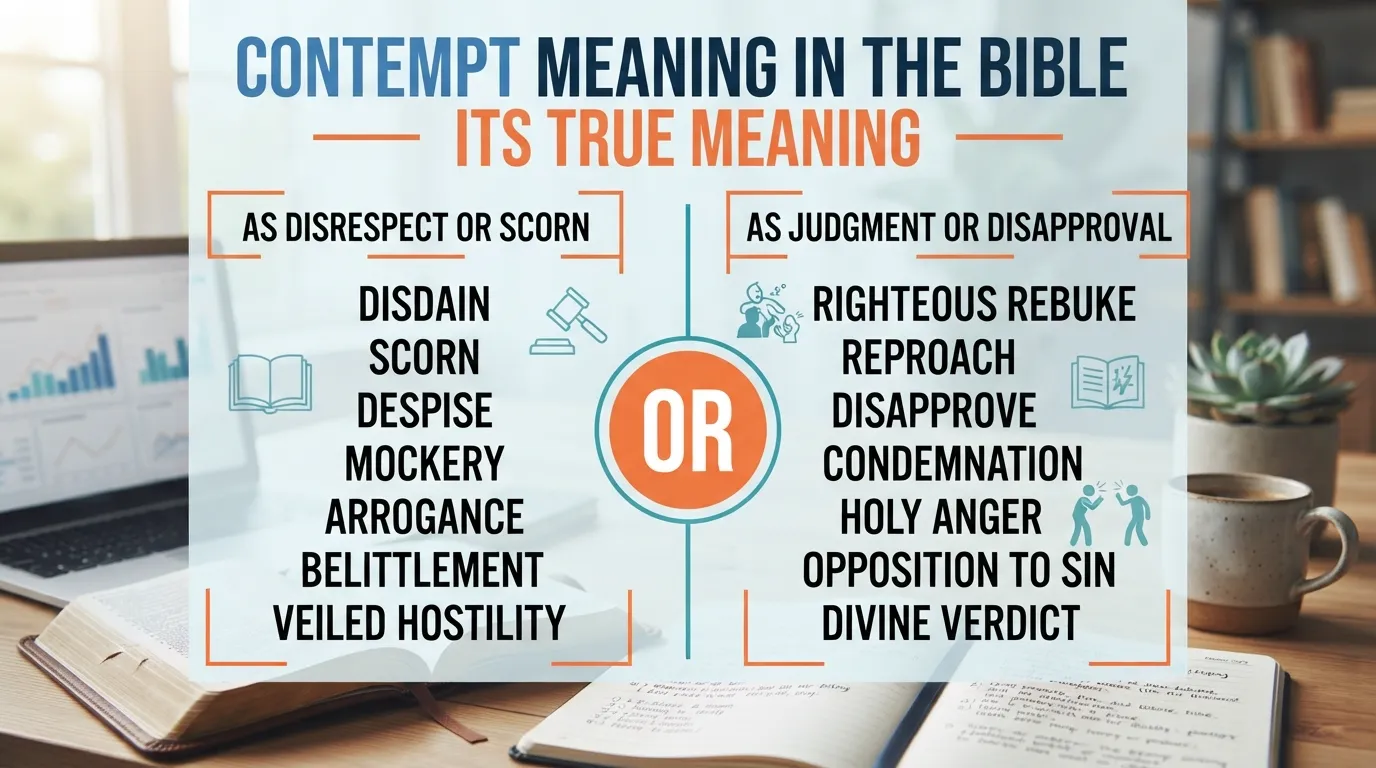
Contempt in the Bible means despising, disdaining, or looking down on someone with disrespect. Scripture warns against contempt as rooted in pride, whether directed toward other people, spiritual leaders, or God Himself.
What Is Contempt? Simple Definition 📘
What Is Contempt?
Contempt is the feeling that a person or thing is worthless or beneath respect.
It mixes scorn, disdain, and a sense of being better than someone else.
What Does It Mean to Show Contempt?
To show contempt is to treat someone as unworthy of honor.
It can appear in words, tone, a look, or even silence.
What Does Contemptible Mean?
Contemptible describes someone or something that seems to deserve contempt.
In Scripture, the priests called God’s altar “contemptible” in Malachi 1:7 and 1:12.
What Does Contemptuous Mean?
Contemptuous describes a person, look, or action that is full of contempt.
A contemptuous attitude dismisses others as unimportant.
How Do You Spell Contempt?
The correct spellings are contempt and contemptible.
Common typing slips include comtempt, contemptable, contempible, and contemtible.
What Does the Bible Say About Contempt?
The Bible says contempt grows from pride and opposes humility.
It warns against looking down on neighbors, leaders, the vulnerable, and God Himself.
Biblical Meaning of Contempt 📖
Contempt describes a posture of the heart that dismisses others as unworthy of respect.
Hebrew and Greek Meaning
The Hebrew word bazah means to despise or hold in low esteem.
The Greek word kataphroneo carries similar meaning, describing looking down on or disregarding someone.
Literal Meaning
Literally, contempt means treating someone or something as worthless or beneath consideration.
Spiritual Meaning
Spiritually, contempt reveals pride, since it elevates self while diminishing others.
Biblical Significance
Scripture consistently connects contempt with judgment, since it opposes the humility God desires.
Key Scripture Reference
“Whoever despises his neighbor is a sinner, but blessed is he who is generous to the people with low-income” (Proverbs 14:21, ESV).
Contempt in Hebrew and Greek 🔤
The Bible uses several original words for contempt. Here are the main ones.
Contempt Meaning in Hebrew
The Hebrew word buz (בּוּז) means contempt or scorn. It appears in Psalm 123:3-4.
Bazah means to despise, and na’ats means to spurn or treat with disrespect.
So what is contempt in Hebrew? It is usually buz, while bazah describes the act of despising.
Disdain in Hebrew
In the Bible, disdain is closely tied to the Hebrew verb bazah.
In 1 Samuel 17:42, Goliath looks at David and disdains him for being a young man.
What Does Enmity Mean in Hebrew?
Enmity means deep hostility. The Hebrew word is eivah (אֵיבָה), first used in Genesis 3:15.
It is stronger than contempt. Contempt looks down on someone, while enmity opposes them.
Contempt in Greek
Kataphroneo means to look down on someone. Paul uses it in 1 Timothy 4:12 and Romans 2:4.
Exoutheneo means to treat someone as nothing. It appears in Luke 18:9 and Romans 14:10.
Historical & Biblical Context 🏛️
Understanding contempt meaning in the Bible requires seeing how it appears across different biblical relationships.
Old Testament Usage
2 Samuel 6:16 describes Michal despising David for his uninhibited worship before the Lord.
Proverbs repeatedly warns against contempt toward the people with low-income and vulnerable.
New Testament Relevance
Romans 14:10 asks why believers show contempt toward fellow Christians over disputable matters.
1 Timothy 4:12 encourages Timothy not to let others show contempt for his youth.
Cultural Understanding in Biblical Times
In ancient hierarchical societies, contempt often flowed from those with status toward those without it.
Scripture repeatedly challenges this cultural norm by calling for honor toward the marginalized.
Is Contempt Mentioned in the Bible? 📜
Yes, appearing in various relational and spiritual contexts.
Where It Appears
Key passages include 2 Samuel 6:16, Proverbs 14:21, Romans 14:10, and 1 Timothy 4:12.
Why It Matters
Its appearance across different relationships shows contempt as a widespread temptation, not limited to one context.
What It Teaches
It teaches that contempt reflects pride and opposes the humility and honor God calls believers toward.
Contempt Meaning in the KJV
The King James Version uses the word contempt in verses like Job 12:21, Psalm 119:22, and Proverbs 18:3.
In Esther 1:18, the KJV pairs it with wrath, showing how contempt often leads to conflict.
Spiritual Meaning & Symbolism ⚖️
Contempt symbolizes pride’s tendency to diminish others in order to elevate self.
Pride vs. Humility
Scripture consistently contrasts contemptuous pride with Christ-like humility.
Judgment vs. Grace
Contempt judges harshly, while grace extends honor even to the undeserving.
God’s Perspective
God opposes the proud but gives grace to the humble (James 4:6), directly addressing the heart behind contempt.
Lessons for Today
In a culture quick to mock and dismiss, Scripture’s warnings against contempt remain deeply relevant.
Biblical Verses About Contempt 📚
Here are key verses that shape the contempt meaning in the Bible.
Proverbs 14:21
“Whoever despises his neighbor is a sinner, but blessed is he who is generous to the people with low-income.”
This proverb directly names contemptuous disregard for others as sin.
It contrasts this attitude with generosity, showing the practical alternative to contempt.
The lesson calls believers toward active kindness rather than dismissive judgment.
2 Samuel 6:16
“As the ark of the Lord came into the city of David, Michal the daughter of Saul looked out of the window and saw King David leaping and dancing before the Lord, and she despised him in her heart.”
Michal’s contempt arose from pride about royal dignity, missing the heart of true worship.
Her judgmental reaction ultimately led to relational and personal consequences (verse 23).
The lesson warns against contempt toward genuine, wholehearted worship of God.
Romans 14:10
“Why do you pass judgment on your brother? Or you, why do you despise your brother? For we will all stand before the judgment seat of God.”
Paul challenges believers who show contempt toward others over disputable matters of conscience.
He reminds them that ultimate judgment belongs to God, not fellow believers.
The lesson calls for humility instead of contemptuous judgment within the church.
1 Timothy 4:12
“Let no one despise you for your youth, but set the believers an example in speech, conduct, love, faith, and purity.”
Paul encourages young Timothy not to let others’ contempt undermine his ministry confidence.
This shows contempt sometimes directed unfairly based on age or perceived inexperience.
The lesson encourages responding to potential contempt with faithful, exemplary living.
Psalm 123:3-4
“Have mercy upon us, O Lord, have mercy upon us, for we have had more than enough of contempt. Our soul has had more than enough of the scorn of those who are at ease.”
This psalm expresses the pain of experiencing ongoing contempt from others.
It models honest prayer, bringing this painful experience directly before God.
The lesson offers comfort for those who have suffered contemptuous treatment from others.
Malachi 1:6
“A son honors his father, and a servant his master. If then I am a father, where is my honor? And if I am a master, where is my fear of me? says the Lord of hosts to you, O priests, who despise my name.”
God directly confronts the priests for showing contempt toward His name through careless worship.
This shows contempt can be directed toward God Himself, not only toward people.
The lesson challenges believers to examine whether their worship reflects true honor or careless disregard.
Luke 18:9
“He also told this parable to some who trusted in themselves that they were righteous, and treated others with contempt.”
Jesus introduces the parable of the Pharisee and tax collector by naming contemptuous self-righteousness directly.
This sets up a powerful contrast between prideful judgment and humble repentance.
The lesson warns against spiritual pride that looks down on others as less worthy before God.
Proverbs 11:12
“Whoever belittles his neighbor lacks sense, but a man of understanding remains silent.”
This proverb connects contemptuous belittling with a lack of wisdom.
It praises thoughtful restraint over careless, dismissive words toward others.
The lesson encourages choosing silence over contemptuous commentary when tempted to judge.
James 2:6
“But you have dishonored the people with low-income man. Are not the rich the ones who oppress you, and the ones who drag you into court?”
James rebukes believers for showing contemptuous favoritism toward the wealthy over the people with low-income.
This directly applies contempt’s danger to practical church life and relationships.
The lesson calls for consistent honor toward all people, regardless of social status.
More Bible Verses About Contempt 📖
These verses add to the list above and answer common searches for a contempt Bible verse.
Psalm 119:22
The psalmist asks God to take away scorn and contempt.
The KJV words it as “reproach and contempt,” which shows how closely these words are linked.
Proverbs 18:3
This proverb says that when wickedness comes, contempt comes with it.
It shows contempt as a companion of a hardened heart.
Isaiah 53:3
The suffering servant is described as despised and rejected.
Christians see this as a picture of Jesus, who faced contempt for our sake.
Daniel 12:2
This verse speaks of “shame and everlasting contempt” for some at the final resurrection.
It shows that Scripture treats contempt as a serious matter, not a small habit.
Contempt of God Meaning
Contempt of God means treating Him as unworthy of honor.
In Numbers 14:11, God asks how long the people will despise Him. In Psalm 10:13, the KJV asks why the wicked “contemn” God.
Examples of Contempt in the Bible 👥
The Bible gives many real examples of contempt. Each shows how pride can twist a heart.
Hagar and Sarai (Genesis 16:4)
When Hagar conceived, she looked with contempt on her mistress Sarai.
Her new status made her look down on the person she served.
Esau and His Birthright (Genesis 25:34)
Genesis says Esau despised his birthright. He traded something sacred for a bowl of stew.
This is contempt toward a spiritual blessing.
Goliath and David (1 Samuel 17:42)
Goliath saw David and disdained him because he was young.
His contempt hid the real power of David’s faith.
Sanballat and Tobiah (Nehemiah 4:1-3)
These two men mocked the Jews who were rebuilding Jerusalem’s wall.
Their ridicule was meant to discourage the builders.
Herod and the Soldiers (Luke 23:11)
Herod and his soldiers treated Jesus with contempt and mocked Him.
This is one of the clearest examples of contempt toward Christ.
The Pharisee in the Temple (Luke 18:9-14)
The Pharisee in Jesus’ parable looked down on the tax collector while praying.
The tax collector went home right with God, not the Pharisee.
Michal’s story is covered in the case study below.
Showing Contempt When We Judge Others (Romans 2:4) ⚖️
For What Do We Show Contempt When We Judge Others?
Romans 2:1-4 says that when we judge others, we can show contempt for God’s kindness, forbearance, and patience.
Some translations say “despise” or “presume on” instead of “show contempt.” The Greek word is kataphroneo.
What Truth About God and Repentance Do We Miss?
We miss that God’s kindness is meant to lead us to repentance (Romans 2:4).
When we judge others harshly, we forget how much mercy we have received ourselves.
Real-Life Biblical Case Study: Michal’s Contempt for David 👑
When David brought the ark of the covenant into Jerusalem, he danced before the Lord with unrestrained joy.
His wife Michal watched from a window, and Scripture records that she despised him in her heart.
She later confronted David sarcastically, mocking his humble display before servants and common people.
David responded that his worship was before the Lord, not for human approval or royal dignity.
The consequence of Michal’s contempt was significant: Scripture notes she remained childless for the rest of her life.
This story illustrates how contempt, rooted in pride about status and appearance, can blind us to genuine worship.
Michal’s judgmental heart missed the beauty of wholehearted devotion to God happening right before her.
Her example warns believers against letting pride and concern for appearances curdle into contempt toward others’ sincere faith.
Life Lessons for Christians ✝️
The contempt meaning in the Bible offers several practical lessons.
Choose generosity over judgment. Proverbs 14:21 contrasts contemptuous disregard with active kindness toward others.
Avoid judging disputable matters harshly. Romans 14:10 calls believers away from contemptuous judgment within the church.
Honor those who seem inexperienced. 1 Timothy 4:12 challenges dismissing others based on age or status.
Examine your worship. Malachi 1:6 warns that even careless worship can reflect contempt toward God.
Practice humble self-examination. Luke 18:9’s parable warns against self-righteous contempt toward others.
Common Misunderstandings 🤔
Several confusions surround this word today.
Modern misuse: People sometimes use “contempt” loosely for any criticism, missing its deeper connection to pride and disdain.
Cultural confusion: Online culture often normalizes contemptuous mockery as humor, contrary to Scripture’s warnings.
Wrong interpretations online: Some claim contempt only applies to legal or formal settings, missing its everyday relational application.
Correct biblical explanation: Contempt describes a heart posture of pride that dismisses others’ worth, whether expressed openly or silently.
Contemned, Contemptible, and Disdain: Related Biblical Words 🔍
Several older or related words often get searched alongside “contempt,” since they describe the same core attitude using different forms.
Contemned is the King James-era past tense of “contemn,” meaning to have despised or treated with scorn. Psalm 15:4 uses this form: “in whose eyes a vile person is contemned.” It describes the same act as “contempt,” just in older English grammar.
Contemptible describes something or someone deserving of contempt, worthy of being despised. Malachi 1:7 and 1:12 use this word when God rebukes the priests for treating His altar and offerings as “contemptible,” meaning worthless or beneath respect.
Disdain and disdainful are close synonyms for contempt, describing the same prideful looking-down on someone. While the exact word “disdain” doesn’t appear often in most modern translations, the attitude it describes is the same one Scripture warns against throughout passages like Luke 18:9 and Romans 14:10.
More Related Words: Despise, Scorn, Reproach, Forbearance and Content 📚
Contemn and Contemners
To contemn is to treat with contempt. Contemners are people who show contempt.
The word is rare in English Bibles. Acts 13:41 uses “despisers” for the same idea.
Contemptuous and Contemptuously
Psalm 31:18 in the KJV speaks of people who speak “contemptuously” against the righteous.
In plain terms, it means speaking with disrespect and scorn.
Disdained in the Bible
Disdained means looked down on with scorn.
First Samuel 17:42 is the clearest example, where Goliath disdained David.
Despise in the Bible
To despise is to look down on someone or something as worthless.
Isaiah 53:3 says the Messiah was “despised,” and Hebrews 12:2 says Jesus endured the cross, “despising the shame.”
Scorn Meaning in the Bible
Scorn is open mockery. Proverbs 3:34 says God scorns the scorners but gives grace to the humble.
Scorn is the outward voice of contempt.
Reproach Meaning in the Bible
Reproach means shame, disgrace, or blame. The Hebrew word is cherpah.
Proverbs 14:34 says sin is a reproach to any people.
Forbearance Meaning in the Bible
Forbearance means patient restraint when you have a reason to be harsh.
Romans 2:4 describes God’s forbearance as the opposite of what contempt ignores.
Content Meaning in the Bible
Content, as in “content with what you have,” means satisfied. Philippians 4:11 and 1 Timothy 6:6 both speak of it.
It sounds like contempt, but the two are unrelated in meaning.
Debauchery Meaning in the Bible
Debauchery means excessive indulgence in sinful pleasure. The Greek word is asotia, as in Ephesians 5:18 and 1 Peter 4:4.
It is a separate sin from contempt, though pride can feed both.
Contempt in Other Languages and Phrases 🌐
Contempt Meaning in Swahili
In Swahili, contempt is often translated as dharau, meaning disrespect or looking down on someone.
Contemptus Mundi Meaning
Contemptus mundi is Latin for “contempt for the world.”
It is a medieval Christian theme about turning away from worldly attachments, not about despising people.
What Does “Familiarity Breeds Contempt” Mean?
It means that knowing someone very well can lead to taking them for granted.
Jesus faced something similar in His hometown, where He said a prophet is not without honor except among his own people (Mark 6:4).
FAQs ❓
What does contempt mean in the Bible?
Contempt in the Bible means despising or looking down on someone with disdain, often rooted in pride and self-righteousness.
Why did Michal despise David in 2 Samuel 6?
Michal’s contempt arose from pride about royal dignity, disapproving of David’s uninhibited worship before the Lord.
Can contempt be directed toward God according to Scripture?
Yes. Malachi 1:6 shows God confronting priests for treating His name with contempt through careless worship.
How does Romans 14:10 address contempt within the church?
It challenges believers not to despise fellow Christians over disputable matters, reminding them that God alone judges rightly.
How can Christians overcome a contemptuous heart?
Christians can overcome contempt through humility, generosity, honoring others, and examining their own hearts for pride.
Is “familiarity breeds contempt” a Bible verse?
No. This is a well-known English proverb, not a verse from Scripture. It traces back to classical and medieval writings, not the Bible, though its warning about overfamiliarity leading to disrespect echoes themes of humility Scripture does address elsewhere.
What does “contempt of God” mean?
Contempt of God describes treating Him, His name, or His worship as unworthy of honor or respect. Malachi 1:6 shows this directly, with God confronting priests who treated His name and altar with contempt through careless, half-hearted worship.
Is “contempt of court” related to biblical contempt?
Not directly. “Contempt of court” is a modern legal term describing disrespect or disobedience toward a judge or legal proceeding. It shares the same root word as biblical contempt, disrespect toward authority, but it’s a specific legal concept rather than a biblical one.
What causes contempt, according to the Bible?
Scripture consistently traces contempt back to pride, an inflated view of oneself that leads to devaluing others. James 4:6 notes that God “opposes the proud but gives grace to the humble,” identifying pride as contempt’s root cause.
What is contempt?
Contempt is the feeling that someone or something is worthless or beneath respect.
What does it mean to show contempt?
It means treating someone as unworthy of honor, through words, tone, looks, or silence.
What does contemptible mean in the Bible?
Contemptible means deserving of contempt. In Malachi 1:7 and 1:12, the priests called God’s altar contemptible.
What does contemned mean in the Bible?
Contemned is the older past tense of contemn, meaning treated with scorn. Psalm 15:4 uses it in the KJV.
What does contemptuous mean in the Bible?
Contemptuous means full of contempt. Psalm 31:18 in the KJV uses “contemptuously” for disrespectful speech.
What is the Hebrew word for contempt?
The main Hebrew word for contempt is buz (בּוּז). Bazah means to despise.
What is the Greek word for contempt?
The main Greek words are kataphroneo, meaning to look down on, and exoutheneo, meaning to treat as nothing.
What does contempt mean in the KJV?
In the KJV, contempt means scorn or disgrace. Psalm 119:22 pairs it with “reproach.”
What does disdain mean in the Bible?
Disdain means looking down on someone with scorn. Goliath disdained David in 1 Samuel 17:42.
What does despise mean in the Bible?
To despise is to treat someone or something as worthless. Esau despised his birthright in Genesis 25:34.
What does the Bible say about contempt?
The Bible says contempt comes from pride and opposes humility. It calls believers to honor others instead.
Are there examples of contempt in the Bible?
Yes. Examples include Hagar and Sarai, Esau, Goliath, Sanballat and Tobiah, Herod, the Pharisee in Luke 18, and Michal.
For what do we show contempt when we judge others?
According to Romans 2:4, we show contempt for God’s kindness, forbearance, and patience. We miss that His kindness leads us to repentance.
What does reproach mean in the Bible?
Reproach means shame, disgrace, or blame. The Hebrew word is cherpah.
What does scorn mean in the Bible?
Scorn means mockery. Proverbs 3:34 says God gives grace to the humble but scorns the scorners.
What does forbearance mean in the Bible?
Forbearance means patient restraint. Romans 2:4 lists it as one of God’s qualities.
What does content mean in the Bible?
Content means satisfied. Philippians 4:11 and 1 Timothy 6:6 speak of contentment.
What does enmity mean in Hebrew?
Enmity means deep hostility. The Hebrew word is eivah, used in Genesis 3:15.
What does debauchery mean in the Bible?
Debauchery means excessive indulgence in sinful pleasure. Ephesians 5:18 and 1 Peter 4:4 use the word.
What does contempt mean in Swahili?
In Swahili, contempt is dharau, meaning disrespect or looking down on someone.
What does contemptus mundi mean?
It is Latin for “contempt for the world,” a medieval Christian theme about renouncing worldly attachments.
Conclusion
The contempt meaning in the Bible exposes a subtle but serious sin: the quiet pride of looking down on others.
From Michal’s judgment of David to the Pharisee’s self-righteousness, Scripture consistently warns against this posture.
Contempt often hides behind seemingly reasonable judgments, yet it reveals a heart resistant to humility.
God calls His people instead toward honor, generosity, and genuine respect for others, regardless of status or appearance.
May we examine our own hearts for hidden contempt, choosing humility over disdain in how we see others.
In doing so, we reflect the grace we ourselves have received from a God who welcomes the humble.

Hello, I’m Michael Bennett. I am passionate about exploring the symbolism, dreams, and spiritual messages found throughout the Bible. My research focuses on understanding how biblical themes connect with faith, personal growth, and everyday life.