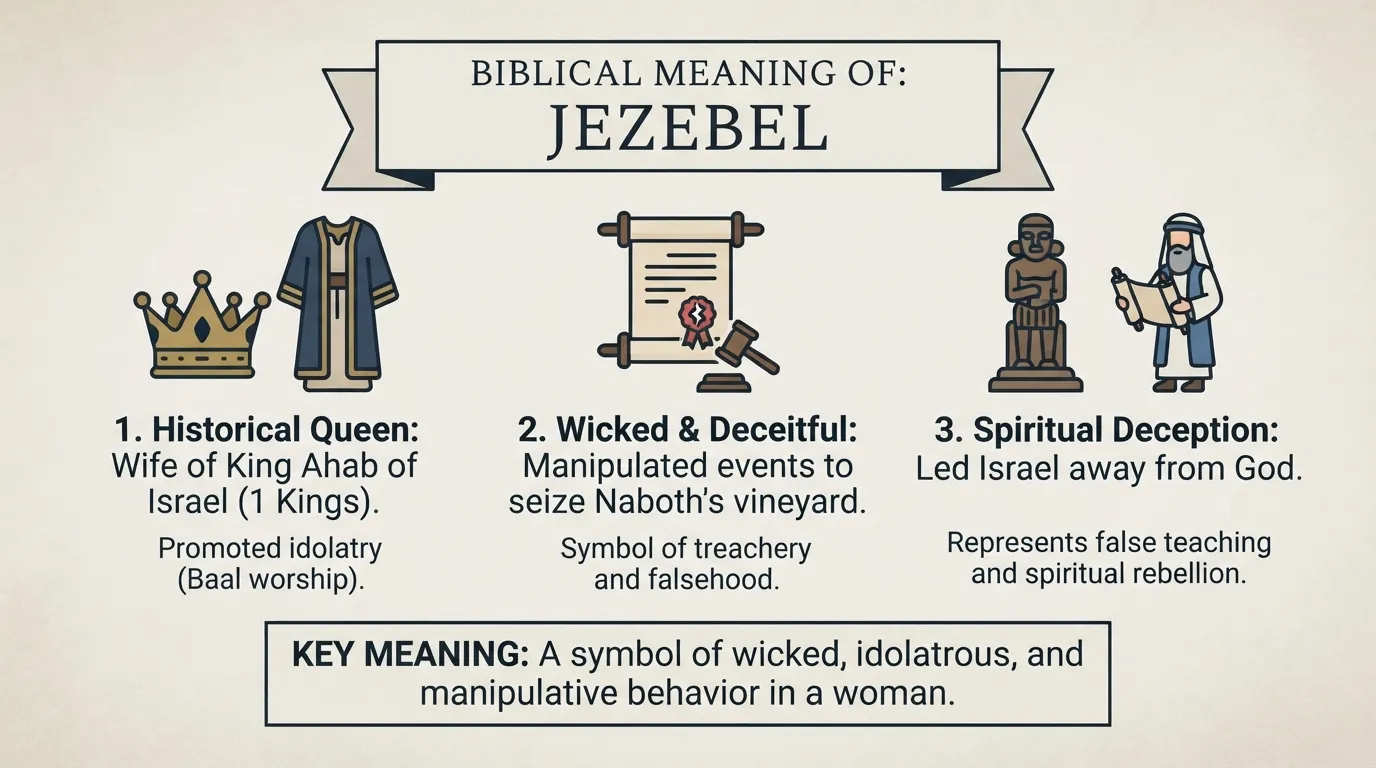
You hear someone called “a real Jezebel,” and even without knowing the full story, you already sense it’s not a compliment.
That instinct comes from one of Scripture’s most infamous figures, a queen whose name eventually became shorthand for manipulation, idolatry, and persecution of God’s people.
But her actual name’s meaning is more complicated, and honestly more interesting, than most quick definitions let on.
Did You Know? 🔍
Scholars genuinely disagree on Jezebel’s exact Hebrew meaning. Some trace it to a Baal-worship ritual cry, others to a name meaning “Baal exalts,” and others suggest Hebrew scribes deliberately altered her original name to make it sound insulting.
Quick Answer
Jezebel’s Hebrew name is generally understood either as “Where is Baal?” (a ritual cry from Canaanite worship) or “Baal exalts,” since her name directly incorporated the Phoenician god Baal. Some scholars believe the Hebrew Bible deliberately altered her original name to make it sound mocking or insulting. In Scripture, Jezebel was a Phoenician princess who became queen of Israel, infamous for promoting Baal worship and persecuting God’s prophets, and her name later became a byword for wickedness.
What Does Jezebel Mean in the Bible? 📖
Jezebel’s name incorporates “Baal,” the Canaanite storm god, making it what scholars call a theophoric name, one built around a deity’s name. Beyond that starting point, the exact meaning is genuinely debated.
What’s not debated is her role: a real historical queen whose actions were serious enough that her name became permanently attached to religious corruption and persecution throughout the rest of Scripture.
Biblical Meaning of Jezebel 📜
Hebrew Meaning (Disputed)
The Hebrew text reads ‘Izevel (אִיזֶבֶל). Major sources offer different readings: “Where is Baal?” (a ritual mourning cry used in Baal worship), “Baal exalts” or “Baal is husband,” and “not exalted,” a possible deliberate alteration.
Literal Meaning
Taken at face value, the name’s core element, “zebel,” points directly to Baal. Whether the full name praised Baal or mocked him depends entirely on which scholarly reading you follow.
Spiritual Meaning
Spiritually, even the uncertainty around her name tells a story. If Hebrew scribes did alter it to sound insulting, that itself reflects how seriously Scripture treated her idolatry, serious enough to rework her very name.
Biblical Significance
Jezebel’s significance isn’t really about etymology at all. It’s about what she did: actively working to replace worship of Yahweh with worship of Baal across an entire kingdom.
Key Scripture Reference
1 Kings 16:31 introduces her plainly: Ahab “took for his wife Jezebel the daughter of Ethbaal king of the Sidonians, and went and served Baal and worshiped him.”
A Note on the Disputed Etymology
It’s worth being direct here: no single, universally agreed meaning exists for Jezebel’s name.
The Oxford Guide to People and Places of the Bible favors “Where is Baal?”, connecting it to a known ritual phrase from Canaanite worship ceremonies.
Strong’s Concordance and other classic Hebrew lexicons favor “Baal exalts” or “Baal is husband,” reading the name as a sincere statement of devotion to Baal, fitting for a Phoenician princess raised in that religion.
A separate, widely repeated theory suggests Hebrew writers deliberately altered her original name, swapping in a root resembling “not exalted” or even a word close to “dung,” as a pointed insult built directly into the text.
Rather than pick one theory as definitively correct, this article treats the uncertainty honestly: all three readings appear in respected sources, and no manuscript evidence settles the question with certainty.
Is Jezebel Mentioned in the Bible? 🔍
Yes, extensively, primarily across 1 Kings 16-21 and 2 Kings 9, with a final, symbolic appearance in Revelation 2:20.
Why it matters: her story spans two full books of the Old Testament and reappears in the New Testament, making her one of the Bible’s most thoroughly documented negative examples.
Historical & Biblical Context 🏺
Old Testament Usage
Jezebel was the daughter of Ethbaal, king of the Phoenician city of Sidon (1 Kings 16:31), and became queen of Israel through marriage to King Ahab, a political alliance that brought Baal worship directly into Israel’s royal house.
New Testament Relevance
In Revelation 2:20, Jesus rebukes the church in Thyatira for tolerating “that woman Jezebel,” using her name as a label for a false prophetess leading believers into sexual immorality and idol worship, not a literal reappearance of the same person.
Cultural Understanding in Biblical Times
Royal marriages across the ancient Near East often sealed political alliances, and a foreign queen commonly brought her own religious practices into the new court. Jezebel’s case became the most consequential example of exactly that danger within Israel’s history.
Jezebel’s Story: A Quick Timeline
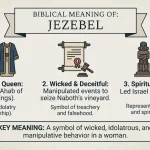
A She marries Ahab, king of Israel, bringing Baal and Asherah worship into the royal court (1 Kings 16:31-33).
She supports hundreds of Baal’s prophets and reportedly works to have Yahweh’s prophets killed (1 Kings 18:4, 13).
The She confronts and threatens the prophet Elijah after his victory over Baal’s prophets at Mount Carmel (1 Kings 19:1-2).
theShe orchestrates false testimony leading to Naboth’s execution, simply so Ahab could seize his vineyard (1 Kings 21:1-16).
She meets a violent, prophesied end, thrown from a window and left for dogs to eat, exactly as Elijah had foretold (2 Kings 9:30-37).
Spiritual Meaning & Symbolism ✨
Idolatry vs. Covenant Faithfulness
Jezebel represents organized, state-level idolatry, actively replacing worship of the true God rather than simply tolerating other religions alongside it.
God’s Perspective
Scripture treats her actions as a direct threat to the covenant relationship between God and Israel, serious enough to warrant specific prophetic confrontation and eventual judgment.
Lessons for Today
Revelation 2:20 shows that “Jezebel” became a lasting symbol for false teaching paired with immorality, a warning that outlasted the original historical figure by centuries.
Comparison Table: The Three Main Etymology Theories
| Theory | Proposed Meaning | Primary Source |
|---|---|---|
| Ritual cry | “Where is Baal?” | Oxford Guide to People & Places of the Bible |
| Sincere devotion | “Baal exalts” / “Baal is husband” | Strong’s Concordance, BDB Hebrew Lexicon |
| Deliberate insult | “Not exalted” (possible wordplay on “dung”) | Various scholarly commentaries |
Biblical Verses About Jezebel 📖
1 Kings 16:31
“And as if it had been a light thing for him to walk in the sins of Jeroboam… he took for his wife Jezebel.” This verse marks her entrance into Israel’s story as a turning point toward deeper national idolatry.
1 Kings 18:4
“Jezebel had cut off the prophets of the Lord.” This single line establishes her as an active persecutor, not merely a passive supporter of a rival religion.
1 Kings 19:1-2
Jezebel threatens Elijah directly: “So may the gods do to me… if I do not make your life as the life of one of them.” This confrontation shows her willing to threaten God’s own prophet personally.
1 Kings 21:25
“There was none who sold himself to do what was evil in the sight of the Lord like Ahab, whom Jezebel his wife incited.” Scripture explicitly names her as the driving influence behind Ahab’s worst actions.
2 Kings 9:30
“When Jehu came to Jezreel, Jezebel heard of it, and she painted her eyes and adorned her head and looked out of the window.” This verse opens the account of her dramatic, prophesied death.
2 Kings 9:36-37
“This is the word of the Lord, which he spoke by his servant Elijah… ‘The dogs shall eat the flesh of Jezebel.'” Her death fulfills Elijah’s earlier prophecy precisely, closing her story with clear divine judgment.
Revelation 2:20
“I will not tolerate that woman Jezebel, who calls herself a prophetess, and is teaching and seducing my servants to practice sexual immorality.” This verse applies her name symbolically to a very different, first-century false teacher in Thyatira.
Real-Life Biblical Case Study: Naboth’s Vineyard 🕊️
King Ahab wanted a vineyard belonging to a man named Naboth, who refused to sell his family’s inherited land, a refusal rooted in genuine Israelite law and tradition.
Rather than accept the refusal, Jezebel arranged false accusations against Naboth, leading directly to his execution and Ahab’s seizure of the land.
The prophet Elijah confronted Ahab immediately afterward, pronouncing judgment on both him and Jezebel for the murder.
This single episode captures Jezebel’s pattern precisely: using real political power to override both justice and God’s law whenever it stood in her way.
Life Lessons for Christians 🌱
Influence carries real responsibility. Scripture directly blames Jezebel for inciting Ahab toward evil, not just allowing it.
Power without accountability leads to real harm. Naboth’s death shows exactly what unchecked royal authority produced.
God’s justice isn’t always immediate, but it is certain. Jezebel’s death came years after her worst actions, fulfilling a prophecy spoken long before.
A name can outlive a person as a warning. Revelation 2:20 shows how “Jezebel” became permanently attached to false teaching and immorality, centuries later.
Common Misunderstandings ⚠️
Many people assume “Jezebel” in Revelation 2:20 refers to the same historical queen somehow reappearing. It doesn’t; John is using her name symbolically, the way someone today might call a modern tyrant “a real Hitler.”
Others assume there’s one clear, agreed-upon meaning for her Hebrew name. As shown above, respected scholarly sources genuinely disagree, and honesty requires presenting that uncertainty rather than confidently picking one.
Expert Insight 💡
When you study Jezebel, read 1 Kings 16 through 2 Kings 9 as one continuous arc rather than isolated episodes. Watching her influence build, peak, and then collapse under prophesied judgment shows the full pattern Scripture is actually warning against.
FAQs
What does the name Jezebel mean?
Scholars disagree. Leading theories include “Where is Baal?” (a ritual cry), “Baal exalts” (a statement of devotion), and “not exalted” (a possible deliberate insult).
Who was Jezebel in the Bible?
She was a Phoenician princess who became queen of Israel through marriage to King Ahab, known for promoting Baal worship and persecuting the prophets of Yahweh.
How did Jezebel die?
She was thrown from a window in Jezreel and her body was eaten by dogs, fulfilling a specific prophecy Elijah had given earlier (2 Kings 9:30-37).
Why is Jezebel mentioned in Revelation?
In Revelation 2:20, Jesus uses “Jezebel” as a symbolic name for a false prophetess in the church at Thyatira, not a literal reference to the Old Testament queen.
Why does “Jezebel” have such a negative connotation today?
Her biblical portrayal, idolatry, persecution of God’s prophets, and orchestrating Naboth’s murder, made her name a lasting byword for wickedness and manipulation throughout later Jewish and Christian tradition.
Conclusion
Even Jezebel’s name carries disagreement, and that’s worth admitting honestly rather than flattening into one tidy definition.
What Scripture makes unmistakably clear is her role: a queen who used real political power to promote idolatry, silence God’s prophets, and override justice itself when it suited her.
Her story ends in judgment, but her name outlasted her, becoming a lasting warning woven permanently into both the Old and New Testaments.

Hello, I’m Samuel Carter. My interest in biblical studies comes from a lifelong desire to understand the wisdom and teachings contained within Scripture. I particularly enjoy researching biblical numbers, patterns, and themes that appear throughout God’s Word.