Have you ever seen the number 666 and wondered whether it has a spiritual meaning? Many people connect this number with evil, the Antichrist, or frightening predictions about the future.
Others encounter it on a receipt, a clock, or online and wonder whether God is trying to send them a message.
The Bible does mention 666, but its main reference appears in a specific passage in the Book of Revelation.
Revelation 13:18 calls it the number of the beast and invites readers to use wisdom and understanding.
This setting is important because the verse is part of a larger vision about false worship, political power, and opposition to God.
The biblical meaning of 666 should therefore begin with Scripture, not modern numerology or fear. Christians have offered different explanations of the number, and some details remain disputed.
By studying the passage in context, we can understand what the Bible says, what scholars suggest, and what we should avoid claiming without clear evidence.
🔍 Did You Know?
Most ancient and modern biblical texts read Revelation 13:18 as 666, but some early manuscript evidence reads 616 instead. This variation is one reason scholars examine how the number may have worked as a coded reference in the ancient world. It also reminds us to study the Bible carefully rather than build an entire belief on one unexplained detail.
📖 Quick Answer: What Does 666 Mean in the Bible?
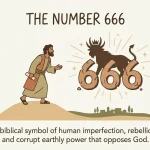
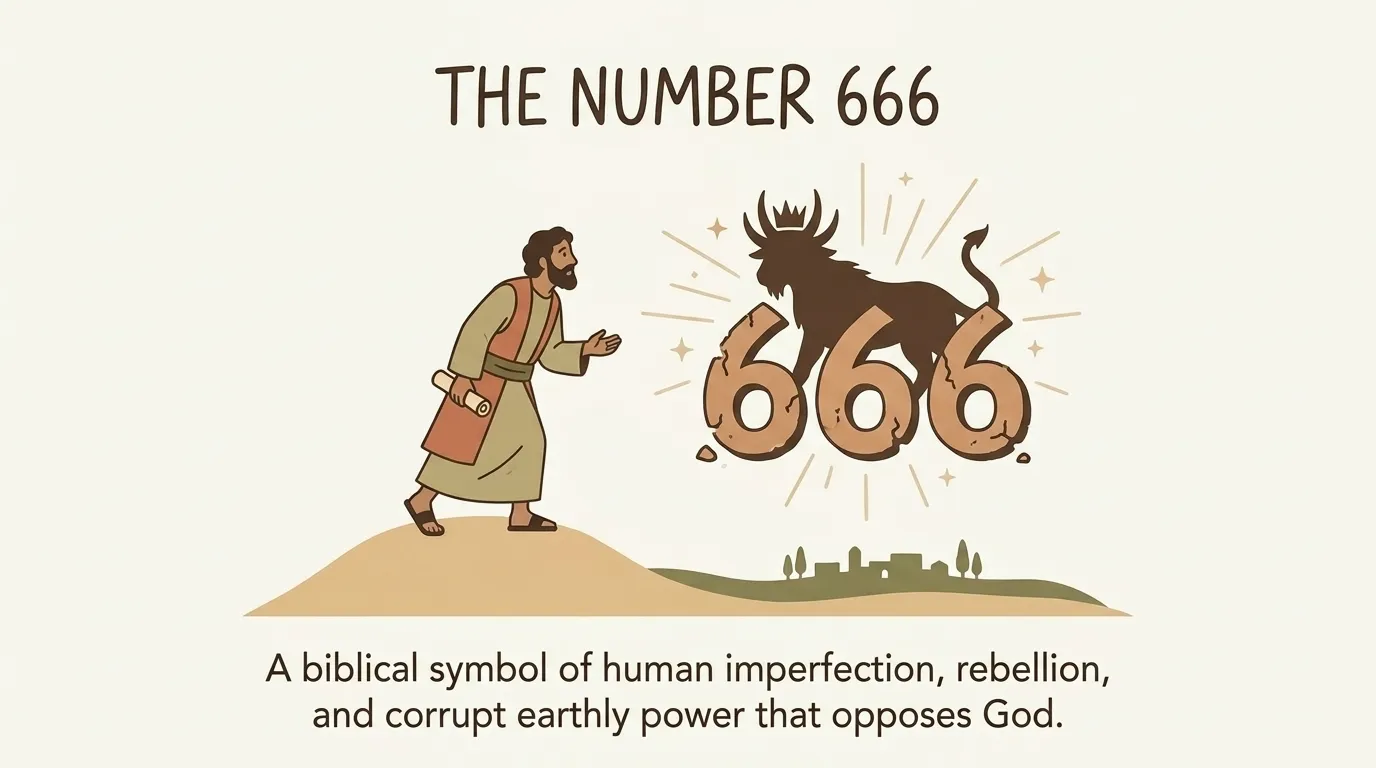
In the Bible, 666 is called the number of the beast in Revelation 13:18. It is linked to a beast that opposes God and demands allegiance. Many scholars think the number may point to Roman Emperor Nero through an ancient letter-number calculation, but the exact identification remains debated among interpreters.
📚 Biblical Meaning of 666
What Does 666 Mean in Simple Words?
The clearest biblical meaning of 666 comes from Revelation 13:18, where it is identified as the number of the beast. The beast appears in a vision that describes power opposing God and misleading people into false worship.
The number is not introduced as a lucky number, a personal sign, or a message to decode every time it appears in daily life. Its meaning belongs first to the story and symbols of Revelation.
Many Christians understand 666 as representing human power set against God. Some also see it as a symbolic picture of imperfection or rebellion. These interpretations are connected to the book’s wider imagery, but the verse itself does not give a simple definition such as “six means evil.”
A careful reading begins with what the passage says directly and then considers possible interpretations.
Is There a Hebrew or Greek Meaning of 666?
Revelation was written in Greek, and Revelation 13:18 uses the Greek expression for the number six hundred sixty-six. The verse calls readers to calculate the number of the beast and describes it as the number of a human being or a man’s number, depending on the translation.
There is no established Hebrew word meaning “666” that explains the verse. The number is not a Hebrew name, and the Bible does not provide a special Hebrew definition for it.
One leading explanation uses gematria, a method in which letters can carry numerical values. Under this approach, the name “Nero Caesar,” written in Hebrew characters in a particular form, can add up to 666. Some scholars consider this a strong explanation because Nero was a Roman ruler remembered for hostility toward Christians. Others disagree about how confidently this identification can be made.
The key point is that this is a proposed historical explanation, not an explicit statement in Revelation saying, “666 means Nero Caesar.” <Cite refs={[“turn637641search2″,”turn637641search6”]} />
What Is the Literal Meaning of 666?
As a number, 666 means six hundred sixty-six. In Revelation, however, it is more than an ordinary number because the writer gives it a symbolic role in the vision of the beast.
The verse asks a person with wisdom to calculate it. That wording suggests that the number had a meaning for the original audience beyond simply counting to 666. It may have functioned as a puzzle or coded reference, which was possible in a world where letters could also represent numbers.
The Bible does not say that every appearance of the number has the same spiritual significance. Its special meaning comes from Revelation 13 and its connection to the beast.
What Is the Spiritual Meaning of 666?
In a Christian perspective, 666 warns readers about power, worship, and loyalty that oppose God. Revelation describes a beast that demands allegiance and uses its authority to deceive and control. The number belongs to that message.
Some Christian interpreters connect the number with human pride and the limits of worldly power. They may compare it with the number seven, which often carries associations of completeness in biblical symbolism. In this reading, 666 falls short of divine perfection. This is a symbolic interpretation, not a definition stated directly in Revelation 13:18.
The main spiritual lesson is not to become frightened of the number. It is to remain faithful to God, reject idolatry, and avoid giving ultimate loyalty to any ruler, system, or power that demands what belongs to God.
Why Is 666 Called the Number of the Beast?
Revelation 13 describes two beasts. The second beast supports the first, promotes its worship, and influences people to accept a mark connected with the beast’s name or number. Revelation 13:17–18 connects the number with the beast’s name.
The word beast is part of Revelation’s symbolic language. Across the book, images of beasts, dragons, crowns, and other signs communicate a message about evil, power, judgment, and God’s victory.
Interpreters differ about how the beasts relate to particular rulers, empires, institutions, or future events. Yet the passage clearly warns against allegiance to power that competes with God and demands false worship.
🕰️ Historical and Biblical Context
The Book of Revelation and Its Original Audience
Revelation is a New Testament book written in an apocalyptic style. This type of writing uses vivid symbols, visions, numbers, and dramatic scenes to communicate spiritual truths and hope in times of conflict.
Its first readers lived under Roman rule. The empire held great political and social power, and public loyalty could be expressed through practices connected with rulers and civic religion. Scholars debate the exact historical setting and the precise referent of every symbol, but the tension between faithful worship and demands for allegiance is central to Revelation’s message.
This context matters because Revelation was not written as a modern codebook for identifying every future technology or public figure. It addressed real communities and encouraged them to remain faithful amid pressure, deception, and suffering.
The Number 666 and Emperor Nero
One widely discussed explanation connects 666 with Nero Caesar, a Roman emperor whose reign is associated with persecution and whose memory became linked with tyranny. In ancient letter-number systems, the letters of a name could be added to produce a total.
When a form of Nero Caesar’s name is written in Hebrew characters and its letters are assigned numerical values, the total can equal 666. Some scholars consider this explanation persuasive because it fits the political setting and the beast’s hostile character.
However, scholars do not all agree that Nero is the only or certain answer. Other proposals have been made, and Revelation’s symbolic language can operate at more than one level. It is more accurate to say that Nero is a prominent scholarly interpretation than to present the identification as a proven fact.
Why Do Some Manuscripts Say 616?
Although 666 is the most familiar reading, some ancient witnesses to Revelation 13:18 give the number as 616. This difference is known as a textual variant.
One proposed explanation links the difference to alternative forms of the name Nero. If the name is represented in a form that omits a final letter with a numerical value of fifty, the total can change from 666 to 616. This is often discussed alongside the Nero interpretation, although the exact history of the variant is not settled beyond dispute.
The existence of 616 does not mean the Bible’s message is meaningless. It shows why biblical scholars compare manuscripts and examine the history of how texts were copied. The main theme of Revelation 13 remains a warning about deceptive power and misplaced worship.
Does 666 Refer to the Antichrist?
Many Christians connect the beast in Revelation with the Antichrist, but the Bible’s terminology requires care. The word antichrist appears in the letters of John, while Revelation speaks of the beast, the dragon, and other symbolic figures.
Some Christian traditions understand these figures as closely related descriptions of an end-time opponent of God. Other interpreters emphasize the Roman Empire and the historical setting of Revelation, or understand the beast as a recurring pattern of oppressive power throughout history.
These approaches differ, and readers should not treat every interpretation as equally certain. Revelation 13 directly associates 666 with the beast. Connecting it to a specific modern person or event requires further interpretation and should not be claimed as a fact without strong evidence.
📜 Is 666 Mentioned in the Bible?
Yes. The central reference is Revelation 13:18. The surrounding passage explains why the number matters: it belongs to the beast and is connected with its name, authority, and demands for allegiance.
The number is not presented in a separate biblical teaching about personal luck, dreams, or daily coincidences. Nor does Scripture tell believers to search for 666 in every part of life.
Other passages help explain the themes surrounding Revelation 13:
- Revelation 13:1–10: Introduces the first beast and describes its power and opposition to God.
- Revelation 13:11–17: Describes the second beast, deceptive signs, worship, and the mark associated with the first beast.
- Revelation 14:9–12: Warns against worshiping the beast and highlights the endurance of God’s people.
- Revelation 19:19–20: Describes the beast’s defeat in the book’s larger vision of judgment.
- Daniel 7:1–8, 17–27: Describes beasts that represent kingdoms and helps explain the symbolic use of beasts in biblical prophecy.
Daniel’s visions are especially relevant because Revelation draws on imagery found in earlier Scripture. This does not mean every detail has a simple one-to-one match, but it shows that Revelation should be read in conversation with the Old Testament.
✨ Spiritual Meaning and Symbolism of 666
A Warning Against Idolatry
Revelation 13 is concerned with worship. The beast does not merely hold political power; it demands allegiance that conflicts with faithfulness to God.
Idolatry can involve worshiping an image, but the Bible also warns against treating human power, wealth, status, or authority as ultimate. The spiritual challenge is to ask whether something has taken God’s place in our hearts and decisions.
The number 666 serves the passage’s warning about a power that seeks loyalty it does not deserve. Christians can apply that warning without claiming that every object or event marked with the number is evil.
Human Power Has Limits
The beast in Revelation looks powerful and frightening, but the book does not portray it as equal to God. Revelation’s wider story emphasizes that evil will face judgment and that God remains sovereign.
This message offered hope to early Christians who faced pressure and uncertainty. It also offers a lesson today: political systems, cultural movements, and influential people should not receive unquestioning devotion.
A Christian can take public life seriously without treating any earthly leader as a savior. Loyalty to God requires wisdom, moral courage, and the ability to question claims that demand blind obedience.
Faithfulness Matters More Than Fear
Some online discussions use 666 to frighten people about ordinary events or to make dramatic predictions. That approach can distract from the passage’s real concerns.
Revelation calls for wisdom, endurance, and faithful worship. It does not tell believers to panic whenever they see the number. Nor does it teach that noticing 666 on a receipt, address, or screen proves that a spiritual attack is happening.
If the number makes you uneasy, return to the biblical passage, read it in context, and speak with a trusted pastor or Bible teacher if needed. Fear-based speculation is not a substitute for careful Bible interpretation.
Is 666 an “Angel Number”?
The phrase angel number is used in modern numerology for numbers believed to carry personal spiritual messages. This is not a biblical teaching about 666.
Revelation gives the number a particular role in its vision of the beast. It does not say that seeing 666 repeatedly means angels are communicating, that the universe is sending a message, or that a personal event is about to happen.
Christians may reflect on their lives and pray for God’s guidance, but they should not present modern numerology as a teaching confirmed by Scripture. A sound Christian perspective tests spiritual claims against the Bible rather than assuming every repeated number has a divine meaning.
⚖️ 666 Compared With Other Biblical Numbers
| Number or symbol | Biblical context | Important caution |
| 666 | Number of the beast in Revelation 13:18 | Its precise historical identification is debated |
| 616 | An ancient textual variant of Revelation 13:18 | It does not appear in most modern Bible translations as the main reading |
| 7 | Often associated with completion in biblical patterns | Its meaning depends on the passage |
| 12 | Often connected with Israel’s cohorts and Jesus’ apostles | Do not assign one fixed meaning to every use |
| 40 | Appears in periods of testing, preparation, or judgment | It does not always mean the same exact thing |
Numbers can play symbolic roles in Scripture, but not every number has a hidden message. The safest approach is to look at how the Bible itself uses a number, then consider the context before drawing a conclusion.
📖 Bible Verses Related to 666 and Its Meaning
1. Revelation 13:18 — The Number of the Beast
This is the only verse that directly identifies 666 as the number of the beast. It calls for wisdom and understanding, suggesting that readers should think carefully about the number rather than respond with panic. The verse links the number to the beast’s name and invites calculation, which is why scholars examine ancient naming and number systems.
Practical lesson: Study the verse alongside Revelation 13:11–17. The surrounding passage gives the number its meaning. Avoid turning the verse into a prediction about a modern person or technology unless the evidence genuinely supports that conclusion.
2. Revelation 13:16–17 — The Mark of the Beast
These verses describe the second beast’s influence over people and connect buying and selling with the mark, name, or number of the first beast. Christians have debated how these images should be understood. Some read them as future events, while others emphasize their meaning for John’s original audience and the pressures of loyalty under imperial power.
Practical lesson: The passage raises questions about conscience, worship, and the cost of refusing unjust demands. Read it carefully instead of assuming that every new payment system, product, or technology must be the mark of the beast.
3. Revelation 14:9–12 — A Warning Against False Worship
Revelation 14 warns against worshiping the beast and receiving its mark. The passage contrasts allegiance to the beast with the endurance of God’s people, who keep God’s commandments and remain faithful to Jesus. This contrast helps explain why 666 matters: the issue is not simply a number, but the worship and loyalty associated with the beast.
Practical lesson: Keep your faith rooted in God rather than fear. Think carefully about the beliefs and values you support. The passage calls for faithful endurance, not endless speculation about secret codes.
4. Revelation 19:19–20 — The Beast’s Defeat
Later in Revelation, the beast and the kings aligned with it gather against the rider and His army. The vision ends with the beast’s defeat. This is part of Revelation’s larger message that evil does not have the final word.
Practical lesson: The Bible’s prophetic visions are meant to strengthen faithfulness and hope, even when their details are debated. Christians can remember that worldly power is limited and that God’s justice is central to the book’s message.
5. Daniel 7:3–8 — Beasts as Symbols of Kingdoms
Daniel’s vision describes four beasts rising from the sea. Later verses explain that these beasts represent kings or kingdoms. This provides an important background for understanding why Revelation uses beast imagery for hostile power.
Practical lesson: Compare related biblical passages before deciding what a symbol means. Revelation draws on earlier Scripture, and Daniel can help readers understand its imagery. Still, each vision has its own context, so avoid assuming every beast represents exactly the same ruler or empire.
6. Daniel 7:23–27 — Human Rule Does Not Last Forever
Daniel’s vision describes a powerful kingdom and its opposition to God’s people, but it also looks toward God’s judgment and the reign given to the holy ones. The passage shares themes with Revelation, including oppressive power and God’s final authority.
Practical lesson: Do not let frightening predictions become the center of your faith. Scripture calls believers to remain faithful and remember God’s justice. Study prophetic passages with patience, humility, and awareness that sincere Christians may disagree about details.
7. Matthew 24:4–6 — Do Not Be Deceived
Jesus warns His disciples not to be deceived by people who claim authority or announce alarming events. He also tells them not to be troubled by wars and reports of wars, explaining that such things do not by themselves mean the end has come.
Practical lesson: Be cautious when someone uses fear to claim that they have decoded the end times with certainty. Check claims against Scripture and avoid spreading dramatic predictions that have no solid basis.
8. 1 John 4:1 — Test Spiritual Claims
First John 4:1 tells believers not to believe every spirit but to test the spirits to see whether they are from God. The surrounding passage discusses false prophets and the need to discern what people teach about Jesus.
Practical lesson: This principle applies when you hear claims about 666, dreams, visions, or supposed spiritual messages. Ask whether the teaching agrees with Scripture and whether the person explains the context honestly. A confident voice does not automatically make a claim true.
9. Romans 12:2 — Renew Your Mind
Romans 12:2 urges Christians not to be shaped by the pattern of this world but to be transformed by the renewing of their minds. The verse is not specifically about 666, yet it offers a useful principle for responding to fear and cultural pressure.
Practical lesson: Do not let viral posts or alarming videos decide what you believe about biblical prophecy. Read the passage for yourself, seek reliable guidance, and let Scripture shape your thinking rather than allowing speculation to control your attention.
🧭 Biblical Case Study: The Beast in Revelation
Revelation 13 provides the clearest biblical setting for 666. In John’s vision, a beast rises and receives authority. Another beast promotes the first beast’s worship and persuades people to show allegiance to it. The chapter ends by identifying 666 as the beast’s number.
The vision speaks to a world where political authority, public worship, and economic life could become connected. For early Christians, remaining faithful could mean resisting social pressure and refusing to give ultimate honor to a ruler or system.
The number may also have acted as a coded reference understood by some original readers. Many scholars connect it to Nero Caesar, although the identification remains debated. Revelation’s imagery can also communicate a broader warning about oppressive power that sets itself against God.
The case study teaches us to read symbols within their story. The number is important because of the beast’s actions and demands, not because the digits themselves have magical power. The central challenge is to remain loyal to God when other powers demand ultimate allegiance.
🌱 Life Lessons for Christians
1. Read Difficult Passages in Context
Start with Revelation 13, then read chapters 12 and 14. Notice the characters, repeated images, and main conflict before deciding what the number means.
2. Do Not Let Fear Control Your Faith
Seeing 666 in daily life does not prove that God is warning you about a specific event. Pray if you feel worried, but ground your understanding in Scripture rather than coincidence.
3. Test Claims About Prophecy
Be cautious when people confidently identify a modern person, product, or technology as the beast without strong evidence. Scripture encourages wisdom and discernment, not careless accusations.
4. Give God Your Highest Loyalty
The passage warns against worship and allegiance that oppose God. Ask whether your choices reflect your faith, values, and conscience. No earthly power should take the place of God.
5. Hold Interpretations With Humility
Christians disagree about the details of Revelation. You can hold a considered view while admitting where evidence is uncertain. Humility is not weakness; it is part of honest Bible study.
⚠️ Common Misunderstandings About 666
Misunderstanding 1: Seeing 666 Means Something Bad Will Happen
The Bible does not say that seeing the number on a receipt, screen, or address predicts personal harm. Revelation 13:18 gives the number a role within a specific vision. Applying that meaning to every everyday appearance goes beyond what the passage says.
Misunderstanding 2: 666 Is an Angel Number
Modern angel-number beliefs are not taught in Revelation. The text connects 666 with the beast, not with a message from angels. Christians should distinguish modern spiritual trends from biblical teaching.
Misunderstanding 3: The Bible Clearly Names a Modern Person as the Beast
Revelation does not name a modern political leader, celebrity, or technology as the beast. Many identifications have been proposed throughout history. Such claims should be treated cautiously and should not be presented as settled biblical facts.
Misunderstanding 4: The Number Six Is Always Evil
The Bible uses numbers in different ways. Revelation gives 666 a particular role, but that does not mean every occurrence of six is evil or spiritually dangerous. Context determines the meaning.
Misunderstanding 5: All Christians Agree on the Meaning
Christians agree that Revelation 13:18 connects 666 with the beast. They do not all agree about the number’s exact historical referent or how the prophecy relates to future events. A fair explanation acknowledges these differences.
💡 Expert Insight: Separate the Text From the Interpretation
When you study a difficult biblical symbol, divide your notes into three parts:
- What the text says: Revelation 13:18 identifies 666 as the number of the beast and calls for wisdom.
- What interpreters propose: One major explanation connects the number with Nero Caesar; other interpretations exist.
- What remains uncertain: The exact identification is debated, and the verse does not explain every detail in modern terms.
This method helps you avoid treating a theory as if it were a direct quotation from Scripture. Compare translations, read the whole chapter, and consult trustworthy study resources. Most importantly, do not let sensational claims replace careful interpretation.
❓ FAQs
Is 666 evil according to the Bible?
Revelation 13:18 associates 666 with the beast, a figure opposed to God. In that context, the number has a negative meaning. However, Scripture does not teach that every ordinary appearance of the number brings evil or that the digits have magical power.
Does 666 mean the Antichrist?
Many Christians connect the beast in Revelation with the Antichrist, but the Bible uses these terms in different books and contexts. Revelation directly calls 666 the number of the beast. The exact relationship between the beast, the Antichrist, and future events depends on one’s interpretation of biblical prophecy.
What does 666 mean spiritually?
In its biblical context, 666 warns about deceptive power, false worship, and loyalty that opposes God. Some interpreters also connect it with human imperfection or rebellion. The exact symbolism is debated, so it is best to focus on Revelation’s clear call to wisdom and faithfulness.
Is 666 an angel number or a message from God?
The Bible does not describe 666 as an angel number. Revelation links it to the beast. If you repeatedly notice the number, that alone is not evidence that God or an angel is sending you a special message. Use Scripture rather than modern numerology to guide your understanding.
Why does Revelation 13:18 mention 616 as well as 666 in some Bibles?
Most biblical texts use 666, but some ancient manuscript evidence reads 616. Scholars have proposed that the difference may relate to alternative forms of the name connected with the number. The variant is a real textual issue, though its origin and significance remain subjects of study.
🙏 Conclusion:
The biblical meaning of 666 comes from Revelation 13:18, where it is identified as the number of the beast. Its setting is a vision about deceptive power, false worship, and the challenge of remaining faithful to God.
Many scholars connect the number with Nero Caesar, but the exact interpretation remains debated.
The Bible does not teach that seeing 666 in everyday life is automatically a warning, a curse, or an angelic message. Its meaning should not be separated from the chapter where it appears.
If this number has worried you, return to Scripture and read the passage calmly. Ask what the text says clearly and where interpreters differ.
Above all, let your study strengthen wisdom, courage, and faithfulness rather than fear.
God’s truth deserves careful attention, and difficult biblical symbols are best approached with patience, humility, and trust.

Hello, I’m Samuel Carter. My interest in biblical studies comes from a lifelong desire to understand the wisdom and teachings contained within Scripture. I particularly enjoy researching biblical numbers, patterns, and themes that appear throughout God’s Word.