An eight-year-old boy is crowned king, inheriting a nation steeped in idol worship for generations.
Most would expect him to follow the corruption around him. Instead, he became one of Scripture’s most remarkable reformers.
His name, Josiah, carries a meaning that fits his story perfectly.
This article explains the Josiah meaning in the Bible, its Hebrew roots, and the remarkable reign that made this name unforgettable.
Did You Know? 🔍
Josiah is called out by name in a prophecy given over three hundred years before his birth, in 1 Kings 13:2, where an unnamed prophet foretold a king named Josiah who would one day destroy the idolatrous altar at Bethel.
Quick Answer 🎯
What Does Josiah Mean in the Bible?
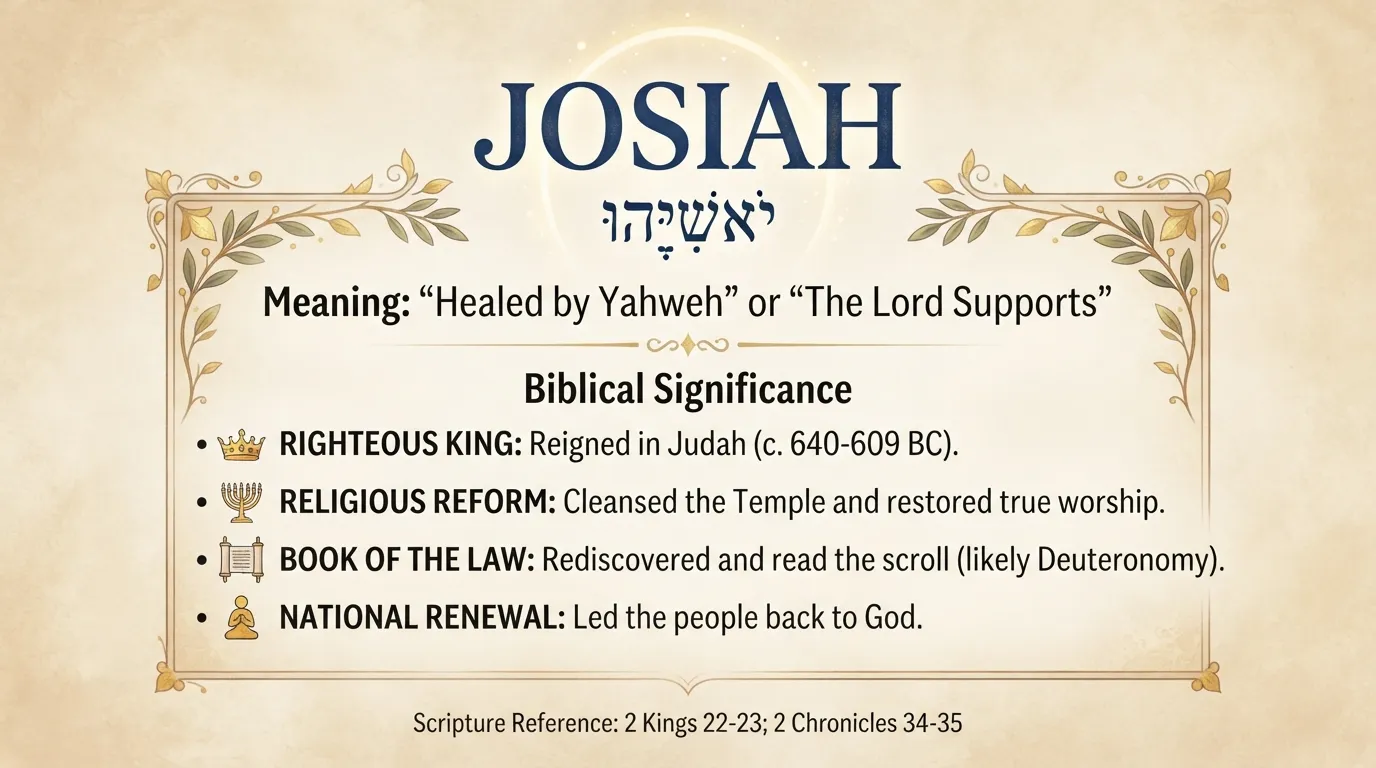
Josiah means “the Lord heals” or “the Lord supports,” from the Hebrew Yoshiyahu, combining a root meaning “to heal or support” with a shortened form of God’s name, Yahweh. Josiah was a righteous king of Judah who became king at age eight and led one of the greatest religious reforms in Israel’s history.
Biblical Meaning of Josiah 📖
Josiah’s name carries genuine weight, matching the character and mission of the king who bore it.
Hebrew Meaning
The Hebrew name is יֹאשִׁיָּהוּ (Yoshiyahu), built from a root related to yashah, meaning “to heal” or “to support,” combined with Yahu, a shortened form of God’s covenant name.
Most scholars translate this as “the Lord heals” or “the Lord supports,” though some connect the root to “the Lord has given.”
Literal Meaning
Literally, Josiah’s name points to God’s active, healing involvement in someone’s life, a fitting description for a king who healed a nation’s broken relationship with God.
Spiritual Meaning
Spiritually, the name reflects restoration, the same restoration Josiah brought to Judah’s worship after generations of idolatry.
Biblical Significance
Josiah stands out as one of only two kings of Judah described with completely unreserved praise, alongside Hezekiah.
Key Scripture Reference
2 Kings 23:25 declares, “Before him there was no king like him, who turned to the Lord with all his heart and with all his soul and with all his might.”
Historical & Biblical Context 🏛️
Understanding Josiah’s story requires knowing the spiritual darkness he inherited and the reform he led in response.
Old Testament Usage
Josiah appears throughout 2 Kings 22–23 and 2 Chronicles 34–35, the two accounts of his reign and reforms.
He became king of Judah at just eight years old, following the assassination of his father, Amon, and reigned for thirty-one years.
His grandfather, Manasseh, had led Judah into deep idolatry, filling the Temple itself with pagan worship practices.
New Testament Relevance
Josiah appears in Jesus’s genealogy in Matthew 1:10-11, connecting this reforming king directly to the lineage of Christ.
Cultural Understanding in Biblical Times
In the eighteenth year of his reign, while repairing the Temple, the high priest Hilkiah discovered a lost scroll, likely an early form of Deuteronomy.
When the scroll was read aloud to Josiah, he tore his clothes in mourning, recognizing how far the nation had drifted from God’s commands.
This discovery launched a nationwide reformation, unlike anything Judah had seen since the days of the Judges.
Is Josiah Mentioned in the Bible? 📜
Yes, extensively, across two full accounts of his reign in the Old Testament.
Where He Appears
Josiah’s story is told in 2 Kings 22:1–23:30 and 2 Chronicles 34:1–35:27, with additional mentions in Jeremiah, Zephaniah, and Matthew’s genealogy.
Why It Matters
His extensive coverage shows how significant his reforms were considered by the biblical writers looking back on Judah’s history.
What It Teaches
His story teaches that genuine, wholehearted devotion to God can transform an entire nation, regardless of how deep the surrounding corruption runs.
Spiritual Meaning & Symbolism 🕊️
Josiah’s life embodies several powerful contrasts that give his name lasting spiritual meaning.
Inherited Corruption vs. Personal Devotion
Josiah inherited a kingdom saturated in idolatry from his grandfather Manasseh, yet chose a completely different path.
His story shows that a person’s spiritual direction isn’t determined by their upbringing or inheritance alone.
Lost Word vs. Rediscovered Word
The Book of the Law had been lost or ignored for so long that its rediscovery shocked the entire royal court.
This mirrors a spiritual pattern seen throughout Scripture: revival often begins when God’s Word is rediscovered and taken seriously again.
God’s Perspective
God’s later prophecy through Huldah acknowledged Josiah’s humble, responsive heart, promising he would be spared from witnessing Judah’s coming judgment.
Lessons for Today
Josiah’s example challenges believers to respond to Scripture with the same urgency and humility, regardless of what came before them.
📊 Quick Comparison: Manasseh vs. Josiah
| Manasseh (Grandfather) | Josiah (Grandson) |
|---|---|
| Filled the Temple with idols | Removed every idol from the Temple |
| Led Judah deep into corruption | Led Judah into genuine reform |
| Reigned the longest of any Judean king | Became king at just eight years old |
| Repented only late in life (2 Chronicles 33) | Sought God “while he was still young” (2 Chronicles 34:3) |
Biblical Verses About Josiah ✝️
These verses trace Josiah’s story and character throughout Scripture.
2 Kings 22:2
“And he did what was right in the eyes of the Lord and walked in all the way of David his father, and he did not turn aside to the right or to the left.”
This verse introduces Josiah’s character immediately, comparing him favorably to David, Judah’s model king.
The phrase “did not turn aside” emphasizes consistent, lifelong faithfulness rather than a single good decision.
The lesson shows that genuine righteousness is measured over a lifetime of steady direction, not isolated moments.
This verse sets the tone for everything that follows in his remarkable reign.
2 Chronicles 34:3
“For in the eighth year of his reign, while he was still young, he began to seek the God of his father David.”
This verse reveals that Josiah’s devotion began years before the Book of the Law was even discovered.
He was only sixteen years old, showing genuine spiritual hunger that predated any external prompting or discovery.
The lesson demonstrates that authentic faith often begins quietly, before it becomes publicly visible through action.
His early seeking laid the groundwork for the massive reforms that would follow.
2 Kings 22:11
“When the king heard the words of the Book of the Law, he tore his clothes.”
This verse captures Josiah’s immediate, emotional response upon hearing how far Judah had strayed from God’s commands.
Tearing one’s clothes was a traditional sign of deep mourning and repentance in ancient Israelite culture.
The lesson shows genuine humility: rather than defending the nation’s past, Josiah grieved honestly over its failures.
This response set the tone for the sweeping reforms that followed his discovery.
2 Kings 23:3
“And the king stood by the pillar and made a covenant before the Lord, to walk after the Lord and to keep his commandments… with all his heart and all his soul.”
This verse records Josiah publicly renewing Judah’s covenant with God, with the people joining him in this commitment.
The language “all his heart and all his soul” echoes Deuteronomy’s core command, showing Josiah’s reform was rooted in genuine Scripture.
The lesson emphasizes that true reform requires public commitment, not merely private conviction.
This covenant renewal marked a defining moment in Judah’s spiritual history.
2 Kings 23:25
“Before him there was no king like him, who turned to the Lord with all his heart and with all his soul and with all his might, according to all the Law of Moses, nor did any like him arise after him.”
This is Scripture’s strongest possible commendation, placing Josiah above every other king of Judah.
The threefold “heart… soul… might” directly quotes the Shema, Israel’s central declaration of devotion to God.
The lesson shows that Scripture measures greatness by wholehearted devotion, not political success or military conquest.
This verse cements Josiah’s legacy as the standard against which faithfulness would be measured.
2 Chronicles 35:18
“No Passover like it had been kept in Israel since the days of Samuel the prophet.”
This verse describes the massive Passover celebration Josiah organized as part of his religious reforms.
It hadn’t been observed with this level of devotion since before Israel even had kings, generations earlier.
The lesson shows that genuine reform doesn’t just remove wrong practices; it restores forgotten, meaningful worship.
Josiah’s Passover became a defining symbol of the spiritual revival he led.
Jeremiah 22:15-16
“Did not your father… do justice and righteousness? Then it was well with him.
Jeremiah, prophesying shortly after Josiah’s death, contrasts Josiah’s justice with his son Jehoiakim’s corruption.
The lesson broadens the definition of faithfulness: genuine devotion to God includes tangible care for the vulnerable.
Jeremiah uses Josiah as the standard his sons tragically failed to meet.
Matthew 1:10-11
“Amon the father of Josiah, and Josiah the father of Jechoniah and his brothers, at the time of the deportation to Babylon.”
This verse places Josiah directly within the genealogy leading to Jesus Christ.
Despite Josiah’s faithfulness, his descendants would ultimately lead Judah into the very exile his reforms had tried to prevent.
The lesson shows how one generation’s faithfulness doesn’t automatically guarantee the next generation’s obedience.
Still, Josiah’s inclusion in this genealogy shows his lasting significance in Israel’s redemptive story.
Real-Life Biblical Case Study: The Discovery of the Book of the Law 🌟
2 Kings 22 records one of the most pivotal moments in Josiah’s reign.
In the eighteenth year of his rule, Josiah sent his secretary Shaphan to oversee repairs on the Temple.
During these repairs, the high priest Hilkiah made a startling discovery: a scroll containing the Book of the Law, likely lost for decades.
Shaphan brought the scroll to Josiah and read it aloud in the king’s presence.
Upon hearing its words, Josiah immediately tore his clothes, recognizing how completely Judah had abandoned God’s commands.
He sent his officials to consult the prophetess Huldah, seeking to understand what judgment this discovery meant for the nation.
Huldah confirmed that judgment was indeed coming, but promised Josiah personally would be spared, because his heart had been humble and responsive.
Josiah then gathered the people, read the Book of the Law publicly, and led the entire nation in renewing their covenant with God.
This single discovery triggered sweeping reforms: destroying idols, removing corrupt priests, and restoring proper worship throughout the land.
Life Lessons for Christians 🙏
Josiah’s story offers several practical, powerful lessons for believers today.
Youth doesn’t limit devotion. Josiah began genuinely seeking God at just sixteen, showing spiritual maturity isn’t tied to age.
Scripture demands a response. Josiah’s torn clothes model genuine, humble reaction to God’s Word, not defensive dismissal.
Reform requires both heart and action. Josiah didn’t just feel convicted; he actively removed idols and restored proper worship.
Public commitment matters. His covenant renewal before the people shows that genuine faith often requires visible, communal expression.
One generation’s faithfulness isn’t automatic for the next. Josiah’s sons didn’t continue his legacy, reminding believers to actively disciple those who follow them.
Common Misunderstandings ⚠️
A few points of confusion surround Josiah’s story and legacy.
Modern misuse: Some sources reduce Josiah’s story to a simple “good king” narrative, missing the depth of his personal spiritual journey before the reforms began.
Cultural confusion: A few readers assume Josiah’s reforms guaranteed lasting national faithfulness; Scripture shows his own sons quickly abandoned his example.
Wrong interpretations online: Some sites treat the “Book of the Law” discovery as though Scripture had been entirely absent from Judah, when it was likely lost or ignored rather than completely unknown.
Correct biblical explanation: Josiah was a genuinely devoted king whose personal faith, begun in his youth, led to national reform, though that reform didn’t outlast his own reign.
💡 Expert Insight
When studying Josiah’s reforms, read both 2 Kings 22–23 and 2 Chronicles 34–35 side by side. Chronicles places his early reforms before the scroll’s discovery, while Kings centers the entire narrative around it, offering two complementary angles on the same remarkable reign.
FAQs ❓
What does the name Josiah mean?
Josiah means “the Lord heals” or “the Lord supports,” from the Hebrew Yoshiyahu, combining a healing-related root with God’s covenant name.
How old was Josiah when he became king?
Josiah became king of Judah at just eight years old, following his father Amon’s assassination, and reigned for thirty-one years.
What did Josiah discover during his reign?
During Temple repairs, the high priest Hilkiah discovered the lost Book of the Law, which sparked Josiah’s sweeping religious reforms.
Why is Josiah considered one of Judah’s best kings?
2 Kings 23:25 states no king before or after him turned to God as completely, with all his heart, soul, and might.
Is Josiah related to Jesus in the Bible?
Yes, Josiah appears in Jesus’s genealogy in Matthew 1:10-11, connecting this reforming king to Christ’s lineage.
Is “Josaiah” a correct spelling of Josiah?
No, “Josaiah” is a common misspelling. The correct biblical spelling is “Josiah,” from the Hebrew Yoshiyahu.
What did Josiah do in the Bible?
Josiah removed idols from the Temple and throughout Judah, restored the Book of the Law to central use, renewed the nation’s covenant with God, and organized one of the greatest Passover celebrations in Israel’s history.
Conclusion 🌿
The Josiah meaning in the Bible, “the Lord heals,” perfectly captures the legacy of a king who healed a nation’s broken relationship with God.
Inheriting deep corruption, he chose instead to seek God earnestly, tear his clothes at conviction, and lead sweeping national reform.
Scripture’s verdict remains unmatched: no king before or after turned to the Lord as completely as Josiah did.
Whatever corruption or confusion you may have inherited, Josiah’s story offers genuine hope that a fresh, wholehearted response to God is always possible.
May that same humble, immediate response to Scripture mark your own life today.

Hello, I’m Samuel Carter. My interest in biblical studies comes from a lifelong desire to understand the wisdom and teachings contained within Scripture. I particularly enjoy researching biblical numbers, patterns, and themes that appear throughout God’s Word.