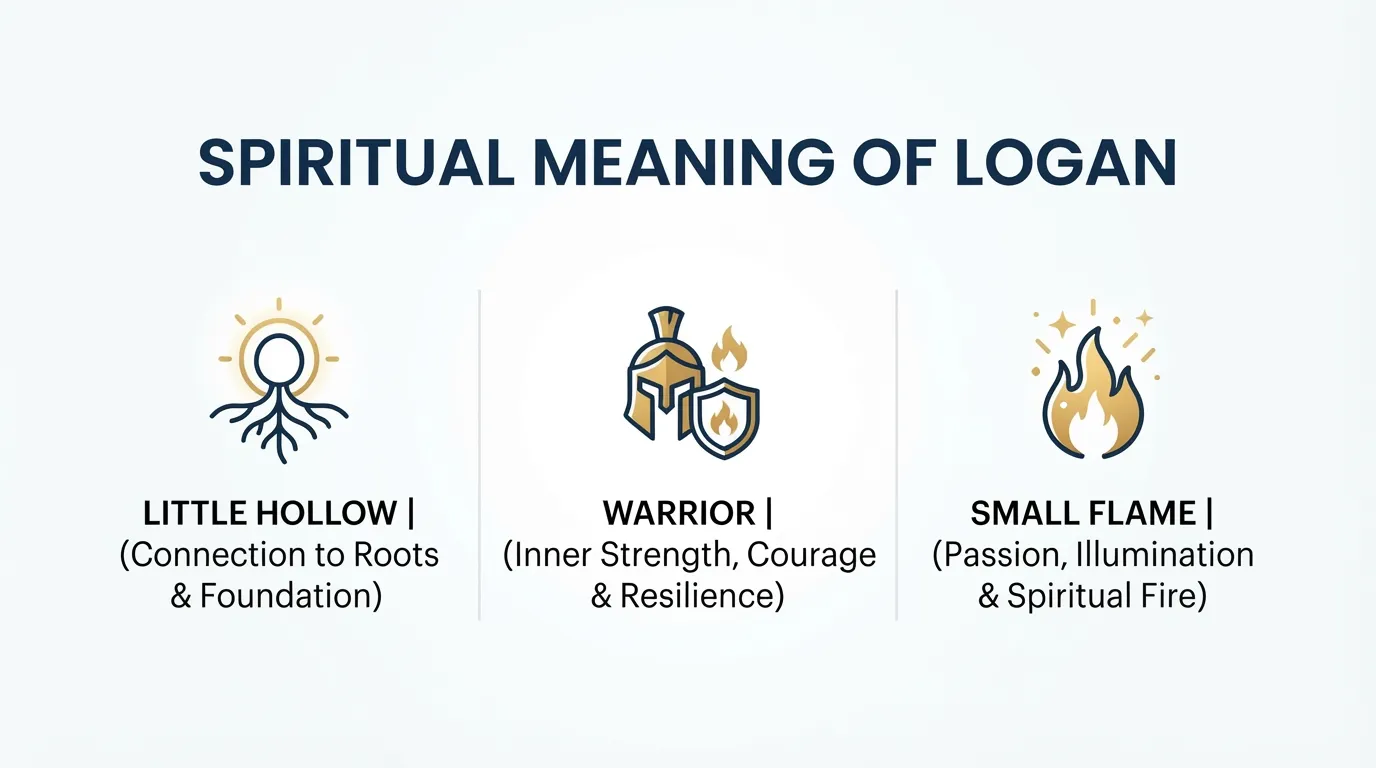
The spiritual meaning of Logan is connected to the name’s Scottish and Gaelic origins.
Logan is traditionally associated with a place name meaning “little hollow” or “small valley.” Spiritually, the name can be explored through themes of humility, peace, nature, and personal growth.
Logan has become a favorite modern name, but its roots trace to Scotland, not Scripture.
If you’re searching for its spiritual meaning, the honest starting point is that Logan isn’t biblical. It’s a Scottish Gaelic place name meaning little hollow.
Even so, that humble meaning connects surprisingly well to a theme God treasures throughout the Bible: humility.
Did You Know? 🔍
Logan originally wasn’t a first name at all.
It was a Scottish surname and place name, referring to a small hollow or dip in the land.
It comes from Gaelic lag, meaning hollow, plus a diminutive ending.
This only became popular as a first name in the last century.
What Does Logan Mean Spiritually? (Quick Answer) 📖
Logan is not a biblical name. It comes from Scottish Gaelic, meaning little hollow or small dip in the land.
While the name itself has no scriptural origin, its meaning connects thematically to the biblical value of humility and to imagery of valleys as places of God’s provision and presence.
Biblical Meaning of Logan 🏞️
Hebrew and Greek Roots
Logan has no Hebrew or Greek root. Its origin is entirely Scottish Gaelic, unrelated to any biblical language or naming tradition from the ancient Near East.
Literal Meaning
Literally, Logan means little hollow, referring to a small low-lying valley or dip in the landscape.
It was originally used to describe a place, not a person.
Spiritual Meaning
Though not scriptural, the imagery of a hollow or low place connects to the Bible’s frequent use of valleys as settings for both hardship and God’s provision.
This is most famous in Psalm 23:4.
Biblical Significance
Some Christian parents draw a connection between Logan’s low place meaning and the biblical theme of humility.
This is the posture God consistently honors throughout Scripture (James 4:10).
Key Scripture Reference
Psalm 23:4, even though I walk through the darkest valley, I will fear no evil, for you are with me, is often paired with the name Logan because of its valley and hollow imagery.
Historical & Biblical Context 🕰️
Old Testament Usage
Valleys appear throughout the Old Testament as places of both danger and divine encounter.
The Valley of Elah, where David faced Goliath (1 Samuel 17:2), and the Valley of Dry Bones in Ezekiel’s vision (Ezekiel 37:1).
New Testament Relevance
The New Testament continues valley imagery metaphorically, especially in Luke 3:5.
This quotes Isaiah’s prophecy that every valley shall be filled in, a picture of God leveling obstacles to prepare the way.
Cultural Understanding in Biblical Times
In the ancient Near East, valleys were often fertile and life-sustaining, but also vulnerable to ambush and flooding.
This gave them a dual reputation of both blessing and danger throughout Scripture.
Is Logan Mentioned in the Bible? 📚
No, Logan itself never appears in any biblical text, genealogy, or narrative.
Its connection to Scripture is entirely thematic, built around valley and low place imagery rather than any direct textual or linguistic link.
Spiritual Meaning & Symbolism 🌄
Humility vs. Pride
Scripture consistently favors the humble over the proud (Proverbs 3:34, James 4:6).
Logan’s low place meaning offers a natural, positive association with this valued biblical posture.
God’s Perspective
God repeatedly meets people in their lowest moments. David in the valley facing Goliath, Israel in the wilderness.
This shows that low places in Scripture are often exactly where God shows up most powerfully.
Lessons for Today
Being in a hollow or low season of life isn’t a sign of God’s absence.
Psalm 23:4 promises His presence precisely in life’s valleys, not just its mountaintops.
Logan’s Meaning vs. Biblical Valley Imagery 📊
| Concept | Represents | Key Reference |
|---|---|---|
| Logan (little hollow) | Low place, humility | Scottish Gaelic etymology |
| Valley of the shadow of death | God’s presence in hardship | Psalm 23:4 |
| Valley of Elah | Facing giants with faith | 1 Samuel 17:2 |
| Valley of Dry Bones | Restoration and new life | Ezekiel 37:1-14 |
Biblical Verses About Valleys and Humility
Psalm 23:4
David describes walking through the darkest valley without fear because God is present with him.
This is the most quoted valley verse in Scripture and pairs naturally with a name meaning low place.
1 Samuel 17:2
Israel’s army gathers in the Valley of Elah before David’s battle with Goliath.
This shows a valley as the setting for one of Scripture’s greatest displays of faith over fear.
Ezekiel 37:1-14
God shows Ezekiel a valley of dry bones that comes back to life, symbolizing Israel’s restoration.
It’s a powerful image of God bringing life to what looks hopeless or low.
Luke 3:5
Quoting Isaiah, this verse describes every valley shall be filled in as preparation for the Lord’s way.
It pictures God removing obstacles and lifting up what is low.
James 4:10
James instructs believers to humble yourselves before the Lord, and he will lift you up.
This verse directly ties humility, a low posture, to God’s promised exaltation.
Proverbs 3:34
This verse states that God gives grace to the humble, contrasting sharply with His opposition to the proud.
It reinforces humility as a consistently honored trait in Scripture.
Isaiah 40:4
This prophetic verse pictures every valley shall be raised up as part of preparing the way for God’s glory to be revealed.
It connects low places to eventual honor and purpose.
Philippians 2:8
This verse describes Christ humbling Himself, becoming obedient to death.
It’s the ultimate biblical model of humility, showing that even the lowest position can carry the highest purpose.
Real-Life Biblical Case Study: David in the Valley of Elah
Before David becomes king, he’s a young shepherd standing in the Valley of Elah, facing a giant everyone else feared (1 Samuel 17).
It’s a literal low place, a valley, that becomes the setting for one of the Bible’s most famous victories.
This story shows how a hollow or low place, physically and spiritually, can become exactly where God does His greatest work.
Life Lessons for Christians
- Low seasons of life aren’t evidence of God’s absence, Psalm 23:4 promises His presence precisely there.
- Humility, symbolized by Logan’s low place meaning, is consistently honored throughout Scripture (James 4:10).
- Some of the Bible’s greatest victories, like David and Goliath, happen in literal valleys.
- God specializes in restoring what looks hopeless, as shown in Ezekiel’s valley of dry bones.
- A name’s humble meaning can become a lifelong reminder to embrace humility rather than pride.
Common Misunderstandings
Some sources incorrectly list Logan as a Hebrew name or claim it appears in the Bible.
Neither is accurate. Logan is Scottish Gaelic in origin and has no textual presence in Scripture. The honest connection is thematic, through valley and humility imagery, not a direct biblical reference.
Expert Insight 💡
When a modern name’s literal meaning describes a physical feature like hollow or valley, search how that specific feature is used symbolically throughout Scripture.
You’ll usually uncover richer, better-documented spiritual meaning than searching the name itself.
FAQs
Is Logan a biblical name?
No, Logan is Scottish Gaelic in origin, meaning little hollow or small valley.
It does not appear anywhere in the Bible and has no Hebrew or Greek root.
What is the spiritual meaning of Logan?
While not biblical, Logan’s low place meaning connects to the biblical theme of humility and to valley imagery.
Especially Psalm 23:4’s promise of God’s presence in life’s hardest seasons.
Is there a Bible verse for the name Logan?
There’s no direct verse naming Logan.
But Psalm 23:4, referencing the darkest valley, is commonly chosen by parents because of its thematic connection to the name’s meaning.
What does the Bible say about valleys?
Valleys in Scripture represent both hardship and divine encounter. Sites of danger (1 Samuel 17), death (Psalm 23:4), and restoration (Ezekiel 37).
They show God’s presence through every season.
Can Logan still be a meaningful Christian name?
Yes. Though not biblical itself, many Christian families choose Logan specifically because its humble, low place meaning reflects the value Scripture places on humility over pride.
Conclusion
Logan won’t appear in any Bible concordance, it’s a Scottish Gaelic name with no ancient scriptural roots.
But its humble meaning, little hollow, opens a door to one of Scripture’s most comforting truths. God meets His people in life’s low places, not just on the mountaintops.
For families drawn to this name, there’s a meaningful biblical theme of humility and God’s presence to grow into over time.

Hello, I’m Daniel Mercer. My passion for studying the Bible began many years ago when I started exploring the historical and spiritual meanings behind biblical names and symbols. Since then, I have dedicated countless hours to researching Scripture, ancient biblical traditions, and Christian teachings.