You fall in love with the name Jennifer, then wonder if it carries any real biblical connection.
It has that timeless, elegant sound, the kind of name that topped charts for over a decade.
The honest answer is straightforward: Jennifer isn’t found anywhere in Scripture, but its story is still worth knowing.
This article traces Jennifer’s true Celtic origins, its meaning, and how it honestly relates to Christian themes.
Did You Know? 🔍
Jennifer held the #1 spot for American baby girls for an incredible fifteen consecutive years, from 1970 to 1984, one of the longest reigns of any name in modern U.S. history.
Quick Answer 🎯
What Does Jennifer Mean in the Bible?
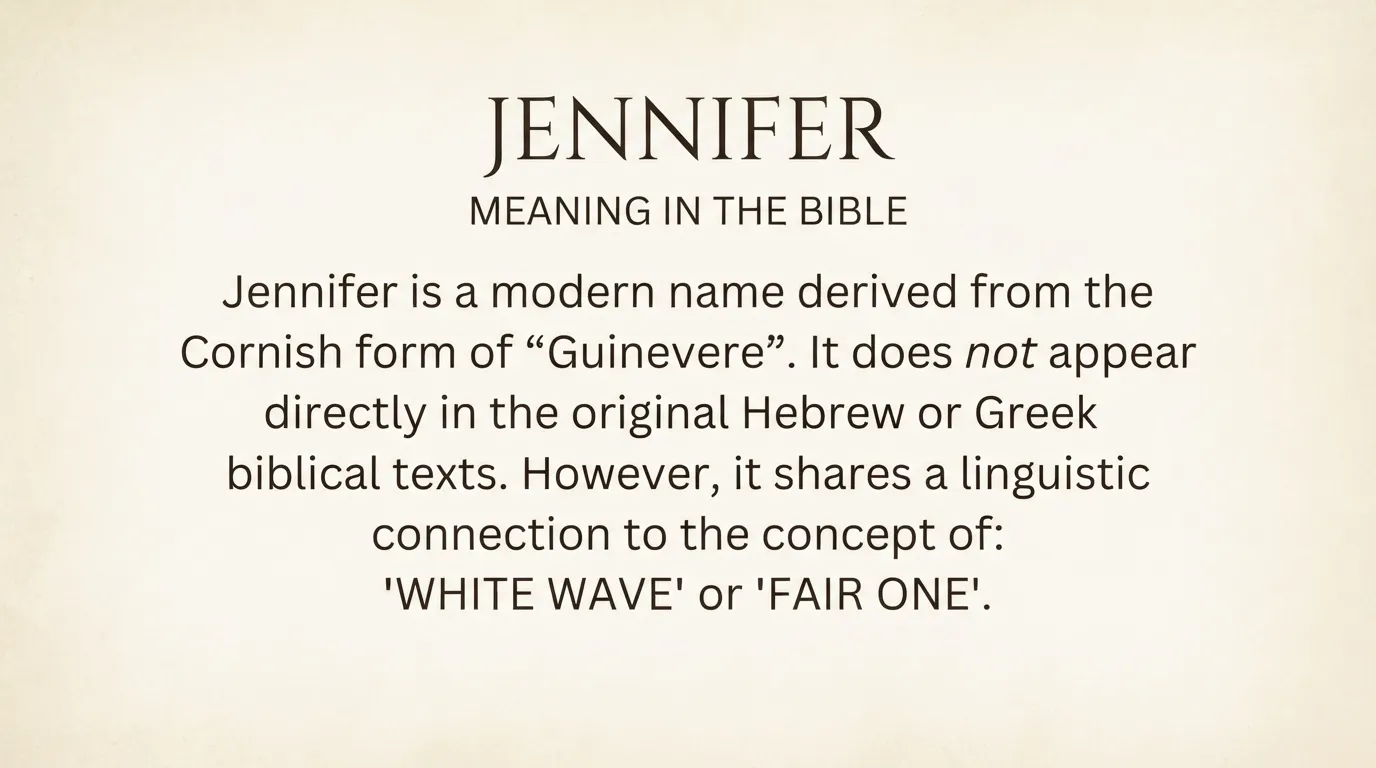
Jennifer is not a name that appears in Scripture. It is the Cornish form of the Welsh name Gwenhwyfar (the source of Guinevere), meaning “fair one” or “white phantom.” While not biblical, its meaning of purity and fairness echoes themes Scripture consistently celebrates.
Biblical Meaning of Jennifer 📖
Understanding Jennifer’s connection to Christian themes starts with honestly tracing its Celtic, not biblical, roots.
Welsh and Cornish Meaning
Jennifer is the Cornish form of the Welsh name Gwenhwyfar, built from gwen (“white,” “fair,” or “blessed”) and hwyfar (“smooth” or “phantom”).
Combined, the name is typically translated as “fair one,” “white wave,” or more literally, “white phantom” or “white spirit.”
Jennifer Meaning in Hebrew
Jennifer has no Hebrew root or origin. It cannot be found in the Hebrew Bible, since its actual history traces to Welsh and Cornish Celtic sources, entirely separate from the Hebrew language. Any “Hebrew meaning” claimed for Jennifer online should be treated with caution, since no genuine Hebrew word or name corresponds to it.
Jennifer Meaning in Greek
Jennifer likewise has no Greek origin or meaning. It doesn’t appear in the Greek New Testament or Septuagint. Like its Hebrew connection, any claimed Greek meaning for Jennifer isn’t linguistically accurate; the name postdates biblical Greek by well over a thousand years.
Literal Meaning
Literally, Jennifer describes fairness or whiteness, an ancient Celtic way of describing someone’s light complexion or radiant appearance.
Spiritual Meaning
Spiritually, many Christians connect Jennifer’s “white” imagery to Scripture’s frequent use of white as a symbol of purity and holiness.
This connection is symbolic rather than textual, since the name itself never appears in Hebrew or Greek Scripture.
Biblical Significance
The name carries no direct biblical significance, but the color symbolism behind it aligns with themes Scripture repeats often.
Key Scripture Reference
Isaiah 1:18 says, “Though your sins are like scarlet, they shall be as white as snow,” using whiteness to picture complete spiritual cleansing.
Historical & Biblical Context 🏛️
Understanding Jennifer’s honest relationship to Christian faith requires tracing its medieval literary history.
Old Testament and New Testament Usage
Jennifer does not appear anywhere in either the Old or New Testament; it is a Celtic name with no biblical origin whatsoever.
Scripture does, however, use white and purity imagery constantly, the very themes Jennifer’s meaning evokes.
Arthurian Legend and Name History
Jennifer’s root name, Guinevere, belonged to King Arthur’s legendary queen, a central figure in medieval British literature.
The name remained rare outside Cornwall for centuries until it gained wider English-speaking popularity in the 20th century.
Cultural Understanding of the Name’s Rise
George Bernard Shaw’s 1906 play The Doctor’s Dilemma featured a character named Jennifer, helping introduce the name beyond Cornwall.
Its use then accelerated dramatically through the mid-20th century, becoming one of the most recognizable American names of that era.
Is Jennifer Mentioned in the Bible? 📜
No, the name Jennifer does not appear anywhere in the biblical text.
Where the Name Comes From Instead
Jennifer’s roots trace to Proto-Celtic and medieval Welsh literature, entirely separate from Hebrew or Greek biblical sources.
Why It Matters
Being clear about this distinction matters for genuine, trustworthy content, separating Celtic folklore from scriptural fact.
What It Teaches
It teaches that a name’s beauty and meaning don’t require biblical origin to hold personal or symbolic significance for someone who carries it.
Spiritual Meaning & Symbolism 🕊️
Jennifer’s “white” and “fair” imagery offers genuine spiritual reflection, even without direct biblical roots.
Purity vs. Stain
Scripture repeatedly uses whiteness to picture purity, from Isaiah’s promise of sins made “white as snow” to Revelation’s white-robed saints.
This imagery invites reflection on spiritual cleansing, a theme completely separate from the name’s actual Celtic origin.
Legend vs. Scripture
Queen Guinevere’s story, marked by both beauty and personal failure in Arthurian legend, differs sharply from any biblical narrative.
It’s worth separating admiration for a name’s sound and history from any claim that Scripture itself addresses it.
God’s Perspective
While Scripture never addresses the name Jennifer directly, it consistently celebrates the purity and fairness the name’s meaning suggests.
Lessons for Today
Someone named Jennifer can find genuine encouragement in Scripture’s purity imagery, understood honestly as symbolic connection.
📊 Quick Comparison: Name vs. Symbol
| The Name “Jennifer” | Purity Imagery in Scripture |
|---|---|
| Cornish form of Welsh Gwenhwyfar | Hebrew and Greek concepts of purity, holiness |
| Meaning: “fair one,” “white phantom” | Isaiah 1:18, Revelation 7:14, Psalm 51:7 |
| Popularized by Arthurian legend | Present throughout the Old and New Testaments |
| Not found in biblical text | A consistent, repeated biblical theme |
Biblical Verses About Purity and Whiteness ✝️
These verses trace Scripture’s use of the imagery connected to Jennifer’s meaning.
Isaiah 1:18
“Though your sins are like scarlet, they shall be as white as snow; though they are red like crimson, they shall become like wool.”
This verse promises complete spiritual transformation, using the strongest possible color contrast to picture forgiveness.
Scarlet and crimson represent deep, visible stain, while snow and wool represent total, thorough cleansing.
The lesson shows that God’s forgiveness doesn’t merely cover sin, but genuinely transforms it into purity.
This remains one of Scripture’s most vivid pictures of what complete spiritual renewal actually looks like.
Psalm 51:7
“Purge me with hyssop, and I shall be clean; wash me, and I shall be whiter than snow.”
David writes this prayer after his sin with Bathsheba, pleading for genuine inner cleansing rather than mere outward ritual.
The imagery of being made “whiter than snow” pictures a restoration deeper than anything David could achieve himself.
The lesson shows genuine repentance seeking real transformation, not simply the appearance of righteousness.
This psalm remains one of Scripture’s most honest models of confession and the hope of true cleansing.
Revelation 7:9-14
“These are the ones coming out of the great tribulation. They have washed their robes and made them white in the blood of the Lamb.”
This vision pictures a vast multitude before God’s throne, their robes made white through Christ’s sacrifice.
The imagery connects whiteness directly to redemption purchased through Jesus, not human effort or achievement.
The lesson reveals that ultimate purity comes through what Christ accomplished, applied to those who trust Him.
Matthew 5:8
“Blessed are the pure in heart, for they shall see God.”
Jesus connects purity directly to genuine relationship with God, promising the ultimate reward of seeing Him.
This beatitude locates purity in the heart, internal sincerity, rather than merely external behavior or appearance.
The lesson challenges readers to seek authentic inner purity, not simply a polished outward reputation.
1 John 1:7
“But if we walk in the light, as he is in the light, we have fellowship with one another, and the blood of Jesus his Son cleanses us from all sin.”
John connects purity to ongoing relationship, “walking in the light,” rather than a single completed event.
This verse ties cleansing directly to genuine fellowship with God and with other believers, not isolated personal effort.
The lesson emphasizes that purity flows from continued closeness to God, sustained rather than one-time.
Philippians 4:8
“Whatever is true, whatever is honorable, whatever is just, whatever is pure… think about these things.”
Paul instructs believers to actively direct their thoughts toward purity, framing it as an ongoing mental discipline.
This verse shows purity as something believers actively cultivate through what they choose to dwell on.
The lesson offers a practical, actionable picture of pursuing purity in everyday thought life.
Titus 2:11-14
“Our great God and Savior Jesus Christ… gave himself for us to redeem us from all lawlessness and to purify for himself a people for his own possession.”
This passage describes Christ’s sacrifice specifically in terms of purification, creating a people set apart for God.
The purity described here isn’t self-generated but purchased through Christ’s own sacrificial giving.
The lesson reminds readers that true purity is ultimately a gift received, not an achievement earned.
Real-Life Biblical Case Study: David’s Prayer for Cleansing 🌟
Psalm 51 records one of Scripture’s most raw, honest prayers, written after David’s affair with Bathsheba.
The prophet Nathan had just confronted David, exposing sin David had tried desperately to hide.
Rather than continuing to hide, David wrote this psalm as an unfiltered confession before God.
“Have mercy on me, O God,” he begins, “according to your steadfast love” (Psalm 51:1).
He specifically asks, “wash me, and I shall be whiter than snow” (51:7), pleading for genuine inner transformation.
David doesn’t ask merely for forgiveness of the act, but for a “clean heart” and a “right spirit” (51:10).
This wasn’t a request for reputation management; it was a genuine plea for real, internal purity.
David’s example shows that true cleansing begins with honest confession, not with hiding behind a polished appearance.
Life Lessons for Christians 🙏
While Jennifer isn’t a biblical name, its “purity” imagery offers genuine, practical lessons for believers today.
Confession precedes cleansing. David’s psalm shows genuine transformation starts with honest acknowledgment, not denial.
Purity is a gift, not just an achievement. Titus 2 reminds believers that Christ’s sacrifice purchases purity, rather than pure effort alone.
Purity involves the mind. Philippians 4:8 shows purity as an ongoing choice about what to dwell on daily.
Purity flows from relationship. 1 John 1:7 ties cleansing to walking closely with God, not isolated self-improvement.
God’s promises are complete. Isaiah 1:18 shows forgiveness doesn’t merely cover sin, but genuinely transforms it.
Common Misunderstandings ⚠️
Several points of confusion surround Jennifer’s connection to the Bible online.
Modern misuse: Some websites claim Jennifer is a “biblical name,” which isn’t accurate; it’s a Celtic name with symbolic, not scriptural, connections.
Cultural confusion: A few sources fabricate direct verse connections that don’t exist, implying Scripture specifically discusses the name.
Wrong interpretations online: Certain articles attach elaborate biblical narratives to Jennifer that Scripture never actually contains.
Correct biblical explanation: Jennifer is a Welsh-Cornish name meaning “fair one,” symbolically connected to Scripture’s purity imagery, but not a biblical name itself.
Is Jennifer a Catholic Name? 🕊️
Many Catholic naming traditions favor names tied to canonized saints, since confirmation names are traditionally chosen this way. Jennifer doesn’t have a canonized Catholic saint by that exact name, since it comes from secular medieval Welsh literature (the Guinevere legend) rather than church history or hagiography.
Catholics named Jennifer who want a saint connection sometimes look to Saint Winifred, a 7th-century Welsh saint, since both names share Welsh Celtic roots and a similar “white” or “fair” meaning. This isn’t a direct or official substitution, just a commonly chosen thematic link for those seeking one.
💡 Expert Insight: When researching a modern name’s “biblical meaning,” always check whether reputable etymology sources (like Behind the Name or established dictionaries) confirm the claimed Hebrew or Greek root. Jennifer’s Celtic origin is well-documented and consistent across credible sources.
FAQs ❓
Is Jennifer a biblical name?
No, Jennifer doesn’t appear in Scripture. It’s the Cornish form of the Welsh name Gwenhwyfar, meaning “fair one” or “white phantom.”
What does the name Jennifer actually mean?
Jennifer means “fair one,” “white wave,” or “white phantom,” derived from the Welsh Gwenhwyfar, the root of the name Guinevere.
Where does the name Jennifer come from?
Jennifer comes from Cornwall, England, as a regional form of the Welsh name Gwenhwyfar, gaining wider popularity in the 20th century.
Does Jennifer have spiritual meaning for Christians?
While not a scriptural name, many Christians find encouragement in its connection to purity and fairness, themes Scripture celebrates often.
Is Guinevere, the root name, connected to the Bible?
No, Guinevere is a figure from medieval Arthurian legend, not Scripture, though her name shares Jennifer’s Celtic linguistic roots.
What does Jennifer mean in Hebrew?
Jennifer has no Hebrew meaning or origin. It comes from Welsh and Cornish roots, not Hebrew, so it cannot be genuinely translated into or traced through Hebrew Scripture.
What does Jennifer mean in Greek?
Jennifer has no Greek meaning or origin either. It doesn’t appear in the Greek New Testament or Septuagint, since its roots are entirely Welsh and Cornish.
Is Jennifer a Catholic biblical name?
No. Jennifer has no canonized Catholic saint bearing that name and doesn’t appear in Scripture. It comes from Welsh Arthurian legend, not church tradition or the Bible.
Is “Jen” connected to the Bible?
No. Jen is simply a modern nickname for Jennifer and shares the same Welsh and Cornish origin. It has no separate biblical meaning or connection.
Does Jennifer’s meaning change in other languages, like German or Tamil?
No. Since Jennifer isn’t a biblical name in its original English or Cornish form, no translation, German, Tamil, French, or otherwise, adds a scriptural meaning that isn’t present in the source. Its Celtic “fair one” meaning stays the same regardless of the language used to search for it.
Conclusion 🌿
The Jennifer meaning in the Bible requires an honest clarification: the name itself isn’t found in Scripture at all.
Rooted in Welsh and Cornish tradition, it carries a beautiful meaning, “fair one,” that echoes purity themes Scripture celebrates often.
Someone named Jennifer can hold onto that connection honestly, without needing to claim the name itself appears in the biblical text.
Purity, fairness, and genuine inner transformation remain real, meaningful themes worth reflecting on, name and Scripture together.
May the same complete cleansing David prayed for in Psalm 51 mark your own life today.

Hello, I’m Michael Bennett. I am passionate about exploring the symbolism, dreams, and spiritual messages found throughout the Bible. My research focuses on understanding how biblical themes connect with faith, personal growth, and everyday life.