Numbers appear throughout the Bible. They record ages, years, measurements, family lines, and the number of people involved in important events.
Some numbers also appear in repeated patterns that help communicate a passage’s message.
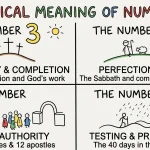
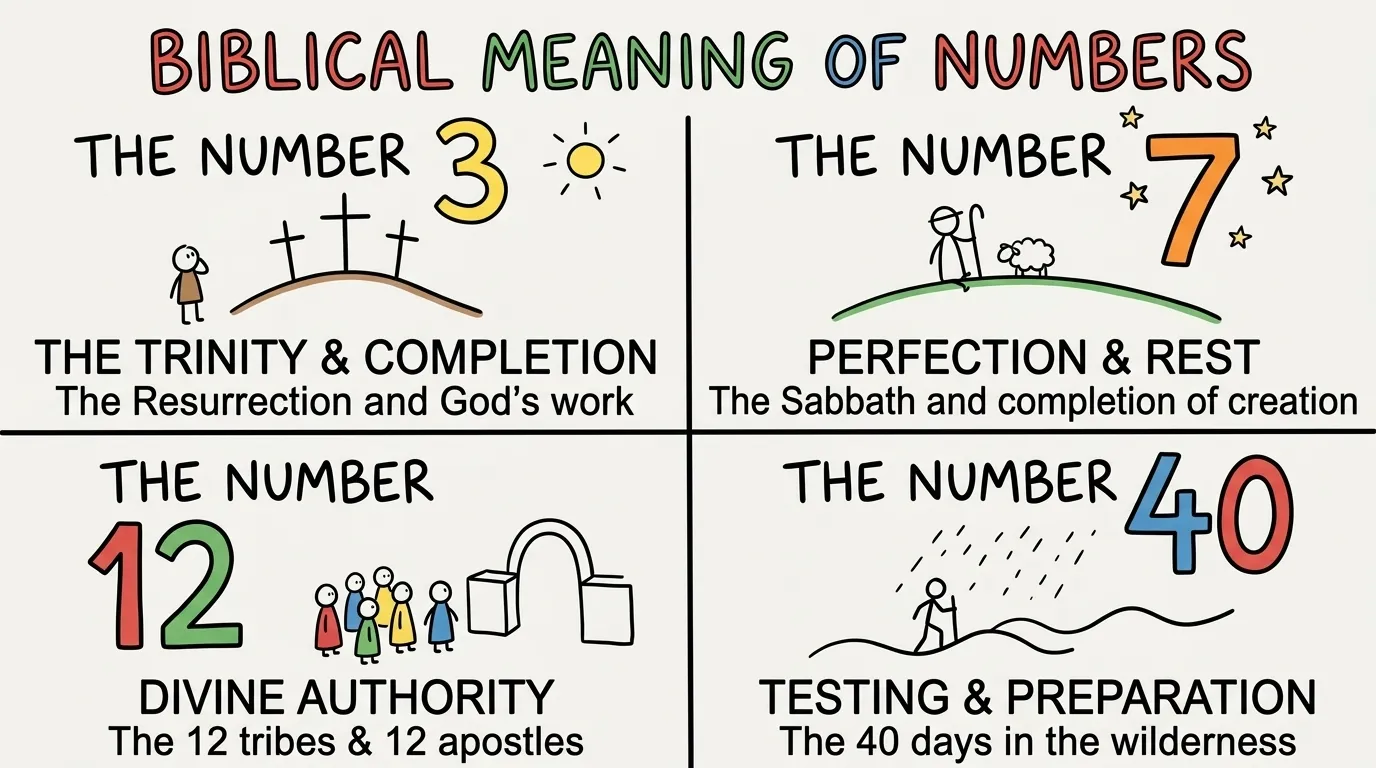
For example, seven appears in the creation account, twelve connects the leagues of Israel with Jesus’ twelve apostles, and forty appears in several periods of testing or preparation.
These patterns have led many readers to study the biblical meaning of numbers and their spiritual significance.
However, not every number is a hidden message. The Bible does not provide a complete code that assigns a spiritual meaning to every number or every sequence we see today.
Modern ideas about angel numbers, such as 111, 333, and 444, should not be treated as established biblical teachings.
In this guide, we will explore important numbers in Scripture, examine the passages where they appear, and explain how Christians can study them responsibly.
The goal is not to predict the future through numbers, but to understand God’s Word more clearly and apply its lessons with wisdom.
Did You Know? 🔍
The number seven appears in the Bible’s creation account, where God rests on the seventh day. It also appears in Revelation’s messages to seven churches. These uses show how a number can help structure a biblical passage, although its meaning still depends on context.
American Bible Society
+1
Quick Answer: What Is the Biblical Meaning of Numbers? 📖
The biblical meaning of numbers refers to how numbers function in Scripture as counts, measurements, time periods, and sometimes symbols. Numbers such as three, seven, twelve, and forty appear in important biblical settings. Their significance comes from the passages in which they occur, not from a universal code for predicting events or interpreting every number we see.
Biblical Meaning of Numbers in Scripture ✨
Hebrew Meaning of Numbers
The Old Testament was written mainly in Hebrew, with some portions in Aramaic. Hebrew uses words for numbers, just as English does. For example, echad (אֶחָד) means “one,” shelosh (שָׁלוֹשׁ) is a form meaning “three,” and sheva (שֶׁבַע) means “seven.”
These words tell us the numerical value. Their spiritual significance, if a passage has one, must be understood from how the number is used.
For instance, the number seven appears in the creation account and in instructions about Sabbath rest. That context supports a connection with completion and rest. It does not mean every appearance of seven carries a hidden message.
Greek Meaning of Numbers
The New Testament was written mainly in Greek. Some basic Greek number words include heis (εἷς), meaning “one,” treis (τρεῖς), meaning “three,” and hepta (ἑπτά), meaning “seven.”
As with Hebrew, these words usually identify amounts. They do not automatically contain a secret spiritual meaning.
A Greek word study can help readers understand a verse, but it cannot prove that a modern number sequence—such as 333 or 444—has a special message from God. Such claims require evidence that the biblical text itself does not provide.
Literal Meaning Versus Symbolic Meaning
A number has a literal meaning when it tells us how many people, objects, days, or years are involved. For example, the Bible identifies twelve leagues of Israel and twelve apostles chosen by Jesus.
A number may also have symbolic importance when its use contributes to a passage’s wider message. Seven appears in the creation week and in several groups in Revelation. Forty appears in accounts of testing, waiting, and preparation.
The key is not to force symbolism into every number. A census count may simply be a census count. A measurement may simply describe the size of a building.
Spiritual Meaning and Biblical Significance
Numbers can help readers notice patterns, structure, and repeated themes in Scripture. For example, twelve connects Israel’s leagues with the apostles, while seven helps organize important events and visions.
Still, the Bible’s main message is not a secret numerical system. Its focus is God’s character, human responsibility, covenant, justice, mercy, and redemption.
A Christian interpretation should begin with the passage’s purpose. Ask what the writer is describing, why the number matters there, and how the passage connects with the rest of Scripture.
Key Scripture Reference: Deuteronomy 6:4
Deuteronomy 6:4 begins the declaration often called the Shema: Israel is called to recognize the Lord as one. Here, the idea of oneness is central to Israel’s worship and devotion to God.
This verse shows that numbers can matter to a passage’s meaning. However, its teaching comes from the statement about God, not from a general rule that every appearance of the number one carries a new message.
Historical and Biblical Context 🏺
Numbers in the Old Testament
The Old Testament uses numbers in many practical ways. Genesis records days of creation, Exodus describes the construction of the tabernacle, and Numbers includes censuses of Israel’s people.
Numbers also appear in laws, festivals, genealogies, and prophetic visions. Some are repeated in ways that seem meaningful within the text. The seventh day is set apart for rest, Israel has twelve leagues, and several important events involve periods of forty days or forty years.
These patterns should be read in their original settings. The meaning of a number in a law or historical account may differ from its use in poetry or prophecy.
Numbers in the New Testament
The New Testament continues this pattern. Jesus chooses twelve apostles, the Gospels describe His forty-day fast in the wilderness, and Revelation is organized around groups of seven, including seven churches and seven seals.
These uses often support the structure or message of a passage. They do not give readers permission to assign a definite meaning to every modern number sequence.
For example, the twelve apostles are an identifiable group within Jesus’ ministry. The text does not say that seeing the number 12 repeatedly in daily life means a new spiritual season is about to begin.
How Ancient Readers Used Numbers
Numbers were essential in the ancient world for trade, timekeeping, construction, travel, and recordkeeping. Biblical writers used them for these practical purposes and sometimes as part of symbolic language.
Readers must therefore consider the type of writing. A historical narrative, a law, a poem, and an apocalyptic vision do not all use language in the same way.
The American Bible Society’s overview of biblical numbers discusses examples such as seven, ten, twelve, and forty, connecting them with particular passages while illustrating the variety of their uses.
American Bible Society
Is the Biblical Meaning of Numbers Taught Directly in the Bible? 📜
The Bible clearly contains numbers and sometimes uses them in meaningful patterns. However, it does not offer one complete guide that assigns a fixed spiritual meaning to every number.
Some associations are strongly supported by repeated scriptural examples. Seven is linked with the creation week and Sabbath rest. Twelve appears in the leagues of Israel, the apostles, and the imagery of the New Jerusalem. Forty marks several notable periods in biblical stories.
Other popular explanations are less certain. Lists claiming that every number has one universal meaning can overlook the passage’s actual purpose. Claims about modern angel numbers go further by suggesting that repeated numbers seen on clocks, receipts, or phone screens deliver personal messages from angels or God.
That system is not taught as a standard method of guidance in Scripture. Christians may find a number personally meaningful, but personal meaning is not the same as a biblical promise.
A responsible study separates three things: what the passage plainly says, what its context reasonably suggests, and what people have added through later interpretation.
Spiritual Meaning and Symbolism of Numbers 🕊️
Number One: Unity and Oneness
The number one can be important when a passage emphasizes unity. Deuteronomy 6:4 declares the oneness of the Lord, and John 17:21 records Jesus praying for unity among His followers.
These passages support themes of unity and undivided devotion in their own contexts. They do not establish that every encounter with the number one is a message that God is sending a new beginning.
Number Three: Significant Events and Repetition
Three appears in several important biblical events. Jesus rises on the third day, as stated in 1 Corinthians 15:4. Peter denies Jesus three times in the Gospel accounts, and Jesus later asks Peter three times whether he loves Him in John 21.
The number is meaningful in these narratives because of what happens in them. It is better to study each passage than to claim that three always means a specific spiritual blessing.
Number Four: The Created World
Four appears in descriptions such as the four winds and the four corners of the earth. Genesis 2:10–14 also describes a river flowing from Eden that divides into four rivers.
These examples can suggest breadth or the whole world in some contexts. Still, not every occurrence of four carries the same symbolic meaning, and the text must guide the interpretation.
Number Seven: Completion and Rest
Seven is one of the clearest recurring numbers in biblical patterns. God rests on the seventh day in Genesis 2:2–3, and the Sabbath commandment in Exodus 20:8–11 reflects this pattern.
Revelation also uses groups of seven throughout its visions. Many readers understand these uses as emphasizing completion or fullness, though the precise role of the number should be examined in each passage.
Number Twelve: God’s People
Twelve connects the twelve sons of Jacob and the leagues of Israel with Jesus’ twelve apostles. Revelation 21:12–14 also describes twelve gates and twelve foundations in the vision of the New Jerusalem.
This repeated pattern supports a connection with God’s people and the structure of His covenant community. It does not mean that seeing twelve in daily life guarantees a particular event or blessing.
Number Forty: Testing and Preparation
Forty appears in several periods of testing, waiting, or preparation. The rain during the flood lasts forty days and nights in Genesis 7:12, Moses spends forty days on Mount Sinai in Exodus 24:18, and Jesus fasts for forty days in Matthew 4:2.
These accounts share themes of challenge and preparation, although they are not identical stories. The number’s role should be understood in each setting rather than turned into a universal rule about every forty-day period.
Comparison Table: Common Numbers in the Bible 📊
| Number | Biblical examples | Possible theme in context |
| 1 | Deuteronomy 6:4 | God’s oneness |
| 2 | Deuteronomy 19:15 | Testimony established by witnesses |
| 3 | 1 Corinthians 15:4 | Jesus’ resurrection on the third day |
| 4 | Genesis 2:10–14 | Four rivers flowing from Eden |
| 7 | Genesis 2:2–3 | Completion and rest |
| 10 | Exodus 20:1–17 | The Ten Commandments |
| 12 | Matthew 10:1–4 | The twelve apostles |
| 40 | Matthew 4:2 | Jesus’ period of fasting and testing |
| 70 or 77 | Matthew 18:21–22 | Forgiveness beyond keeping a strict count |
This table summarizes examples, not an exhaustive dictionary of spiritual meanings. The number’s role can change depending on the passage, and some interpretations remain debated. The safest approach is to read the full context before drawing conclusions.
American Bible Society
+1
9 Bible Verses About Numbers and Their Meaning 📖
1. Genesis 1:1–2:3 — Seven Days of Creation
The creation account describes God’s work across six days, followed by rest on the seventh day. Genesis 2:2–3 says God blessed and set apart the seventh day. This pattern becomes important in the Bible’s teaching about Sabbath rest.
The number seven is meaningful here because it is part of the account’s structure and the foundation for later teaching. It is not a promise that every group of seven things carries a special message.
Faith lesson: Value rest, worship, and the order God establishes in Scripture.
2. Genesis 2:10–14 — Four Rivers from Eden
Genesis describes a river flowing out of Eden and dividing into four rivers: the Pishon, Gihon, Tigris, and Euphrates. The passage gives geographical details as part of its description of the garden.
Readers sometimes connect four with the wider created world, especially when comparing this passage with biblical references to the four winds. Yet Genesis does not directly state that the number four is a secret code.
Faith lesson: Notice details in the text, but do not claim more than the passage supports.
3. Deuteronomy 19:15 — Two or Three Witnesses
Deuteronomy 19:15 explains that a charge must be established through the testimony of two or three witnesses. The purpose is to protect the process of judgment and prevent a person from being condemned on the claim of one witness alone.
Here, the number serves a clear legal purpose. It is not mainly about a mystical meaning of two or three, but about fairness and reliable evidence.
Faith lesson: Seek truth carefully. Avoid spreading accusations without evidence, and listen before reaching a conclusion.
4. 1 Corinthians 15:3–4 — Jesus Rose on the Third Day
Paul summarizes the Christian message by saying that Christ died for sins, was buried, and was raised on the third day according to the Scriptures. This is a central statement of Christian faith.
The third day matters because Paul connects it with Jesus’ resurrection and the message handed down to believers. Christians should focus on the event and its meaning, not on turning every appearance of three into a prediction.
Faith lesson: Keep the death and resurrection of Jesus at the center of Christian hope.
5. Exodus 20:8–11 — The Seventh Day of Rest
The Sabbath commandment tells Israel to remember the Sabbath day and keep it holy. The reason given is the creation pattern: God made heaven and earth in six days and rested on the seventh.
This passage connects the number seven with a weekly rhythm of work and rest. Its importance comes from God’s command and the creation account, not from a promise that the number seven will bring good luck.
Faith lesson: Make space for rest and worship, and consider how your daily routine reflects your priorities.
6. Matthew 10:1–4 — The Twelve Apostles
Matthew lists the twelve apostles whom Jesus called and gave authority for their ministry. Their number echoes Israel’s twelve leagues and helps connect Jesus’ mission with the wider story of God’s people.
The significance is rooted in the group Jesus chose and the role they played in His ministry. The passage does not tell Christians to interpret every appearance of twelve as a personal sign.
Faith lesson: Consider how God calls people to serve others in different ways. Faithfulness is more important than searching for hidden messages in ordinary events.
7. Matthew 4:1–2 — Jesus Fasted for Forty Days
Matthew describes Jesus being led into the wilderness, where He fasted for forty days and forty nights before facing temptation. The account presents a period of physical hardship and spiritual testing before the start of His public ministry.
Forty also appears in other biblical accounts, including Israel’s wilderness journey. These patterns invite comparison, but each event has its own purpose and setting.
Faith lesson: Testing can be a difficult part of life. Turn to God’s Word and seek wisdom when facing challenges, without assuming every difficult period follows a fixed numerical pattern.
8. Matthew 18:21–22 — Forgiveness Beyond Counting
Peter asks Jesus how many times he should forgive someone who sins against him. Jesus responds with language often translated as “seventy-seven times” or “seventy times seven,” depending on the Bible version.
The point is not that a person should keep a literal tally and stop forgiving after reaching a certain number. Jesus challenges a limited, scorekeeping view of forgiveness.
Faith lesson: Forgiveness should not become a way to keep score. This does not mean ignoring abuse or refusing wise boundaries; it means resisting a spirit of revenge.
9. Revelation 1:20 — The Seven Stars and Seven Lampstands
In Revelation 1:20, the text explains the meaning of the seven stars and seven lampstands in John’s vision. The stars are identified with the angels of the seven churches, and the lampstands with the churches themselves.
This is an important example because the passage itself provides an interpretation of the symbols. Readers do not need to invent a meaning based only on the number seven.
Faith lesson: When Scripture explains a symbol, pay attention to that explanation. Let the text guide your interpretation rather than relying on speculation.
A Biblical Case Study: The Number Seven in Creation 🌱
The creation account in Genesis 1:1–2:3 offers a clear example of how a number can help shape a biblical message. The story describes God’s work over six days and His rest on the seventh. Genesis 2:3 says God blessed the seventh day and made it holy.
This pattern later informs the Sabbath commandment in Exodus 20:8–11. The repeated connection between seven, rest, and the completion of the creation account gives readers a strong reason to treat the number as significant in these passages.
Notice how the interpretation is grounded in the text. We can point to the seventh day in Genesis and the Sabbath commandment in Exodus. We do not need to claim that seeing seven on a clock means God is promising a breakthrough.
The case study illustrates a useful principle: biblical number symbolism is strongest when it comes from a clear pattern within Scripture. The more an interpretation relies on personal guesses or hidden codes, the more carefully it should be questioned.
Life Lessons for Christians 🙏
1. Read the Whole Passage
Before deciding that a number has spiritual significance, read the verses around it. Look at the people, events, and purpose of the passage.
This helps you avoid pulling a number away from its original meaning.
2. Keep God’s Word Above Popular Interpretations
Online articles may offer confident explanations for every number from one to thousands. Confidence does not make an interpretation biblical.
Compare such claims with Scripture. If the Bible does not teach the claimed meaning, do not present it as a promise from God.
3. Seek Wisdom Instead of Predictions
Prayer is an important part of Christian life, but numbers are not a reliable shortcut for predicting the future. James 1:5 encourages believers to ask God for wisdom.
When facing a decision, consider biblical principles, seek wise advice, and look carefully at the facts.
4. Notice Patterns Without Forcing Them
Repeated numbers can help readers notice themes in Scripture. Seven in creation and Sabbath rest is a clear example. However, not every number in a passage has symbolic importance.
Good Bible study allows the text to set the limits of the interpretation.
5. Focus on Faithful Living
The purpose of studying Scripture is not simply to collect secret meanings. It is to know God, understand His Word, love others, and live with wisdom.
Let number studies support that purpose rather than replace it.
Common Misunderstandings About Biblical Numbers ⚠️
Misunderstanding 1: Every Number Has One Fixed Spiritual Meaning
Correction: Some numbers have recurring patterns, but not every occurrence is symbolic. A number may simply record an age, measurement, or count.
Misunderstanding 2: Biblical Number Symbolism Is the Same as Numerology
Correction: Biblical number study examines how numbers function in Scripture. Modern numerology often assigns hidden meanings to numbers, combinations, or repeated sequences. These are different methods, and the second should not automatically be treated as biblical teaching.
Misunderstanding 3: Seeing 111, 333, or 444 Is a Guaranteed Message from God
Correction: Scripture does not establish a universal system in which repeated modern number sequences deliver personal messages from angels. A person may find a sequence meaningful, but that is not the same as a promise taught in the Bible.
Misunderstanding 4: The Hebrew or Greek Number Word Reveals a Hidden Code
Correction: Hebrew and Greek words can clarify what a number means in a verse. They do not, by themselves, prove that the number predicts an event or carries a secret message for a modern reader.
Misunderstanding 5: A Number Can Replace Prayer, Wisdom, or Scripture
Correction: Christians are encouraged to seek wisdom and test what they hear. Decisions should be guided by Scripture, sound judgment, prayer, and wise counsel—not by a number alone.
Expert Insight: How to Interpret Biblical Numbers Correctly 💡
Use a simple three-step method when studying a number:
- Find the passage. Identify the exact verse and read the surrounding chapter.
- Identify its function. Ask whether the number is a count, measurement, time period, legal requirement, or part of symbolic imagery.
- Check the wider pattern. Compare related passages, but do not assume that a number always carries the same meaning.
For Hebrew and Greek word studies, use a reliable lexicon or Bible dictionary to confirm the word and its context. A dictionary can help explain the text, but it cannot prove that a number appearing in your daily life is a message from God.
This approach respects Scripture and leaves room for uncertainty where the Bible does not give a clear answer.
FAQs About the Biblical Meaning of Numbers 🙋
1. What is the most important number in the Bible?
There is no single number that the Bible declares most important in every context. Seven, twelve, three, and forty appear in significant passages. Their importance depends on the message of each passage, while the central focus of Christian faith remains God and His work through Jesus Christ.
2. What does the number seven mean in the Bible?
Seven is often associated with completion or fullness because of its use in the creation account and Sabbath pattern. It also appears throughout Revelation. However, context matters: not every occurrence of seven has a symbolic meaning, and the number should not be treated as a guarantee of good fortune.
3. Are angel numbers biblical?
Modern angel numbers, such as 111, 333, and 444, are not presented in Scripture as a standard system of personal messages from angels. The Bible does use numbers symbolically in some passages, but that is different from assigning spiritual predictions to repeated number sequences seen in daily life.
4. Does God communicate through numbers?
The Bible records specific occasions when God used dreams, visions, signs, and other means to communicate. However, it does not teach that every number a person notices is a message from God. Christians can seek guidance through prayer, Scripture, wisdom, and trusted counsel without treating numbers as predictions.
5. How should Christians study numbers in the Bible?
Start by reading the passage in context. Identify whether the number is a count, measurement, time period, or symbol. Then compare related passages and consult reliable Bible study resources. Avoid interpretations that depend on hidden codes or claims the text does not support.
Conclusion 🌅
The biblical meaning of numbers becomes clearer when we study how they appear in Scripture.
Seven is linked with creation and rest, twelve connects with Israel and the apostles, and forty appears in periods of testing and preparation.
These patterns can help us understand the Bible’s message.
Still, not every number is symbolic, and the Bible does not provide a universal code for interpreting every number we encounter.
Modern angel-number interpretations should not be confused with established biblical teaching.
As you study, read passages in context, compare related verses, and remain about what Scripture does not explain. Ask God for wisdom and let His Word shape your understanding.
Numbers can be useful clues in Bible study, but they should never distract from the larger message of Scripture: God’s character, His faithfulness, and His call for us to live with faith, love, and wisdom.

Hello, I’m Samuel Carter. My interest in biblical studies comes from a lifelong desire to understand the wisdom and teachings contained within Scripture. I particularly enjoy researching biblical numbers, patterns, and themes that appear throughout God’s Word.