You love the name Ryan, then wonder if it carries any real biblical weight beyond its strong, simple sound.
It’s been one of the most popular names in the English-speaking world for decades, especially in Ireland and America.
The honest answer is straightforward: Ryan isn’t found in Scripture, and even its famous “little king” meaning is less certain than most sites claim.
This article traces Ryan’s real Irish Gaelic origins, its debated meaning, and how it can still connect honestly to Christian reflection.
Did You Know? 🔍
According to John Ryan, a professor of early and medieval history at University College Dublin, the original meaning of “Rian,” the root of the Ryan surname, is actually unknown; it may be too ancient for its meaning to have survived into historical records.
Quick Answer 🎯
What Does Ryan Mean in the Bible?
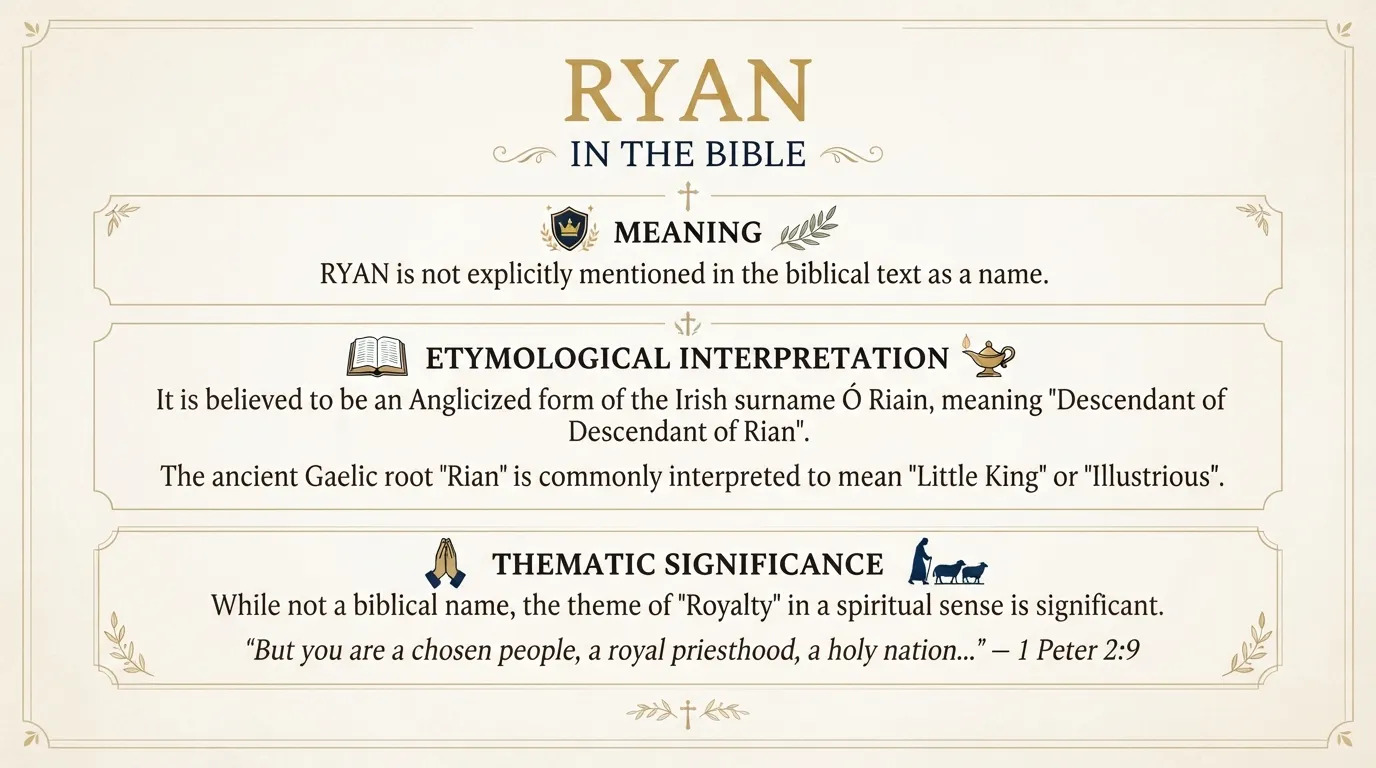
Ryan is not a name that appears in Scripture. It comes from the Irish surname Ó Riain, meaning “descendant of Rian.” While popularly translated “little king,” linguistic scholars note the original meaning of Rian is actually uncertain. Regardless, its popular royal meaning echoes biblical themes of kingship and leadership.
Biblical Meaning of Ryan 📖
Understanding Ryan’s connection to Christian themes starts with honestly tracing its Irish, not biblical, roots.
Irish Gaelic Meaning
Ryan comes from the Irish surname Ó Riain, meaning “descendant of Rian,” an ancient Old Irish personal name.
Popular sources widely translate this as “little king,” connecting it to the Old Irish word rí, meaning “king.”
However, according to genuine scholarly research, the original meaning of Rian was likely lost before written records began, making “little king” a popular but unconfirmed interpretation.
Literal Meaning
Literally, if the popular etymology holds, Ryan suggests royal descent or connection, though this remains linguistically uncertain.
Spiritual Meaning
Spiritually, many Christians connect Ryan’s popular “little king” meaning to Scripture’s rich teaching on kingship and godly leadership.
This connection is symbolic rather than textual, since the name itself never appears in Hebrew or Greek Scripture.
Biblical Significance
The name carries no direct biblical significance, but the kingship theme popularly associated with it aligns with major biblical concepts.
Key Scripture Reference
1 Peter 2:9 describes believers as “a royal priesthood,” connecting kingship imagery directly to every Christian’s identity in Christ.
Historical & Biblical Context 🏛️
Understanding Ryan’s honest relationship to Christian faith requires tracing its Irish surname history accurately.
Old Testament and New Testament Usage
Ryan does not appear anywhere in either the Old or New Testament; it is a post-biblical Irish Gaelic name.
Scripture does, however, discuss kingship extensively, particularly God’s own kingship and Christ’s role as King of Kings.
Irish Surname History
Ryan developed from the Gaelic Ó Riain, historically associated with several distinct Irish clans, particularly in County Tipperary.
It transitioned from surname to popular given name gradually, becoming especially common in the 20th century across Ireland and America.
Cultural Understanding of the Name’s Popularity
Ryan consistently ranked among Ireland’s top 10 boys’ names for decades, reflecting deep cultural roots beyond its uncertain etymology.
Its popularity in the United States grew substantially through the late 20th century, becoming a widely recognized, culturally Irish-American name.
Is Ryan Mentioned in the Bible? 📜
No, the name Ryan does not appear anywhere in the biblical text.
Where the Name Comes From Instead
Ryan’s roots trace to ancient Old Irish, entirely separate from Hebrew or Greek biblical sources.
Why It Matters
Being clear about this distinction matters for trustworthy content, especially since many websites confidently state a meaning (“little king”) that scholars actually consider uncertain.
What It Teaches
It teaches the importance of checking claimed name meanings against genuine linguistic scholarship, not just repeated online claims.
Spiritual Meaning & Symbolism 🕊️
Ryan’s popularly claimed “little king” meaning offers spiritual reflection worth exploring honestly, uncertainty included.
Human Kingship vs. Divine Kingship
Scripture consistently shows human kings as imperfect, while pointing toward God’s own perfect, eternal kingship.
Even Israel’s best kings, like David and Solomon, ultimately fell short, while Scripture points toward Christ as the true, lasting King.
Popular Claim vs. Scholarly Caution
It’s worth holding the “little king” meaning with appropriate humility, since genuine linguistic scholarship doesn’t confirm it as certain.
This doesn’t diminish the name’s beauty, but it does call for honesty rather than overconfident claims.
God’s Perspective
While Scripture never addresses the name Ryan directly, it consistently teaches about godly kingship, leadership, and servant authority.
Lessons for Today
Someone named Ryan can find genuine encouragement in Scripture’s teaching on humble, servant-hearted leadership.
📊 Quick Comparison: Popular Claim vs. Scholarly Caution
| Popular Online Claim | Scholarly Linguistic View |
|---|---|
| Ryan means “little king,” confirmed meaning | Meaning of root “Rian” is actually uncertain |
| Traced confidently to Old Irish rí (king) | This connection has been “discounted by scholars” |
| Presented as settled fact across many sites | Professor John Ryan (UCD) calls it “lost before records began” |
| Widely repeated without citation | Verified in Wikipedia’s sourced entry on the Ryan surname |
Biblical Verses About Kingship and Leadership ✝️
These verses trace Scripture’s teaching on kingship, the theme popularly connected to Ryan’s meaning.
1 Peter 2:9
“But you are a chosen race, a royal priesthood, a holy nation, a people for his own possession.”
Peter describes every believer, not just special leaders, as belonging to a “royal” identity through Christ.
This verse redefines kingship as something shared among God’s people, rather than restricted to a single ruler.
The lesson connects meaningfully to Ryan’s popular meaning, reframing “little king” imagery around shared identity in Christ.
This remains one of Scripture’s clearest statements on the royal dignity given to every believer.
Psalm 72:12-13
“For he delivers the needy when he calls, the people with low-income and him who has no helper. He has pity on the weak and the needy.”
This psalm describes ideal kingship not as raw power, but as compassionate care for the vulnerable.
It sets a biblical standard for what genuine, godly leadership actually looks like in practice.
The lesson challenges any leader, or anyone reflecting on Ryan’s “king” meaning, toward servant-hearted rather than self-serving authority.
1 Samuel 16:12-13
“Then Samuel took the horn of oil and anointed him in the midst of his brothers. And the Spirit of the Lord rushed upon David.”
This passage records David’s anointing as king, chosen not for outward appearance but for his heart.
God’s selection process here emphasizes character over status, a striking contrast to typical assumptions about royal choice.
The lesson shows that biblical kingship was never about bloodline alone, but about God’s own careful selection.
Isaiah 9:6-7
“For to us a child is born, to us a son is given; and the government shall be upon his shoulder… of the increase of his government and of peace there will be no end.”
This prophecy points toward Christ as the ultimate, eternal King, surpassing every human ruler who came before.
Unlike human kings, His kingdom is described as one of endless peace and justice, never ending or declining.
The lesson points beyond any human “king” name meaning toward Christ’s own perfect, lasting kingship.
Revelation 19:16
“On his robe and on his thigh he has a name written, King of kings and Lord of lords.”
This vision describes Christ’s ultimate title, surpassing every earthly ruler or claim to royal descent.
It places all human kingship, and by extension any name meaning “little king,” in proper perspective beneath Christ’s authority.
The lesson reminds readers that whatever royal meaning a name carries, true kingship ultimately belongs to Christ alone.
Mark 10:42-45
“Whoever would be great among you must be your servant… For even the Son of Man came not to be served but to serve.”
Jesus directly redefines greatness and leadership, contrasting worldly power with genuine, humble service.
This passage reshapes any “kingly” meaning around Christ’s own example of servant leadership rather than dominance.
The lesson offers the clearest biblical model for what someone connected to “king” imagery should actually aspire toward.
Real-Life Biblical Case Study: David’s Anointing as Shepherd-King 🌟
1 Samuel 16 records Samuel’s search for Israel’s next king after God rejected Saul’s continued reign.
Samuel visited Jesse’s household, expecting God to choose one of the older, more physically impressive sons.
But God told Samuel, “man looks on the outward appearance, but the Lord looks on the heart” (1 Samuel 16:7).
One by one, Jesse’s older sons were passed over, until only the youngest, David, remained, tending sheep in the field.
David was summoned from the pasture, still smelling of the flock he had faithfully cared for.
Samuel anointed him there, and Scripture records that “the Spirit of the Lord rushed upon David” (16:13).
David wouldn’t take the throne immediately; years of waiting, hardship, and humble service followed before he actually reigned.
This story offers a fitting picture connected to any “king” name meaning: true royalty in Scripture starts with humble faithfulness, not status.
Life Lessons for Christians 🙏
While Ryan isn’t a biblical name, its popularly claimed “king” meaning offers genuine lessons for believers today.
Kingship belongs to every believer. 1 Peter 2:9 shows royal identity isn’t reserved for a select few, but shared among God’s people.
True leadership serves. Mark 10 redefines greatness entirely around humble service rather than power or status.
God looks at the heart. David’s anointing shows character matters more than outward appearance or birth order.
Christ is the ultimate King. Isaiah 9 and Revelation 19 both point beyond any human ruler toward Christ’s eternal reign.
Compassion marks godly rule. Psalm 72 shows that caring for the vulnerable is central to what genuine, biblical kingship looks like.
Common Misunderstandings ⚠️
Several points of confusion surround Ryan’s connection to the Bible and its actual meaning online.
Modern misuse: Some websites present “little king” as a confirmed, certain meaning, when genuine scholarship considers the original root’s meaning lost or unknown.
Cultural confusion: A few sources fabricate direct biblical genealogy connections for Ryan that simply don’t exist anywhere in Scripture.
Wrong interpretations online: Certain articles claim confident Hebrew or Arabic etymological connections for Ryan that aren’t linguistically accurate.
Correct biblical explanation: Ryan is an Irish Gaelic name whose original meaning is genuinely uncertain; its popular “little king” gloss is widespread but not scholarly confirmed.
💡 Expert Insight: When a name’s “meaning” seems too neatly poetic, it’s worth checking a source like Wikipedia’s sourced surname entries or a professional linguistic dictionary. Ryan is a good reminder that popular baby-name sites sometimes simplify or overstate genuinely uncertain etymology.
FAQs ❓
Is Ryan a biblical name?
No, Ryan doesn’t appear in Scripture. It’s an Irish Gaelic name from the surname Ó Riain, popularly but not certainly translated “little king.”
Does Ryan really mean “little king”?
This is the popular translation, but linguistic scholars note the original meaning of the root name “Rian” was likely lost before historical records began.
Where does the name Ryan come from?
Ryan comes from the Irish surname Ó Riain, meaning “descendant of Rian,” historically associated with clans in County Tipperary, Ireland.
Does Ryan have spiritual meaning for Christians?
While not a scriptural name, many Christians connect its popular “king” meaning to biblical themes of kingship, leadership, and identity in Christ.
Is Ryan used for both such as kids?
Ryan is traditionally and predominantly a male name, though it does appear occasionally as a name for girls in modern usage.
Conclusion 🌿
The Ryan meaning in the Bible requires an honest, two-part clarification: the name itself isn’t in Scripture, and even its famous meaning is less certain than commonly claimed.
Rooted in ancient Irish Gaelic, “little king” remains a popular, meaningful interpretation, even if genuine scholarship holds it more cautiously.
Someone named Ryan can still hold onto real, biblical encouragement, not through a confirmed etymology, but through Scripture’s rich teaching on shared royal identity in Christ.
Servant leadership, humble faithfulness, and true kingship under God remain real, meaningful themes worth reflecting on.
May the same Spirit that rushed upon young David mark your own life with humble, faithful service today.

Hello, I’m Daniel Mercer. My passion for studying the Bible began many years ago when I started exploring the historical and spiritual meanings behind biblical names and symbols. Since then, I have dedicated countless hours to researching Scripture, ancient biblical traditions, and Christian teachings.