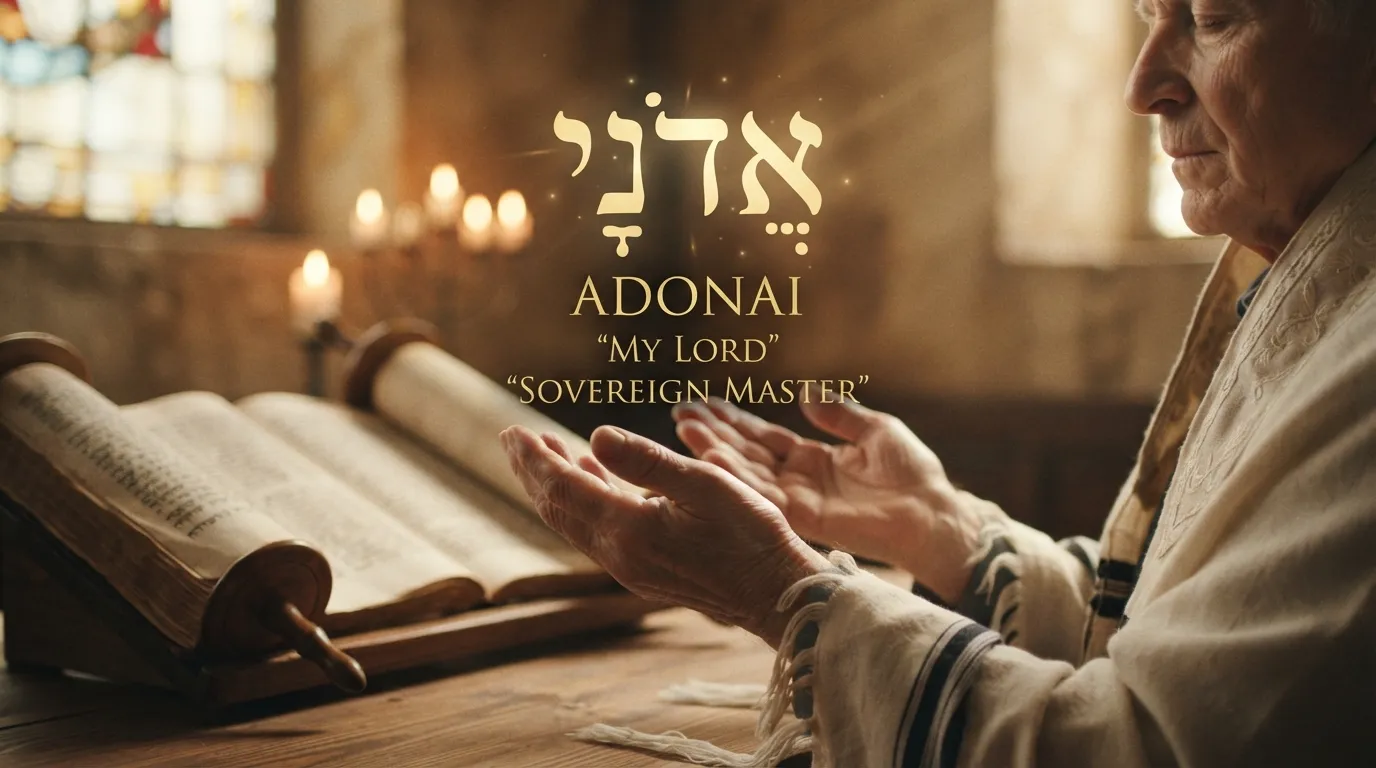
You may have heard Adonai in a worship song, seen it in a Messianic Bible, or noticed it in a study note. It sounds familiar and a little mysterious.
Many readers aren’t sure what it means or how it differs from the name Yahweh.
The question is a good one. In most English Bibles, you’ll see both “LORD” in small capital letters and “Lord” in normal letters.
They come from two different Hebrew words, and knowing the difference can change how you read a verse.
This guide explains the Adonai meaning in the Bible, where the word comes from in Hebrew, how it shows up in your English translation, and what it teaches about God’s authority.
We’ll also clear up a few common mix-ups, including the difference between Adonai and YHWH.
Adonai is a title, not a puzzle. Once you see how it works, many familiar verses open up in a fresh way.
Did You Know? 🔍
Adonai appears roughly 450 times in the Hebrew Old Testament, and more than 300 of those sit right beside the name YHWH. That’s why many English Bibles print “Lord GOD.”
Quick Answer ⚡
Adonai is a Hebrew title for God that means “my Lord” or “Master,” and it appears roughly 450 times in the Old Testament, often standing beside the divine name YHWH, which most English Bibles print as “LORD” in small capitals.
What Does Adonai Mean in the Bible?
Adonai comes from the Hebrew adon, meaning “lord” or “master.” Its form shows respect and is often read as “my Lord” or “Lord of all.” In the Bible, it names God as the sovereign ruler who deserves honor and obedience. It is a title rather than his personal name.
Biblical Meaning of Adonai 📖
Hebrew Meaning
Adonai (אֲדֹנָי) comes from adon, which means lord, master, or owner. Lexicons describe it as an emphatic form of adon that is used as a name of God only.
In everyday Hebrew, adon could describe a human master. Adonai, with its special ending, is reserved for God.
Literal Meaning
Literally, Adonai is a plural form, often explained as “my lords.” This doesn’t mean many gods. Scholars usually explain it as a plural of majesty, a way of showing fullness of authority.
In some verses it reads naturally as “my Lord.” In others it carries the wider sense of “Lord of all.”
Spiritual Meaning
Calling God Adonai is a statement about who is in charge. It puts the speaker in the place of a servant and God in the place of master.
At the same time, the word “my” makes it personal. The Lord of all is also the Lord of the one who prays.
Biblical Significance
Adonai is one of the most common titles for God in the Old Testament. It helps readers see God as sovereign, not just as a distant power.
Over time, Jewish readers began saying “Adonai” aloud in place of the name YHWH, out of reverence. That habit shaped how Bibles were translated into Greek and English.
Key Scripture Reference
“But Abram said, ‘O Lord GOD, what will you give me, for I continue childless…?'” (Genesis 15:2, ESV)
Historical & Biblical Context 🏛️
Old Testament Usage
The first appearance is Genesis 15:2, where Abram speaks to God. After that, Adonai shows up in prayers, psalms, and prophetic visions.
It often appears right next to YHWH, as in “Adonai YHWH.” The translators of most English Bibles print this pair as “Lord GOD.”
The exact pronunciation of YHWH is uncertain. For that reason, the habit of reading Adonai in its place became widespread.
New Testament Relevance
Adonai itself is Hebrew, so it doesn’t appear in the New Testament, which was written in Greek. The Greek word kyrios (“Lord”) takes its place.
The Greek translation of the Old Testament, the Septuagint, uses kyrios about 7,000 times, mostly for YHWH. The New Testament uses it about 740 times, usually for Jesus.
Cultural Understanding in Biblical Times
In the ancient world, a master or lord held real authority over his household and servants. Calling someone adon meant acknowledging that authority.
Roman emperors were also called lord. So when early Christians said “Jesus is Lord,” they were making a bold claim about who deserved their loyalty.
Is Adonai Mentioned in the Bible? 📜
Yes. Adonai appears roughly 450 times in the Hebrew Old Testament. Sources differ slightly on the exact count, but the number is always close to that.
How can you spot it in English? Look at the capital letters.
- “LORD” in small capitals stands for YHWH.
- “Lord” in normal letters usually stands for Adonai.
- “Lord GOD” or “Sovereign LORD” usually stands for Adonai YHWH together.
Some Jewish-style Bibles, such as the Complete Jewish Bible, print “ADONAI” where most translations print “LORD.” In those Bibles, ADONAI usually stands in for YHWH.
What does it teach? It teaches that the God who made a covenant with Israel is also the sovereign ruler of everything.
Spiritual Meaning & Symbolism ✨
Authority vs. Self-Rule
Calling God Adonai is a choice about who steers your life. The opposite is making yourself the lord of your own decisions.
The Bible shows how often people struggle with this. Moses, Abram, and Isaiah each wrestle with the Lord before they follow.
God’s Perspective
The Lord who has all authority is also the Lord who listens. Adonai appears in many prayers where people argue, ask, and confess.
God doesn’t turn them away for speaking honestly. He answers, corrects, and sends them forward.
Lessons for Today
The Adonai meaning in the Bible invites a simple question: who is my Lord? The word asks for trust, not just respect.
Names and Titles for the Lord Compared 📊
| Name or Title | Language | Meaning | How English Bibles Show It |
|---|---|---|---|
| YHWH | Hebrew | God’s personal covenant name | LORD (small capitals) |
| Adonai | Hebrew | My Lord, Lord of all | Lord |
| Adonai YHWH | Hebrew | Sovereign Lord | Lord GOD or Sovereign LORD |
| Adoni | Hebrew | My lord, usually a human master | my lord |
| Kyrios | Greek | Lord | Lord |
Biblical Verses About Adonai 📖
These verses show Adonai, or its Greek equivalent, in action. Quotes are from the ESV.
Genesis 15:2
“But Abram said, ‘O Lord GOD, what will you give me, for I continue childless, and the heir of my house is Eliezer of Damascus?'”
This is the first use of Adonai in the Bible, and it appears right beside YHWH, which is why the ESV prints “Lord GOD.” Abram is honest and a little worried. God has promised him descendants, yet he still has no child. He doesn’t walk away from God in frustration. He calls him Lord and brings the problem straight to him. The conversation ends with God’s promise about the stars (Genesis 15:5).
Lesson: Bring your honest questions to the Lord. Calling him Lord doesn’t mean hiding your doubts.
Exodus 4:10
“But Moses said to the LORD, ‘Oh, my Lord, I am not eloquent, either in the past or since you have spoken to your servant, but I am slow of speech and of tongue.'”
Moses uses “my Lord” while arguing with God at the burning bush. He feels unqualified to speak to Pharaoh. The words are respectful, but they are also a polite way of saying no. God answers by reminding Moses who made the human mouth (Exodus 4:11). Calling God Lord means accepting his authority even when the task feels too big. Moses’s fear is real, and God doesn’t brush it aside, yet he still sends him.
Lesson: Saying “Lord” includes trusting him with assignments you feel unready for.
Psalm 16:2
“I say to the LORD, ‘You are my Lord; I have no good apart from you.'”
David uses two names in one line: LORD (YHWH) and Lord (Adonai). He tells YHWH, “You are my Adonai.” It’s a personal statement. The covenant God of Israel is also his master. David then adds that he has no good apart from God. That is a simple but deep confession: everything good in his life comes from the One he serves. In English, the capital letters can hide this pair, so it’s a good verse to check in your own Bible.
Lesson: Let “my Lord” be a personal statement, not just a title.
Psalm 51:15
“O Lord, open my lips, and my mouth will declare your praise.”
This prayer comes from David’s repentance. The heading of Psalm 51 connects it to the time Nathan confronted him after his sin with Bathsheba. David calls God Adonai and asks for help to praise him. At this moment he can’t trust his own lips, so he asks the Master to open them. It is a humble prayer. Worship is something God enables, not something David produces on his own. The verse is also still used in prayer today.
Lesson: When words fail you, ask the Lord to open your lips.
Isaiah 6:8
“And I heard the voice of the Lord saying, ‘Whom shall I send, and who will go for us?’ Then I said, ‘Here I am! Send me.'”
Isaiah has just seen Adonai on a throne (Isaiah 6:1) and has been cleansed. Now he hears the Lord asking who will go. The same Master who is high and lifted up is also the One who sends. Isaiah’s answer, “Here I am! Send me,” is what a servant says to his master. Lordship in the Bible is never only about power. It is about calling people into his work, and Isaiah responds with a willing heart.
Lesson: If Christ is Lord, be ready to say, “Send me.”
2 Samuel 7:28
“And now, O Lord GOD, you are God, and your words are true, and you have promised this good thing to your servant.”
David prays this after God promises that his house will last (2 Samuel 7:11–16). He uses Adonai YHWH and calls himself “your servant.” The titles go together: master and servant, promise and trust. David bases his confidence on God’s word, not on his own strength. Because the Lord is sovereign, his promises can be counted on, and David doesn’t need to force the future. He simply thanks God and rests in what he has been told.
Lesson: Rest in the promises of a Lord who keeps his word.
John 20:28
“Thomas answered him, ‘My Lord and my God!'”
This verse is in Greek, but it echoes Adonai. John writes kyrios, the word Greek-speaking Jews used for YHWH and Adonai in the Septuagint. Thomas has doubted that Jesus rose from the dead. When he sees the risen Jesus, he confesses him as both Lord and God. Many Christians see this as one of the clearest moments where Jesus is worshiped as Lord. Thomas moves from doubt to worship in a single sentence.
Lesson: Honest doubt can lead to worship when it meets the risen Lord.
Philippians 2:11
“…and every tongue confess that Jesus Christ is Lord, to the glory of God the Father.”
Paul writes that one day everyone will confess Jesus as Lord. The word is kyrios, the same Greek word used for the Lord in the Greek Old Testament. In a world where Roman emperors were also called lord, this was a bold claim. Notice that the verse ends with glory to the Father. The lordship of Jesus doesn’t compete with the Father. It honors him. This confession is at the center of Christian faith.
Lesson: Confessing Jesus as Lord is meant to shape daily life, not just Sunday worship.
Real-Life Biblical Case Study: Isaiah Meets the Lord 🕊️
Isaiah’s vision begins in the year King Uzziah died. He sees the Lord sitting on a high throne, with the train of his robe filling the temple (Isaiah 6:1).
Isaiah’s first reaction isn’t excitement. It’s fear. He says he is lost, a man of unclean lips living among a people of unclean lips (Isaiah 6:5).
A seraph touches his lips with a burning coal and tells him his guilt is taken away (Isaiah 6:6–7). Only then does he hear the Lord’s question and answer, “Here I am! Send me.”
The order matters. Isaiah sees the Lord’s majesty, receives cleansing, and then accepts the call. That is what it looks like to follow Adonai: honor first, then obedience.
Life Lessons for Christians 🙏
Let God be Lord. Adonai asks who is really in charge of your plans.
Pray honestly. Abram, Moses, and David all spoke plainly to the Lord.
Serve willingly. Isaiah’s “Send me” shows what a servant’s heart looks like.
Trust his word. David rested in promises he could not yet see fulfilled.
Worship Jesus as Lord. The New Testament uses the Greek word for Lord as a confession of faith.
Common Misunderstandings ⚠️
“Adonai is God’s personal name.” It isn’t. Adonai is a title. God’s personal name in the Old Testament is YHWH.
“The plural form means many gods.” No. The plural ending is a plural of majesty, not a statement about the number of gods.
“Psalm 110:1 uses Adonai twice.” It doesn’t. The second “Lord” there is adoni, “my lord,” which is a different form, usually used of people.
“Adonai belongs only to Jewish tradition.” The word is in the Old Testament, which Christians also read. It’s part of the shared Scripture.
“Christians must say Adonai.” The New Testament doesn’t command it. Some believers use it as a reverent way to speak of God. Others simply say “Lord.”
Expert Insight 💡
When you read the Old Testament, pay attention to how “Lord” is printed. “LORD” in small capitals points to YHWH. “Lord” in normal letters usually points to Adonai. Then look up the verse in an interlinear or in Strong’s H136 to confirm. A small change in capital letters can reveal which Hebrew word is behind the English.
FAQs ❓
What does Adonai mean in the Bible?
Adonai means “my Lord” or “Lord of all.” It comes from the Hebrew adon, meaning lord or master, and it is used for God throughout the Old Testament. It is a title of respect and authority, not God’s personal name.
Is Adonai the same as YHWH?
No, they are different. YHWH is God’s personal covenant name, while Adonai is a title meaning Lord. They often appear together as “Lord GOD,” and Jewish readers say “Adonai” aloud when they see YHWH in the text.
Why does Adonai look plural?
Adonai is a plural form of adon, but it is usually understood as a plural of majesty, not a reference to many gods. The plural ending expresses fullness of authority, which is why it fits God and not human masters.
Is Adonai in the New Testament?
Not as a Hebrew word, since the New Testament was written in Greek. The Greek word kyrios, meaning Lord, serves the same role. The Septuagint uses kyrios for YHWH, and the New Testament uses it often for Jesus.
Why do Jewish readers say Adonai instead of YHWH?
Out of reverence for God’s name. Over time, readers began saying “Adonai” aloud whenever they reached YHWH in the text. The exact pronunciation of YHWH is uncertain, and this practice also shaped how translators later wrote “LORD.”
Conclusion 🌿
Adonai is a Hebrew title that means “my Lord” or “Lord of all.” It appears roughly 450 times in the Old Testament, and it tells us who God is: the sovereign ruler who also listens to his people.
The word is not a secret code or a hidden name. It’s an invitation to see God as master and to see ourselves as his servants, trusting his word and answering his call.
When Abram asked his question, Moses made his excuse, and Isaiah said “Send me,” each of them spoke to Adonai. Their words show that honest, humble prayer fits well with a God who is both powerful and near.
The next time you see “Lord” in your Bible, remember there is a meaning behind that one word. It points to a God worth following.

Hello, I’m Daniel Mercer. My passion for studying the Bible began many years ago when I started exploring the historical and spiritual meanings behind biblical names and symbols. Since then, I have dedicated countless hours to researching Scripture, ancient biblical traditions, and Christian teachings.