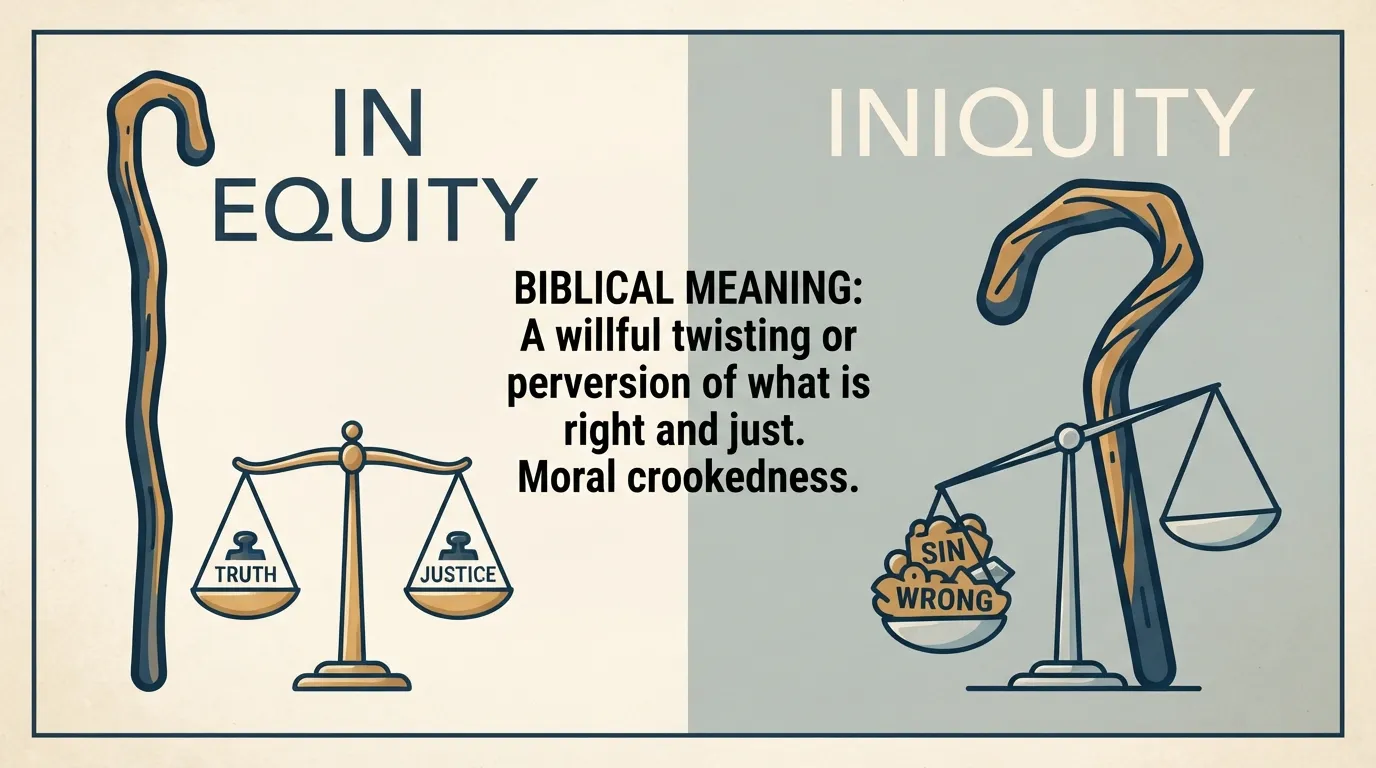
Iniquity Meaning in the Bible: Hebrew and Greek Roots
Iniquity Meaning in the Bible: Hebrew and Greek Roots
You read the word “iniquity” in a psalm or an old hymn, and it feels heavier than “sin,” even if you can’t quite say why.
That instinct is correct. Iniquity isn’t just another word for doing something wrong. Scripture uses it to describe something deeper, a twisted condition, not only a bad choice.
Understanding the real meaning behind this word changes how several familiar verses actually land.
Did You Know? 🔍
The Hebrew word behind “iniquity,” avon, comes from a root picture meaning “to bend” or “to twist.” It’s the same imagery used for a crooked path or a bent-over back, not just a broken rule.
Quick Answer
Iniquity in the Bible refers to a deep moral crookedness, not just an isolated wrong action. In the Old Testament, the Hebrew word avon pictures something bent or twisted out of its proper shape. In the New Testament, the Greek word anomia means “lawlessness,” a settled opposition to God’s law. Together, they describe sin that has become part of a person’s condition, not just a single mistake.
What Does Iniquity Mean in the Bible? 📖
Iniquity describes a moral distortion that runs deeper than one bad decision. It’s the Bible’s word for sin that has settled into a pattern, a bent condition rather than a single slip.
This is different from simply breaking a rule once. Iniquity points to something crooked in a person’s heart or nature that keeps producing wrong behavior.
Biblical Meaning of Iniquity 📜
Hebrew Meaning
The primary Hebrew word is avon (עָוֹן), appearing well over 200 times in the Old Testament. Its root pictures something bent, twisted, or distorted, rather than simply broken.
Greek Meaning
In the New Testament, the Greek word anomia (ἀνομία) is common, literally meaning “without law” or “lawlessness.” It emphasizes active rebellion against God’s standard, rather than inward crookedness specifically.
Literal Meaning
Literally, avon pictures a crooked path or a bent back, the kind of physical image that makes moral corruption easy to visualize: something that should be straight, but isn’t.
Spiritual Meaning
Spiritually, iniquity describes more than an action. It describes a condition, the kind of inward twist that produces sinful choices again and again, almost naturally.
Biblical Significance
Iniquity’s significance lies in how seriously Scripture treats it. It’s not minimized as a small misstep; it’s treated as something requiring real confession and real forgiveness from God.
Key Scripture Reference
Psalm 51:5 captures this condition vividly: “Behold, I was brought forth in iniquity, and in sin did my mother conceive me,” showing iniquity as something deeper than a single act.
Iniquity vs. Sin vs. Transgression: What’s the Difference?
Scripture actually uses three related but distinct Hebrew words, and knowing the difference sharpens how you read many passages.
Sin (Hebrew: chattah) pictures “missing the mark,” falling short of a standard.
Transgression (Hebrew: pesha) pictures crossing a known boundary, active rebellion against a clear line.
Iniquity (Hebrew: avon) pictures a bent or twisted condition, the underlying crookedness that produces both sin and transgression.
Is Iniquity Mentioned in the Bible? 🔍
Yes, extensively. Avon appears over 200 times in the Old Testament alone, and anomia appears repeatedly throughout the New Testament, especially in passages discussing lawlessness and final judgment.
This isn’t a rare or obscure term. It’s one of the Bible’s core words for describing humanity’s moral condition before God.
Historical & Biblical Context 🏺
Old Testament Usage
In the Old Testament, iniquity often appears in confession, like David’s prayers in the Psalms, and in warnings about generational consequences, as in Exodus 34:7’s description of God “visiting the iniquity of the fathers on the children.”
New Testament Relevance
In the New Testament, anomia appears in passages about final judgment, including Jesus’s warning in Matthew 7:23, where He tells false followers, “depart from me, you workers of lawlessness.”
Cultural Understanding in Biblical Times
In the ancient Hebrew worldview, moral crookedness wasn’t treated as a private matter. A community’s iniquity could bring real, tangible consequences, which is part of why confession and atonement carried such serious weight throughout the Old Testament.
Spiritual Meaning & Symbolism ✨
Crookedness vs. Straightness
Scripture consistently uses straightness as an image for righteousness and crookedness as an image for sin. Iniquity fits squarely into that crooked category, something bent out of its intended shape.
God’s Perspective
God treats iniquity seriously enough to require atonement, yet consistently offers forgiveness to those who confess it honestly, as seen throughout the Psalms.
Lessons for Today
Recognizing iniquity as a condition, not just an action, changes how people approach confession. It’s less about fixing one mistake and more about asking God to address something deeper.
Comparison Table: Sin, Transgression, and Iniquity
| Term | Hebrew Word | Core Picture | Emphasis |
|---|---|---|---|
| Sin | Chattah | Missing the mark | Falling short of a standard |
| Transgression | Pesha | Crossing a line | Active rebellion against a boundary |
| Iniquity | Avon | Bent or twisted | An inward, ongoing moral distortion |
Biblical Verses About Iniquity 📖
Psalm 51:5
“Behold, I was brought forth in iniquity, and in sin did my mother conceive me.” David describes iniquity as part of the human condition itself, not just something he did on a particular day.
Exodus 34:7
God describes Himself as “forgiving iniquity and transgression and sin,” while also “visiting the iniquity of the fathers on the children.” This verse holds both God’s mercy and the real, generational weight of iniquity together.
Isaiah 53:5
“He was pierced for our transgressions; he was crushed for our iniquities.” This verse connects iniquity directly to the suffering of the coming Messiah, framing Christ’s death as the answer to humanity’s crooked condition.
Psalm 32:5
“I acknowledged my sin to you, and I did not cover my iniquity; I said, ‘I will confess my transgressions to the Lord,’ and you forgave the iniquity of my sin.” David models the appropriate response to iniquity: honest confession rather than concealment.
Matthew 7:23
“Then I will declare to them, ‘I never knew you; depart from me, you workers of lawlessness [anomia].'” Jesus uses the Greek word for iniquity to describe people who looked religious outwardly but lived in ongoing rebellion against God’s will.
2 Thessalonians 2:7
“For the mystery of lawlessness [anomia] is already at work.” Paul uses the same Greek root to describe a coming, organized rebellion against God, showing iniquity’s scope extending beyond individuals.
1 John 3:4
“Everyone who makes a practice of sinning also practices lawlessness [anomia]; sin is lawlessness.” John ties ongoing sinful practice directly to this same concept of settled rebellion.
Micah 7:19
“He will again have compassion on us; he will tread our iniquities underfoot and cast all our sins into the depths of the sea.” This verse pictures God actively and completely dealing with iniquity, not simply overlooking it.
Real-Life Biblical Case Study: David’s Confession in Psalm 51 🕊️
After his sin with Bathsheba was exposed by the prophet Nathan, David didn’t just apologize for a single bad decision.
Psalm 51 shows him going deeper, acknowledging a crooked condition in his own heart that produced that sin in the first place.
His prayer asks God to “blot out all my iniquities” and to “create in me a clean heart,” recognizing that surface-level regret wasn’t enough.
This case study shows exactly why the Bible distinguishes iniquity from a single sinful act: David needed more than forgiveness for one night; he needed his underlying condition addressed.
Life Lessons for Christians 🌱
Confession should go deeper than the surface. David’s example in Psalm 51 shows real repentance addressing root causes, not just isolated actions.
God takes iniquity seriously, and takes mercy seriously too. Exodus 34:7 holds both truths together without softening either one.
Iniquity doesn’t disqualify someone from forgiveness. Psalm 32 and Micah 7 both show God fully dealing with iniquity for those who confess honestly.
Outward religion isn’t the same as inward righteousness. Jesus’s warning in Matthew 7:23 shows that even religious activity can mask ongoing lawlessness.
Common Misunderstandings ⚠️
Many people treat “iniquity” as simply a fancier, old-fashioned word for “sin.” While related, Scripture’s own vocabulary distinguishes a single wrong act (sin) from an ongoing, bent condition (iniquity).
Others assume iniquity only describes dramatic, obvious wrongdoing. In reality, Scripture applies it to quiet, inward crookedness just as much as outward rebellion.
Expert Insight 💡
When you study a word like iniquity, compare how it’s used across several passages rather than relying on one dictionary definition. Notice how David uses it personally in the Psalms, while Jesus and Paul apply the same underlying Greek concept to describe systemic, end-times rebellion. The range matters.
FAQs
What is the difference between sin, transgression, and iniquity?
Sin means missing a standard, transgression means crossing a known line, and iniquity describes the deeper, bent condition that produces both. They’re related but distinct concepts in Scripture.
What does the Hebrew word avon mean?
Avon pictures something bent, twisted, or distorted, describing a moral condition rather than just a single action.
What does the Greek word anomia mean?
Anomia literally means “without law” or “lawlessness,” describing active, settled rebellion against God’s standard.
Can iniquity be forgiven?
Yes. Scripture repeatedly shows God forgiving confessed iniquity, as seen in Psalm 32, Psalm 51, and Micah 7:19.
¿Qué significa “iniquidad” en la Biblia?
En la Biblia, “iniquidad” describe una condición moral profunda y torcida, no solo un acto de pecado aislado. En hebreo, la palabra avon significa algo doblado o distorsionado, mostrando que la iniquidad es una condición del corazón que Dios perdona cuando se confiesa con sinceridad.
Conclusion
Iniquity isn’t simply an old-fashioned synonym for sin. It’s the Bible’s word for something bent at the root, a condition that produces wrongdoing again and again rather than a single isolated choice.
Seeing that distinction changes how familiar verses read, especially David’s honest confession in Psalm 51 and the hope offered in passages like Micah 7:19.
Scripture never pretends iniquity is minor, but it never leaves it without an answer either. God’s consistent response, across both Testaments, is genuine forgiveness for those who stop hiding and start confessing.

Hello, I’m Jonathan Reed. I have a strong interest in biblical interpretation and Christian education. Over the years, I have spent significant time studying Scripture and researching its historical context to better understand its teachings and messages.