You hear a pastor mention “eschatology” during a sermon series, and it sounds academic, maybe even intimidating, even though the topic itself, what happens at the end of history, is something almost every believer wonders about eventually.
The word itself never appears in Scripture. But the concept behind it runs through both Testaments, tied to one specific, repeated Greek word.
Understanding that word, and how carefully Scripture actually treats the end of the story, makes “eschatology” far less academic than it first sounds.
Did You Know? 🔍
The Greek word behind “eschatology,” eschatos, appears 46 times in the New Testament, most often paired with “day” or “days,” as in Hebrews 1:2’s reference to “these last days.”
Quick Answer
Eschatology comes from the Greek words eschatos (“last”) and logos (“study” or “word”), meaning “the study of last things.” In the Bible, it refers to the teaching about the end of the present age, including Christ’s second coming, the resurrection of the dead, final judgment, and the eternal state. While the term itself is a later theological label, the concept is drawn directly from repeated biblical language and imagery.
What Does Eschatology Mean in the Bible? 📖
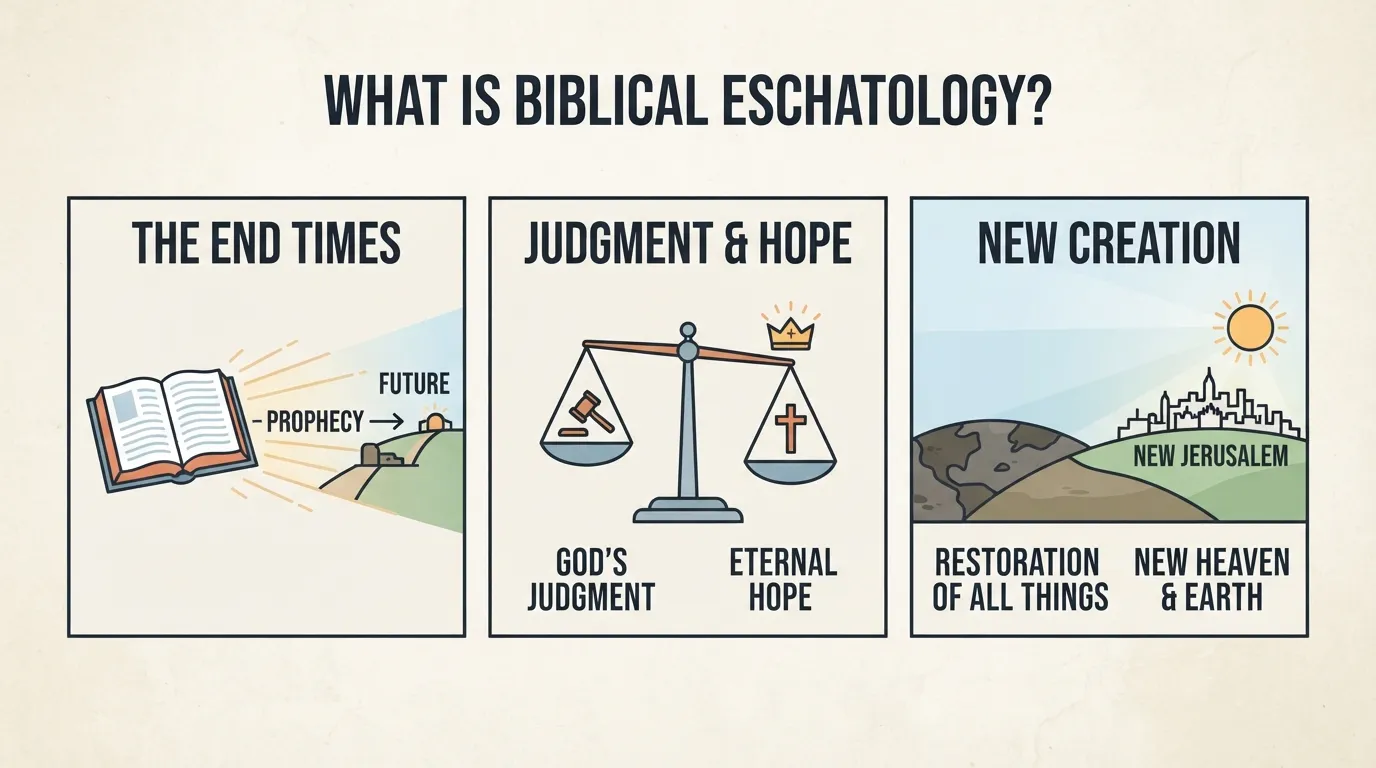
Eschatology is the branch of theology that studies what the Bible teaches about the end of history and humanity’s ultimate future: Christ’s return, resurrection, judgment, and the new heavens and new earth.
The term itself is a theological label coined from Greek roots, not a word Scripture uses directly, but the subject matter is unmistakably biblical, built from passages spanning Genesis to Revelation.
Biblical Meaning of Eschatology 📜
Greek Meaning
Eschatology combines eschatos (ἔσχατος), meaning “last,” “final,” or “furthest,” with logos/logia, meaning “word” or “study of.” Together, the term simply means “the study of last things.”
Literal Meaning
Literally, eschatology studies the end: the end of the present age, the end of earthly suffering, and the final, eternal state of creation.
Spiritual Meaning
Spiritually, eschatology gives present Christian life its direction. Knowing where history is heading shapes how believers are called to live now, with hope rather than despair.
Biblical Significance
Scripture treats the end of history as a certainty, not a vague possibility. That confidence runs through the Old Testament prophets and reaches its fullest New Testament expression in Revelation.
Key Scripture Reference
Hebrews 1:1-2 anchors the whole concept directly: “God… has in these last days spoken to us by his Son,” using the same eschatos root behind the word “eschatology” itself.
Is Eschatology Mentioned in the Bible? 🔍
The word “eschatology” itself never appears in Scripture; it’s a theological term scholars later built from the Greek. The underlying concept, though, is mentioned constantly, through the repeated word eschatos and extended passages describing the end of the age.
Why it matters: this distinction, a modern label versus a biblical concept, is worth being honest about. The theme is thoroughly biblical, even though the specific term is not.
Historical & Biblical Context 🏺
Old Testament Usage
Old Testament prophets like Daniel and Isaiah wrote extensively about a future day of judgment and restoration, often called “the Day of the Lord,” laying the foundation for later New Testament eschatology.
New Testament Relevance
Jesus Himself taught directly about the end of the age in the Olivet Discourse (Matthew 24-25, Mark 13, Luke 21), and Paul developed the theme further in letters like 1 Thessalonians 4-5, culminating in the extended vision of Revelation.
Cultural Understanding in Biblical Times
First-century Jewish thought already anticipated a coming “Day of the Lord” and a Messianic age. The New Testament writers built directly on that existing expectation, rather than introducing an entirely new concept.
Individual vs. General Eschatology
Theologians typically divide this subject into two categories.
Individual eschatology concerns what happens to a single person after death: the intermediate state, final resurrection, and personal judgment.
General eschatology concerns what happens to the world as a whole: Christ’s return, the Millennium (however understood), and the new heavens and new earth.
Both categories draw from real biblical texts, but they answer different questions, personal destiny versus cosmic history.
The Major Views on the End Times (A Careful Overview)
This is genuinely disputed ground among Bible-believing Christians, and it’s worth presenting fairly rather than picking a side.
Premillennialism holds that Christ will return before a literal thousand-year reign described in Revelation 20.
Postmillennialism holds that Christ returns after a long period of growing Christian influence and gospel success in the world.
Amillennialism holds that the “thousand years” in Revelation 20 is symbolic, representing Christ’s present spiritual reign through the church rather than a future literal era.
Preterism holds that many end-times prophecies, especially in passages like Matthew 24, were already fulfilled around the destruction of Jerusalem in 70 AD, rather than pointing to a still-future event.
Sincere, serious Bible readers hold each of these positions, and this article isn’t attempting to settle that debate, only to show that it exists and why.
Spiritual Meaning & Symbolism ✨
Hope vs. Fear
Scripture consistently frames the end of history as good news for believers, not primarily a source of dread. Titus 2:13 calls it “our blessed hope.”
God’s Perspective
God’s eschatological plan reflects completion, not abandonment. The story that began with creation and fell into brokenness moves toward genuine restoration, not permanent ruin.
Lessons for Today
Jesus’s own teaching repeatedly pairs end-times discussion with a call to watchfulness and faithful living now, rather than anxious speculation about exact dates.
Comparison Table: Key Eschatological Themes
| Theme | Old Testament Root | New Testament Development |
|---|---|---|
| Day of the Lord | Isaiah, Joel, Amos | 2 Peter 3, 1 Thessalonians 5 |
| Resurrection of the dead | Daniel 12:2 | John 11:24, 1 Corinthians 15 |
| Final judgment | Isaiah, Daniel 7 | Matthew 25, Revelation 20 |
| New creation | Isaiah 65:17 | Revelation 21:1 |
| Messiah’s reign | Daniel 7:13-14 | Revelation 19-20 |
Biblical Verses About Eschatology 📖
Hebrews 1:1-2
“God… has in these last days spoken to us by his Son.” This verse frames the entire era since Christ’s first coming as already part of the “last days,” a theme central to New Testament eschatology.
Acts 2:16-17
Peter quotes the prophet Joel: “In the last days it shall be… I will pour out my Spirit.” This connects Pentecost directly to Old Testament end-times prophecy, showing continuity between the Testaments.
John 11:24
Martha tells Jesus, “I know that he will rise again in the resurrection at the last day.” This verse reflects an already-existing Jewish belief in a future bodily resurrection, which Jesus affirms and expands.
Matthew 24:36
“But concerning that day and hour, no one knows, not even the angels of heaven, nor the Son, but the Father only.” Jesus explicitly discourages date-setting, a caution directly relevant to how eschatology should be studied.
1 Thessalonians 4:16-17
“The Lord himself will descend from heaven… and the dead in Christ will rise first. Then we who are alive… will be caught up together with them.” This passage is central to discussions of Christ’s return and the resurrection of believers.
2 Peter 3:10
“But the day of the Lord will come like a thief, and then the heavens will pass away with a roar.” Peter ties final judgment directly to cosmic transformation, not just individual accountability.
Revelation 21:1-4
“Then I saw a new heaven and a new earth… He will wipe away every tear from their eyes.” This passage represents the culmination of biblical eschatology: full restoration, not just the end of the old order.
Real-Life Biblical Case Study: The Thessalonian Church’s Confusion 🕊️
The church in Thessalonica genuinely struggled with eschatology, not as an academic subject, but as a pressing, practical concern.
Some believers had apparently stopped working, assuming Christ’s return was so imminent that ordinary life no longer mattered (2 Thessalonians 3:11).
Others were grieving deeply over believers who had already died, worried they might somehow miss out on Christ’s return (1 Thessalonians 4:13).
Paul’s response in both letters models exactly how eschatology should function: comforting the grieving with real hope, while correcting those using future expectation as an excuse to abandon present responsibility.
Life Lessons for Christians 🌱
Hope should shape daily life, not replace it. Paul corrected believers who stopped working, not believers who hoped for Christ’s return.
Grief and hope can coexist. 1 Thessalonians 4 offers genuine comfort without denying real loss.
Watchfulness matters more than date-setting. Jesus’s own words in Matthew 24:36 discourage speculation about exact timing.
Restoration is the end goal, not destruction. Revelation 21 pictures renewal, tears wiped away, not simply an ending.
Common Misunderstandings ⚠️
Many people assume eschatology is mainly about predicting specific dates or current events matching prophecy. Scripture itself, in Matthew 24:36, directly discourages that kind of date-setting.
Others assume all Christians throughout history have agreed on the details of the end times. In reality, sincere believers have held differing views, premillennial, postmillennial, amillennial, and preterist, for centuries, often while agreeing fully on the core hope of Christ’s return and final restoration.
Expert Insight 💡
When you study eschatology, separate the core, widely agreed truths, Christ will return, the dead will be raised, God will judge and restore, from the more debated details, like the exact nature of the millennium. That distinction keeps the subject grounded rather than overwhelming.
FAQs
What does the word “eschatology” literally mean?
It comes from the Greek eschatos (“last”) and logos (“study”), meaning “the study of last things.”
Is the word “eschatology” actually in the Bible?
No. It’s a theological term built from Greek roots. The Bible uses the underlying word eschatos frequently, but not the compound term “eschatology” itself.
What’s the difference between individual and general eschatology?
Individual eschatology concerns a single person’s fate after death; general eschatology concerns the end of world history and Christ’s return.
Does the Bible give a specific date for the end times?
No. Matthew 24:36 states plainly that no one, “not even the angels,” knows the exact day or hour.
Do all Christians agree on the details of eschatology?
No. Views like premillennialism, postmillennialism, amillennialism, and preterism differ on specific details, while generally agreeing on Christ’s return and final judgment.
Conclusion
Eschatology is simply the study of what the Bible says about how the story ends, Christ’s return, resurrection, judgment, and a renewed creation.
The word itself is a later theological label, but the subject is woven through Scripture from the Old Testament prophets to Revelation’s closing vision.
Christians genuinely disagree on some of the details, and that honesty matters. What they consistently share is the same core hope: history is moving toward real restoration, not simply running out of time.

Hello, I’m Samuel Carter. My interest in biblical studies comes from a lifelong desire to understand the wisdom and teachings contained within Scripture. I particularly enjoy researching biblical numbers, patterns, and themes that appear throughout God’s Word.