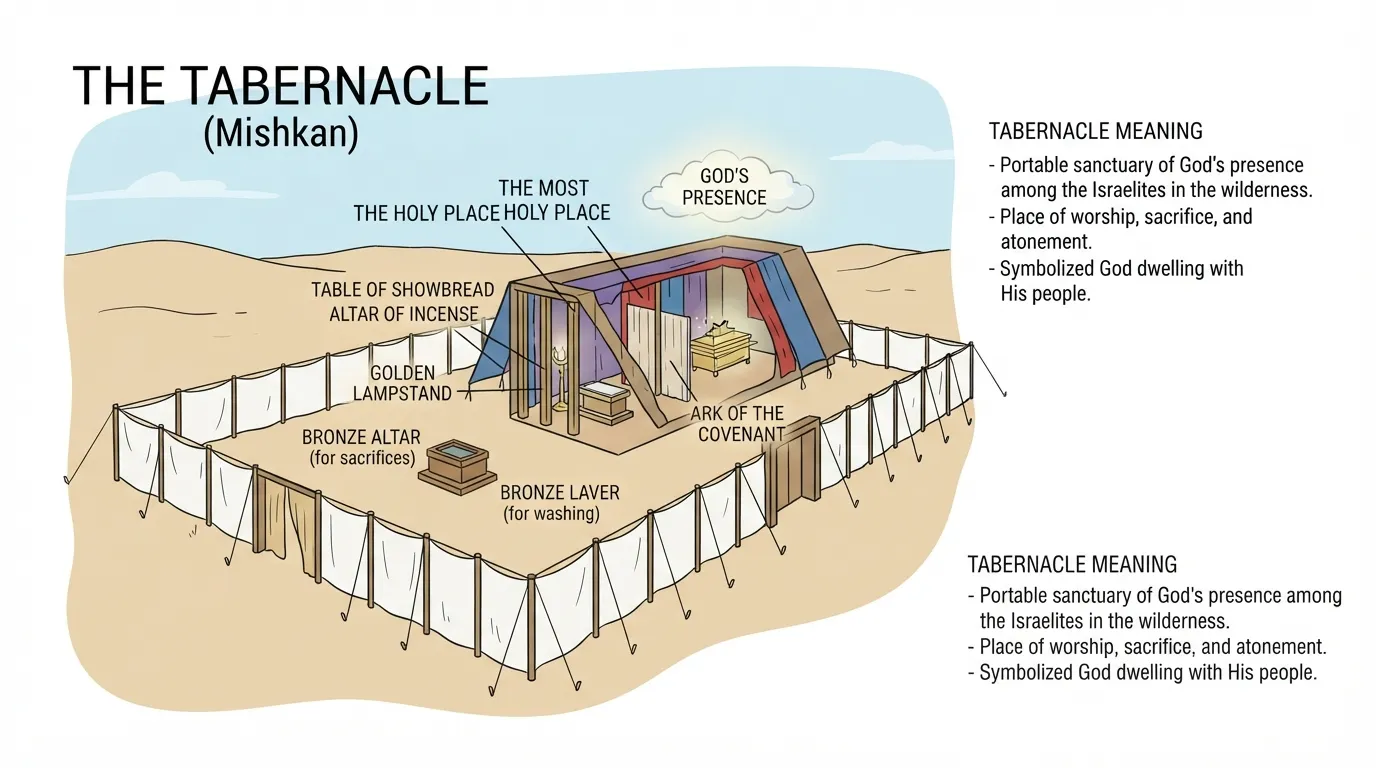
You may have read about the tabernacle in Exodus and felt lost in the details. There are curtains, boards, bronze, gold, and a long list of measurements. It is easy to wonder why the Bible spends so many chapters on a tent.
If you’re searching for the tabernacle meaning in the Bible, the short answer is that it was God’s dwelling place among his people.
But there is much more to see. Its design, its furniture, and its rules all point to a God who is holy and who still wants to live near people.
This guide explains the Hebrew and Greek words behind the tabernacle, how it worked, where it appears in Scripture, and how the New Testament connects it to Jesus.
We’ll also clear up a few common mix-ups, like the difference between the tabernacle and the temple.
The tabernacle was a tent, but it carried a big message.
Did You Know? 🔍
The Hebrew word for tabernacle, mishkan, comes from a root meaning “to dwell,” so it literally means “dwelling place.” John 1:14 echoes this with a Greek verb that means “to pitch a tent.”
Quick Answer ⚡
In the Bible, the tabernacle was the portable tent where God’s presence dwelt among the Israelites as they traveled from Egypt to the Promised Land, and its Hebrew name, mishkan, means “dwelling place,” showing that God wanted to live among his people.
What Does the Tabernacle Mean in the Bible?
The tabernacle, from the Hebrew mishkan, was a sacred tent built at Mount Sinai as God’s dwelling place among Israel. It was also called the tent of meeting. Its design, priests, and sacrifices taught Israel how to approach a holy God, and the New Testament connects it to Jesus.
Biblical Meaning of the Tabernacle 📖
Hebrew Meaning
The Hebrew word is mishkan (מִשְׁכָּן). It comes from shakan, “to dwell,” and it means “dwelling place.”
Lexicons note that the same word can describe any home, even a shepherd’s hut. When it names the tabernacle, it becomes a special dwelling for God.
The tabernacle also goes by other names. It is called the “tent of meeting” and the “tabernacle of the testimony” (Exodus 38:21).
Greek Meaning
The Greek word for tent is skene, and the related verb skenoo means to dwell, or to “tabernacle.”
John 1:14 uses this verb when it says the Word “dwelt” among us. Revelation 21:3 uses a form of the same word when it says God will dwell with his people.
Literal Meaning
Literally, the tabernacle was a portable tent. It sat inside a courtyard about 100 cubits long and 50 cubits wide (Exodus 27:18). A cubit is about 18 inches.
Inside the tent were two rooms. A curtain separated the Holy Place from the Most Holy Place (Exodus 26:33). The ark of the covenant sat in the inner room.
Spiritual Meaning
The tabernacle teaches that God is both holy and near. He wanted to live among his people, yet he set clear rules for how they could approach him.
For many Christians, that picture points forward to Jesus, who brings God’s presence among people in a new way.
Biblical Significance
The tabernacle meaning in the Bible is closely tied to its design. God gave Moses the design for the tabernacle “after the pattern” he showed him (Exodus 25:9, 40). Nothing about it was random.
The New Testament says the tabernacle was “a copy and shadow of the heavenly things” (Hebrews 8:5).
Key Scripture Reference
“And let them make me a sanctuary, that I may dwell in their midst.” (Exodus 25:8, ESV)
Historical & Biblical Context 🏛️
Old Testament Usage
God gave the instructions in Exodus 25–31, and the people built it in Exodus 35–40. The furnishings included the ark, the table for bread, the lampstand, the altar of incense, the bronze altar, and the washbasin.
When the cloud lifted from the tabernacle, Israel moved on. When it settled, they camped (Exodus 40:36–38).
Later, the tent stood at Shiloh (Joshua 18:1) and at Gibeon (1 Chronicles 16:39). Under Solomon, the tent of meeting was brought into the new temple (1 Kings 8:4).
New Testament Relevance
The New Testament picks up the tabernacle in several places. John 1:14 says the Word dwelt among us. Hebrews 8–9 explains the tabernacle as a copy of heavenly realities.
When Jesus died, the curtain of the temple was torn in two (Matthew 27:51). Revelation 21:3 looks ahead to a time when God’s dwelling is with his people for good.
Cultural Understanding in Biblical Times
Israel was a traveling people, so their place of worship traveled too. The twelve crews camped around the tent of meeting (Numbers 2:2).
Only priests from Aaron’s family served inside (Exodus 28:1). Ordinary Israelites came to the courtyard with their offerings.
Is the Tabernacle Mentioned in the Bible? 📜
Yes, many times. In the NASB, the Hebrew word mishkan is translated “tabernacle” 109 times. Most of those are in Exodus, Leviticus, and Numbers.
What does the Bible say about the tabernacle? It says God commanded it, gave the design, and filled it with his glory.
What names does it use? It uses “tabernacle,” “tent of meeting,” and “tabernacle of the testimony.” Translations vary, and some use “tent” or “dwelling” in places.
What is it not? It is not the same as the temple, and it is not the Feast of Tabernacles. We’ll clear up both below.
Why does it matter? The tabernacle meaning in the Bible shows that God’s plan to live among people goes back to the early pages of Exodus.
Spiritual Meaning & Symbolism ✨
Holiness vs. Closeness
The tabernacle holds two truths together. God is holy, so there are curtains, priests, and sacrifices. God is also near, so he dwells in the middle of the camp.
Neither truth cancels the other. The structure shows how a holy God can live among a sinful people.
God’s Perspective
The idea behind the tabernacle is relationship. In Leviticus 26:12, God says, “I will walk among you and will be your God, and you shall be my people.”
The tent was never just a building. It was a way for God to be with those he had rescued.
Lessons for Today
The tabernacle meaning in the Bible is a reminder that God is not distant. He has always wanted to be close to his people.
Tabernacle, Tent of Meeting, Temple, and Booths Compared 📊
| Term | Hebrew | Meaning | Where to Read |
|---|---|---|---|
| Tabernacle | mishkan | Dwelling place | Exodus 25–40 |
| Tent of meeting | ohel moed | Place of meeting with God | Exodus 33:7; 40:34 |
| Temple | bayit | House (a permanent building) | 1 Kings 6 |
| Feast of Tabernacles | sukkot | Booths, or temporary shelters | Leviticus 23:34 |
The first two terms overlap. The temple replaced the tent as the center of worship. The feast is a separate idea that recalls the wilderness years.
Biblical Verses About the Tabernacle 📖
These verses trace the tabernacle from Exodus to Revelation. Quotes are from the ESV.
Exodus 25:8
“And let them make me a sanctuary, that I may dwell in their midst.”
This is the heart of the whole tabernacle project. God doesn’t say, “Build me a monument.” He says, “Make me a sanctuary, that I may dwell in their midst.” The goal is his presence among the people, not an impressive structure. The detailed instructions that follow in Exodus 25–31 all serve that purpose. Every board, curtain, and piece of furniture was part of making a place where a holy God could live near sinful people. It shows that God moved first toward his people.
Lesson: God’s desire is to be with his people, not just to be served by them.
Exodus 29:45–46
“I will dwell among the people of Israel and will be their God. And they shall know that I am the LORD their God, who brought them out of the land of Egypt that I might dwell among them. I am the LORD their God.”
This passage links the exodus and the tabernacle. God rescued Israel from Egypt so that he could live among them. Freedom wasn’t the final goal. Presence was. The people would come to know God not only as the one who saved them, but as the one who stayed with them. That is a deep statement about the purpose of salvation. God rescues so that he can dwell with those he rescues, and the tabernacle gave that promise a real address in the middle of the camp.
Lesson: Salvation leads to a relationship, not just an escape.
Exodus 40:34–35
“Then the cloud covered the tent of meeting, and the glory of the LORD filled the tabernacle. And Moses was not able to enter the tent of meeting because the cloud settled on it, and the glory of the LORD filled the tabernacle.”
When the work was finished, God’s glory filled the tent. Even Moses, who spoke with God face to face, could not enter at that moment. The scene shows how seriously the Bible treats God’s holiness. It also shows that God accepted the work done “according to the pattern.” The people had built what he asked, and he came. This was the visible sign that the tent was not an empty shell but the place where God’s presence truly rested among Israel.
Lesson: Worship begins with respect for who God is.
Leviticus 26:11–12
“I will make my dwelling among you, and my soul shall not abhor you. And I will walk among you and will be your God, and you shall be my people.”
Here God describes the tabernacle’s purpose in simple words. He will make his dwelling among the people, and he will walk among them. This echoes the language of the Garden of Eden, where God walked with Adam and Eve (Genesis 3:8). The promise is covenant language: “I will be your God, and you shall be my people.” It tells us that the tabernacle was meant to restore closeness. The rules around it did not exist to keep God far away, but to let him stay close.
Lesson: God’s rules around worship protect a relationship rather than block it.
John 1:14
“And the Word became flesh and dwelt among us, and we have seen his glory, glory as of the only Son from the Father, full of grace and truth.”
John uses a Greek verb that literally means “to pitch a tent” or “to tabernacle.” He is saying that Jesus, the Word, came to live among people the way God’s presence once lived in the tent. John also mentions “glory,” a word that echoes Exodus 40, where glory filled the tabernacle. Christians see here the heart of the incarnation: God did not only send a message, he came himself. The tabernacle was a sign pointing toward that arrival. The tent in the wilderness had been preparing people for this.
Lesson: In Jesus, God’s presence came close in the most personal way.
Hebrews 8:5
“They serve a copy and shadow of the heavenly things. For when Moses was about to erect the tent, he was instructed by God, saying, ‘See that you make everything according to the pattern that was shown you on the mountain.'”
The writer of Hebrews says the tabernacle was a pattern pointing to something greater. The earthly tent was real and necessary, but it was not the final reality. The command to follow the pattern shows that every detail had meaning. For Christians, this verse is part of an argument that Jesus serves in a better tabernacle, a heavenly one. It does not make the old tent unimportant. It shows how the old tent prepared people to understand what Christ would do.
Lesson: Old Testament worship was a signpost, and signposts matter.
Matthew 27:51
“And behold, the curtain of the temple was torn in two, from top to bottom. And the earth shook, and the rocks were split.”
The curtain in the temple served the same purpose as the curtain in the tabernacle: it separated the Holy Place from the Most Holy Place. When Jesus died, it tore from top to bottom, which suggests God did it, not people. Many Christians read this as a sign that access to God was opened through Christ’s death. The book of Hebrews picks up this idea and speaks of entering the holy places with confidence (Hebrews 10:19–20). The tabernacle’s barrier gave way to open access.
Lesson: In Christ, the way to God is open.
Revelation 21:3
“And I heard a loud voice from the throne saying, ‘Behold, the dwelling place of God is with man. He will dwell with them, and they will be his people, and God himself will be with them as their God.'”
This verse brings the tabernacle story to its goal. The Greek word for “dwelling place” is skene, the word for tent or tabernacle. God’s dwelling will be with people, not in a tent in a camp but in a renewed world. The language repeats the promise from Leviticus 26: they will be his people, and he will be their God. The story that began with a tent at Sinai ends with God living with his people fully and permanently. It is a hopeful ending to a long story.
Lesson: The Bible’s story ends with God close to his people.
Real-Life Biblical Case Study: Setting Up the Tabernacle ⛺
Exodus 40 describes the day the tabernacle was set up. Moses raised it on the first day of the first month in the second year after Israel left Egypt (Exodus 40:17).
He placed the ark, the table, the lampstand, and the altars in their places. He hung the curtain and set up the courtyard.
Then the cloud covered the tent, and the glory of the LORD filled the tabernacle (Exodus 40:34). From that point on, Israel followed the cloud. When it lifted, they traveled. When it stayed, they camped (Exodus 40:36–37).
The chapter ends by saying the cloud was over the tabernacle by day, and fire was in it by night, “in the sight of all the house of Israel” (Exodus 40:38). God’s presence was visible and steady.
Life Lessons for Christians 🙏
God wants to be near. The tabernacle shows his desire to live among people.
Holiness deserves respect. The curtains and rules remind us that God is not casual.
Follow his lead. Israel moved when the cloud moved, not before.
Obedience matters. The craftsmen built “according to the pattern.”
Look to Christ. The New Testament sees the tabernacle as pointing to him.
Common Misunderstandings ⚠️
“The tabernacle and the temple are the same.” They aren’t. The tabernacle was a portable tent. The temple was a permanent building first built by Solomon.
“The Feast of Tabernacles is about the tabernacle tent.” It isn’t. That feast uses a different Hebrew word, sukkot, meaning booths. It recalls Israel living in temporary shelters (Leviticus 23:42–43).
“The tent of meeting and the tabernacle are always the same thing.” They overlap, but Exodus 33:7 describes a tent of meeting pitched outside the camp before the full tabernacle was built.
“The tabernacle was just a building for sacrifices.” Sacrifices were part of it, but the main point was God’s presence among his people.
“Tabernacle only means a church building.” In some churches today, “tabernacle” names a container or a worship space. That is a later use of the word, not the Bible’s main meaning.
Expert Insight 💡
To see how seriously the Bible treats the tabernacle, read Exodus 25–31 (the instructions) and then Exodus 35–40 (the construction) side by side. Notice how often the text says the people did “as the LORD had commanded Moses.” That repetition is a clue: the writer wants you to see that obedience and God’s presence go together.
FAQs ❓
What does tabernacle mean in the Bible?
The tabernacle was the portable tent where God’s presence dwelt among Israel. Its Hebrew name, mishkan, means “dwelling place.” It was built at Mount Sinai and used during Israel’s travels, with priests, sacrifices, and sacred furniture inside and around it.
What was the tabernacle used for?
It was where Israel worshiped and where priests offered sacrifices on behalf of the people. It held the ark of the covenant in the Most Holy Place. Above all, it showed that God lived among his people and how they could approach him.
What is the difference between the tabernacle and the temple?
The tabernacle was a portable tent used in the wilderness, while the temple was a permanent stone building in Jerusalem built by Solomon. Both served as places of God’s presence, but the tabernacle came first and was designed for a traveling people.
Is the Feast of Tabernacles the same as the tabernacle?
No. The Feast of Tabernacles, or Booths, uses a different Hebrew word, sukkot, meaning temporary shelters. It remembers Israel living in booths in the wilderness (Leviticus 23:42–43). The tabernacle tent is a separate structure, though both recall the wilderness years.
What does John 1:14 mean by “tabernacled”?
John uses a Greek verb that literally means to pitch a tent or dwell. He is saying that the Word, Jesus, came to live among people, much like God’s presence dwelt in the tabernacle. It connects the Old Testament tent with Christ’s coming.
Conclusion 🌿
The tabernacle was a tent, but it carried the heart of the Bible’s message: God wants to live among his people. Its Hebrew name, mishkan, means “dwelling place,” and everything about it, from the curtains to the cloud, pointed to that purpose.
The tabernacle meaning in the Bible also shows that God is holy. Priests, sacrifices, and boundaries reminded Israel that his presence was not to be taken lightly.
The New Testament carries this story forward. John says the Word “dwelt” among us, and Revelation promises that God’s dwelling will be with his people. The tent in the wilderness was never the end of the story.
If you ever feel that God is far away, the tabernacle offers a quiet encouragement. From the very beginning, he chose to be near.

Hello, I’m Samuel Carter. My interest in biblical studies comes from a lifelong desire to understand the wisdom and teachings contained within Scripture. I particularly enjoy researching biblical numbers, patterns, and themes that appear throughout God’s Word.