You’ve probably heard “unequally yoked” tossed around in a sermon about dating.
Or maybe you’ve read Jesus’s words about taking his yoke and wondered what that image actually meant to the people first hearing it.
A yoke was a real, physical object in the ancient world. That physical meaning is exactly what gives the biblical picture its power.
Once you see what a yoke actually did, verses that once felt like vague spiritual language start to feel concrete and personal.
Scripture uses “yoked” in more than one way. Sometimes as a warning, sometimes as an invitation. Understanding both sides gives a fuller picture of what the Bible is really teaching.
Did You Know? 🔍
A yoke wasn’t just any harness.
It was carefully shaped and fitted to the specific animals wearing it, since a poorly fitted yoke would rub, chafe, and slow the whole team down.
That detail adds real weight to Jesus’s promise that his yoke is “easy” in Matthew 11:30. The Greek word there (chrestos) can also mean well-fitted or suited to the wearer.
What Does Yoked Mean in the Bible? 📖
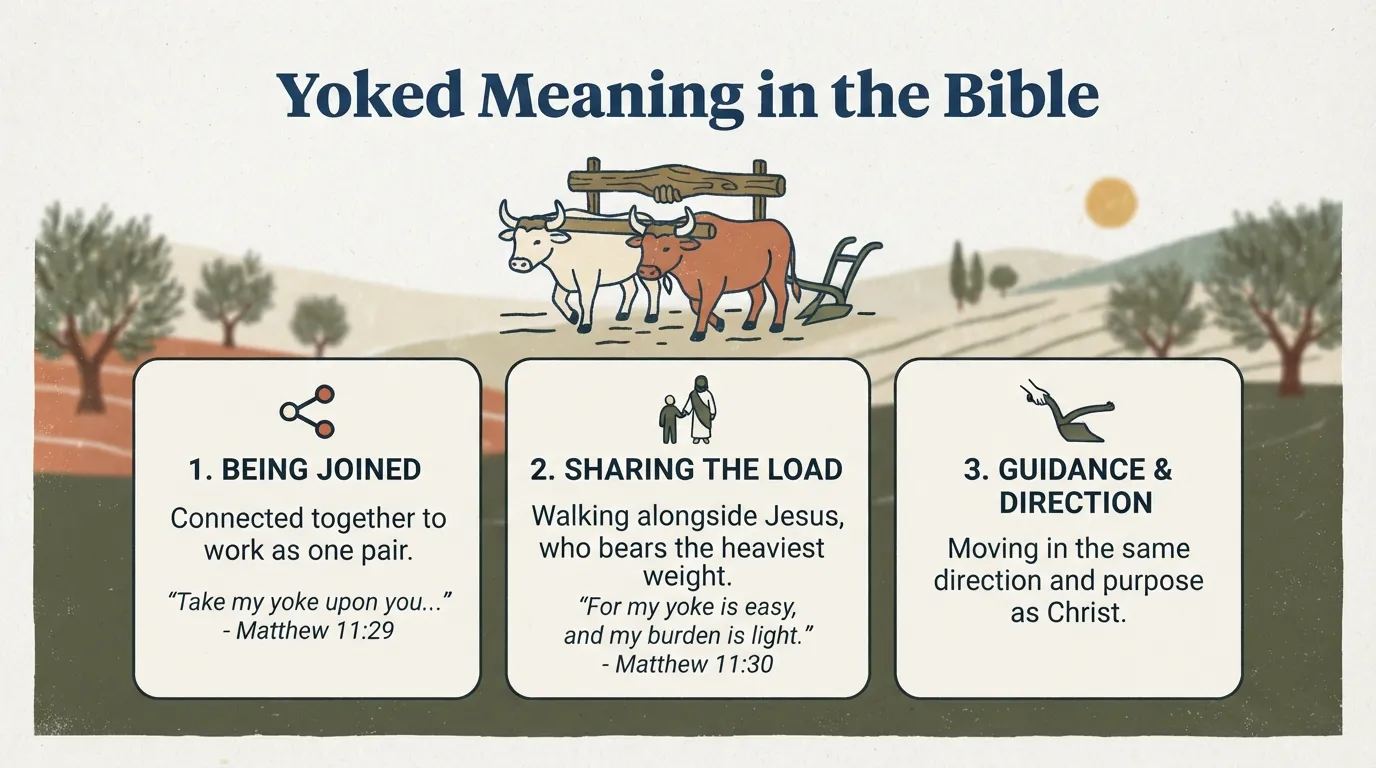
Yoked describes two animals, usually oxen, joined together by a wooden crossbar so they can pull a plow or cart as one unit.
Biblically, this becomes a picture of partnership: being bound to someone or something in shared direction and shared load.
It’s used both as a warning against mismatched partnerships and as an invitation into partnership with Christ.
Biblical Meaning of Yoked 📜
Literal Meaning
A yoke was a wooden beam laid across the necks of two animals, distributing the weight of plowing or hauling between them.
Deuteronomy 22:10 even instructs against yoking an ox and a donkey together, since mismatched strength and stride made the pairing unworkable.
Greek Meaning
In 2 Corinthians 6:14, the Greek word is heterozygeo, a compound meaning to be yoked differently or unequally.
It’s a rare word in the New Testament, used specifically to describe an unworkable mismatch, not just any kind of togetherness.
Spiritual Meaning & Biblical Significance
Spiritually, being yoked describes being closely bound to something. This could be a belief system, a relationship, or a way of living.
As a result, its direction can become your direction too. Scripture treats this connection as significant. After all, a yoke does not allow much independent movement.
Biblical Significance
The image of a yoke works both as a warning and an invitation.
However, its meaning depends on the passage and its context.
Historical & Biblical Context 🏺
New Testament Relevance
The New Testament gives the image an important new dimension.
For example, Jesus describes His yoke as restful rather than crushing in Matthew 11:29–30.
Similarly, Paul uses yoke language to describe partnership and shared direction. In Philippians 4:3, the image relates to ministry teamwork. In contrast, 2 Corinthians 6:14 uses it as a warning about spiritual mismatch.
Cultural Understanding in Biblical Times
People in biblical times understood the practical meaning of a yoke.
For example, farmers knew that animals worked together under the same wooden yoke.
A mismatch could create serious problems. The animals could pull in different directions and struggle under the shared burden.
Therefore, the image provided a clear picture of partnership, direction, and shared responsibility.
Is Yoked Mentioned in the Bible? 🔍
Yes, the concept of being yoked appears in several forms throughout the Bible.
For instance, it appears in agricultural and legal contexts, such as Deuteronomy 22:10 and 1 Kings 19:19.
In addition, Scripture uses the image to describe national oppression in passages such as Isaiah 9:4 and Jeremiah 27–28.
In the New Testament, Jesus uses the image as an invitation in Matthew 11:29–30. Paul also uses it as a warning in 2 Corinthians 6:14.
Therefore, the meaning of a yoke depends heavily on its context. In one passage, it can represent oppression. In another, it can represent rest, partnership, or willing discipleship.
Spiritual Meaning & Symbolism ✨
Burden vs. Partnership
Old Testament yoke imagery often points to burden and subjugation.
However, Jesus presents the same physical image differently.
He describes His yoke as something entered willingly. Instead of forced servitude, it represents a relationship with Him and a life of discipleship.
God’s Perspective
When Jesus invites people to take His yoke in Matthew 11, the image is not simply about carrying a heavy burden alone.
Instead, it presents a picture of shared direction and care. Jesus describes Himself as gentle and humble.
Therefore, His invitation points to a relationship marked by trust rather than crushing pressure.
Lessons for Today
The warning about being unequally yoked in 2 Corinthians 6:14 is often applied to marriage. However, the principle can be understood more broadly.
Close and ongoing partnerships can shape our direction over time. For example, this may include friendships, business relationships, or ministry partnerships.
Because of this, Scripture encourages believers to think carefully about relationships that strongly influence their faith and values.
Yoked: Old Testament vs. New Testament Usage Compared 📊
| Feature | Old Testament Usage | New Testament Usage |
|---|---|---|
| Common tone | Burden, oppression, subjugation | Partnership, rest, shared direction |
| Key example | Israel’s yoke under Egypt/foreign powers | Jesus’s yoke offered in Matthew 11:29-30 |
| Typical warning | Escaping an unjust yoke | Avoiding a mismatched yoke (2 Cor. 6:14) |
| Emotional weight | Heavy, forced | Willingly taken on, restful |
Biblical Verses About Yoked 📖
Deuteronomy 22:10 “You shall not plow with an ox and a donkey together.” A literal farming law that becomes the practical backdrop for every later symbolic use of mismatched yoking in Scripture.
1 Kings 19:19 Elisha is found “plowing with twelve yoke of oxen,” a detail showing the yoke as ordinary agricultural life before it becomes a spiritual metaphor elsewhere.
Isaiah 9:4 “For the yoke of his burden, and the staff for his shoulder, the rod of his oppressor, you have broken.” Here the yoke represents national oppression, with its breaking symbolizing liberation.
Jeremiah 28:2 The prophet Hananiah declares, “I have broken the yoke of the king of Babylon,” using the image politically to describe freedom from foreign domination.
Matthew 11:29-30
“Take my yoke upon you, and learn from me, for I am gentle and lowly in heart, and you will find rest for your souls. For my yoke is easy and my burden is light.” Jesus reframes the image entirely, from forced burden to willing, restful partnership.
Galatians 5:1 “For freedom Christ has set us free; stand firm therefore, and do not submit again to a yoke of slavery.” Paul uses yoke language to warn against returning to legalistic bondage after being set free in Christ.
2 Corinthians 6:14 “Do not be unequally yoked with unbelievers. For what partnership has righteousness with lawlessness? Or what fellowship has light with darkness?” The clearest New Testament warning against a mismatched, spiritually incompatible partnership.
Acts 15:10 Peter describes the burden of the law as “a yoke that neither our fathers nor we have been able to bear,” connecting Old Testament oppression language directly to New Testament theological debate.
Lamentations 3:27 “It is good for a man that he bear the yoke in his youth.” Even burden itself is framed here as having formative value, not purely negative.
Real-Life Biblical Case Study: Elisha and the Twelve Yoke of Oxen 🕊️
In 1 Kings 19:19-21, Elijah finds Elisha literally plowing with twelve yoke of oxen, an ordinary farmer in the middle of ordinary work.
When Elijah throws his cloak over him, calling him into prophetic ministry, Elisha’s response is telling.
He slaughters the oxen, uses the wooden yokes themselves as fuel to cook the meat, and gives it to the people before leaving to follow Elijah.
He doesn’t just walk away from his old yoke, he burns the very equipment behind him.
It’s a vivid, literal picture of leaving one yoke fully behind to take on a new calling, with nothing kept in reserve to go back to.
Life Lessons for Christians 🌱
Examine what you’re yoked to. Relationships, habits, and commitments shape direction over time, worth evaluating honestly rather than ignoring.
Rest can come through partnership, not isolation. Jesus’s yoke in Matthew 11 offers rest precisely because it’s shared, not carried alone.
Mismatched partnerships create real strain. The warning in 2 Corinthians 6:14 isn’t about judgment; it’s about the practical difficulty of pulling in different directions long-term.
Freedom sometimes means leaving something behind fully. Elisha’s example shows that some transitions call for a clean break, not a half-measure.
A yoke well-fitted feels different than one poorly fitted. Jesus’s own description of his yoke as “easy” suggests partnership with him is meant to fit, not chafe.
Common Misunderstandings ⚠️
A common misunderstanding is that “unequally yoked” applies only to dating and marriage.
Paul’s language in 2 Corinthians 6 is broader. He addresses partnership and fellowship in general.
Another common mistake is assuming that every biblical reference to a yoke has a negative meaning.
Scripture uses the image of a yoke in different ways.
Some yokes represent oppression and need to be broken. Others describe willing partnership or discipleship. The surrounding context determines the meaning.
Expert Insight 💡
When you read about a “yoke” in Scripture, look at the context.
Is the yoke entered willingly? It may describe a positive partnership or an invitation to discipleship.
This simple distinction can clear up much of the confusion surrounding biblical references to a yoke.
FAQs
What does it mean to be unequally yoked?
Being unequally yoked means being closely partnered with someone whose faith or core values differ from your own. The phrase comes from 2 Corinthians 6:14. It is often discussed in relation to marriage, but the principle can apply more broadly.
What is Jesus’s yoke in Matthew 11?
Jesus’s yoke is an invitation to follow Him and learn from Him. He describes His yoke as easy and His burden as light. This contrasts with the heavy religious burdens placed on people by some teachers.
Is being yoked always a bad thing in the Bible?
No. A yoke does not always have a negative meaning in the Bible. Some Old Testament passages use it to describe oppression. The New Testament also uses the image positively. Jesus speaks of His yoke in Matthew 11, and Philippians 4:3 refers to a trusted ministry partner as a “true yokefellow.”
What was a yoke used for literally?
A yoke was a wooden crossbar placed over the necks of two animals. Oxen could then work together to plow a field or pull a cart. The image became a useful picture of shared work, direction, and responsibility.
Does “unequally yoked” only apply to marriage?
No. Marriage is the most common application today, but Paul’s language is broader. He discusses partnership and fellowship in general. Christians may also apply this principle to close friendships, business partnerships, and ministry relationships.
Is “yoke” the same word as “yolk” (like an egg yolk)?
No, these are different words that sound similar. “Yoke” refers to the wooden crossbar for animals and its biblical meaning of partnership. “Yolk” is the yellow part of an egg — unrelated in meaning and origin.
What is a “yokefellow”?
A yokefellow is a partner who shares the same load or mission, someone paired with you under the same yoke. Paul uses the term in Philippians 4:3 to describe a trusted co-worker in ministry.
What does “unyoked” mean?
Unyoked describes being freed from a bound partnership or burden, released from whatever direction or load you were previously tied to.
Is there a Hebrew word for yoke too?
Yes. The Hebrew word is motah or ol, often used in the Old Testament to describe both literal farming equipment and figurative burdens like national oppression.
Does “yoked” ever mean something outside the Bible, like being muscular?
Yes, in modern slang, “yoked” can describe someone with a muscular build, unrelated to the biblical meaning. This guide focuses specifically on the biblical and spiritual sense of the word.
What does it mean to live “under the yoke”?
Living “under the yoke” describes being subject to an imposed burden, historically used for oppression or slavery, and later applied more broadly to any binding obligation.
Conclusion
The image of a yoke gives Scripture a clear picture of shared direction and shared burden.
Sometimes a yoke represents a harmful mismatch. Such a relationship can create strain and hardship.
Other times, a yoke describes a willing partnership. Jesus’s yoke is a good example. He invites people to follow Him and learn from Him.
The key is to read the context. Ask whether the yoke is imposed or invited. Is it oppressive or restful? This distinction helps us understand what each passage is actually teaching.

Hello, I’m Jonathan Reed. I have a strong interest in biblical interpretation and Christian education. Over the years, I have spent significant time studying Scripture and researching its historical context to better understand its teachings and messages.