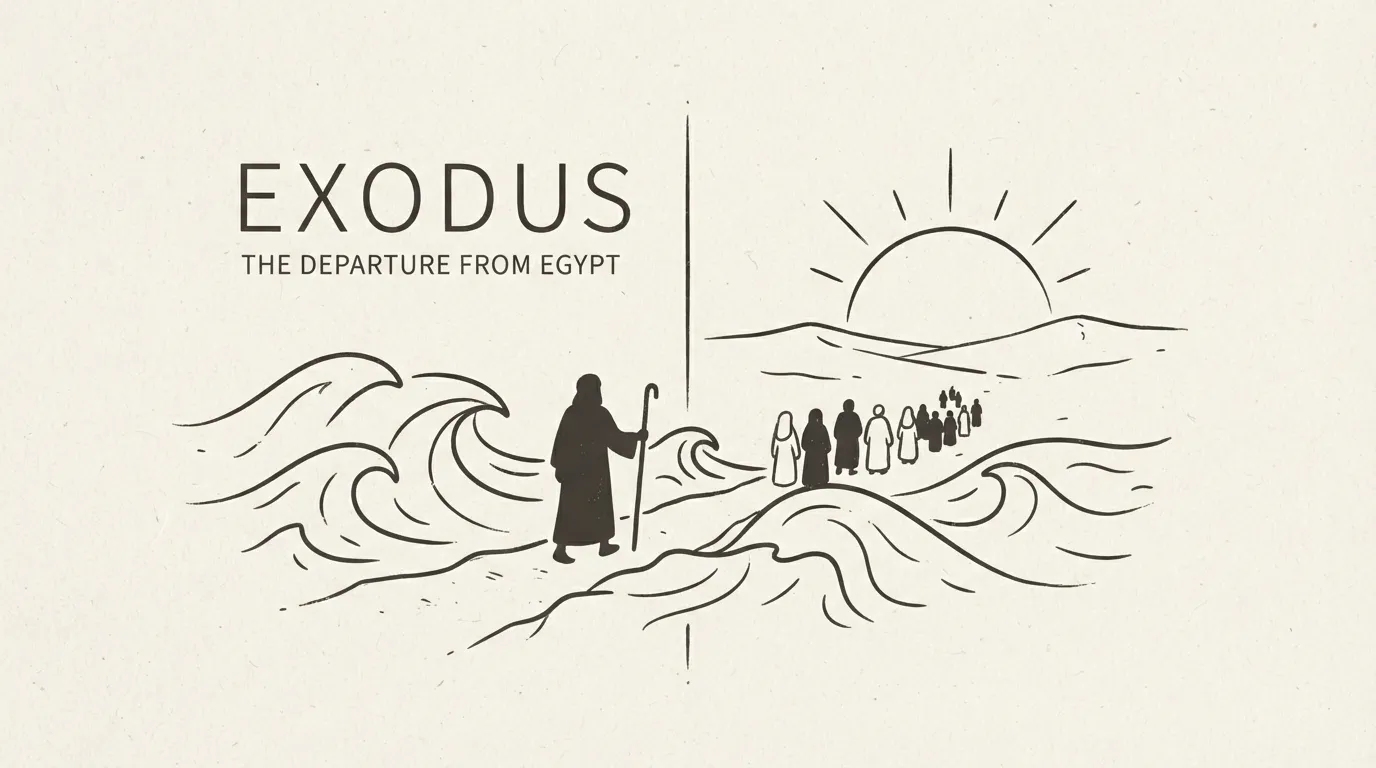
Imagine leaving everything you’ve ever known in the middle of the night, with only what you can carry.
That’s exactly what an entire nation did, and Scripture named the whole event after that single act of leaving.
The word “Exodus” isn’t just the title of the Bible’s second book. It’s a description of the story itself.
Many readers wonder where this word actually comes from, and what it reveals about the story it names.
This article explains the Exodus meaning in the Bible, its Greek and Hebrew roots, and why it still matters today.
Did You Know? 🔍
The book we call “Exodus” was never called that in the original Hebrew Bible. Its Hebrew name is Shemot, meaning “names,” taken from its opening words.
Quick Answer 🎯
What Does Exodus Mean in the Bible?
Exodus comes from the Greek word exodos, meaning “departure” or “a going out,” combining ex (“out of”) and hodos (“way” or “road”). It refers to the Israelites’ departure from slavery in Egypt under Moses, and became the title of the Bible’s second book through the ancient Greek translation known as the Septuagint.
Biblical Meaning of Exodus 📖
The name Exodus carries meaning on two levels: its Greek title and its original Hebrew name.
Greek Meaning
The Greek word exodos (ἔξοδος) literally means “the road out,” formed from ex (“out of”) and hodos (“road” or “way”).
This title was given by the translators of the Septuagint, the ancient Greek translation of the Hebrew Scriptures, centuries after the book was written.
Hebrew Meaning
In Hebrew, the book is called Shemot (שְׁמוֹת), meaning “names,” taken directly from its opening line: “These are the names of the sons of Israel.”
This Hebrew title focuses on identity and lineage, while the Greek title focuses on the central event: leaving Egypt.
Literal Meaning
Literally, “exodus” describes a mass departure, specifically the moment an entire enslaved nation walked out of bondage toward freedom.
Spiritual Meaning
Spiritually, Exodus represents deliverance: moving from slavery to freedom, from oppression to covenant relationship with God.
Exodus as a Given Name
Some parents choose Exodus as a first name, drawn to its meaning of deliverance and new beginnings. As a given name, it carries the same Greek root, exodos, meaning “departure” or “going out,” and it’s increasingly used, particularly among Christian families, as a symbol of freedom, transformation, or a fresh start.
Unlike names such as Aiden or Avery, Exodus is unusual in that it’s also a book title within Scripture itself, giving it a more direct, if unconventional, biblical connection than many popular baby names carry.
Biblical Significance
The Exodus became Israel’s defining rescue story, referenced throughout the rest of the Old and New Testaments as proof of God’s saving power.
Key Scripture Reference
Exodus 12:41 records the moment itself: “At the end of four hundred and thirty years, on that very day, all the hosts of the Lord went out from the land of Egypt.”
How to Pronounce “Exodus”
Exodus is pronounced EK-suh-dus, with the stress on the first syllable.
The Greek original, exodos, is pronounced slightly differently, EK-so-dos, but the English word has settled into its own standard pronunciation over centuries of use.
Exodus, Exitus, and Exousia: Three Different Words Worth Separating
A few similar-sounding words sometimes get confused with “exodus,” so it’s worth being direct about each one.
“Exitus” is a Latin word meaning “death” or “outcome,” unrelated to the Greek exodos, and it’s sometimes used in medical or legal Latin, not in the Bible.
“Exousia” is a different Greek word entirely, meaning “authority” or “power,” used in the New Testament (for example, Matthew 28:18), but it shares no root with exodos.
None of these words are interchangeable, even though they sound somewhat alike in English.
Historical & Biblical Context 🏛️
Understanding the Exodus meaning requires looking at both when the book was written and when its events took place.
Old Testament Timeline
Conservative biblical scholarship generally dates the Exodus event to around 1446-1443 BC, based on details in 1 Kings 6:1.
Moses is traditionally credited as the author, writing the book sometime during Israel’s forty years in the wilderness.
The book covers roughly two major sections: Israel’s escape from Egypt (chapters 1-18) and the covenant given at Mount Sinai (chapters 19-40).
New Testament Relevance
The New Testament repeatedly references the Exodus as a pattern of God’s saving work, pointing forward to salvation through Christ.
Luke 9:31 even uses the Greek word exodos to describe Jesus’s coming death, calling it His own “departure” that He would accomplish in Jerusalem.
Hebrews 11:22 also references Joseph’s faith regarding “the exodus of the Israelites,” showing the word’s continued theological weight.
Cultural Understanding in Biblical Times
Ancient Hebrew books were traditionally named after their opening words, not by a summary title describing their content.
The Greek-speaking translators who created the Septuagint, working roughly in the 3rd century BC, introduced the more descriptive title “Exodus” for Greek-reading audiences.
This Greek title was later carried into Latin (Liber Exodus) and eventually into English Bibles through that same translation tradition.
Exodus in Greek Theater: A Different, Related Usage
Separate from the Bible, “exodos” was also a technical term in ancient Greek drama, referring to the final scene or exit song of a play, when the chorus departed the stage.
This theatrical usage and the biblical book’s title share the same root word, “a going out,” but they describe entirely different things: one a dramatic convention, the other a historical and theological event.
There’s no documented connection between this theatrical term and any figure in Greek mythology; “exodos” names an action, a departure, not a god or myth.
Where Does the Word Exodus Come From? 📜
The word’s origin traces through several languages before reaching modern English Bibles.
Where It Appears
The English name “Exodus” comes via Latin from the Greek Septuagint’s title Exodos Aigyptou, meaning “going out from Egypt.”
Why It Matters
This layered naming history shows how the same book carries two valid titles, each highlighting a different aspect of its message.
What It Teaches
The Hebrew name, “Names,” emphasizes God’s personal knowledge of His people, while the Greek name, “Departure,” emphasizes His saving action on their behalf.
Together, both titles paint a fuller picture: a God who knows His people by name and delivers them by power.
Exodus in Other Languages
The word “Exodus” is typically transliterated rather than translated in most modern languages, keeping its Greek-based sound.
In Spanish, it’s commonly written “Éxodo”; in Arabic and Farsi contexts, the book is usually referred to by a translated phrase meaning “the going out” or “departure,” rather than a direct transliteration.
Regardless of the language, every translation describes the same historical event: Israel’s departure from slavery in Egypt.
Spiritual Meaning & Symbolism 🕊️
Beyond its linguistic roots, Exodus carries deep spiritual symbolism throughout Scripture.
Bondage vs. Freedom
The Exodus consistently symbolizes movement from slavery into freedom, a pattern Scripture returns to again and again.
Isaiah later draws on Exodus imagery when describing Israel’s future return from Babylonian exile, calling it a new deliverance.
Egypt vs. Promised Land
Egypt represents bondage and old identity, while the Promised Land represents covenant freedom and new purpose under God.
The wilderness journey between the two pictures the process of transformation that often accompanies genuine spiritual freedom.
God’s Perspective
God doesn’t merely observe Israel’s suffering from a distance. Exodus 3:7 shows Him saying, “I have surely seen the affliction of my people.”
Lessons for Today
Believers today can find hope in a God who actively intervenes in bondage, whatever form that bondage takes in a person’s life.
📊 Quick Comparison: Hebrew Title vs. Greek Title
| Shemot (Hebrew) | Exodus (Greek) |
|---|---|
| Means “Names” | Means “Departure” or “Going Out” |
| Taken from the book’s opening words | Describes the book’s central event |
| Emphasizes identity and lineage | Emphasizes deliverance and freedom |
| Used in the original Hebrew Bible | Introduced by the Septuagint translators |
Biblical Verses About the Exodus ✝️
These verses trace the Exodus story and its meaning across Scripture.
Exodus 3:7-8
“I have surely seen the affliction of my people… and I have come down to deliver them out of the hand of the Egyptians.”
God speaks directly to Moses from the burning bush, revealing His awareness of Israel’s suffering under slavery.
This passage marks the true beginning of the Exodus story, showing God as the initiator of the coming deliverance.
The lesson reveals that God sees suffering clearly and responds to it with real, active intervention.
It also introduces Moses as the chosen instrument through whom this deliverance would come.
Exodus 12:41
“At the end of four hundred and thirty years… all the hosts of the Lord went out from the land of Egypt.”
This verse marks the precise moment the Exodus itself took place, after centuries of slavery in Egypt.
The specific timeframe shows the historical seriousness with which the biblical author recorded this event.
The lesson highlights God’s faithfulness to His timing, even after what must have felt like an unbearably long wait.
It also connects directly back to God’s earlier promise to Abraham regarding his descendants’ eventual freedom.
Exodus 14:14
“The Lord will fight for you, and you have only to be silent.”
Moses speaks these words to a terrified Israel, trapped between Pharaoh’s approaching army and the sea.
It’s one of the shortest, most quoted verses from the entire Exodus narrative, often cited on its own as a promise of God’s protection.
The lesson offers a model of trust in moments of real fear: God’s deliverance doesn’t always require human strategy, sometimes it requires stillness and confidence in Him.
This verse is frequently paired with the dramatic sea-crossing that follows just a few verses later.
Exodus 14:21-22
“The Lord drove the sea back… and the waters were divided. And the people of Israel went into the midst of the sea on dry ground.”
This passage describes the dramatic crossing of the sea, Israel’s final, decisive escape from Pharaoh’s pursuing army.
It stands as one of the most well-known miracles in the entire Bible, demonstrating God’s power over creation itself.
The lesson shows that God’s deliverance often arrives at the point of greatest apparent impossibility.
This event became a permanent symbol of salvation referenced throughout the rest of Scripture.
Deuteronomy 5:15
“You shall remember that you were a slave in the land of Egypt, and the Lord your God brought you out.”
Moses reminds the new generation of Israelites to actively remember their nation’s deliverance from slavery.
This command ties the Exodus directly to later commandments, including the reason for observing the Sabbath.
The lesson emphasizes that remembering deliverance shapes how a community treats others, especially the vulnerable.
Memory, in this context, becomes a moral foundation, not just a historical fact to recall.
Psalm 114:1-2
“When Israel went out from Egypt… Judah became his sanctuary, Israel his dominion.”
This psalm poetically celebrates the Exodus, using vivid imagery of nature responding to God’s power.
It reflects how deeply the Exodus shaped Israel’s worship and collective national identity for generations afterward.
The lesson shows that genuine deliverance naturally leads to worship, celebration, and grateful remembrance.
Many of Israel’s psalms and festivals directly commemorate this foundational rescue story.
Luke 9:31
“They spoke of his departure, which he was about to accomplish at Jerusalem.”
The Greek word translated “departure” here is exodos, the very same word used for the Old Testament book’s title.
This verse describes Moses and Elijah speaking with Jesus about His coming death and resurrection at the Transfiguration.
The lesson draws a powerful connection: just as the Exodus delivered Israel from Egypt, Christ’s “exodus” would deliver humanity from sin.
This linguistic link shows the New Testament intentionally building on Exodus imagery to explain Jesus’s mission.
Hebrews 11:22
“By faith Joseph, at the end of his life, made mention of the exodus of the Israelites and gave directions concerning his bones.”
This verse references Joseph’s faith generations before the actual Exodus took place, showing his confident expectation of it.
It’s part of Hebrews’ broader “hall of faith” chapter, highlighting examples of trust in God’s future promises.
The lesson shows that genuine faith often looks forward to promises not yet fulfilled in one’s own lifetime.
Joseph’s request regarding his bones (see Genesis 50:25) was eventually fulfilled during the actual Exodus journey.
1 Corinthians 10:1-2
“Our fathers were all under the cloud, and all passed through the sea… and all were baptized into Moses in the cloud and in the sea.”
Paul references the Exodus crossing directly, using it as a symbolic picture relevant to the Corinthian church.
He draws a parallel between Israel’s physical deliverance and the spiritual reality of Christian baptism and identity.
The lesson shows how New Testament writers regularly used Exodus imagery to explain deeper spiritual truths.
This passage reminds readers that Old Testament history carries lasting, applicable meaning for believers today.
Real-Life Biblical Case Study: The Night of the Exodus 🌟
Exodus 12 records the specific night Israel finally left Egypt after generations of slavery.
Each family had prepared according to God’s instructions, marking their doorframes with the blood of a sacrificed lamb.
That night, the final plague struck Egypt, while Israel’s households, marked and protected, were spared entirely.
Pharaoh, devastated by the loss, finally released the Israelites, urging them to leave immediately.
Exodus 12:31 records his exact words: “Rise up, go out from among my people… go, serve the Lord.”
The Israelites left in haste, carrying unleavened bread since there wasn’t time for dough to rise.
This single night became the foundation for Passover, a feast Israel would observe for the rest of their history.
It shows deliverance arriving suddenly, decisively, and through God’s specific provision rather than Israel’s own strength.
What Is the Main Message of the Book of Exodus?
At its core, Exodus teaches that God delivers His people and then forms them into a covenant community.
The book moves through three connected stages: God rescuing Israel from slavery (chapters 1-13), leading them through the wilderness (chapters 13-18), and establishing His covenant and law with them at Sinai (chapters 19-40).
Taken together, the message is that God’s deliverance always has a purpose beyond simply ending suffering, it’s meant to bring His people into a defined, ongoing relationship with Him.
Who Was the Book of Exodus Written For?
Exodus was originally written for the nation of Israel, likely compiled by Moses during the wilderness years, to record their own recent history and the covenant God had just established with them.
Its original audience needed to understand both what God had done for them and what He now expected of them as His covenant people, which is why the narrative of deliverance (chapters 1-18) leads directly into law and worship instructions (chapters 19-40).
For later readers, including Christians today, it continues to serve as a foundational account of God’s character and His pattern of saving His people.
Life Lessons for Christians 🙏
The Exodus meaning offers several lasting, practical lessons for believers today.
God sees real suffering. Exodus 3:7 shows a God who notices affliction and responds with active intervention.
Deliverance often requires patience. Israel waited 430 years, yet God’s promise ultimately proved faithful and precisely timed.
Freedom leads to worship. Israel’s response to deliverance was celebration, memory, and ongoing gratitude toward God.
Remembering shapes character. Deuteronomy 5:15 ties memory of deliverance directly to how Israel was meant to treat others.
The Exodus points to Christ. Luke 9:31 connects this Old Testament rescue directly to Jesus’s ultimate work of salvation.
Common Misunderstandings ⚠️
A few points of confusion surround this word and its biblical usage.
Modern misuse: People often use “exodus” casually to describe any mass departure, losing the word’s specific biblical roots in the process.
Cultural confusion: Some assume “Exodus” was the book’s original title, when it was actually a later Greek addition to the Hebrew text.
Wrong interpretations online: A few sources conflate the Hebrew and Greek titles, missing that they highlight two genuinely different emphases.
Correct biblical explanation: Exodus describes both a historical departure from Egypt and a lasting pattern of God’s deliverance throughout Scripture.
“Exodus” in Everyday and Modern Usage 🌍
Beyond its biblical meaning, “exodus” is commonly used as an ordinary English word for any large-scale departure, such as “a mass exodus from the city” or “the great exodus of refugees.” This everyday usage borrows the biblical word’s imagery of a large group leaving somewhere significant, even when there’s no direct religious meaning intended.
Some people also use phrases like “my exodus” personally, to describe their own major life transition, leaving a job, a relationship, or a difficult season, drawing on the same imagery of moving from bondage or hardship into freedom that defines the original biblical story.
Synonyms, Antonyms, and Using “Exodus” in a Sentence
Close synonyms for “exodus” include departure, migration, evacuation, and flight (in the sense of fleeing).
A rough antonym would be “arrival” or “influx,” describing movement into a place rather than away from it.
In an ordinary sentence: “After the factory closed, there was a mass exodus of workers from the small town,” using the word exactly as its everyday, non-biblical sense describes.
Is “Exodus” Ever Plural?
Yes, grammatically. The plural form is “exoduses,” used when referring to more than one separate departure event, as in “the exoduses of several refugee groups during that decade.”
In its biblical sense, referring to the specific book or the one historical event, “Exodus” is treated as a proper noun and doesn’t take a plural form.
Exodus vs. Diaspora: What’s the Difference?
“Exodus” describes the act of leaving a place, especially in a large, significant departure. “Diaspora” describes the resulting scattered community living outside their original homeland afterward.
The Exodus from Egypt was a single departure event; the Jewish diaspora, by contrast, describes the centuries-long dispersal of Jewish communities across many nations, a related but distinct concept.
💡 Expert Insight
When studying Exodus further, read the Hebrew title Shemot alongside the Greek title Exodos side by side. Noticing how one book carries two intentional titles helps explain why the same story emphasizes both identity (“Names”) and rescue (“Departure”).
Exodus Meaning and Definition at a Glance
Here are the fast answers to the most common questions about the word.
What Does Exodus Mean?
“Exodus” means a mass departure, especially of a large group of people leaving a place together.
In the Bible, “the Exodus” is the departure of the Israelites from slavery in Egypt.
What Is an Exodus?
An exodus is a large-scale movement of people out of a place.
For example, “a mass exodus from the city” describes many people leaving at once.
Exodus Definition
Definition: a noun meaning a mass departure of people. With a capital E, it means the departure of the Israelites from Egypt, and the second book of the Bible.
The Exodus vs an Exodus
“The Exodus” (capital E) points to the biblical event and the book.
“An exodus” (lowercase) is any large departure, such as people leaving a region.
Exodus Word Origin and Root
“Exodus” comes from the Greek “exodos,” built from “ex” (out of) and “hodos” (road or way).
So the root literally means “the road out.”
What Does “Ex” Mean in Exodus?
The “ex” in “exodus” means “out of.”
It’s the same “ex” you see in words like “exit” and “exhale.”
Why Is Exodus Called Exodus?
It’s called Exodus because the Greek translators of the Septuagint named the book after its central event: Israel’s departure from Egypt.
What Is Another Name for Exodus?
The Hebrew name of the book is Shemot, meaning “names.”
It’s also called the Second Book of Moses, because it’s the second book of the Torah.
Another Word for Exodus
Other words that work in different contexts include departure, migration, flight, evacuation, and emigration.
Opposite of Exodus
The opposite of an exodus is an influx, an arrival, or a return.
Is Exodus the Opposite of Genesis?
No. Genesis means “beginning” or “origin,” and Exodus means “departure.”
They’re simply the first two books of the Bible, one after the other.
Does Exodus Mean Exit?
Not exactly. Both involve leaving, but “exodus” suggests a large, often historic departure, while “exit” is a simple way out.
What Does Exodus Mean Spiritually?
Spiritually, Exodus means deliverance, or being brought out of bondage into freedom.
It’s a picture of redemption: God rescuing His people and leading them into a covenant relationship with Him.
Exodus as a Journey
The story has three stages: leaving slavery, traveling through the wilderness, and receiving God’s covenant.
Many believers see that pattern in their own spiritual lives.
This Is My Exodus Meaning
If someone says “this is my exodus,” they mean this is their own big departure or fresh start.
It might be leaving a job, a place, or a hard season of life.
Mass Exodus, Great Exodus, and Mass Exodus in the Bible
“Mass exodus” means a large group leaving at the same time. “The great exodus” can refer to a historic migration.
In the Bible, the mass departure of the Israelites from Egypt is the original example.
Exodus in Hebrew: Shemot and Yetziat Mitzrayim
Hebrew has two names to know here.
What Does Exodus Mean in Hebrew?
The Hebrew name of the book is Shemot (שְׁמוֹת), meaning “names.”
The Hebrew phrase for the event itself is Yetziat Mitzrayim (יציאת מצרים), meaning “the going out of Egypt.”
Hebrew Word for Exodus
For the event, the Hebrew phrase is “Yetziat Mitzrayim.”
For the book, it’s “Shemot.”
Why Two Names?
“Shemot” comes from the book’s opening words. “Yetziat Mitzrayim” describes the event that the book centers on.
Exodus in Greek, Latin, and Greek Theater
The “Exodus” is a Greek word, so its roots show up in several places.
Exodus Meaning in Greek
In Greek, “exodos” (ἔξοδος) means “a going out” or “a way out.”
The Greek phrase for the book’s title is “Exodos Aigyptou,” meaning “going out from Egypt.”
Exodus in Latin
In Latin, the book is called “Exodus,” borrowed from the Greek.
The Latin word “exitus” means “exit,” “outcome,” or “death,” and it’s a separate word.
Exodos in Greek Theater
In ancient Greek theater, the “exodos” was the final part of a tragedy, after which the chorus left the stage.
It’s a different use of the same root word.
Is Exodus Greek Mythology?
No. “Exodos” names an action, not a god or a myth.
Exodus Translations: Quick Answers by Language
Here’s how the word and book title appear in other languages.
- Spanish: “Éxodo” means a mass departure. It’s also the name of the book.
- French: “Exode” means a mass departure. “L’Exode” refers to the departure from Egypt.
- Dutch: “Exodus” is also called “Uittocht,” meaning “going out.” Betekenis: een massale vertrek.
- Portuguese: “Êxodo” is the book’s name. It doesn’t mean death. The Latin word “exitus” can.
- Arabic: “سفر الخروج” (Sifr al-Khuruj) is the Book of Exodus, and “خروج” means departure.
- Persian (Farsi): “سفر خروج” is the Book of Exodus, and “خروج” means departure. “Deliverance” is “نجات.”
- Hindi: “निर्गमन” (Nirgaman) is the Hindi name for the book.
- Urdu / Roman Urdu: “Khuruj” (خروج) means nikalna ya rukhsat hona, aur Bible ki kitab ka naam bhi hai.
- Indonesian and Malay: “Keluaran” is the name of the Book of Exodus. “Eksodus” means a mass departure.
- Tagalog: “Exodo” is the book’s name. It describes the departure of many people.
- Japanese: 出エジプト記 is the book’s title. “Exodus” in general use means 大量脱出 (a mass departure).
- Chinese: 出埃及记 is the book’s title.
For languages like Telugu, Konkani, Shona, and Kikuyu, Bible translations usually use a transliteration or a phrase meaning “going out.” Check a Bible in that language for the exact title.
Exodus in Islam and Judaism
The Exodus story matters in several faiths.
What Is Exodus in Islam?
Islam has no book called Exodus, since that’s a Biblical title.
However, the Quran tells the story of Prophet Musa (Moses) leading the Children of Israel out of Egypt, the parting of the sea, and Pharaoh’s pursuit. See, for example, Surah Al-Baqarah 2:50, Surah Ta-Ha 20:77-78, and Surah Ash-Shu’ara 26:52-68.
Is Exodus the Same as Hijra?
No. The Hijra is the migration of the Prophet Muhammad ﷺ and his companions from Makkah to Madinah. It’s a different event.
What Is Exodus in Judaism?
In Judaism, the Exodus is the founding story of the people of Israel.
It’s remembered every year at Passover (Pesach), especially at the Seder meal.
The Book of Exodus: Author, Date, Genre, and Summary
Here are some quick facts about the book itself.
Who Wrote the Book of Exodus?
Tradition credits Moses as the author.
Many modern scholars suggest the book took shape over time, so views differ.
When Was the Book of Exodus Written?
The date is debated. Some date the Exodus event to about 1446 BC, while others suggest a later date in the 13th century BC.
What Genre Is Exodus?
Exodus mixes historical narrative with law and worship instructions.
Summary of the Book of Exodus
- Chapters 1-13: Israel in Egypt, Moses, the plagues, and the Passover.
- Chapters 13-18: The sea crossing and the journey through the wilderness.
- Chapters 19-24: The covenant and the law at Mount Sinai, including the Ten Commandments (Exodus 20).
- Chapters 25-40: Instructions for the tabernacle, and its construction.
Exodus 1
Exodus 1 describes Israel growing in number in Egypt and a new Pharaoh who oppresses them.
The midwives Shiphrah and Puah protect the Hebrew baby boys.
Exodus 6
In Exodus 6, God reassures Moses that He will bring Israel out of Egypt and redeem them (Exodus 6:6-8).
The chapter also includes a family record of Moses and Aaron.
Exodus 31:1-5
These verses describe Bezalel, who is filled with the Spirit of God to craft the tabernacle’s furnishings.
Exodus 38:8
This verse says the bronze basin was made from the mirrors of the women who served at the tabernacle entrance.
Summary of Exodus 40
Exodus 40 records the setting up of the tabernacle.
At the end, a cloud covers the tent and the glory of the Lord fills it (Exodus 40:34-35).
Who Is Exodus in the Bible?
Exodus isn’t a person. It’s the name of the book and the event.
Moses is the central human figure in the story.
The Exodus From Egypt: Story and Route
The Exodus from Egypt is the heart of the Bible’s story of deliverance.
The Story in Brief
Israel was enslaved in Egypt. God called Moses, sent plagues on Egypt, and Pharaoh released the people.
Israel then crossed the sea and traveled to Mount Sinai.
The Route of the Exodus
The Bible lists stages such as Rameses, Succoth, Etham, the crossing of the sea, Marah, Elim, and Sinai (see Numbers 33).
The exact route and the location of Mount Sinai are debated.
Exodus 14:14 Meaning
Exodus 14:14 says the Lord will fight for His people, and they only need to be still.
It’s often quoted as a promise of God’s protection in moments of fear.
Exodus Name Meaning
As a name, Exodus means “departure” or “going out.”
It’s sometimes chosen for its association with freedom and new beginnings.
There’s no person named Exodus in the Bible.
How to Say Exodus
Exodus is pronounced EK-suh-dus. The stress falls on the first syllable.
Exodus Pronunciation Tips
Say “ex,” then “uh,” then “dus,” and keep the first part strong.
The IPA is /ˈɛksədəs/.
Common Misspellings of Exodus
Typing quickly leads to plenty of slips. None of these are correct.
- Wrong vowels: exidus, exudus, exedus, exadus, exodis, exodous, exudos, exodes, exodux
- Wrong letters: expdus, expodus, wxodus, ecodus, excodus, exocus, exofus, erodus, esoto
- Extra or missing letters: exxodus, exoodus, exdous, exhodus, xodus, e odus
- Other slips: exodist, exodice, exoduce, exodua, exodues, exoudus, exoudes, exsdus, exodius
“Expdus” and “wxodus” come from nearby keys on the keyboard.
Searches like “exodus menaing,” “exodus meanign,” and “exodus defintion” are typos for “exodus meaning” and “exodus definition.”
Vocabulary: Exodus, Subliminal, and Precursor
Here are three vocabulary words that often appear together.
- Exodus: a movement of many people away from a place.
- Subliminal: below the level of someone’s conscious awareness.
- Precursor: something that comes before another thing and leads to it.
Exodus in a Sentence
Here are a few more ways to use the word.
- The factory closure led to an exodus of workers.
- Many families joined the exodus from the flooded area.
- The book of Exodus tells the story of Israel’s departure from Egypt.
- She called her move abroad her personal exodus.
- A mass exodus followed the announcement.
Exodus in Pop Culture
“Exodus” is also the title of other works.
It’s the title of Bob Marley and the Wailers’ 1977 album and of Leon Uris’s 1958 novel.
In science fiction and games, “exodus from Earth” usually means a mass departure from the planet.
FAQs ❓
What does the word Exodus literally mean?
Exodus literally means “departure” or “a going out,” from the Greek word exodos, combining ex (“out of”) and hodos (“road” or “way”).
Why is the book of Exodus called Shemot in Hebrew?
The Hebrew title Shemot means “names,” taken from the book’s opening words: “These are the names of the sons of Israel.”
When did the Exodus actually take place?
Conservative biblical scholarship generally dates the Exodus to around 1446-1443 BC, based on chronological details in 1 Kings 6:1.
Does the New Testament use the word Exodus?
Yes. Luke 9:31 uses the Greek word exodos to describe Jesus’s coming death, directly linking it to the Old Testament deliverance story.
What is the spiritual meaning of the Exodus today?
Spiritually, the Exodus represents deliverance from bondage into freedom, a pattern many Christians apply to freedom from sin through Christ.
Is Exodus used as a given name?
Yes, some parents choose Exodus as a first name, drawn to its meaning of “departure” and its association with deliverance and new beginnings, especially within Christian families.
Does exodus mean exit?
Not exactly. While both words describe leaving a place, “exodus” specifically implies a large-scale, often significant or historic departure, unlike “exit,” which can describe any simple act of leaving.
What does “mass exodus” or “the great exodus” mean?
These phrases use “exodus” in its everyday English sense, describing a large group of people leaving somewhere at once. It borrows imagery from the biblical Exodus without necessarily carrying religious meaning.
What is the biblical abbreviation for the book of Exodus?
The book of Exodus is commonly abbreviated as “Ex.” or “Exod.” in Bible citations and commentaries.
How do you pronounce “Exodus”?
EK-suh-dus, with the stress on the first syllable.
What’s the plural of “exodus”?
“Exoduses,” used for multiple separate departure events. The book and the specific historical event, though, are treated as proper nouns and don’t take a plural form.
Is “exitus” the same word as “exodus”?
No. “Exitus” is a separate Latin word meaning “death” or “outcome.” It sounds similar but shares no root with the Greek exodos.
What is “exousia,” and is it related to exodus?
“Exousia” is a different New Testament Greek word meaning “authority” or “power.” Despite the similar sound, it shares no linguistic root with exodos.
What is the main message of the book of Exodus?
The main message is that God delivers His people from bondage and then forms them into a covenant community, bound to Him through His law and presence.
Who was the book of Exodus originally written for?
It was written for the nation of Israel, to record their deliverance from Egypt and the covenant God established with them at Sinai.
What is the main message in Exodus?
God delivers His people from slavery and forms them into a covenant community.
What is Exodus in Islam?
Islam has no book called Exodus, but the Quran tells the story of Musa (Moses) leading the Children of Israel out of Egypt.
What does the word “exodus” mean?
It means a mass departure, from the Greek “exodos,” meaning “a going out.”
What is another name for Exodus?
The Hebrew name is Shemot, meaning “names.” It’s also called the Second Book of Moses.
People Also Search For
What does exodus mean spiritually
It means deliverance from bondage into freedom and covenant relationship with God.
Exodus meaning in Hebrew
The book is called Shemot (“names”), and the event is called Yetziat Mitzrayim (“the going out of Egypt”).
What is the main message of the book of Exodus
God rescues His people and forms them into a covenant community.
The Exodus from Egypt in the Bible
It’s the story of Israel’s escape from slavery under Moses, told in the book of Exodus.
Exodus meaning in Greek
“Exodos” means “a going out” or “a way out.”
Bible verses Exodus 14:14
Exodus 14:14 says the Lord will fight for His people, and they only need to be still.
This is My Exodus meaning
It means this is my own big departure or fresh start.
What is exodus mean
It means a mass departure of people. In the Bible, it’s Israel’s departure from Egypt.
What is the exodus?
It’s the departure of the Israelites from slavery in Egypt under Moses.
What is an exodus?
A large-scale departure of people from a place.
What does exodus mean in the Bible?
It refers to the Israelites’ departure from Egypt and to the book that tells the story.
What is the definition of exodus?
A noun meaning a mass departure of people. With a capital E, it’s the biblical departure from Egypt.
Exodus meaning in Farsi?
In Farsi, “خروج” means departure, and “سفر خروج” is the Book of Exodus.
Exodus in Arabic?
“سفر الخروج” is the Book of Exodus.
Exodus in Spanish?
“Éxodo.”
Exodus in Tagalog?
The book is called “Exodo.”
Exodus in Hebrew?
“Shemot” is the book, and “Yetziat Mitzrayim” is the event.
Exodus in Latin?
The Latin title is “Exodus,” borrowed from Greek.
Hebrew word for exodus?
“Yetziat Mitzrayim” for the event, “Shemot” for the book.
Greek word for exodus?
“Exodos” (ἔξοδος).
Who wrote the book of Exodus?
Tradition credits Moses.
When was the book of Exodus written?
The date is debated. Some place the Exodus around 1446 BC, and others in the 13th century BC.
What genre is Exodus?
Historical narrative combined with law and worship instructions.
Who is Exodus in the Bible?
Exodus isn’t a person. It’s the name of the book and the event.
What does the name Exodus mean?
“Departure” or “going out.”
What is Exodus in Judaism?
The founding story of Israel, remembered at Passover.
What is the opposite of exodus?
An influx, arrival, or return.
Is Exodus the opposite of Genesis?
No. They are the first two books of the Bible.
Exodus ka matlab kya hai?
Exodus ka matlab hai bahut se logon ka ek jagah se ek saath nikalna. Bible mein ye Bani Israel ka Misr se nikalna hai.
Exodus ke liye Urdu lafz kya hai?
Urdu mein Exodus ko “Khuruj” (خروج) kehte hain. Ye Bible ki doosri kitab ka naam bhi hai.
Conclusion 🌿
The Exodus meaning in the Bible carries two layered titles: a Hebrew name focused on identity, and a Greek name focused on deliverance.
Together, they tell one unforgettable story of a God who knew His people by name and rescued them by power.
That same rescue pattern echoes throughout the rest of Scripture, ultimately pointing toward Christ’s own “exodus” accomplished at Jerusalem.
Whatever form of bondage you may be facing today, the Exodus story offers real hope in a God who sees, hears, and delivers.
May that same faithful God continue writing deliverance into your own story, just as He did for Israel long ago.

Hello, I’m Samuel Carter. My interest in biblical studies comes from a lifelong desire to understand the wisdom and teachings contained within Scripture. I particularly enjoy researching biblical numbers, patterns, and themes that appear throughout God’s Word.