You meet someone named Damian, or maybe you’re naming a son, and a question comes up almost automatically: does this name appear in the Bible, and does it carry any spiritual weight?
It’s a fair question. Plenty of names, like Michael or Daniel, have a clear verse and a clear Hebrew meaning behind them.
Damian is a different kind of name entirely, and that difference is actually worth understanding rather than glossing over.
This article looks honestly at where Damian comes from, what it actually means, and why so many Christian parents still feel a real spiritual connection to it.
Did You Know? 🔍
Saint Damian wasn’t a solo figure. He’s almost always mentioned alongside his twin brother, Cosmas, as “Saints Cosmas and Damian,” physicians from the third century who treated the threshold without payment before being martyred.
Quick Answer
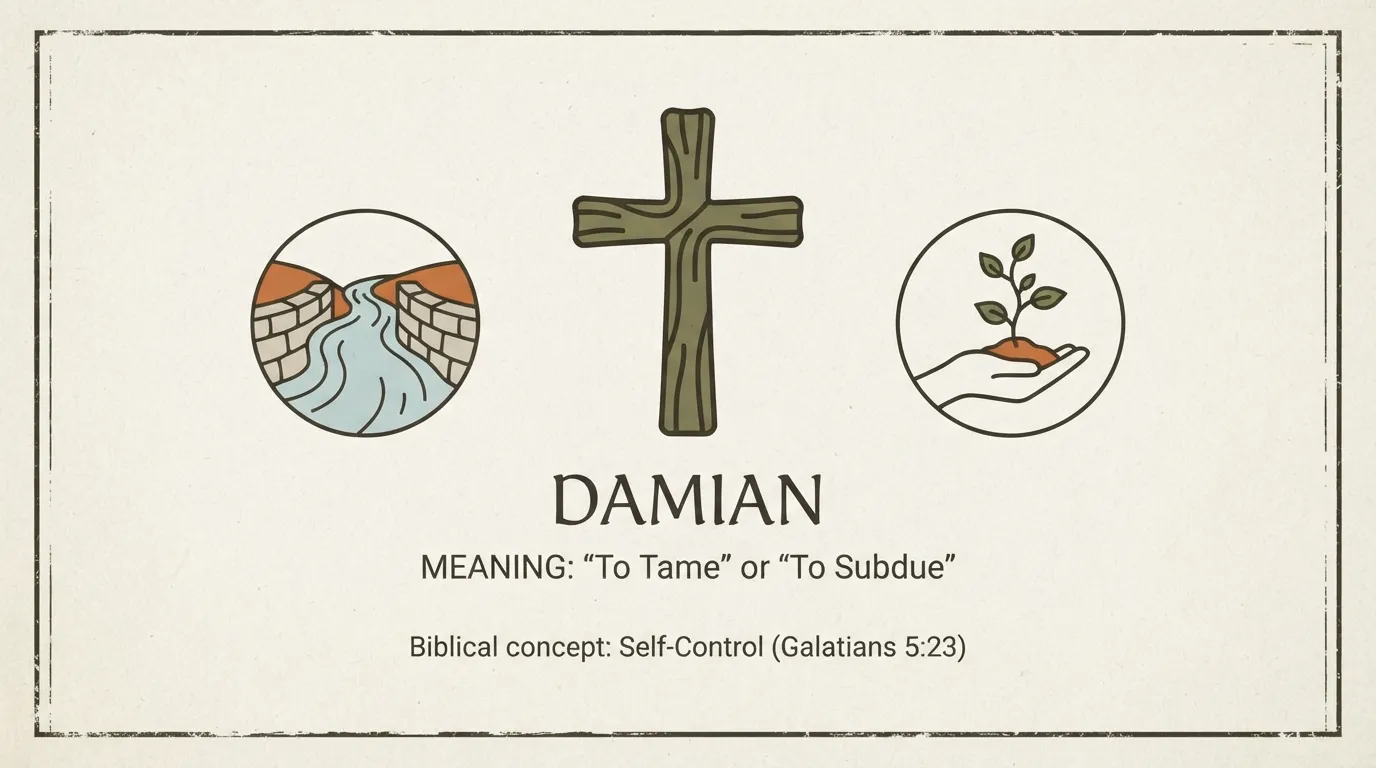
Damian is not a biblical name. It doesn’t appear anywhere in Scripture, and it has no Hebrew root. The name comes from the Greek word damazō, meaning “to tame” or “to subdue,” and its spiritual association with healing and self-mastery comes from the legacy of Saint Damian, a third-century Christian physician, not from a direct Bible verse.
What Does Damian Mean in the Bible? 📖
Damian doesn’t mean anything “in the Bible” in the literal sense, because the name itself never appears in the biblical text.
What it does carry is a Greek meaning, “to tame” or “to master,” which connects naturally to biblical themes like self-control and spiritual discipline, even without a direct scriptural reference.
Biblical Meaning of Damian 📜
Greek Meaning
Damian comes from the Greek name Damianos (Δαμιανός), built on the verb damazō (δαμάζω), meaning “to tame,” “to subdue,” or “to overcome.”
Literal Meaning
Taken literally, the name points to mastery or control, the idea of taming something wild or difficult rather than being ruled by it.
Spiritual Meaning
Because Scripture repeatedly praises self-control and restraint as marks of spiritual maturity, many Christians read a name built on “taming” as a quiet reminder to master one’s own impulses, not other people.
Biblical Significance
The name’s real significance isn’t textual, since it’s absent from Scripture, but thematic. It echoes a value the Bible teaches clearly, even though the name itself was never written into the text.
Key Scripture Reference
Proverbs 16:32 captures the same idea the name points to: “Whoever is slow to anger is better than the mighty, and he who rules his spirit than he who takes a city.”
Is Damian Mentioned in the Bible? 🔍
No. Damian doesn’t appear in any book, chapter, or verse of the Old or New Testament, in any translation.
This matters to say plainly, because several websites imply a looser connection than actually exists. There’s no hidden reference, no obscure footnote, no verse using this name.
What does exist is a strong historical Christian connection through Saint Damian, which the next section explains clearly.
Historical & Biblical Context 🏺
Old Testament Usage
There is no Old Testament usage of this name. Hebrew names in Scripture, like Michael or Daniel, were built from Hebrew roots; Damian’s roots are entirely Greek and post-date the Old Testament period by centuries.
New Testament Relevance
The New Testament doesn’t mention Damian either. The name’s Christian association comes from later church history, not from the apostolic era covered by the New Testament.
Cultural Understanding in Biblical Times
In the ancient Near East, names typically carried Hebrew or Aramaic meaning tied directly to God, family circumstances, or prophecy. Greek names describing personal virtues, like “the one who tames,” reflect a different, later cultural pattern from the Greco-Roman world, which is where Damian’s story actually begins.
Who Was Saint Damian? ✝️
Saint Damian lived in the third century, likely in what is now Turkey or Syria, alongside his twin brother Cosmas.
Historical church tradition holds that both were trained physicians who treated patients for free, out of Christian conviction, regardless of a person’s ability to pay.
They were martyred for their faith during a period of Roman persecution, and the church later recognized them as patron saints of physicians, surgeons, and pharmacists.
This history, not a Bible verse, is the real foundation for Damian’s enduring Christian association with healing.
Spiritual Meaning & Symbolism ✨
Self-Control vs. Being Ruled by Impulse
The Bible treats self-control as a genuine spiritual fruit, not just a personality trait. Galatians 5:23 lists self-control among the fruits of the Spirit, right alongside love, joy, and peace.
A name meaning “to tame” lines up naturally with that teaching, pointing toward mastering one’s own reactions rather than being controlled by anger, fear, or impulse.
God’s Perspective
Scripture consistently values quiet strength and restraint over raw power or domination. The same verse quoted earlier, Proverbs 16:32, makes that comparison directly: ruling your own spirit outranks conquering a city.
Lessons for Today
Someone named Damian doesn’t inherit a biblical calling automatically, but the name offers a genuinely useful, Scripture-aligned theme to reflect on: strength that shows up as self-mastery, not force over others.
Comparison Table: Damian’s Meaning vs. Common Misconceptions
| Claim | Accurate? | What’s Actually True |
|---|---|---|
| Damian appears in the Bible | ❌ No | The name never appears in any book of Scripture |
| Damian is a Hebrew name | ❌ No | It’s Greek, from Damianos and the verb damazō |
| Damian means “to tame” or “subdue” | ✅ Yes | This is the verified Greek etymology |
| The healing association comes from a Bible verse | ❌ No | It comes from Saint Damian’s history, not Scripture |
| The self-control theme aligns with biblical teaching | ✅ Yes | Galatians 5:23 and Proverbs 16:32 support this theme |
Biblical Verses Connected to Damian’s Themes 📖
Galatians 5:22-23
“But the fruit of the Spirit is love, joy, peace, patience, kindness, goodness, faithfulness, gentleness, self-control.” This passage lists self-control as genuine spiritual fruit, directly connecting to the “taming” sense behind Damian’s Greek root.
Proverbs 16:32
“Whoever is slow to anger is better than the mighty, and he who rules his spirit than he who takes a city.” This verse praises inward mastery over outward conquest, echoing the same core idea as the name’s meaning.
1 Corinthians 9:27
“But I discipline my body and keep it under control, lest after preaching to others I myself should be disqualified.” Paul uses almost the exact same “taming” imagery here, applied to his own spiritual discipline.
James 1:19
“Let every person be quick to hear, slow to speak, slow to anger.” This verse offers a practical, everyday picture of the self-control theme the name’s meaning points toward.
Exodus 15:26
“I am the Lord, your healer.” Often cited alongside Damian’s name because of Saint Damian’s medical legacy, this verse speaks to God’s identity as healer, a thematic link rather than a direct connection to the name itself.
Matthew 5:9
“Blessed are the peacemakers, for they shall be called sons of God.” Some writers connect this verse to Damian’s association with calm, measured strength, since taming conflict is itself a form of peacemaking.
Titus 2:12
“Training us to renounce ungodliness and worldly passions, and to live self-controlled, upright, and godly lives.” This verse ties self-control directly to godly living, reinforcing the same theme without ever using the name Damian.
Real-Life Case Study: Saints Cosmas and Damian 🕊️
Church history remembers Cosmas and Damian as twin physicians who practiced medicine as an act of Christian charity, often refusing payment entirely.
Their commitment reportedly continued even as persecution intensified against Christians in their region, and tradition holds that they were eventually martyred for refusing to renounce their faith.
Centuries later, they’re still invoked as patron saints of doctors and healers in Catholic and Orthodox tradition, a legacy that explains why “healing” so often gets attached to the name Damian, even though Scripture itself never mentions either brother.
Life Lessons for Christians 🌱
Not every meaningful name has to come from Scripture directly. Damian’s story shows how church history and genuine biblical themes can connect, even without a verse to point to.
Self-mastery is a real spiritual goal. Galatians 5:23 treats self-control as spiritual fruit, not just good manners.
Service can outlast persecution. Cosmas and Damian’s willingness to keep serving others, even under threat, reflects a costly kind of Christian love.
Healing points back to God. Exodus 15:26 reminds Christians that any genuine healing, physical or spiritual, ultimately comes from God.
Honesty matters more than a flattering myth. A name doesn’t need a fabricated Bible verse to carry real spiritual meaning.
Common Misunderstandings ⚠️
Many websites claim or imply that Damian appears in the Bible, or quietly treat its Greek meaning as if it were a direct scriptural teaching. Neither is accurate.
Others suggest the name carries a specific, personal spiritual destiny, similar to how prophetic Hebrew names function in Scripture. That’s not how this name works; it’s a Greek virtue name with a strong post-biblical Christian history, not a divinely assigned Hebrew identity.
The honest version is more interesting anyway: a name about self-mastery, carried by a real historical Christian healer, that happens to line up well with things the Bible already teaches.
Expert Insight 💡
When you’re researching a name like this, check whether a “Bible meaning” claim points to an actual verse or just a thematic echo. Reliable Bible dictionaries and concordances, like BibleHub or Blue Letter Bible, will tell you plainly when a name has no scriptural entry at all, which is exactly the case here.
FAQs
Is Damian a biblical name?
No. Damian doesn’t appear anywhere in the Bible. It’s a Greek name, not a Hebrew one, and its Christian association comes from church history, not Scripture itself.
What does the name Damian mean?
Damian comes from the Greek word damazō, meaning “to tame,” “to subdue,” or “to master.” It doesn’t have a separate, different meaning specifically “in the Bible.”
Why is Damian associated with healing?
The healing association comes from Saint Damian, a third-century Christian physician who, along with his twin brother Cosmas, treated patients for free. It’s historical, not scriptural.
Is Damian a Hebrew name?
No. Despite some websites suggesting a Hebrew connection, Damian’s roots are entirely Greek, through Damianos and the verb damazō.
Does the Bible give Damian a spiritual meaning?
Not directly. The Bible never uses the name, but its “taming” meaning connects naturally to biblical teachings on self-control, found in verses like Galatians 5:23 and Proverbs 16:32.
Conclusion
Damian isn’t a name you’ll find in Scripture, and it’s worth saying that plainly rather than stretching the truth to make it sound otherwise.
What it does have is a real, verifiable Greek meaning, “to tame” or “to master,” and a genuine historical connection to Saint Damian, a Christian physician remembered for selfless healing.
Put those two things together, and you get a name that quietly echoes real biblical values, self-control, humility, and service, even without a verse to call its own.
That’s a meaningful legacy in its own right, built on honest history rather than an invented Bible reference.

Hello, I’m Jonathan Reed. I have a strong interest in biblical interpretation and Christian education. Over the years, I have spent significant time studying Scripture and researching its historical context to better understand its teachings and messages.