Your world falls apart in a single phone call, and suddenly you’re scanning every direction for a way out that doesn’t exist.
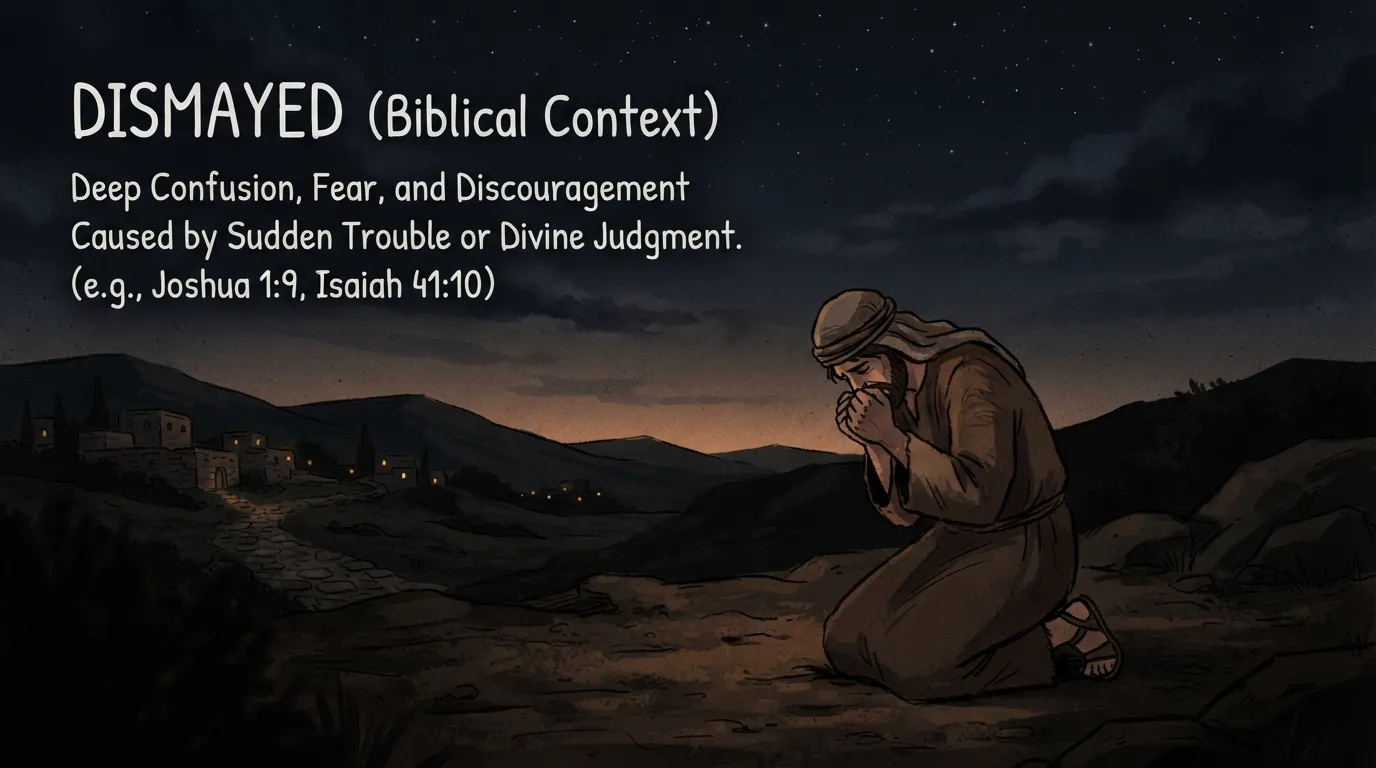
That frozen, panicked feeling has a name in Scripture: dismay.
It’s one of the most common emotional states addressed throughout the Bible, from Moses to the exiled nation of Israel.
Yet God doesn’t just acknowledge this feeling. He repeatedly commands His people not to stay there.
This article explores the dismayed meaning in the Bible, its Hebrew roots, and how God consistently meets this fear with His presence.
Did You Know? 🔍
The Hebrew word most often translated “dismayed” in the King James Version, chathath, is used roughly 50 times throughout the Old Testament, making it one of Scripture’s most repeated emotional warnings.
Quick Answer 🎯
What Does Dismayed Mean in the Bible?
To be dismayed in the Bible means to be shattered in spirit, terrified, or overwhelmed with anxious fear, often pictured as anxiously looking around for danger. Scripture repeatedly commands God’s people not to be dismayed, grounding that command in His personal presence, as seen clearly in Isaiah 41:10 and Joshua 1:9.
Biblical Meaning of Dismayed 📖
Dismay describes more than passing worry. It pictures a person genuinely shattered by fear.
Hebrew Meaning
Two main Hebrew words are translated “dismayed” in English Bibles: chathath (חָתַת), meaning to be shattered, broken, or terrified, and sha’ah (שָׁעָה), meaning to look around anxiously, as if scanning for danger.
Both words appear frequently in moments of national crisis, personal fear, or overwhelming uncertainty.
Literal Meaning
Literally, dismay describes the physical posture of panic: eyes darting around, searching desperately for an escape that isn’t there.
Spiritual Meaning
Spiritually, dismay represents a heart that has temporarily lost its grip on God’s presence and promises.
Scripture treats this feeling honestly, never shaming people for experiencing it, while still calling them beyond it.
Biblical Significance
The command “do not be dismayed” appears throughout Scripture precisely because dismay was such a common, real human experience among God’s people.
Key Scripture Reference
Isaiah 41:10 says, “Fear not, for I am with you; be not dismayed, for I am your God; I will strengthen you, I will help you, I will uphold you with my righteous right hand.”
Historical & Biblical Context 🏛️
Understanding dismay’s biblical meaning requires seeing how often God’s people faced genuinely dismaying circumstances.
Old Testament Usage
The command not to be dismayed first appears in Deuteronomy 1:21, as Moses challenges Israel before entering the Promised Land.
It reappears throughout Joshua, as God commissions Joshua to lead Israel into genuinely dangerous territory.
Isaiah uses the word repeatedly in chapters addressing Israel’s exile, offering comfort to a people facing national catastrophe.
New Testament Relevance
While the specific Hebrew vocabulary doesn’t carry directly into Greek, the same emotional reality appears throughout the New Testament.
Peter’s experience walking on water, then sinking in fear (Matthew 14:30), pictures this same kind of overwhelmed, anxious dismay.
Jesus consistently responds to dismayed disciples the same way God responded to dismayed Israel: with His reassuring presence.
Cultural Understanding in Biblical Times
In the ancient Near East, facing military threats, famine, or exile without modern resources made genuine dismay a common, rational response to real danger.
God’s repeated command not to be dismayed wasn’t a denial of real threats, but an invitation to trust His greater power over those threats.
Is Dismayed Mentioned in the Bible? 📜
Yes, the word and concept appear throughout both the Old and New Testaments.
Where It Appears
Key passages include Deuteronomy 1:21, Joshua 1:9, Isaiah 41:10, Jeremiah 1:17, and 1 Samuel 17:11 regarding Israel’s army facing Goliath.
Why It Matters
Its frequent appearance shows dismay as a genuine, recurring struggle even among faithful believers throughout Scripture.
What It Teaches
It teaches that God consistently meets human dismay not with condemnation, but with reassurance rooted in His own presence and power.
Spiritual Meaning & Symbolism ⚖️
Dismay’s biblical symbolism centers on a contrast between human fear and God’s steady presence.
Fear vs. Faith
Dismay represents fear that has taken over, while faith represents trust that holds steady despite real danger.
Scripture never asks believers to pretend danger isn’t real, only to trust God’s presence within it.
Panic vs. Presence
The Hebrew picture of “looking around anxiously” contrasts directly with God’s repeated promise, “I am with you.”
Where panic scans the horizon for threats, faith rests in the certainty of who stands beside you.
God’s Perspective
God doesn’t dismiss dismay as weakness. He addresses it directly, repeatedly, and personally throughout Scripture.
Lessons for Today
Believers today can bring genuine dismay honestly to God, trusting the same presence that steadied Joshua, Israel, and Peter.
📊 Quick Comparison: Dismay vs. Faith
| Dismay (Chathath/Sha’ah) | Faith (Trust in God’s Presence) |
|---|---|
| Shattered, broken spirit | Steady, grounded spirit |
| Anxiously scanning for danger | Resting in God’s promise to help |
| Focused on the threat itself | Focused on God’s presence and power |
| A natural human response to danger | A supernatural response enabled by trust |
Biblical Verses About Being Dismayed ✝️
These verses trace how Scripture addresses dismay from Moses through the New Testament.
Deuteronomy 1:21
“See, the Lord your God has set the land before you.
This is the first appearance of this specific command in Scripture, spoken as Israel prepared to enter Canaan.
Moses grounds the command not in Israel’s strength, but in God’s prior promise and provision for the land ahead.
The lesson shows that facing genuinely uncertain circumstances doesn’t require denial, but confident trust in God’s stated promises.
This verse set the pattern for how God would repeatedly address fear throughout Israel’s history.
Joshua 1:9
“Have I not commanded you? Be strong and courageous.
God speaks directly to Joshua as he takes on leadership after Moses’ death, facing an enormous, daunting task.
This command pairs courage directly with God’s constant presence, “wherever you go,” not just in comfortable circumstances.
Joshua would need this reminder repeatedly throughout the challenging conquest of Canaan that followed.
Isaiah 41:10
“Fear not, for I am with you; be not dismayed, for I am your God; I will strengthen you, I will help you, I will uphold you with my righteous right hand.”
This verse offers comfort to Israel during the crisis of Babylonian exile, a genuinely dismaying national circumstance.
The lesson shows that God’s commands against dismay always come attached to concrete reasons rooted in His character.
This remains one of Scripture’s most quoted verses for facing personal fear and uncertainty today.
Jeremiah 1:17
“Dress yourself for work; arise, and say to them everything that I command you.
God speaks to Jeremiah as he begins a difficult prophetic ministry, facing likely opposition and rejection.
The lesson encourages believers to root their confidence in God’s commission rather than in how others might respond.
Jeremiah’s ministry would indeed face significant opposition, making this early charge deeply relevant throughout his life.
1 Samuel 17:11
This verse describes Israel’s army facing Goliath, genuinely overwhelmed by the giant’s size and taunts.
Their dismay stands in sharp contrast to young David’s confident faith later in the same chapter.
The lesson shows dismay as a real, understandable response, while also setting up faith as the better alternative David demonstrates.
David’s response reminds readers that facing the same threat doesn’t require the same fearful reaction.
Psalm 55:4-5
“My heart is in anguish within me; the terrors of death have fallen upon me. Fear and trembling come upon me, and horror overwhelms me.”
David describes his own experience of overwhelming dismay, showing that even faithful believers genuinely struggle with this feeling.
This psalm gives permission for honest emotional expression before God, rather than pretending fear doesn’t exist.
The lesson encourages bringing genuine dismay directly to God in prayer, just as David modeled throughout the Psalms.
David’s honesty here didn’t disqualify him from being called a man after God’s own heart.
Matthew 14:30
“But when he saw the wind, he was afraid, and beginning to sink he cried out, ‘Lord, save me.'”
Peter’s fear while walking on water pictures the same overwhelmed, dismayed state described throughout the Old Testament.
His immediate response, crying out to Jesus, models exactly the right response to dismay: turning toward God rather than away.
The lesson shows that even genuine faith can waver under pressure, but God remains ready to respond immediately.
Jesus’s response, reaching out to catch him, mirrors God’s consistent pattern of meeting dismay with active help.
2 Chronicles 20:15
“Thus says the Lord to you: ‘Do not be afraid and do not be dismayed at this great horde, for the battle is not yours but God’s.'”
King Jehoshaphat receives this word facing an overwhelming military alliance against Judah.
The reasoning given, “the battle is not yours but God’s,” reframes the entire source of dismay for the listener.
The lesson teaches that dismay often shrinks when we remember which battles genuinely belong to us versus to God.
Judah’s response, worship before the battle even began, shows genuine faith replacing what could have been paralyzing fear.
Isaiah 41:13
“For I, the Lord your God, hold your right hand; it is I who say to you, ‘Fear not, I am the one who helps you.'”
This verse continues the same passage as Isaiah 41:10, reinforcing the same promise with vivid, personal imagery.
The picture of God holding someone’s hand conveys intimate, active support rather than distant reassurance.
The lesson reminds readers that God’s help isn’t passive observation, but active, hands-on involvement in real difficulty.
This imagery echoes throughout Scripture whenever God comforts His genuinely afraid or dismayed people.
Real-Life Biblical Case Study: Israel Facing Goliath 🌟
1 Samuel 17 records one of Scripture’s clearest pictures of collective dismay giving way to individual faith.
For forty days, Goliath taunted Israel’s army, and Scripture says they were “dismayed and greatly afraid” (1 Samuel 17:11).
Even King Saul, Israel’s chosen leader, offered no solution beyond fear and hesitation during this standoff.
Then young David arrived, bringing food to his brothers, and heard Goliath’s taunts against the living God.
Unlike the entire dismayed army, David responded with confident faith: “The Lord who delivered me from the paw of the lion… will deliver me.”
David’s confidence wasn’t rooted in his own strength, but in God’s proven faithfulness in his own past experience.
He faced Goliath with a sling and five stones, and Scripture records his victory in dramatic, decisive terms.
This story shows that dismay doesn’t have to be permanent, even when it grips an entire community around you.
Life Lessons for Christians 🙏
Dismay’s biblical meaning offers several practical, encouraging lessons for facing real fear today.
Dismay is a real, honest emotion. Scripture never shames people for feeling overwhelmed; it consistently meets them there with comfort.
God’s presence is the antidote. Every major “do not be dismayed” command in Scripture is grounded in God’s stated presence.
Bring dismay to God directly. Psalm 55 and Peter’s cry in Matthew 14 both model honest, immediate prayer in moments of fear.
Remember whose battle it is. 2 Chronicles 20 reframes dismay by reminding believers which struggles genuinely belong to God.
Faith can grow even in dismayed company. David’s confidence stood out precisely because everyone around him remained afraid.
Common Misunderstandings ⚠️
A few points of confusion surround this word in modern usage and casual Bible reading.
Modern misuse: People often use “dismayed” casually today to mean mild disappointment, missing its much stronger biblical sense of shattering fear.
Cultural confusion: Some assume feeling dismayed reflects a lack of faith, when Scripture consistently shows faithful people experiencing genuine dismay.
Wrong interpretations online: A few sources treat “do not be dismayed” as a simple command to suppress emotion, rather than an invitation to trust God’s presence.
Correct biblical explanation: Dismay describes real, honest fear that Scripture repeatedly meets not with shame, but with God’s personal, active presence.
💡 Expert Insight: When studying this word further, compare how “dismayed” is translated across versions. The NASB often renders it “do not anxiously look about you,” which more literally captures the Hebrew sha’ah than the more general English word “dismayed.”
FAQs ❓
What does it mean to be dismayed in the Bible?
To be dismayed in the Bible means to be shattered in spirit or overwhelmed with anxious fear, often pictured as anxiously looking around for danger or escape.
What is the Hebrew word for dismayed?
Two Hebrew words are translated “dismayed”: chathath, meaning shattered or terrified, and sha’ah, meaning to look around anxiously in fear.
Why does God repeatedly say “do not be dismayed”?
God repeats this command because dismay was a genuine, common struggle among His people, and He consistently meets it with reassurance of His presence.
Is feeling dismayed a sign of weak faith?
No. Scripture shows even faithful figures like David and Peter experiencing genuine dismay, showing it’s a normal human response God meets with grace.
What is the opposite of being dismayed in the Bible?
The biblical opposite of dismay is confident faith and courage, rooted not in personal strength but in trust in God’s presence and promises.
Conclusion 🌿
The dismayed meaning in the Bible captures something deeply human: the shattered, anxious feeling that comes with facing genuine danger or uncertainty.
Yet Scripture never leaves that feeling unanswered. Again and again, God meets dismay with the promise of His own presence.
From Moses commissioning Israel to Jesus reaching for a sinking Peter, the pattern remains remarkably consistent throughout Scripture.
Whatever is currently dismaying you, God’s invitation remains the same one He gave Joshua: be strong and courageous, for He is with you.
That presence, not the absence of real difficulty, is what Scripture offers as the true answer to dismay.

Hello, I’m Daniel Mercer. My passion for studying the Bible began many years ago when I started exploring the historical and spiritual meanings behind biblical names and symbols. Since then, I have dedicated countless hours to researching Scripture, ancient biblical traditions, and Christian teachings.