Five loaves of bread. Five smooth stones. Five wounds on the cross.
The same number keeps showing up at pivotal moments throughout Scripture, and it’s not by accident.
Many Christians want to know whether this pattern carries genuine biblical meaning, or if it’s simply coincidence.
This article explains the number 5 meaning in the Bible, tracing where it appears and what it consistently represents.
Did You Know? 🔍
The number 5 appears 318 times throughout the Bible, and when multiplied by itself, it produces 25, which many Bible teachers connect to John 1:16’s phrase “grace upon grace.”
Quick Answer 🎯
What Does the Number 5 Mean in the Bible?
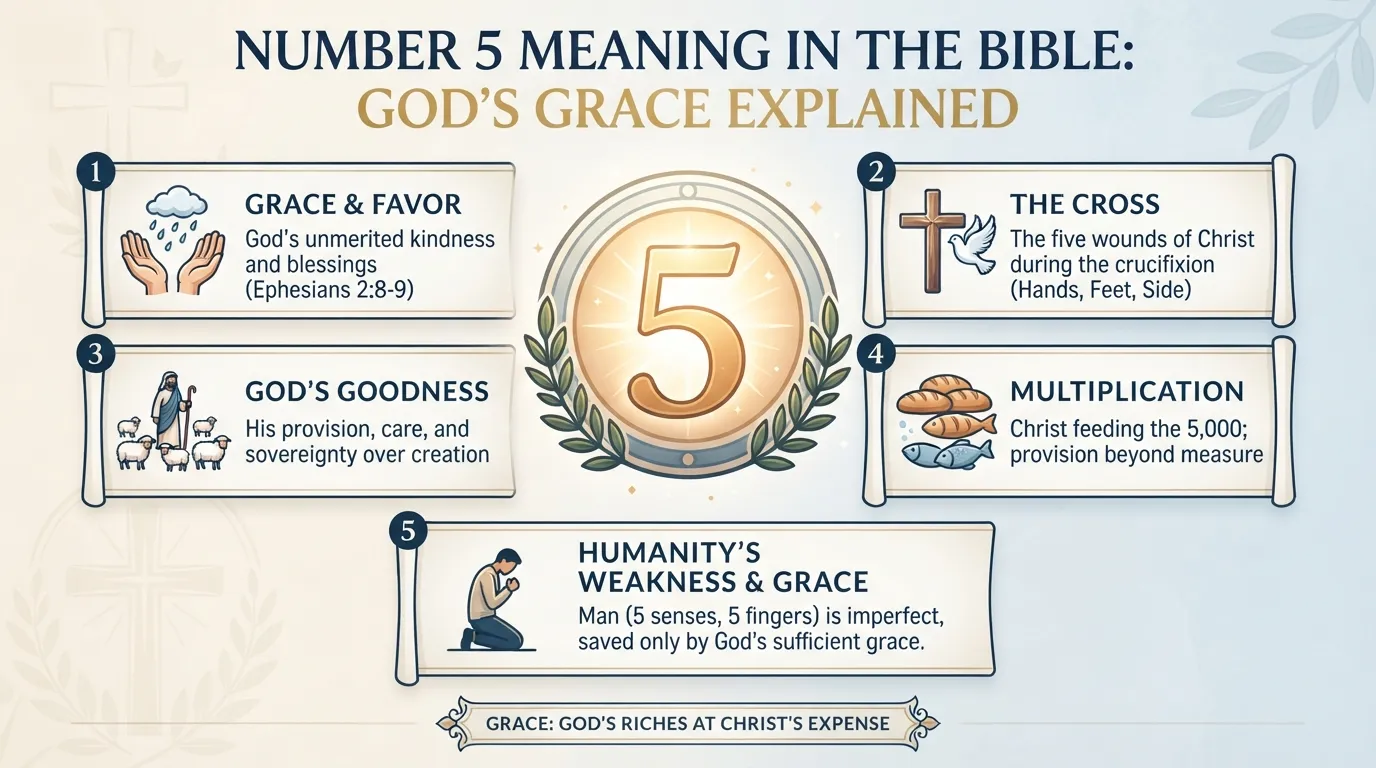
The number 5 in the Bible is widely associated with God’s grace, goodness, and favor toward humanity. This isn’t stated as a formal doctrine, but the pattern appears repeatedly: the five books of Moses, the five loaves that fed five thousand, and the five offerings prescribed in Leviticus, all connecting to themes of divine provision and grace.
Biblical Meaning of Number 5 📖
Understanding the number 5’s meaning means looking at where it consistently appears rather than treating it as a fixed code.
Numerical Significance in Scripture
The Bible doesn’t present numbers as secret codes, but consistent patterns do emerge through repeated symbolic use.
The number 5 appears most often in contexts tied to God’s provision, grace, and kindness toward people who haven’t earned it.
Literal Meaning
Literally, 5 is simply a numeral, but its recurring placement in pivotal biblical moments has led many readers to notice a consistent theme.
Spiritual Meaning
Spiritually, many believers associate 5 with grace precisely because of how often it appears at moments of God’s unearned favor toward His people.
Biblical Significance
The Torah itself, God’s foundational law given to Israel, consists of exactly five books: Genesis, Exodus, Leviticus, Numbers, and Deuteronomy.
Key Scripture Reference
John 1:16 says, “For from his fullness we have all received, grace upon grace,” a verse many connect to the doubled significance of 5 multiplied by itself (25).
Historical & Biblical Context 🏛️
To understand the number 5’s meaning responsibly, it helps to trace its actual appearances throughout Scripture’s history.
Old Testament Usage
The five books of Moses (the Pentateuch) form the foundation of the entire Old Testament, establishing God’s law and His covenant relationship with Israel.
Leviticus 1-7 describes five primary offerings: the burnt offering, grain offering, peace offering, sin offering, and trespass offering.
The Tabernacle’s design incorporated the number 5 repeatedly, including its curtains, pillars, and sockets (Exodus 26-27).
The holy anointing oil used to consecrate the Tabernacle was made from five specific ingredients, given directly by God (Exodus 30:23-25).
New Testament Relevance
Jesus fed five thousand people using five loaves of bread and two fish, one of His most well-known miracles (Matthew 14:17-21).
The apostle John wrote exactly five New Testament books centered heavily on grace: the Gospel of John, 1 John, 2 John, 3 John, and Revelation.
The four Gospels together with Acts form a set of five books often called the “New Testament Pentateuch,” establishing the foundation of Christ’s teaching and the early church.
Cultural Understanding in Biblical Times
Ancient Hebrew thought often connected numbers to broader theological themes rather than treating them as mystical codes to decipher.
The number 5’s frequent connection to grace likely emerged organically through its repeated placement at moments of God’s provision, rather than through any stated numerical formula.
Where Does the Number 5 Appear in the Bible? 📜
The number 5 shows up in specific, traceable patterns throughout both Testaments.
Where It Appears
Key appearances include the five books of Moses, the five offerings in Leviticus, David’s five smooth stones (1 Samuel 17:40), and the five loaves that fed the five thousand.
Why It Matters
Its consistent placement at moments of provision, law-giving, and grace has led generations of Bible readers to notice this recurring pattern.
What It Teaches
The pattern teaches that God’s grace often shows up in structured, intentional ways throughout Scripture’s unfolding story, not merely as isolated events.
Spiritual Meaning & Symbolism 🕊️
The number 5’s symbolism centers on God’s provision meeting genuine human need or weakness.
Human Weakness vs. Divine Provision
Some Bible teachers note that 4, often associated with human limitation, plus 1, representing God’s added presence, produces 5, divine strength added to human need.
This isn’t a strict biblical formula, but it captures the pattern of grace repeatedly meeting insufficiency throughout Scripture.
Law vs. Grace
The five books of Moses established God’s law, yet even within that law, the five offerings provided a consistent path toward forgiveness and restored relationship.
This shows grace wasn’t absent from the Old Testament; it was woven into the very structure of Israel’s worship from the beginning.
God’s Perspective
Whether through five loaves feeding thousands or five stones defeating a giant, Scripture repeatedly shows God working through small, seemingly insufficient means.
Lessons for Today
Believers can find encouragement that God’s grace consistently transforms limited resources into more than enough.
📊 Quick Comparison: Number 5 in the Old Testament vs. New Testament
| Old Testament | New Testament |
|---|---|
| Five books of Moses (the Torah) | Five books by John centered on grace |
| Five offerings in Leviticus | Five loaves feeding five thousand |
| Five ingredients in anointing oil | Five wounds of Christ on the cross |
| David’s five smooth stones | Five wise virgins (Matthew 25) |
Biblical Verses Connected to the Number 5 ✝️
These verses trace the pattern many associate with the number 5’s meaning.
Exodus 30:23-25
“Take also the finest spices… and make of these a sacred anointing oil.”
This passage lists five specific ingredients God commanded for the Tabernacle’s sacred anointing oil.
The oil was used to consecrate the Tabernacle’s furniture, setting it apart entirely for God’s purposes.
The lesson shows that even the precise formula for consecration reflected careful, intentional divine instruction.
Many Bible teachers connect this five-part composition to the broader theme of grace poured out for sacred purposes.
Leviticus 1-7
“These are the burnt offering, the grain offering, the sin offering, the guilt offering, and the peace offering.”
This section establishes the five primary offerings God prescribed for Israel’s worship system.
Each offering served a distinct purpose, from atonement for sin to expressing gratitude and fellowship with God.
The lesson shows that God provided a complete, structured path toward forgiveness even within the Old Testament law.
Together, these five offerings reflect the full picture of God’s provision for restored relationship.
1 Samuel 17:40
“Then he took his staff in his hand and chose five smooth stones from the brook.”
David selected five stones before facing Goliath, though he ultimately needed only one to defeat the giant.
Scripture doesn’t explain why he chose exactly five, leading to various interpretations among Bible teachers.
The lesson shows God’s provision often includes more than what’s strictly necessary, reflecting abundant grace rather than bare sufficiency.
David’s confidence rested not in the number of stones, but in the God who had delivered him before.
Matthew 14:17-21
“They said to him, ‘We have only five loaves here and two fish.’… And they all ate and were satisfied.”
This passage describes Jesus feeding five thousand people using drastically insufficient resources by human calculation.
The disciples saw only scarcity; Jesus saw an opportunity to demonstrate God’s abundant provision.
The lesson shows that God’s grace regularly transforms genuine insufficiency into more than enough for everyone present.
This miracle remains one of the few recorded in all four Gospels, emphasizing its significance.
John 1:16
“For from his fullness we have all received, grace upon grace.”
This verse describes believers receiving continuous, layered grace from Christ’s own fullness.
Many teachers connect this “grace upon grace” language to 5 multiplied by itself, producing 25, symbolizing doubled or compounded grace.
The lesson emphasizes that God’s grace isn’t a single, limited gift, but an ongoing, generous supply.
This verse captures the heart of what many associate with the number 5’s biblical symbolism.
Ephesians 4:11
“And he gave the apostles, the prophets, the evangelists, the shepherds and teachers.”
This verse lists five specific gifts Christ gave the church for building up believers, often called the “fivefold ministry.”
Each role serves a distinct function in equipping and strengthening the body of Christ.
The lesson shows grace expressed practically, through gifted individuals serving the broader church community.
This passage extends the number 5’s association with grace into the New Testament church’s structure.
Matthew 25:1-2
“Then the kingdom of heaven will be like ten virgins… Five of them were foolish, and five were wise.”
Jesus’s parable divides ten virgins evenly into two groups of five, wise and foolish, based on their preparation.
While the number itself isn’t the parable’s central point, the even division has drawn attention from many Bible teachers.
The lesson emphasizes genuine spiritual readiness over mere appearance or association with the right group.
This parable ultimately teaches about watchfulness and preparedness for Christ’s return, not numerology.
Real-Life Biblical Case Study: The Feeding of the Five Thousand 🌟
Matthew 14 records one of Jesus’s most well-known miracles, following the death of John the Baptist.
Jesus had withdrawn to a desolate place, but crowds followed him, and by evening, thousands remained without food.
The disciples suggested sending the people away to buy their own food, seeing no realistic solution to the growing need.
Jesus responded simply: “They need not go away; you give them something to eat” (Matthew 14:16).
The disciples could offer only five loaves of bread and two fish, clearly insufficient for a crowd this size.
Jesus took the small offering, looked to heaven, blessed it, and began distributing it through his disciples.
Scripture records that everyone ate and was satisfied, with twelve baskets of leftovers gathered afterward.
This miracle shows grace multiplying genuine insufficiency into complete provision, with abundance left over besides.
Life Lessons for Christians 🙏
The number 5’s biblical pattern offers several practical, encouraging lessons for believers today.
God’s grace meets genuine insufficiency. The five loaves feeding thousands shows that limited resources aren’t a barrier to God’s provision.
Structured worship reflects grace. The five offerings in Leviticus show God provided a complete path toward forgiveness, even under the law.
Small offerings matter. David’s stones and the boy’s loaves both show that God uses what’s genuinely offered, however small.
Grace builds on grace. John 1:16’s “grace upon grace” reminds believers that God’s kindness is ongoing, not a single limited gift.
Preparedness matters more than numbers. Matthew 25’s parable redirects attention from numerical patterns toward genuine spiritual readiness.
Common Misunderstandings ⚠️
Several points of confusion surround this topic in modern discussion.
Modern misuse: Some treat the number 5 as a “lucky number” or mystical code; Scripture never teaches numerology or lucky numbers in this sense.
Cultural confusion: A few sources present the number 5’s meaning as a rigid, universal rule rather than an observed pattern across Scripture’s narrative.
Wrong interpretations online: Some articles claim overly specific, invented meanings for the number 5 in personal life circumstances without scriptural basis.
Correct biblical explanation: The number 5 shows a consistent, traceable pattern of appearing at moments of God’s grace and provision, without functioning as a secret biblical code.
💡 Expert Insight: When exploring number symbolism in Scripture, always distinguish between an observed pattern (5 repeatedly appearing near grace) and a formal biblical teaching (the Bible explicitly defining 5 as “the number of grace”). The former is well-supported; the latter goes beyond what Scripture explicitly states.
FAQs ❓
What does the number 5 mean in the Bible?
The number 5 is widely associated with God’s grace, goodness, and favor, based on its repeated appearance at moments of divine provision throughout Scripture.
How many times does the number 5 appear in the Bible?
The number 5 appears 318 times throughout Scripture, often connected to offerings, provision, and grace-related themes.
Why is the Torah made of exactly five books?
The five books of Moses (Genesis through Deuteronomy) form the foundational law given to Israel, though Scripture doesn’t explain the number itself as symbolic.
Does the Bible officially teach that 5 means grace?
Not as a formal doctrine. Rather, the number 5 repeatedly appears in contexts of grace and provision, leading many Bible teachers to note this consistent pattern.
Is number symbolism the same as numerology?
No. Biblical number patterns emerge through Scripture’s own narrative and structure, while numerology often assigns mystical meaning to numbers independent of context.
Conclusion 🌿
The number 5 meaning in the Bible centers consistently on God’s grace, provision, and favor toward those in genuine need.
From the five books of Moses to the five loaves that fed thousands, this pattern appears too often across Scripture to dismiss as pure coincidence.
Still, the Bible never presents this as a rigid formula or hidden code; it’s a pattern woven naturally through the story of God’s faithfulness.
Whatever insufficiency you’re facing today, the number 5’s recurring appearance offers a gentle reminder: God’s grace consistently transforms genuine lack into more than enough.
May that same grace meet you exactly where you find yourself lacking today.

Hello, I’m Michael Bennett. I am passionate about exploring the symbolism, dreams, and spiritual messages found throughout the Bible. My research focuses on understanding how biblical themes connect with faith, personal growth, and everyday life.