You may be reading Genesis 17 and stumble on a word that feels strange. Or you may have noticed “uncircumcised” used as an insult in the Old Testament and wondered what it meant. It’s a fair question, and it deserves a clear, respectful answer.
If you searched for the circumcised meaning in the Bible, you’re probably looking for two things: what the word describes and why it matters in Scripture.
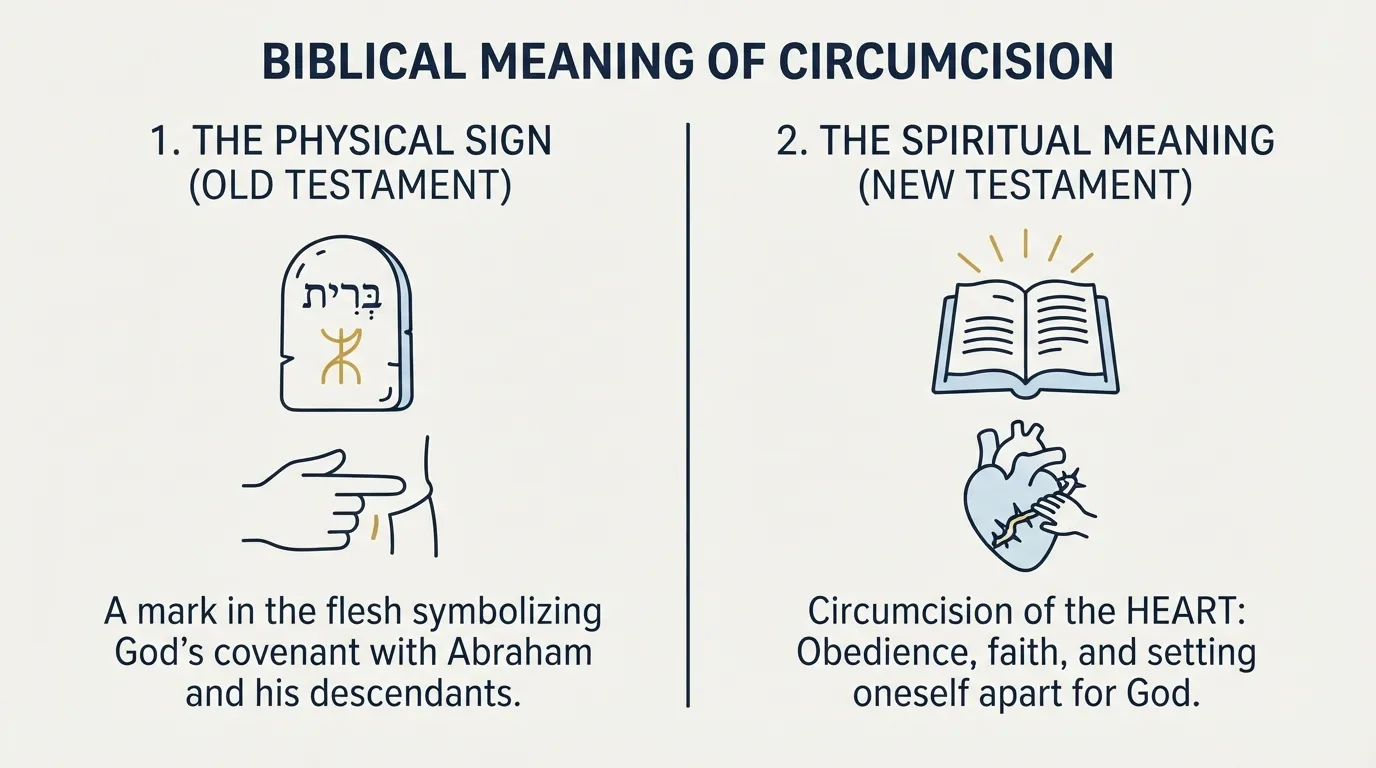
The short answer is that circumcision was the sign of God’s covenant with Abraham and his family. Later, the Bible also uses the word for something deeper: a heart that belongs to God.
This guide covers the Hebrew and Greek words, the key stories, the New Testament debate, and a few common mix-ups. We’ll keep the focus on what Scripture says.
It can be an uncomfortable topic for some readers, but it unlocks a lot of the Bible.
Did You Know? 🔍
In Exodus 6:12, Moses calls his own lips “uncircumcised.” The Bible also speaks of uncircumcised ears and hearts, using the word as a picture of something that is closed or unresponsive.
Quick Answer ⚡
In the Bible, being circumcised means a male had the foreskin removed as the sign of God’s covenant with Abraham and his descendants, and the word later describes a heart set apart for God, as the prophets and the apostle Paul explain.
What Does Circumcised Mean in the Bible?
Circumcision comes from the Hebrew mul, meaning to cut off, and the Greek peritemnō, meaning to cut around. Physically, it marked Israelite males as members of God’s covenant people. Spiritually, the Bible uses it for a changed heart. The New Testament says Gentile believers do not need it.
Biblical Meaning of Circumcised 📖
Hebrew and Greek Meaning
The main Hebrew word is mul (מוּל), which means to cut short or cut off. It is used for the rite of circumcision.
The Greek verb is peritemnō (περιτέμνω), from peri (“around”) and temnō (“to cut”). The noun peritomē means circumcision itself.
The Greek word for the uncircumcised state is akrobustia, often translated “uncircumcision” (as in Romans 2:25–27). Paul also uses peritomē as a name for the Jewish people, in contrast with Gentiles.
Literal Meaning
Literally, circumcision meant removing the foreskin of a male. God commanded it for Abraham’s household, and for his male descendants on the eighth day after birth (Genesis 17:12).
The Bible presents it as a covenant sign, not as a medical practice. It does not explain the rite in health terms.
Spiritual Meaning
Spiritually, circumcision stood for belonging to God and for a heart that is open to him. The prophets said Israel needed to “circumcise” their hearts (Deuteronomy 10:16; Jeremiah 4:4).
Paul builds on that idea in the New Testament. He says true circumcision is “a matter of the heart, by the Spirit” (Romans 2:29).
Biblical Significance
Circumcision was the sign of the covenant with Abraham (Genesis 17:11). It was never the covenant itself, and the Bible is clear that the promise came first.
Paul points this out in Romans 4:11. Abraham was declared righteous by faith before he was circumcised.
Key Scripture Reference
“You shall be circumcised in the flesh of your foreskin, and it shall be a sign of the covenant between me and you.” (Genesis 17:11, ESV)
Historical & Biblical Context 🏛️
Old Testament Usage
The command first appears in Genesis 17. Abraham was ninety-nine, and his son Ishmael was thirteen when they were circumcised (Genesis 17:24–25). Isaac was circumcised on the eighth day (Genesis 21:4).
The law repeated the command (Leviticus 12:3). Foreigners who wanted to join in the Passover also had to be circumcised (Exodus 12:48).
After forty years in the wilderness, the men born during the journey had not been circumcised. Joshua circumcised them at Gilgal before Israel entered the land (Joshua 5:2–9).
The prophets then pressed a deeper point. God wanted hearts that were willing, not just a sign on the body (Deuteronomy 30:6; Jeremiah 4:4).
New Testament Relevance
Jesus was circumcised on the eighth day (Luke 2:21). The rite was still part of Jewish life, even on the Sabbath (John 7:22–23).
The big question came when Gentiles began believing in Jesus. Some said they had to be circumcised to be saved (Acts 15:1). The church council in Jerusalem decided not to burden them with it (Acts 15:19, 28).
Paul’s letters pick up the same theme. He says circumcision does not count for anything in Christ, only faith working through love (Galatians 5:6).
Cultural Understanding in Biblical Times
For ancient Israel, circumcision marked a person’s identity. It set Israel apart from nations who did not practice it.
Other peoples also practiced forms of circumcision. Jeremiah 9:25–26 lists several nearby nations and says that Israel was just as uncircumcised in heart.
“Uncircumcised” also became a way of describing outsiders, as when David calls Goliath “this uncircumcised Philistine” (1 Samuel 17:26).
Is Circumcision Mentioned in the Bible? 📜
Yes, many times. The Greek verb peritemnō appears 18 times in the New Testament, and the noun peritomē about 36 times. The Old Testament uses mul and related words from Genesis through Jeremiah.
What does the Bible say about circumcision? It says God commanded it as a covenant sign, it marked Israel’s males, and it pointed to the heart.
What does it say about “uncircumcised”? It uses the word for people outside the covenant, and also figuratively for lips, ears, and hearts that are closed (Exodus 6:12; Jeremiah 6:10; Leviticus 26:41).
What does it not say? It gives no health reason for the practice, and it does not discuss modern medical circumcision. That is a separate matter that families decide.
Why does it matter? The circumcised meaning in the Bible helps explain the covenant, Paul’s letters, and why the early church debated so strongly.
Spiritual Meaning & Symbolism ✨
Outward Sign vs. Inward Change
The Bible holds an outward sign and an inward reality side by side. The outward mark belonged to Israel’s covenant. The inward change was what God wanted all along.
Paul says an outward sign without an inward change is empty (Romans 2:25–29). That does not make the sign worthless. It means the sign points to something deeper.
God’s Perspective
From the start, God cared about the heart. Deuteronomy 30:6 says God himself will “circumcise your heart” so that you may love him fully.
This shows that heart change is something God does, not just something people produce on their own.
Lessons for Today
The circumcised meaning in the Bible reminds us that religious signs matter most when they point to a living relationship with God.
Physical Circumcision and Circumcision of the Heart Compared 📊
| Aspect | Physical Circumcision | Circumcision of the Heart |
|---|---|---|
| What it is | A covenant sign on the body | An inward change toward God |
| Who it applied to | Males in Abraham’s household and Israel | Anyone God changes, Jew or Gentile |
| What it showed | Belonging to the covenant people | A willing, softened heart |
| Key verses | Genesis 17:10–11; Leviticus 12:3 | Deuteronomy 10:16; 30:6; Romans 2:29 |
| New Testament view | Not required for Gentile believers | Described as work of the Spirit |
Biblical Verses About Circumcision 📖
These verses trace circumcision from Abraham to Paul. Quotes are from the ESV.
Genesis 17:10–11
“This is my covenant, which you shall keep, between me and you and your offspring after you: Every male among you shall be circumcised. You shall be circumcised in the flesh of your foreskin, and it shall be a sign of the covenant between me and you.”
God gives Abraham a clear sign of the covenant. It applies to the males in his household, whether born there or bought (Genesis 17:12–13). The text calls it “a sign of the covenant,” not the covenant itself. The promises came first, in Genesis 12 and 15, and the sign followed. It marked belonging to a family God had chosen. Abraham, at ninety-nine, obeyed that very day (Genesis 17:23–24). His quick response shows trust, and it shows that obedience was meant to follow the promise.
Lesson: Obedience follows God’s promise. It does not earn it.
Deuteronomy 10:16
“Circumcise therefore the foreskin of your heart, and be no longer stubborn.”
Moses speaks to Israel long before the New Testament. He tells them to circumcise their hearts. The point is clear: the outward sign was never meant to be enough. God wanted hearts that were soft and willing, not stubborn. Later in the same book, Moses says God himself will do this work: “the LORD your God will circumcise your heart” (Deuteronomy 30:6). Together, the two verses show both sides. People are called to respond, and God is the one who makes the change possible. The idea of a changed heart did not begin with Paul.
Lesson: God wants a heart that listens, not just a sign that shows.
Joshua 5:9
“And the LORD said to Joshua, ‘Today I have rolled away the reproach of Egypt from you.’ And so the name of that place is called Gilgal to this day.”
After the wilderness years, a new generation had not been circumcised (Joshua 5:5). Before taking the land, Joshua circumcised them at Gilgal. Then God says he has rolled away “the reproach of Egypt.” Scholars discuss exactly what that means, but it clearly marks a fresh start for the people. Many readers also note that the name Gilgal sounds like the Hebrew word for “roll.” Israel was a covenant people again, ready to enter the land God had promised, and the sign once more marked their identity.
Lesson: God can renew a people and give them a fresh start.
Luke 2:21
“And at the end of eight days, when he was circumcised, he was called Jesus, the name given by the angel before he was conceived in the womb.”
Jesus was born under the Law (Galatians 4:4) and was circumcised on the eighth day, like any Jewish boy. This is also the moment he is named. Luke shows Joseph and Mary carefully keeping the law, including offerings and presentation in the temple (Luke 2:22–24). Jesus’ circumcision shows he belonged fully to Israel’s story. The Gospel does not treat it as a side detail. It shows him entering the covenant community, even as he would later fulfill what that community was waiting for.
Lesson: Jesus entered his people’s story fully.
Acts 15:1
“But some men came down from Judea and were teaching the brothers, ‘Unless you are circumcised according to the custom of Moses, you cannot be saved.'”
This verse begins the first church council debate. Gentiles were coming to faith in Jesus, and some teachers insisted they also had to be circumcised. Paul and Barnabas strongly disagreed (Acts 15:2). In Jerusalem, Peter reminded the council that salvation comes through the grace of the Lord Jesus (Acts 15:11). The council then wrote a letter telling Gentile believers they did not need to take on circumcision. This decision shaped the church for good, and it shaped much of what Paul wrote afterward.
Lesson: Salvation is by grace, so don’t add requirements God hasn’t given.
Romans 2:28–29
“For no one is a Jew who is merely one outwardly, nor is circumcision outward and physical. But a Jew is one inwardly, and circumcision is a matter of the heart, by the Spirit, not by the letter. His praise is not from man but from God.”
Paul is speaking to people who relied on outward identity. He says real circumcision is not only a physical mark. It is a matter of the heart, done by the Spirit. He isn’t saying the old covenant sign was bad. A few verses later he says the Jewish people had “much” advantage (Romans 3:1–2). His point is that an outward sign without inward faith is empty. What counts is a life that is genuinely turned toward God.
Lesson: God looks at the heart, not just at outward religion.
Galatians 5:6
“For in Christ Jesus neither circumcision nor uncircumcision counts for anything, but only faith working through love.”
Galatians is Paul’s strongest letter against forcing circumcision on Gentile believers. Earlier in the chapter he warns that trusting in circumcision to be right with God would make Christ of no benefit (Galatians 5:2–4). Yet here he says that neither circumcision nor uncircumcision counts. His concern isn’t the act itself. It is relying on it for acceptance with God. What counts is faith that shows itself in love for others. That is the life God wants from every believer, Jew or Gentile.
Lesson: Faith that works through love is what truly counts.
Colossians 2:11
“In him also you were circumcised with a circumcision made without hands, by putting off the body of the flesh, by the circumcision of Christ.”
Paul uses circumcision as a picture of what God does for believers. It is “made without hands,” so it is not physical. It is about “putting off the body of the flesh,” a way of describing the old self being cut away. The next verse connects this with baptism (Colossians 2:12), and Christians understand that link in different ways. In any case, the passage shows how the New Testament carries the old covenant sign into a spiritual reality that Christ makes available to all who trust him.
Lesson: In Christ, God deals with the old self and gives a new start.
Real-Life Biblical Case Study: Timothy and Titus 📖
Paul worked with two young companions, and he handled their circumcision differently.
Timothy had a Jewish mother and a Greek father. Paul circumcised him “because of the Jews who were in those places, for they all knew that his father was a Greek” (Acts 16:3).
Titus was a Greek, and Paul refused to let him be forced to be circumcised (Galatians 2:3). In that case, the issue was whether circumcision was required for acceptance with God.
The difference shows Paul’s thinking. When it was a matter of ministry among Jewish people, he was flexible. When it was a demand for salvation, he held firm. The act was not the issue. The reason behind it was.
Life Lessons for Christians 🙏
Look beyond outward signs. The Bible always points to the heart.
Grace comes first. The covenant promise came before the sign.
Don’t add requirements. The Jerusalem council protected Gentile believers from extra burdens.
Welcome all believers. The gospel is open to Jew and Gentile alike.
Let God change you. Heart change is something God does.
Common Misunderstandings ⚠️
“Christians must be circumcised.” The New Testament says no. Acts 15 and Galatians 5 make clear that it is not required for salvation or for belonging to the church.
“Circumcision was only for health reasons.” The Bible gives a covenant reason, not a health one. Its purpose was to mark God’s people.
“Only Israel practiced circumcision.” Other nearby peoples also did, as Jeremiah 9:25–26 shows. What was special for Israel was the covenant meaning.
“Circumcision of the heart is a New Testament idea.” It’s older than that. Moses and Jeremiah both spoke of it (Deuteronomy 10:16; Jeremiah 4:4).
“Paul was against the Old Testament law.” Paul said the law had real value (Romans 3:1–2; 7:12). His concern was using any rule to earn God’s favor.
Expert Insight 💡
When you see “circumcised” or “uncircumcised,” ask whether the verse is literal or figurative. Genesis 17 and Joshua 5 are literal. Deuteronomy 10:16, Jeremiah 4:4, Romans 2:29, and Colossians 2:11 are figurative. Reading Acts 15 and Galatians 5 together is also helpful, because they show the same debate from two angles.
FAQs ❓
What does circumcised mean in the Bible?
In the Bible, circumcised means a male had the foreskin removed as the sign of God’s covenant with Abraham. The word also describes a heart set apart for God, as Moses, Jeremiah, and Paul explain. The Hebrew word is mul, and the Greek is peritemnō.
Why were Israelite boys circumcised on the eighth day?
God commanded it in Genesis 17:12 and repeated it in Leviticus 12:3. The Bible does not explain why the eighth day was chosen. It simply presents the day as part of the covenant command given to Abraham and his descendants.
Do Christians have to be circumcised?
No. The Jerusalem council decided that Gentile believers did not need it (Acts 15). Paul says circumcision counts for nothing in Christ (Galatians 5:6). The Bible does not address modern medical circumcision, which families decide with their doctors.
What is circumcision of the heart?
It is a changed, willing heart toward God. Moses told Israel to circumcise their hearts (Deuteronomy 10:16) and promised God would do it (Deuteronomy 30:6). Paul describes true circumcision as a matter of the heart, by the Spirit (Romans 2:29).
What does uncircumcised mean in the Bible?
Literally, it describes someone outside the covenant, like the Philistines in 1 Samuel 17:26. Figuratively, it describes lips, ears, or hearts that are closed or unresponsive. Examples include Exodus 6:12, Jeremiah 6:10, and Jeremiah 9:26.
Conclusion 🌿
In the Bible, being circumcised first meant carrying the sign of God’s covenant with Abraham. It marked a family that God had chosen and made promises to.
Over time, Scripture shows a deeper meaning. Moses and Jeremiah called Israel to circumcise their hearts, and Paul explained that true circumcision is a change the Spirit makes within a person.
The New Testament also makes a clear point: Gentile believers do not need to be circumcised to belong to God’s people. Faith working through love is what counts.
If you’ve struggled with this topic, take heart. The circumcised meaning in the Bible comes down to a simple hope. God cares most about a heart that is open to him, and he is the one who makes that change possible.

Hello, I’m Samuel Carter. My interest in biblical studies comes from a lifelong desire to understand the wisdom and teachings contained within Scripture. I particularly enjoy researching biblical numbers, patterns, and themes that appear throughout God’s Word.