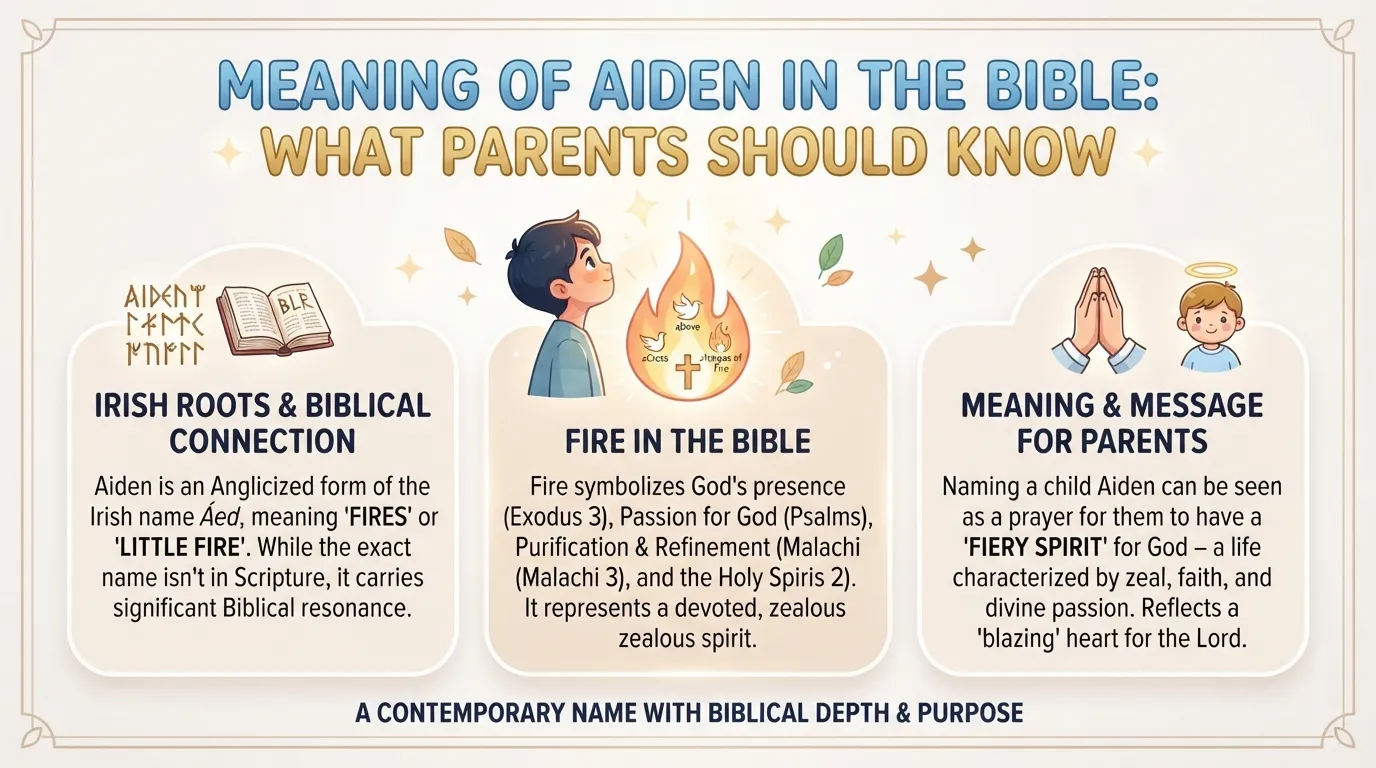
If you’re expecting a baby or just love studying names, you may have searched “Aiden meaning in the Bible.” You were hoping for a direct scriptural connection.
Here’s the honest, well-researched answer. Aiden isn’t a biblical name.
But its story still connects beautifully to themes found throughout Scripture, especially fire, light, and God’s presence.
Did You Know? 🔍
Aiden comes from the Irish name Aodh, pronounced roughly “ay,” later anglicized as Aiden or Aidan. It was originally connected to a Celtic word for fire.
It later became famous through Saint Aidan of Lindisfarne, a 7th century Irish missionary bishop.
What Does Aiden Mean in the Bible? (Quick Answer) 📖
Aiden does not appear in the Bible and has no Hebrew or Greek origin. It comes from the Irish Gaelic name Aodh, meaning little fire.
While the name itself isn’t biblical, fire is a rich and recurring biblical symbol representing God’s presence, purification, and the Holy Spirit.
Biblical Meaning of Aiden 🔥
Hebrew and Greek Roots
There is no Hebrew or Greek root for Aiden. Its origin is entirely Celtic and Irish, not ancient Near Eastern.
So it doesn’t trace back to any biblical language.
Literal Meaning
Literally, Aiden means little fire or fiery one. It’s derived from Aodh, an old Irish name likely connected to a Celtic god of fire and the sun in pre-Christian tradition.
Spiritual Meaning
Even without direct scriptural roots, fire carries deep spiritual weight throughout the Bible. It represents God’s holy presence (Exodus 3:2), purification (Malachi 3:2-3), and the Holy Spirit’s arrival (Acts 2:3-4).
Biblical Significance
Because Aiden isn’t a biblical name, its significance for Christian parents usually comes from the associated meaning of fire rather than a specific verse or figure named Aiden.
Key Scripture Reference
Acts 2:3 describes the Holy Spirit appearing as tongues of fire resting on the disciples at Pentecost. Many Christian parents connect this thematically to a name meaning fire.
Historical & Biblical Context 🕰️
Old Testament Usage
Fire appears constantly in the Old Testament. The burning bush (Exodus 3:2), the pillar of fire guiding Israel (Exodus 13:21), and fire consuming sacrifices as a sign of God’s acceptance (1 Kings 18:38).
New Testament Relevance
In the New Testament, fire shifts toward representing the Holy Spirit’s power and presence. This is most vivid at Pentecost (Acts 2:3-4), and it also appears as a symbol of testing and refinement (1 Corinthians 3:13).
Cultural Understanding in Biblical Times
Ancient Israelites associated fire with both danger and divine encounter. It could destroy, but it could also mark God drawing near, which is why fire imagery carries such weight throughout Scripture.
Is Aiden Mentioned in the Bible? 📚
No, Aiden is not found in any biblical text, genealogy, or narrative.
The closest biblical connection is thematic, through the symbol of fire, rather than a direct name reference.
Some sources may confuse this with Aidan, a similarly spelled name of a Christian saint. But Saint Aidan of Lindisfarne lived centuries after the biblical period.
Spiritual Meaning & Symbolism 🕊️
Fire as Purification vs. Destruction
Fire in Scripture holds two sides. It purifies, as Malachi 3:2-3 describes God refining His people like a refiner’s fire.
It can also judge or destroy (Genesis 19:24). Understanding both sides gives a fuller, more honest picture of the symbolism behind a fire name.
God’s Perspective
God doesn’t assign spiritual value to names by their sound or etymology. He looks at the heart (1 Samuel 16:7).
A name like Aiden can still carry a meaningful, faith-filled association without being a Bible name.
Lessons for Today
Choosing a name isn’t about finding scriptural proof-texts for every syllable.
It’s about the character and faith you hope to nurture, regardless of a name’s linguistic origin.
Aiden vs. Biblically-Rooted “Fire” Names 📊
| Name | Origin | Meaning | Biblical Connection |
|---|---|---|---|
| Aiden | Irish/Celtic | Little fire | Thematic only (fire symbolism) |
| Nadab | Hebrew | Generous (linked to fire offering account) | Leviticus 10:1-2 |
| Uriah | Hebrew | God is my light/flame | 2 Samuel 11 |
| Seraphiel/Seraph | Hebrew | Burning one (angelic beings) | Isaiah 6:2 |
Biblical Verses About Fire and God’s Presence
Exodus 3:2
God appears to Moses in a burning bush that isn’t consumed.
This moment shows fire representing God’s holy, untouchable presence, and it’s often the first verse Christian parents reference for a fire name.
Exodus 13:21
God leads Israel through the wilderness in a pillar of fire by night.
This shows fire as guidance and God’s visible presence with His people during a difficult journey.
1 Kings 18:38
Fire falls from heaven to consume Elijah’s sacrifice, proving God’s power over the false prophets of Baal.
It’s a dramatic picture of fire as a sign of God’s authority and answered prayer.
Malachi 3:2-3
God is described as a refiner’s fire, purifying His people like precious metal.
This verse reframes fire as something that refines character rather than merely destroying.
Acts 2:3-4
Tongues of fire rest on the disciples at Pentecost as the Holy Spirit fills them.
This is the clearest New Testament link between fire and God’s empowering presence in a believer’s life.
1 Corinthians 3:13
Paul describes each person’s work being tested by fire to reveal its true quality.
This verse ties fire to spiritual testing and integrity, not just dramatic miracles.
Hebrews 12:29
God is described as a consuming fire, a reminder of His holiness and the seriousness of approaching Him.
It balances the warmer fire imagery with reverence.
Luke 3:16
John the Baptist says Jesus will baptize with the Holy Spirit and fire.
This connects fire directly to spiritual transformation and the ministry of Christ.
Real-Life Biblical Case Study: Elijah and the Fire on Mount Carmel
In 1 Kings 18, Elijah stands alone against 450 prophets of Baal, challenging them to call fire down from their god. Nothing happens for the false prophets.
But when Elijah prays, God’s fire consumes the sacrifice, the wood, and even the water poured over it.
It’s a powerful reminder that fire in Scripture often marks God proving Himself faithful, even in impossible-seeming situations. A fitting story to share with a child named Aiden as they grow.
Life Lessons for Christians
- A name doesn’t need Hebrew or Greek roots to carry meaningful spiritual significance.
- Fire symbolism throughout Scripture teaches both God’s holiness and His refining work in believers’ lives.
- Parents can build a name’s meaning around biblical themes like fire, even when the name itself isn’t found in the text.
- God values character over etymology (1 Samuel 16:7), a name is a starting point for identity, not a spiritual guarantee.
- Teaching children the biblical story behind their name’s associated symbol, like Elijah’s fire, can become a meaningful family tradition.
Common Misunderstandings
Some websites incorrectly claim Aiden is a Hebrew name meaning fire or list it as a Bible name.
This isn’t accurate. Aiden is Celtic and Irish in origin with no Hebrew or Greek roots at all.
The correct, honest answer is that Aiden’s connection to Scripture is thematic, through fire imagery, not linguistic or textual.
Expert Insight 💡
When researching a name’s biblical meaning, check whether the name itself appears in a Hebrew or Greek concordance like Strong’s.
Compare that against whether someone has simply matched its dictionary meaning to a biblical theme. Both can be meaningful, but they’re different kinds of connections worth distinguishing.
FAQs
Is Aiden a biblical name?
No, Aiden is not found in the Bible.
It originates from the Irish name Aodh, meaning little fire, and has no Hebrew or Greek root connecting it to Scripture directly.
What is the spiritual meaning of Aiden?
While not biblical itself, Aiden’s meaning of fire connects to strong spiritual themes in Scripture.
This includes God’s presence (Exodus 3:2) and the Holy Spirit’s arrival at Pentecost (Acts 2:3-4).
Is Aidan the same as Aiden?
Yes, they share the same Irish origin, Aodh.
Aidan is the more traditional Gaelic spelling, often associated with Saint Aidan of Lindisfarne, a 7th century Christian missionary.
Can I use Aiden as a Christian name for my child?
Yes. While it’s not a biblical name, many Christian parents choose names based on meaningful associations, like fire and the Holy Spirit, rather than requiring a direct scriptural reference.
What Bible verse goes well with the name Aiden?
Acts 2:3-4, describing the Holy Spirit appearing as tongues of fire, is a popular verse choice for parents wanting a scriptural theme connected to a fire name like Aiden.
Conclusion
Aiden isn’t a name you’ll find in any Bible concordance, and that’s okay to say plainly.
Its real story starts in Irish history with Aodh, meaning little fire. But that doesn’t mean the name is spiritually empty.
Fire is one of the richest, most consistent symbols in all of Scripture, pointing to God’s presence, purification, and power. If you love the name Aiden, you can absolutely pair it with a meaningful biblical theme, even without a direct verse to point to.

Hello, I’m Daniel Mercer. My passion for studying the Bible began many years ago when I started exploring the historical and spiritual meanings behind biblical names and symbols. Since then, I have dedicated countless hours to researching Scripture, ancient biblical traditions, and Christian teachings.