Unlike numbers such as 888, the number five actually shows up again and again throughout Scripture. In the Torah’s five books, David’s five smooth stones, five loaves of bread, and more.
Many Christian teachers associate five with God’s grace. That tradition is worth exploring honestly.
It’s a widely held pattern observation, not a verse that directly states five means grace.
Did You Know? 🔍
The Torah, the first five books of the Bible (Genesis through Deuteronomy), is traditionally called the Pentateuch. This comes from the Greek penta, meaning five.
This is one of the clearest, most literal five-based structures in all of Scripture.
What Does the Number Five Mean in the Bible? (Quick Answer) 📖
The number five appears frequently throughout Scripture. Most notably in the five books of the Torah, the five loaves that fed the crowd, and the five wise and five foolish virgins.
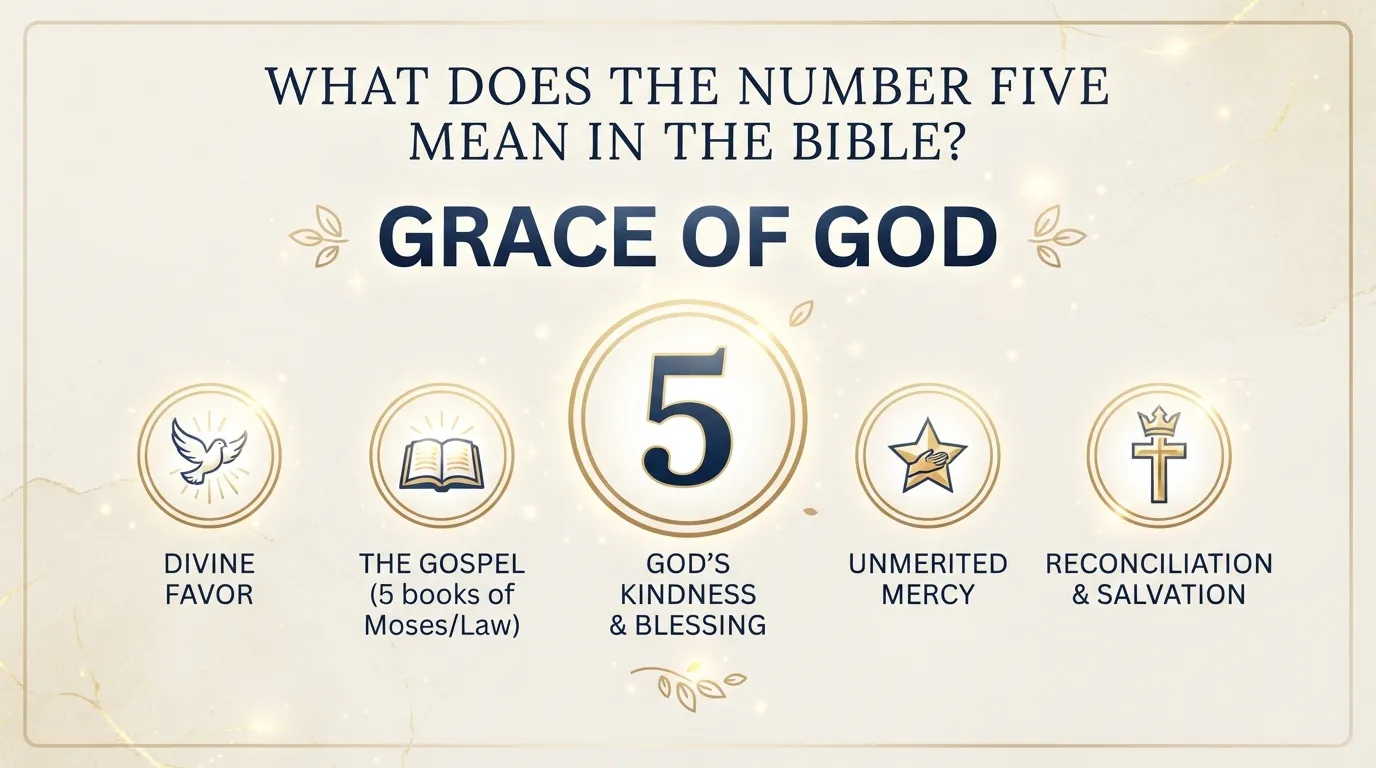
Many Bible teachers associate five with grace, based on these repeated patterns. Though this is a traditional interpretation rather than a verse that explicitly defines the number’s meaning.
Biblical Meaning of the Number Five 📖
Hebrew and Greek Roots
The Hebrew word for five is chamesh, and the Greek is pente, the root of Pentateuch and Pentecost.
Both appear regularly throughout the biblical text in counts, measurements, and lists.
Literal Meaning
Literally, five is simply a numeral used throughout Scripture to count people, items, days, and structures.
Its recurring use across pivotal stories is what has drawn attention to it over centuries of study.
Spiritual Meaning
The grace association comes from Bible teachers, notably E.W. Bullinger, observing that five consistently appears in contexts involving God’s provision and unmerited favor.
An example is the five loaves feeding thousands (Matthew 14:17-21).
Biblical Significance
Whether or not one accepts the grace label, five’s genuine textual significance lies in its structural role.
Five books of the Torah, five main offerings in Leviticus 1-5, and five pillars in the tabernacle’s curtain structure (Exodus 26:37).
Key Scripture Reference
Matthew 14:17-21, Jesus feeding 5,000 people with five loaves and two fish, is the most commonly cited five passage tied to abundant, grace-filled provision.
Historical & Biblical Context 🕰️
Old Testament Usage
Five structures the Torah itself with its five books, the tabernacle’s design with five pillars and five bars (Exodus 26-27), and Israel’s offering system with five main offerings described in Leviticus 1-5.
New Testament Relevance
Jesus’s feeding of the 5,000 with five loaves (Matthew 14:17-21) and the parable of the five wise and five foolish virgins (Matthew 25:1-13) are the two most prominent New Testament uses of the number.
Cultural Understanding in Biblical Times
Ancient Israelites used numbers structurally and symbolically far more than modern readers typically do.
Recurring patterns like five, seven, and twelve were often noticed and discussed by rabbis and later by Christian scholars as meaningful, even when not explicitly labeled in the text itself.
Is the Number Five Mentioned in the Bible? 📚
Yes, extensively, far more than numbers like 888.
Five appears throughout genealogies, measurements, offerings, and several pivotal narratives.
This makes it one of the more textually grounded numbers to study, even though its symbolic meaning, like grace, remains a matter of tradition and interpretation rather than direct statement.
Spiritual Meaning & Symbolism 🌾
Grace vs. Law
Some teachers contrast the five books of the Torah (law) with the New Testament’s emphasis on grace.
Others see five itself as pointing toward grace because of its association with provision (the loaves) and mercy (David’s stones). Both views are traditions built on pattern recognition, not direct scriptural definition.
God’s Perspective
Regardless of numerological debate, the actual stories connected to five, feeding the hungry, arming an underdog shepherd, structuring worship, consistently show God’s provision and care in action.
Lessons for Today
Rather than treating five as a formula, it’s more biblically grounded to focus on what the five-related stories actually teach.
Trust in God’s provision (Matthew 14) and preparedness (Matthew 25).
The Number Five: Tradition vs. Textual Fact 📊
| Claim About Five | Status | Reference |
|---|---|---|
| Five books of the Torah | Textual fact | Genesis-Deuteronomy |
| Five loaves fed 5,000 | Textual fact | Matthew 14:17-21 |
| Five wise, five foolish virgins | Textual fact | Matthew 25:1-13 |
| Five means grace | Traditional interpretation | Not explicitly stated in Scripture |
Biblical Verses Featuring the Number Five
Matthew 14:17-21
Jesus takes five loaves and two fish and feeds a crowd of 5,000 men, with twelve baskets of leftovers.
This is the most famous five miracle in Scripture, often cited as an example of abundant provision.
Matthew 25:1-13
Jesus tells the parable of ten virgins, five wise and five foolish, waiting for a bridegroom.
The five who prepared with enough oil represent readiness and wisdom, while the other five illustrate the cost of being unprepared.
1 Samuel 17:40
David selects five smooth stones from a stream before facing Goliath.
Though he only needed one, the preparation shown in gathering five reflects faith paired with practical readiness.
Genesis (Introductory Note on the Pentateuch)
The first five books of the Bible, Genesis, Exodus, Leviticus, Numbers, and Deuteronomy, together form the Torah.
This establishes Israel’s law, history, and covenant relationship with God from the very beginning of Scripture.
Leviticus 1-5
These chapters describe five main categories of offerings: burnt, grain, fellowship, sin, and guilt offerings.
Together, they structure Israel’s entire sacrificial worship system around the number five.
Exodus 26:37
Instructions for the tabernacle include five pillars for its entrance curtain.
This shows five used as a literal architectural measurement within Israel’s most sacred structure.
Mark 6:38-44
This parallel account of the feeding miracle repeats the detail of five loaves and two fish feeding the crowd.
It reinforces the connection between five and provision across multiple Gospel writers.
Acts 2:1-4 (Pentecost Reference)
While not about the number five directly, Pentecost derives from the Greek pente (five).
It refers to the fiftieth day after Passover when the Holy Spirit came upon believers, an indirect but notable five-related term.
Real-Life Biblical Case Study: David’s Five Stones
Before facing Goliath, David gathers five smooth stones from a streambed, though he ultimately needs only one to defeat the giant (1 Samuel 17:40, 49).
This moment blends faith with preparation. David trusted God completely, but he still came ready.
It’s a helpful picture for anyone drawn to the number five: readiness and reliance on God aren’t opposites, they work together.
Life Lessons for Christians
- Preparation, David’s five stones, and faith aren’t in tension, Scripture models both together.
- Provision stories, like the feeding of the 5,000, remind believers that God can multiply what looks insufficient.
- The parable of the ten virgins teaches that spiritual readiness matters more than good intentions alone.
- Structural patterns like the five books of the Torah remind readers that Scripture was carefully organized, not randomly assembled.
- It’s healthy to appreciate numerical patterns in the Bible without turning them into rigid formulas or predictions.
Common Misunderstandings
Many websites confidently state five means grace in the Bible as if it were a direct scriptural statement.
It isn’t, no verse defines five this way. The honest picture is that this is a long-standing teaching tradition, largely from 19th century scholar E.W. Bullinger, built on observed patterns, not an explicit biblical claim, and readers deserve to know that distinction.
Expert Insight 💡
When studying biblical numbers, separate what the text actually says, five loaves, five books, five stones, from what later teachers have inferred, five means grace.
Both can be valuable, but only the first is verifiable directly from Scripture.
FAQs
Does the number five mean grace in the Bible?
This is a popular teaching tradition, not a direct scriptural statement.
No verse explicitly defines five as grace, though teachers have drawn this association from patterns like the feeding of the 5,000.
Why are there five books in the Torah?
The five books of the Torah, Genesis, Exodus, Leviticus, Numbers, and Deuteronomy, form a structured account of Israel’s origins, law, and covenant relationship with God.
They’re traditionally grouped together as the Pentateuch.
What is the significance of David’s five stones?
David gathered five stones before facing Goliath but only used one (1 Samuel 17:40, 49).
This illustrates a balance of faithful trust in God and practical preparation.
What does the parable of the ten virgins teach about the number five?
The parable’s five wise and five foolish virgins (Matthew 25:1-13) contrast spiritual readiness with unpreparedness.
It emphasizes the importance of being ready for God’s timing.
Is five considered a “perfect” number like seven?
No, seven is more consistently associated with completeness in Scripture.
Five’s reputation is more tied to specific stories of provision and structure rather than a broad perfection theme.
Conclusion
The number five has real, verifiable roots throughout Scripture, from the Torah’s five books to David’s five stones to the feeding of the 5,000.
Its popular association with grace is a meaningful teaching tradition, even though it isn’t something the Bible states outright.
What matters most isn’t memorizing a formula, but noticing what these five-related stories actually teach.
God provides, God calls His people to be ready, and faith and preparation can work hand in hand.

Hello, I’m Samuel Carter. My interest in biblical studies comes from a lifelong desire to understand the wisdom and teachings contained within Scripture. I particularly enjoy researching biblical numbers, patterns, and themes that appear throughout God’s Word.