You see a dove on a sympathy card, in a church window, or on a baptism certificate. Most people link it to peace and gentleness.
But where does that picture come from, and what does the Bible itself say?
If you’ve searched for the dove meaning in the Bible, you’re probably looking for a clear answer.
Maybe you’re reading the story of Noah. Maybe you’re wondering why the Holy Spirit appears like a dove at Jesus’ baptism.
Or maybe you just love the symbol and want to know if it has real roots in Scripture.
It does. But the full picture is richer than one word like “peace.” This guide covers the Hebrew and Greek words for dove, the key Bible stories, the symbolism, and a few common mix-ups.
The dove is a small bird, yet it shows up at some of the biggest moments in the Bible, from the flood to the Jordan River.
Did You Know? 🔍
The prophet Jonah’s name, Yonah in Hebrew, literally means “dove.” It is the same Hebrew word used for the bird Noah sent out from the ark.
Quick Answer ⚡
In the Bible, a dove most often stands for gentleness, purity, hope, and God’s presence, and it appears at key moments such as Noah’s flood and the baptism of Jesus, where the Holy Spirit is described as descending like a dove.
What Does the Dove Mean in the Bible?
The Hebrew word for dove is yonah, and the Greek word is peristera. In Scripture, the dove can show hope and new beginnings, humble sacrifice, innocence, love, and the Holy Spirit’s presence. Peace is a later, popular link rather than something the Bible states directly.
Biblical Meaning of the Dove 📖
Hebrew and Greek Meaning
The Hebrew word is yonah (יוֹנָה). Translators note that it is related to a verb meaning “to moan,” which fits the soft, mournful cooing of the bird.
The Greek word is peristera (περιστερά). It appears in the New Testament in verses such as Matthew 3:16 and Luke 2:24.
A related bird, the turtledove, is tor in Hebrew and trugon in Greek. Both names are based on the sound the bird makes.
Literal Meaning
Literally, the dove is a small, gentle bird in the same family as pigeons. The Bible often uses “dove” and “pigeon” for the same kind of bird, so which English word you see depends on the translation.
Doves were common in Israel. They were also the sacrifice of choice for people who could not afford a larger animal.
Spiritual Meaning
For many Christians, the dove stands for the gentleness and presence of the Holy Spirit. It also stands for hope, because of Noah’s story.
The Bible does not give a single “official” meaning. Its symbolism comes from how the bird is used in different passages.
Biblical Significance
The dove appears in some of the Bible’s most important scenes: after the flood, in temple offerings, in love poetry, and at the baptism of Jesus.
Few animals connect so many parts of Scripture, from Genesis to the Gospels. The dove meaning in the Bible reaches across both Testaments.
Key Scripture Reference
“And he saw the Spirit of God descending like a dove and coming to rest on him.” (Matthew 3:16, ESV)
Historical & Biblical Context 🏛️
Old Testament Usage
The dove first appears in Noah’s story (Genesis 8). Later, the law allows doves or pigeons as offerings (Leviticus 5:7; 12:8).
The dove also appears in poetry. In Song of Solomon, it is a picture of love and beauty. In the Psalms and Isaiah, it is a picture of longing and sorrow.
New Testament Relevance
All four Gospels describe the Holy Spirit coming down on Jesus like a dove at his baptism (Matthew 3:16; Mark 1:10; Luke 3:22; John 1:32).
Jesus also tells his disciples to be “innocent as doves” (Matthew 10:16). And the Gospel writers mention those who sold doves in the temple.
Cultural Understanding in Biblical Times
In the ancient world, a dove was an affordable offering. The law made room for families with limited means to bring doves or pigeons instead of a lamb (Leviticus 12:8).
That detail appears again in Luke 2:24, where Mary and Joseph offer “a pair of turtledoves or two young pigeons” after Jesus’ birth.
Is the Dove Mentioned in the Bible? 📜
Yes, many times. The dove appears from Genesis to the Gospels, in stories, laws, poems, and prophecies.
Translations differ on the word. The same Greek word, peristera, can be translated “dove” or “pigeon,” depending on the verse and the translator.
What does the Bible say about doves? It says they were released by Noah, offered in sacrifice, praised in love poetry, and used as a picture of the Spirit at Jesus’ baptism.
What does it not say? It never says the dove means “peace,” and it never says the dove was white. Those ideas came later through Christian tradition.
Why does it matter? For the dove meaning in the Bible, knowing where the text stops and tradition begins helps you read the dove with both respect and clarity.
Spiritual Meaning & Symbolism ✨
Gentleness vs. Aggression
When Jesus says to be “wise as serpents and innocent as doves,” he pairs two very different qualities (Matthew 10:16). The dove stands for harmlessness and a pure heart.
This kind of gentleness isn’t weakness. It is a deliberate choice to act without cruelty.
God’s Perspective
At Jesus’ baptism, the Spirit appears like a dove while the Father speaks: “This is my beloved Son, with whom I am well pleased” (Matthew 3:17).
The dove marks a moment of God’s presence and approval.
Lessons for Today
The dove meaning in the Bible reminds us that God’s work often comes quietly. Hope and new beginnings do not always arrive with noise.
What the Dove Represents in Different Passages 📊
| Passage | What the Dove Shows | Verse |
|---|---|---|
| Noah’s flood | Hope and a new beginning | Genesis 8:11 |
| Jesus’ baptism | The Holy Spirit’s presence | Matthew 3:16 |
| Temple offerings | Humble, accessible sacrifice | Leviticus 5:7; Luke 2:24 |
| Song of Solomon | Love and beauty | Song of Solomon 2:14 |
| Psalms | Longing for rest | Psalm 55:6 |
| Isaiah | Mourning and sorrow | Isaiah 38:14 |
| Jesus’ teaching | Innocence | Matthew 10:16 |
| Hosea | Naïveté, or lack of wisdom | Hosea 7:11 |
The dove is flexible. Its meaning depends on the verse, so it is best to read each passage on its own terms.
Biblical Verses About the Dove 📖
These verses show the dove in different settings. Quotes are from the ESV.
Genesis 8:11
“And the dove came back to him in the evening, and behold, in her mouth was a freshly plucked olive leaf. So Noah knew that the waters had subsided from the earth.”
After months in the ark, Noah sends out a dove. When it returns with an olive leaf, he knows the water is going down. The bird doesn’t speak, yet it brings clear news: life is returning. The verse never uses the word “peace.” It simply shows hope and the end of the flood. Later generations connected this image with peace, and the connection stuck. The story shows how a small sign can carry a big message from God. It is a quiet but powerful moment of rescue.
Lesson: Look for small signs of hope. God often shows his care in quiet ways.
Matthew 3:16
“And when Jesus was baptized, immediately he went up from the water, and behold, the heavens were opened to him, and he saw the Spirit of God descending like a dove and coming to rest on him.”
All four Gospels include this moment. The text says the Spirit descended “like” a dove, so it is a comparison, not a claim that the Spirit is a bird. Luke adds that it was “in bodily form” (Luke 3:22). The Gospels don’t explain why a dove was used.
Many readers see gentleness and a sign of the Father’s approval, since a voice follows from heaven. It marks the start of Jesus’ public ministry. Many Christians see all three persons of the Trinity present in this scene.
Lesson: The Spirit’s presence is real, and it often comes with gentleness.
Matthew 10:16
“Behold, I am sending you out as sheep in the midst of wolves, so be wise as serpents and innocent as doves.”
Jesus says this to his disciples before sending them on a mission. They will face opposition, so he asks for two qualities that seem opposite. Serpents are known for caution. Doves are known for harmlessness. The disciples are to be sharp enough to see danger and gentle enough not to answer cruelty with cruelty. The verse doesn’t ask for naïveté or for harshness. It asks for wisdom and a clean heart together, which is a hard combination to keep. Few instructions in the Gospels are as practical.
Lesson: Use wisdom without losing gentleness.
Song of Solomon 2:14
“O my dove, in the clefts of the rock, in the crannies of the cliff, let me see your face, let me hear your voice, for your voice is sweet, and your face is lovely.”
Here the dove is a pet name of love. The beloved is pictured hiding in the rocks, like a shy bird, and the speaker calls her out gently. The poem treats the dove as a picture of beauty and tenderness. Some Christians also read the verse as a picture of God’s love for his people, though that is an interpretation, not something the text says directly. In either case, the dove stands for something precious and delicate. The imagery is tender rather than dramatic.
Lesson: Gentleness and affection have a real place in how we speak to others.
Psalm 55:6
“And I say, ‘Oh that I had wings like a dove! I would fly away and be at rest.'”
David is under pressure. He feels betrayal in the city and wishes he could escape. The dove here is not a symbol of the Spirit or of hope. It is a picture of swiftness and the desire for rest. Doves were known for quick flight, and David wants that kind of escape. The psalm doesn’t stop with this wish, though. It ends with a turn back to God: “Cast your burden on the LORD, and he will sustain you” (Psalm 55:22).
Lesson: It is natural to want to flee. Bring that longing to God instead of only running.
Isaiah 38:14
“Like a swallow or a crane I clamored; I moaned like a dove; my eyes were weary with looking upward.”
King Hezekiah wrote these words after a serious illness. He compares his cries to the sounds of birds, including the dove’s moan. This fits the meaning of the Hebrew word yonah, which is related to a verb meaning “to moan.” In this verse, the dove stands for sorrow, not joy. Hezekiah is honest about his pain, and God hears him. Scripture is willing to use the dove for both mourning and hope, depending on the moment. His example gives us permission to be honest in prayer.
Lesson: Honest sorrow is a valid way to pray.
Luke 2:24
“…and to offer a sacrifice according to what is said in the Law of the Lord, ‘a pair of turtledoves or two young pigeons.'”
This verse describes the offering made after Jesus’ birth. Under the law, a family with limited means could bring birds instead of a lamb (Leviticus 12:8). So the dove here stands for humble, accessible worship. Jesus is born into an ordinary family that follows the law faithfully. The verse is a small detail, yet it shows how God’s story includes everyday obedience. It also reminds us that worship in Scripture was open to people at every income level. Such details root the story in real life.
Lesson: God welcomes the offerings of the humble and the ordinary.
Hosea 7:11
“Ephraim is like a dove, silly and without sense, calling to Egypt, going to Assyria.”
Not every use of the dove is positive. Here the prophet compares Israel to a foolish dove that flutters between powers instead of trusting God. The same bird known for gentleness is used to describe a lack of discernment. This verse is a helpful reminder that the dove has no single fixed meaning. Context decides. Reading the surrounding passage keeps us from adding meaning the text doesn’t intend. The prophet’s point is that real security comes from God alone, not from shifting alliances.
Lesson: Gentleness needs wisdom. Without it, we can drift from one false hope to another.
Real-Life Biblical Case Study: Noah’s Dove 🕊️
After the flood, Noah first sends out a raven (Genesis 8:7). Then he sends out a dove to see if the waters have gone down.
The dove finds no place to rest its foot, so it returns to the ark (Genesis 8:9). Noah waits seven more days and sends it out again.
This time it comes back in the evening with a freshly plucked olive leaf (Genesis 8:11). Noah waits another seven days and sends the dove once more. It does not return (Genesis 8:12). The land is ready.
Scripture doesn’t tell us what Noah felt. But the pattern is clear. He waited, tested, and trusted. The dove helped him see what was happening, one step at a time.
Life Lessons for Christians 🙏
Watch for quiet signs of hope. Noah’s olive leaf was small, but it was enough.
Be gentle and wise. Jesus asks his followers to hold both qualities together.
Welcome the Spirit. The dove at Jesus’ baptism points to God’s presence with his people.
Pray with honesty. Hezekiah and David both used the dove to describe real longing and sorrow.
Value humble offerings. The law made room for doves so that everyone could worship.
Common Misunderstandings ⚠️
“The Bible says the dove means peace.” It doesn’t state this directly. The link between the dove, the olive branch, and peace developed later in Christian tradition.
“The Holy Spirit is a dove.” The Gospels say the Spirit descended “like” a dove, which is a comparison. Luke adds “in bodily form,” but it is not a claim that the Spirit is a bird.
“The Bible says the dove was white.” The text never mentions color.
“Doves and pigeons are different birds in the Bible.” In Scripture, the words are often used for the same group of birds, so translations may use either.
“The dove always means something good.” Hosea 7:11 uses it for foolishness. Context decides.
Expert Insight 💡
When you see “dove” in a verse, check two things. First, ask whether the verse is describing a literal bird, making a comparison (“like a dove”), or using the bird as a symbol. Second, compare translations. A verse that says “dove” in one version may say “pigeon” in another, and that small change can help you see what the passage is emphasizing.
Dove in the Bible: Quick Answers
Here are fast answers to the most common versions of the question.
What Does a Dove Mean in the Bible?
A dove can mean hope, gentleness, innocence, humble sacrifice, love, or the Holy Spirit, depending on the passage.
What Does the Dove Represent in the Bible?
It represents different things in different verses. Noah’s dove represents hope. The dove at Jesus’ baptism represents the Spirit’s presence.
Symbol of a Dove in the Bible
The dove is a flexible symbol. Its meaning comes from the verse it appears in.
Dove Significance in the Bible
The dove is significant because it connects many parts of Scripture, from Noah to Jesus’ baptism.
Doves in the Bible
Doves appear in stories (Noah), laws (offerings), poems (Song of Solomon), and the Gospels.
Dove Biblical Meaning
In short: hope, gentleness, innocence, humble worship, and the Spirit’s presence.
Dove in the Bible: What Does It Symbolize?
It symbolizes several things, so always read the surrounding verses.
How Many Times Is Dove Mentioned in the Bible?
The exact number depends on the translation.
Many English translations use “dove” or “doves” roughly 50 to 60 times. The count changes if you include “turtledove” and “pigeon.”
To get a precise number for your translation, check a Bible concordance or an online Bible search.
Where Does the Dove First Appear?
The dove first appears in Genesis 8, in the story of Noah.
Where Does the Dove Appear in the New Testament?
It appears at Jesus’ baptism, in his teaching (Matthew 10:16), in the temple offerings (Luke 2:24), and in the account of dove sellers in the temple.
Characteristics of a Dove in the Bible
The Bible describes doves in several ways.
- Gentle and harmless: Jesus says to be innocent as doves (Matthew 10:16).
- Mournful voice: the dove’s moan stands for sorrow (Isaiah 38:14; Isaiah 59:11; Nahum 2:7).
- Swift flight: David wishes for wings like a dove (Psalm 55:6).
- Nests in rocks: a dove hides in the clefts of the rock (Song of Solomon 2:14; Jeremiah 48:28).
- Returns home: doves are pictured returning to their windows (Isaiah 60:8).
- Beautiful: a dove’s wings are described as covered with silver (Psalm 68:13).
- Humble offering: doves were an affordable sacrifice (Leviticus 5:7; Luke 2:24).
2 Doves and 3 Doves in the Bible
Numbers of doves appear in a few places.
2 Doves in the Bible
Two doves, or two birds, are mentioned in offerings.
In Luke 2:24, Mary and Joseph offer “a pair of turtledoves or two young pigeons.” Leviticus 14:22 describes a similar offering for cleansing.
3 Doves Biblical Meaning
The Bible doesn’t assign a meaning to “three doves.”
Noah sends a dove out three times (Genesis 8:8-12). Some Christians also link the number three with the Trinity, but that is a tradition, not something the text says.
What Did Jesus Say About Doves?
Jesus mentions doves in two main ways.
Innocent as Doves
In Matthew 10:16, he tells his disciples to be wise as serpents and innocent as doves.
Overturning the Dove Sellers
In the temple, Jesus overturned the seats of those who sold doves (Matthew 21:12-13; John 2:14-16).
He said they were turning his Father’s house into a place of trade.
Holy Spirit as a Dove: Bible Verses
Four Gospels describe the Spirit coming down on Jesus like a dove.
- Matthew 3:16: the Spirit of God descends like a dove.
- Mark 1:10: the Spirit descends like a dove.
- Luke 3:22: the Spirit descends in bodily form like a dove.
- John 1:32: John the Baptist testifies that he saw the Spirit descend like a dove.
Do Doves Symbolize Love?
In the Bible, the dove is used as a picture of love and beauty.
In Song of Solomon, the beloved is called “my dove” (2:14; 5:2; 6:9), and her eyes are compared to doves (1:15; 4:1).
Is the Dove a Biblical Symbol of Love?
The Bible uses the dove in love poetry, but it doesn’t teach that the dove is a symbol of love in a doctrinal sense.
It’s a poetic image of tenderness.
Dove Symbolism and Death
The Bible uses the dove’s moan as a picture of sorrow and mourning (Isaiah 38:14; Isaiah 59:11; Ezekiel 7:16; Nahum 2:7).
That’s one way the dove connects to grief in Scripture.
Doves at Funerals
Releasing white doves at funerals is a modern tradition that often stands for peace or the soul.
The Bible doesn’t teach this practice, so it’s best understood as a cultural custom.
Black Dove Meaning in the Bible
The Bible doesn’t mention a black dove, and it assigns no meaning to the color of a dove.
Any “black dove” meaning comes from modern folklore or superstition, not from Scripture.
What About White Doves?
The Bible never says that doves are white either. The white dove is a tradition.
Psalm 68:13 uses poetic language about a dove’s wings covered with silver, which is an image, not a color rule.
What Is the Spiritual Meaning of Dove?
For many Christians, the spiritual meaning of the dove is the Holy Spirit’s gentle presence.
It also stands for hope, purity, and humble worship.
Meaning of Dove Spiritual: A Summary
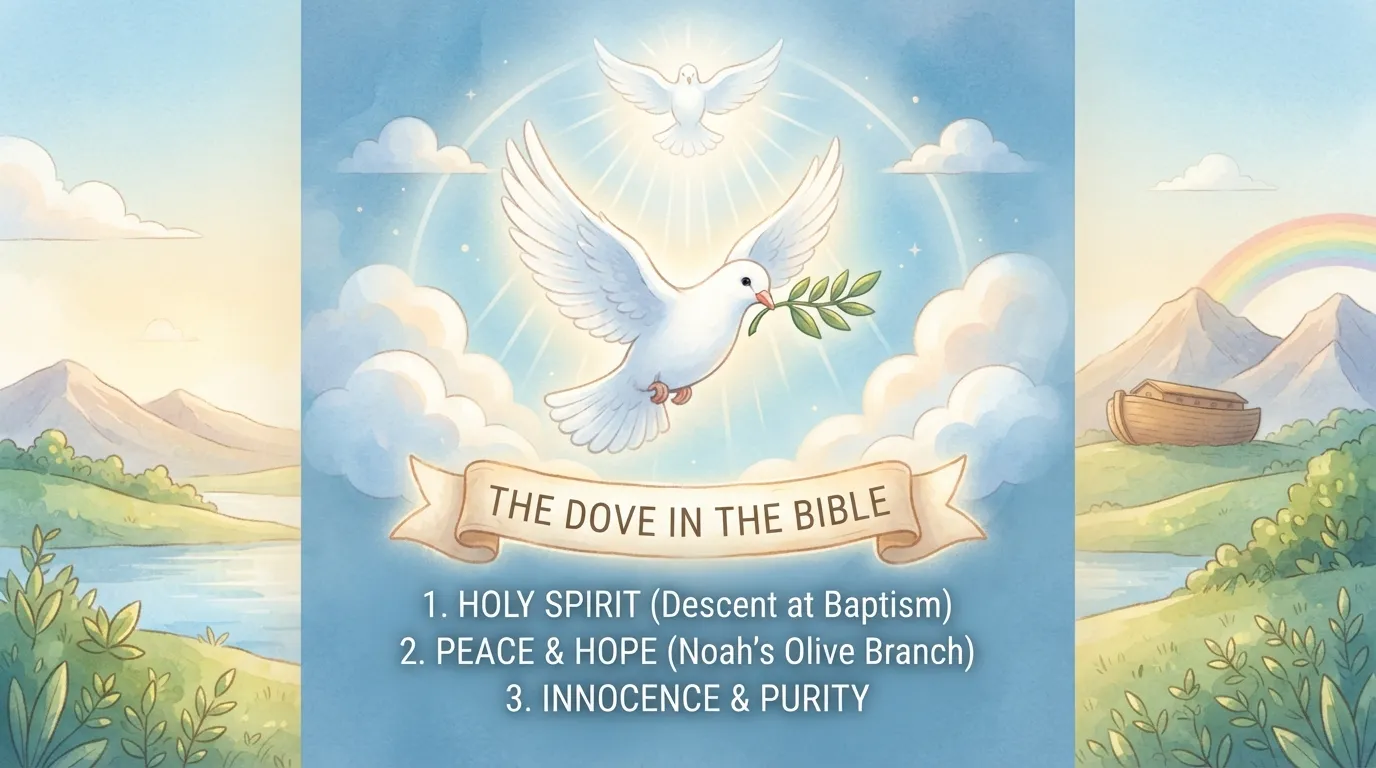
- Hope and new beginnings (Genesis 8)
- The Holy Spirit’s presence (Matthew 3:16)
- Innocence and gentleness (Matthew 10:16)
- Humble sacrifice (Luke 2:24)
- Love and tenderness (Song of Solomon)
- Sorrow and longing (Isaiah 38:14; Psalm 55:6)
When God Sends You a Dove?
Many people feel comforted when they see a dove during a hard time.
The Bible doesn’t teach that God sends doves as personal signs, so a dove sighting isn’t automatically a message.
If it brings you comfort, you can receive it as a moment to pray and reflect. For direction, the surest guide is Scripture, prayer, and wise counsel.
FAQs ❓
What does a dove symbolize in the Bible?
A dove can symbolize hope, gentleness, purity, humble sacrifice, love, or the Holy Spirit’s presence, depending on the passage. The Bible does not give it a single fixed meaning. Context decides what the bird represents in each verse. Reading each passage on its own is the safest approach.
Is the dove a symbol of peace in the Bible?
Not directly. The Bible never says the dove means peace. Noah’s dove brought an olive leaf, which signaled that the flood was over. Christians later connected the dove and olive branch with peace, but that link comes from tradition. It is a lovely association, not a stated teaching.
Why did the Holy Spirit appear as a dove at Jesus’ baptism?
The Gospels don’t explain it. Many readers see gentleness, a link to Noah’s hopeful dove, and a sign of the Father’s approval. Because the text says “like a dove,” most interpret it as a comparison for how the Spirit appeared.
Does Jonah mean dove?
Yes. The Hebrew name Jonah, Yonah, means “dove.” It is the same word used for the bird in Noah’s story. The Bible does not make a point of this connection, so it is an interesting word fact rather than a teaching.
What is the difference between a dove and a pigeon in the Bible?
The Bible often uses the same words for both. In Greek, peristera can be translated either way, and in Hebrew, yonah can be “dove” or “pigeon.” The difference you see usually depends on the English translation. Reading two translations side by side is helpful.
People Also Search For
Meaning of dove spiritual
Spiritually, the dove can mean the Holy Spirit’s gentle presence, hope, purity, and humble worship.
3 doves biblical meaning
The Bible assigns no meaning to three doves. Noah sent a dove out three times, and some link the number three to the Trinity by tradition.
Dove symbolism death
The Bible uses the dove’s moan as a picture of mourning. Releasing doves at funerals is a modern custom.
2 doves in the Bible
Two doves (or a pair of turtledoves or pigeons) were a humble offering, as in Luke 2:24.
Holy Spirit as a dove Bible verse
Matthew 3:16, Mark 1:10, Luke 3:22, and John 1:32.
How many times is dove mentioned in the Bible
It depends on the translation. Many English versions use “dove” or “doves” roughly 50 to 60 times.
Characteristics of a dove in the Bible
Gentle, harmless, mournful, swift, nesting in rocks, and returning home. A dove was also a humble offering.
Black dove meaning in the Bible
The Bible doesn’t mention black doves. Any meaning comes from folklore.
What is the spiritual meaning of dove?
Hope, gentleness, innocence, humble worship, love, and the Holy Spirit’s presence.
When God sends you a dove?
The Bible doesn’t teach that God sends doves as personal signs. If it comforts you, take it as a moment to pray.
What did Jesus say about doves?
He told his disciples to be innocent as doves (Matthew 10:16), and he overturned the seats of the dove sellers in the temple.
Do doves symbolize love?
In Song of Solomon, the dove is a poetic image of love and beauty. It’s not a doctrinal symbol of love.
More Questions About Doves in the Bible
Is the dove mentioned in the Bible?
Yes, many times, from Genesis to the Gospels.
What does the dove represent in the Bible?
Hope, gentleness, innocence, humble sacrifice, love, or the Holy Spirit, depending on the verse.
Does the Bible say doves are white?
No. The text never describes the dove’s color.
Does the dove always mean something positive?
No. Hosea 7:11 uses it for foolishness.
What does the dove with an olive branch mean?
It signaled the end of the flood in Noah’s story, and tradition links it with peace.
Dove biblical meaning in Hebrew?
The Hebrew word is “yonah,” related to a verb meaning “to moan.”
Dove biblical meaning in Greek?
The Greek word is “peristera.”
Is the Holy Spirit a dove?
No. The Gospels say the Spirit descended “like” a dove, which is a comparison.
Bible mein kabootar ka kya matlab hai?
Bible mein kabootar (dove) umeed, narmi, masoomiyat, aajizana qurbani, aur Rooh-ul-Quds ki mojoodgi ko dikhata hai. Iska ek hi fixed matlab nahi hai, jis aayat mein aaye wahi matlab tay karti hai.
Kya Bible mein kabootar amn ki nishani hai?
Seedha nahi. Bible kabootar ko amn ka matlab nahi deti. Ye jor baad ki Christian riwayat se aaya hai.
Conclusion 🌿
The dove is a small bird with a big place in Scripture. It brings Noah an olive leaf, carries the offerings of the people with low-income, and appears at Jesus’ baptism as a picture of the Spirit’s presence.
Its meaning isn’t fixed. In one verse it shows hope, in another sorrow, and in another innocence. That’s why the best way to understand the dove meaning in the Bible is to read each passage in its own setting.
The popular link between the dove and peace is a beautiful tradition, but it grew after the Bible was written. Knowing that helps you honor the symbol without adding to Scripture.
When you see a dove, let it point you back to the God who brings hope, welcomes the humble, and meets his people with gentle presence.

Hello, I’m Michael Bennett. I am passionate about exploring the symbolism, dreams, and spiritual messages found throughout the Bible. My research focuses on understanding how biblical themes connect with faith, personal growth, and everyday life.