Imagine returning home after decades of exile, only to find the sacred texts scattered and the community’s faith nearly forgotten. One man stepped into that gap and helped rebuild it all.
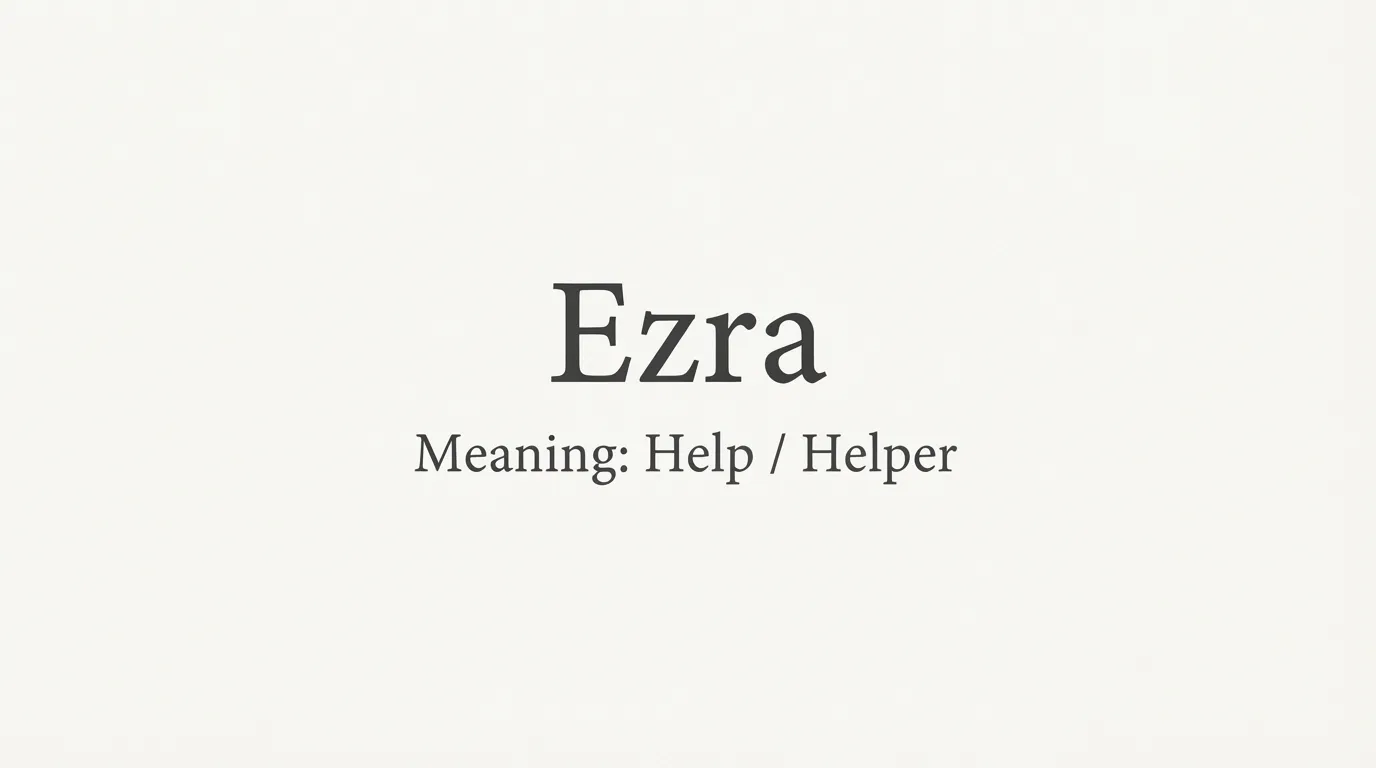
Ezra means “help” or “helper” in Hebrew, and the man who carried this name lived it out fully — a priest and scribe who helped restore God’s Word to a broken, scattered people.
Did You Know? 🔍
Ezra’s name likely began as a shortened form of the longer Hebrew name Azaryahu, meaning “Yah helps” — so even the compressed, everyday version of his name still quietly carries God’s presence within it.
Quick Answer 📖
What Does Ezra Mean in the Bible?
Ezra comes from the Hebrew root azar, meaning “to help” or “to support.” The name is typically translated as “help” or “helper.” In Scripture, Ezra was a priest and scribe who led a group of exiles back to Jerusalem and helped restore the Torah’s central place in Jewish worship after the Babylonian exile.
Biblical Meaning of Ezra 📜
Hebrew Meaning
The Hebrew name Ezra (עֶזְרָא) comes from the root azar (עזר), meaning “to help” or “to support.” This same root produces a whole family of biblical names, including Eleazar, Ebenezer, and Azariah — all carrying some form of God’s helping presence woven into them.
Literal Meaning
Literally, Ezra simply means “help.” Some scholars connect it to a shortened form of Azaryahu, meaning “Yah helps” or “the Lord helps” — suggesting the name always carried a quiet reminder that any true help ultimately comes from God.
Spiritual Meaning
Spiritually, Ezra’s name reflects a life devoted entirely to helping restore what had been lost — not physical rebuilding alone, but the spiritual foundation of an entire nation. His name and his calling matched perfectly: he was, in every sense, a helper of God’s people.
Biblical Significance
Ezra holds a unique place in Scripture as both a historical leader and the traditional author or compiler of several biblical books. His work didn’t just preserve history — it actively shaped how the Jewish community understood its own covenant relationship with God after returning from exile.
Key Scripture Reference
Ezra 7:10 — “For Ezra had set his heart to study the Law of the Lord, and to do it and to teach his statutes and rules in Israel.”
Historical & Biblical Context 🏛️
Old Testament Usage
Ezra appears as the central figure of the Book of Ezra, which recounts two waves of Jewish return from Babylonian exile — first under Zerubbabel, then later under Ezra himself. Ezra arrived in Jerusalem roughly eighty years after the first return, tasked by the Persian king Artaxerxes with teaching and enforcing the Law of Moses among the resettled community.
New Testament Relevance
While Ezra himself doesn’t appear by name in the New Testament, his legacy as a teacher devoted to Scripture set a pattern later echoed by figures like the scribes and teachers of the Law that Jesus frequently addressed. Ezra’s model — studying, practicing, then teaching God’s Word — reflects a rhythm the New Testament consistently upholds for spiritual leaders.
Cultural Understanding in Biblical Times
In the post-exilic period, Ezra’s role as both priest and scribe carried enormous weight. Scribes weren’t simply copyists; they were trained interpreters and teachers of the Law, responsible for making sure a scattered, traumatized community could reconnect with its covenant identity through Scripture.
Is Ezra Mentioned in the Bible? 📜
Yes, extensively. Ezra is the central figure of the Book of Ezra and is traditionally credited with authoring or compiling Ezra-Nehemiah and possibly the Books of Chronicles. Why it matters: Ezra’s leadership marks a turning point where the returned exiles recommitted themselves to God’s Law after generations of displacement. What it teaches: restoration isn’t only physical — rebuilding a temple matters less than rebuilding a people’s relationship with God’s Word, which was Ezra’s true life’s work.
Spiritual Meaning & Symbolism 📚
Exile vs. Restoration
Ezra’s story sits at the hinge point between judgment and restoration in Israel’s history. The exile represented consequences for generations of disobedience; Ezra’s return and teaching ministry represented God’s faithfulness to bring His people back and re-establish covenant life.
God’s Perspective
Ezra’s own prayer in Ezra 9 shows a leader who took personal ownership of his people’s sin, even sin he hadn’t personally committed. This reflects God’s desire for leaders who intercede on behalf of their community rather than simply managing it from a distance.
Lessons for Today
Ezra 7:10 offers a simple but demanding pattern still relevant today: study first, live it out second, then teach it to others. Skipping any one of these steps, Scripture suggests, produces a shallow or inconsistent faith.
Comparison Table: Ezra Alongside Related Hebrew Names
| Name | Hebrew Root | Meaning | Key Reference |
|---|---|---|---|
| Ezra | azar (help) | Help, helper | Ezra 7:10 |
| Eleazar | El + azar | God has helped | Exodus 6:23 |
| Ebenezer | eben + ezer | Stone of help | 1 Samuel 7:12 |
| Azariah | azar + Yah | The Lord has helped | 2 Kings 14:21 |
Biblical Verses About Ezra 📖
Ezra 7:6 “This Ezra went up from Babylonia. He was a scribe skilled in the Law of Moses that the Lord, the God of Israel, had given.” This verse establishes Ezra’s credentials from the outset — not a political appointee, but a genuinely skilled scholar of Scripture.
Ezra 7:10 “Ezra had set his heart to study the Law of the Lord, and to do it and to teach his statutes and rules in Israel.” This verse gives the clearest picture of Ezra’s life mission: study, obedience, then teaching — in that specific order.
Ezra 7:27-28 Ezra blesses God for putting it into the king’s heart to beautify the temple, recognizing God’s hand even in a foreign ruler’s decree.
This teaches that God can work through unexpected political circumstances to accomplish His purposes.
Ezra 9:5-6
Ezra falls on his knees and confesses the sins of the people as if they were his own, praying, “O my God, I am ashamed and blush to lift my face to you.”
This models deep, humble intercession rather than distant leadership.
Ezra 10:1
As Ezra prays and confesses, a great assembly of people gathers around him, weeping bitterly, showing how genuine spiritual leadership can stir authentic communal repentance.
Nehemiah 8:1-3
Ezra reads the Law aloud to the assembled people from early morning until midday, and “the ears of all the people were attentive.” This scene captures the deep hunger the returned exiles had for reconnecting with God’s Word.
Nehemiah 8:8
Ezra and the Levites “read from the book, from the Law of God, clearly, and they gave the sense, so that the people understood the reading.” This verse highlights the importance of clear, understandable teaching, not just recitation.
Real-Life Biblical Case Study 🕊️
Nehemiah 8 offers one of Scripture’s most moving pictures of Ezra in action.
Following the rebuilding of Jerusalem’s walls, the people gather as one and specifically ask Ezra to bring out the Book of the Law — they didn’t wait to be told; they wanted it themselves.
Ezra reads from daybreak until noon, standing on a specially built wooden platform so the entire assembly can see and hear him.
As he opens the book, the people stand together in a spontaneous act of reverence. When the reading brings the people to tears, likely from recognizing how far they’d drifted, Ezra and the Levites reassure them, saying, “Do not mourn or weep… the joy of the Lord is your strength” (Nehemiah 8:9-10). This single scene captures Ezra’s entire calling: bringing God’s people back into living relationship with His Word.
Life Lessons for Christians ✝️
True help starts with personal devotion. Ezra 7:10 shows that Ezra’s ability to help others flowed from his own disciplined study of Scripture first.
Confession can be communal, not just personal. Ezra’s prayer in chapter 9 models taking responsibility for a community’s spiritual state, not just individual sin.
Clear teaching matters as much as accurate content. Nehemiah 8:8 emphasizes that Ezra didn’t just read the Law — he made sure people actually understood it.
Restoration is rarely quick or easy. Ezra’s ministry took place across years of slow, careful rebuilding, both physically and spiritually.
A name can shape a calling. Ezra’s life became a living demonstration of what his name already meant — help, rooted in God’s own faithfulness.
Common Misunderstandings ⚠️
Some assume Ezra and Nehemiah were the same era or even worked side-by-side throughout their entire ministries, when in fact Ezra’s initial return preceded some of Nehemiah’s specific wall-building work, though their ministries did overlap and intersect, as seen together in Nehemiah 8.
Another common misunderstanding treats Ezra as primarily a builder like Nehemiah.
While Ezra supported the physical rebuilding efforts of Jerusalem, his primary calling and lasting legacy was spiritual and educational — restoring the Law’s central place in the community’s life, not construction itself.
Expert Insight 💡
When studying Ezra, read the Book of Ezra alongside Nehemiah 8 rather than treating them as separate storylines — Nehemiah 8 shows Ezra’s teaching ministry in vivid, specific action, filling out the more administrative narrative found in the Book of Ezra itself.
FAQs
What does the name Ezra mean?
Ezra means “help” or “helper” in Hebrew, coming from the root azar, meaning to help or support.
Who was Ezra in the Bible?
Ezra was a Jewish priest and scribe who led a group of exiles back to Jerusalem and worked to restore the Law of Moses as the center of the community’s spiritual life.
Did Ezra write the Book of Ezra?
Tradition credits Ezra with writing or compiling the Book of Ezra, and possibly Nehemiah and Chronicles as well, though certainty about ancient authorship always carries some scholarly debate.
What is Ezra 7:10 about?
It describes Ezra’s threefold commitment: to study God’s Law, to live it out personally, and then to teach it to others — a pattern often cited as a model for spiritual leadership.
How does Ezra’s story connect to Nehemiah?
Ezra focused primarily on spiritual and teaching restoration, while Nehemiah focused on rebuilding Jerusalem’s walls; their ministries overlapped, most visibly in the public reading of the Law in Nehemiah 8.
What does “Ezrahite” mean, and is it related to Ezra?
“Ezrahite” (as in “Ethan the Ezrahite” or “Heman the Ezrahite” in the Psalms) is a separate term describing a clan or family line, not a direct reference to Ezra the priest and scribe — the similar spelling is coincidental rather than a shared root.
What is the main message of the Book of Ezra?
The Book of Ezra centers on God’s faithfulness in restoring His exiled people, both physically bringing them back to Jerusalem and spiritually reconnecting them to His Law through Ezra’s teaching and leadership.
How is the name Ezra written in the Spanish Bible?
In Spanish Bible translations, the name is rendered “Esdras,” the same name used for the book itself in Spanish-language Scripture.
Conclusion
Ezra’s name and his life tell the same story: help, rooted not in personal ability but in devotion to God’s Word.
From his careful study to his public teaching to his tearful, humble prayers of confession, Ezra modeled what it looks like to genuinely restore a community’s relationship with God.
His example still challenges believers today to study first, live it out, and then help others do the same.

Hello, I’m Daniel Mercer. My passion for studying the Bible began many years ago when I started exploring the historical and spiritual meanings behind biblical names and symbols. Since then, I have dedicated countless hours to researching Scripture, ancient biblical traditions, and Christian teachings.