You’ve probably heard the name Michael your whole life, maybe it’s your own name, or a friend’s, or the name of a church down the street.
But behind the familiarity is one of Scripture’s most striking names, one built as a question rather than a statement.
Michael isn’t just a popular name; it’s tied to one of the Bible’s most distinct angelic figures, described as a protector, a “great prince,” and a leader in a heavenly battle.
Understanding what the name actually means, and where this figure appears in Scripture, adds real depth to a name many people use without ever asking what it says.
Did You Know? 🔍
Michael is one of only two angels named directly in the entire Protestant Bible, the other being Gabriel. A third angel, Raphael, appears by name in the Book of Tobit, which is part of Catholic and Orthodox Scripture but not the Protestant canon.
What Does Michael Mean in the Bible? 📖
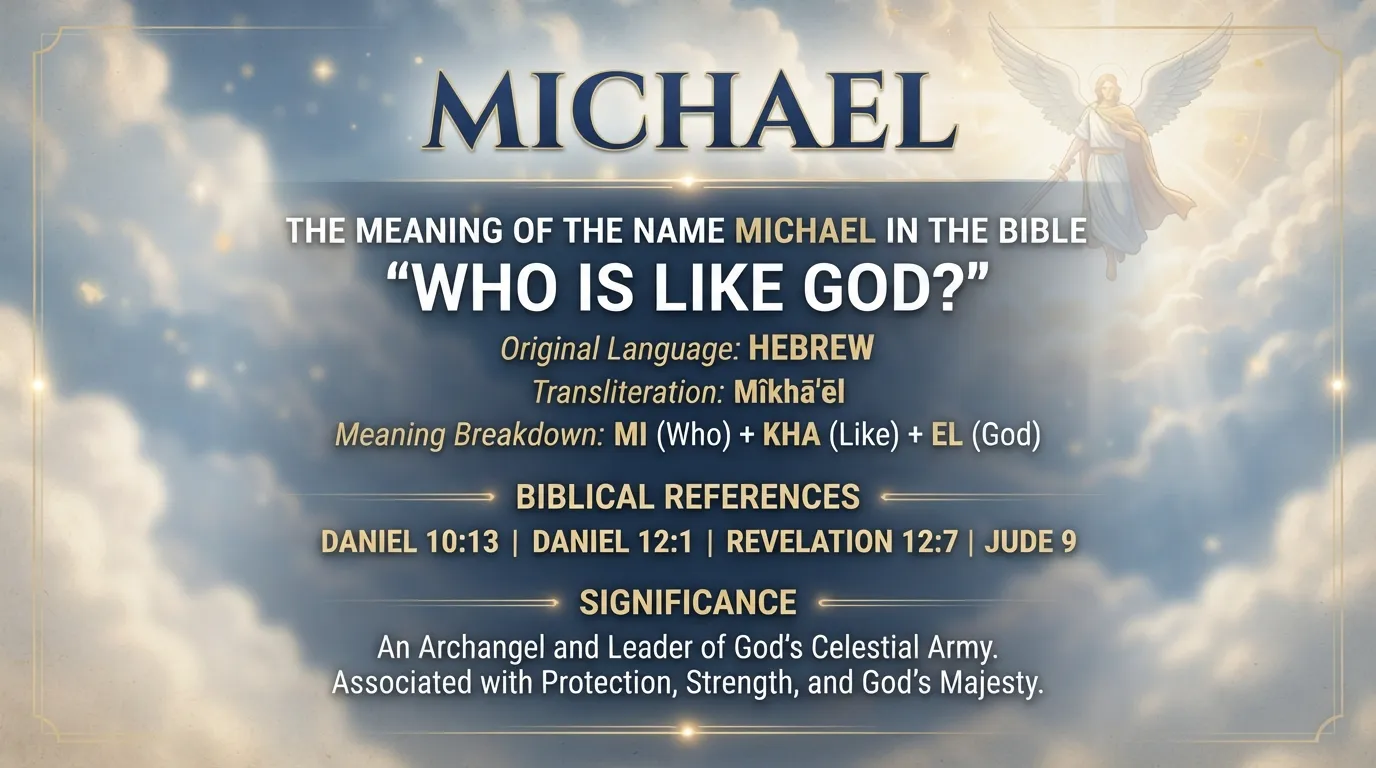
Michael is a Hebrew name, Mikha’el (מִיכָאֵל), meaning “Who is like God?” The name uses a rhetorical question rather than a direct statement. In other words, the implied answer is “no one.”
In Scripture, Michael appears as an archangel who protects God’s people and leads in spiritual conflict against evil. Therefore, his name and biblical role both point to God’s unmatched power and authority.
What Does “Archangel” Actually Mean?
“Archangel” comes from Greek roots meaning “chief” or “leading” angel.
It describes a position of authority among angels, not a separate type of spiritual being altogether.
Jude 9 is the only verse in Scripture that applies this specific title directly to Michael by name, calling him “the archangel Michael.”
So when people ask whether Michael is “an angel or an archangel,” the answer is both: he’s an angel who holds the specific rank of archangel.
Biblical Meaning of Michael 📜
Hebrew Meaning
The name breaks down into three Hebrew elements: mi (“who”), kha (“like”), and El (“God”). Together they form a rhetorical question built directly into the name itself, a structure shared with other Hebrew names like Micaiah.
Literal Meaning
Taken word for word, Michael means “Who is like God?” It isn’t asking for an answer; it’s making a statement of God’s incomparable uniqueness by posing it as an unanswerable question.
Spiritual Meaning
As a name carried by an archangel devoted to opposing evil and protecting God’s people, Michael carries a spiritual weight beyond ordinary names, functioning almost like a declaration of loyalty and humility before God.
Biblical Significance
Michael’s name matters because of what he does in Scripture, standing against opposition on Israel’s behalf and leading the fight against Satan in Revelation. The name and the role reinforce each other: a figure whose very identity asks “who compares to God?” is shown consistently defending God’s authority.
Historical & Biblical Context 🏺
Old Testament Usage
Michael appears by name in the Book of Daniel, described as “one of the chief princes” who comes to help in Daniel’s vision (Daniel 10:13) and as “the great prince who has charge of your people” (Daniel 12:1), specifically tied to protecting Israel.
New Testament Relevance
Michael appears twice more in the New Testament: in Jude 9, disputing with the devil over the body of Moses, and in Revelation 12:7-9, leading angels in battle against a dragon identified as Satan.
Cultural Understanding in Biblical Times
Names built as theological statements were common in the ancient Hebrew world; Michael fits a pattern where a name itself carried meaning about God, similar to names like Elijah (“My God is Yahweh”) or Immanuel (“God with us”).
Daniel’s Visions and Michael’s Role
The Book of Daniel is where Michael first appears by name, inside two separate visions given to the prophet.
In Daniel 10, Michael comes to assist another heavenly messenger who had been delayed by a spiritual conflict described as “the prince of the kingdom of Persia.”
In Daniel 12, Michael is described as the prince “who has charge of your people,” tied specifically to a future time of distress facing Israel.
Across both visions, Michael’s role is consistent: a powerful heavenly figure assigned specifically to Israel’s defense, acting within a larger spiritual conflict the text only partly explains.
Is Michael Mentioned in the Bible? 🔍
Yes, Michael appears by name four times total: twice in Daniel (10:13, 12:1), once in Jude (verse 9), and once in Revelation (12:7). Each appearance places him in a position of authority and conflict, defending, protecting, or actively fighting on behalf of God’s purposes.
Why it matters: unlike many names in Scripture used only once or twice in passing, Michael’s four appearances span both Testaments and consistently depict the same kind of role, suggesting a stable, well-recognized figure across centuries of biblical writing.
Spiritual Meaning & Symbolism ✨
A Name as a Question
Unlike many biblical names that state a truth outright, Michael’s structure as a rhetorical question is unusual and pointed. It doesn’t describe Michael himself so much as it points away from him, toward God’s incomparable nature.
God’s Perspective
Every appearance of Michael in Scripture shows him acting on God’s behalf rather than his own, resisting a hostile spiritual power in Daniel, disputing respectfully rather than presumptuously in Jude, and leading God’s armies rather than claiming personal glory in Revelation.
Lessons for Today
Michael’s name offers a quiet correction to self-importance: even a figure powerful enough to lead armies against Satan carries a name built around humility before God, not personal exaltation.
Michael: Where He Appears in Scripture 📊
| Reference | Testament | Role Described |
|---|---|---|
| Daniel 10:13 | Old Testament | “One of the chief princes,” aiding against opposition |
| Daniel 12:1 | Old Testament | “The great prince” who protects God’s people |
| Jude 9 | New Testament | Disputes with the devil over the body of Moses |
| Revelation 12:7 | New Testament | Leads angels in battle against the dragon (Satan) |
What Does Archangel Michael Look Like According to the Bible?
Scripture never gives a direct physical description of Michael himself.
The biblical text focuses entirely on his role and actions, not his appearance, clothing, or form.
Some readers connect him with the dazzling, powerful imagery used for other heavenly beings in Daniel and Revelation, but those specific descriptions aren’t written about Michael by name.
Any detailed visual image of Michael, like the armored warrior common in religious art, comes from later artistic and devotional tradition, not from a direct scriptural description.
Biblical Verses About Michael 📖
Daniel 10:13
“The prince of the kingdom of Persia withstood me twenty-one days, but Michael, one of the chief princes, came to help me.” This verse places Michael in a spiritual conflict tied to real political powers, showing him coming to aid another heavenly messenger.
Daniel 10:21
“There is none who contends by my side against these except Michael, your prince.” Michael is specifically identified here as Israel’s own prince, a defender assigned particularly to God’s people.
Daniel 12:1
“At that time shall arise Michael, the great prince who has charge of your people.” This verse ties Michael directly to a future time of distress, framing him as a protector who “arises” specifically when his people need defense.
Jude 1:9
“But when the archangel Michael, contending with the devil, was disputing about the body of Moses, he did not presume to pronounce a blasphemous judgment, but said, ‘The Lord rebuke you.'” This is the only place in Scripture where Michael’s actual words are recorded, and notably, he doesn’t rebuke Satan directly himself; he defers to God’s authority to do so.
Revelation 12:7
“Now war arose in heaven, Michael and his angels fighting against the dragon. And the dragon and his angels fought back.” This begins the most dramatic New Testament scene involving Michael, framing him as a military leader in direct cosmic conflict.
Revelation 12:8-9
“But he was defeated, and there was no longer any place for them in heaven. And the great dragon was thrown down, that ancient serpent, who is called the devil and Satan.” Michael’s fight results in Satan being cast out of heaven entirely, a decisive spiritual victory.
Real-Life Biblical Case Study: Michael’s Restraint in Jude 9 🕊️
Jude 9 offers a small but telling window into Michael’s character. Rather than issuing his own condemnation of the devil during their dispute over Moses’s body, Michael, despite being described as an archangel with real authority, defers entirely to God: “The Lord rebuke you.” He doesn’t claim the authority to pronounce judgment himself, even against Satan directly. It’s a striking contrast to how power is often displayed, real strength paired with restraint, and it echoes exactly what his name suggests: pointing toward God’s authority rather than asserting his own.
Life Lessons for Christians 🌱
Humility and strength aren’t opposites. Michael leads armies and disputes with the devil, yet consistently defers to God’s authority rather than his own.
Names can carry theology. Michael’s meaning, built as a rhetorical question, reflects a broader biblical pattern of naming that points people back toward God.
Protection in Scripture often comes through unseen means. Michael’s role as a protector of God’s people, largely unseen by those he defends, is a reminder that spiritual battles aren’t always visible.
Restraint under pressure reflects trust. Michael’s response in Jude 9 models restraint even in direct confrontation with evil.
Consistency across Scripture builds trust in the text. Michael’s role stays remarkably stable from Daniel through Revelation, spanning centuries of biblical writing.
Common Misunderstandings ⚠️
A common misunderstanding treats Michael and Satan as equal opposing forces, almost like rival gods. Scripture doesn’t support that framing; Michael acts as a created being under God’s authority, not an independent power matching Satan in status.
Common Misunderstanding
Another popular idea claims that Michael is the only true archangel. However, the Bible does not clearly support this claim. Jude 9 names Michael as an archangel, but Scripture does not say that he holds the only such position. Therefore, Christians continue to discuss this question from different theological perspectives.
Did Michael Die?
No. Scripture never describes Michael dying, and angels in general aren’t portrayed in the Bible as subject to death the way humans are.
Popular questions about “how St. Michael died” usually come from confusion with human saints and martyrs, whose stories do include death. Michael’s biblical story has no death narrative at all.
Expert Insight 💡
When you study Michael’s appearances, read Daniel 10–12 as one connected section. This approach helps you understand the political and spiritual imagery involving Persia and other “princes.”
For example, Daniel describes Michael’s role within a specific historical and spiritual conflict. Therefore, his appearance does not simply point to a vague or general spiritual role. Instead, the surrounding chapters give important context for understanding his position and purpose.
Michael vs Gabriel: What’s the Difference? ⚔️
Michael and Gabriel are the only two angels named directly in the Protestant Bible.
Gabriel is a messenger. Michael is a warrior and protector.
| Angel | Primary Role | Key Appearances |
|---|---|---|
| Michael | Protector, warrior, “great prince” | Daniel 10, 12; Jude 9; Revelation 12 |
| Gabriel | Messenger | Daniel 8, 9; Luke 1 |
Neither ranks above the other in Scripture; their roles are simply distinct.
Michael Meaning: Non-Religious Context 💬
Outside Scripture, Michael simply means “who is like God” in Hebrew.
Most parents today choose the name for its sound and popularity, not its literal meaning, similar to names like Daniel or Sarah.
Michael: Personality Traits Associated with the Name
Baby-name sites and popular culture often attach personality traits to the name Michael, such as leadership, strength, and loyalty.
These associations come from the name’s long history and its biblical connection to a protector figure, not from any scientific link between a name and someone’s character.
If the name has any real “meaning” for a person today, it’s more about family tradition or personal connection than a guaranteed personality trait.
How Is Michael Written and Pronounced in Hebrew? 🔤
In Hebrew, the name is written מִיכָאֵל (Mikha’el).
It breaks down as: מִי (mi, “who”), כָ (kha, “like”), אֵל (El, “God”).
Michael in Other Languages
The name itself doesn’t translate into a different word in other languages; it’s typically transliterated, keeping its Hebrew-based sound.
In Malayalam, the name is commonly written as മൈക്കിൾ, and in Kannada as ಮೈಕಲ್, both simply representing the sound of “Michael” rather than translating its meaning.
The underlying meaning, “who is like God,” stays the same no matter which language or script is used to write the name.
Is Michael a Patron Saint? 🛡️
In Catholic and Orthodox tradition, Michael is venerated as a saint, associated with protection and warriors.
September 29 is Michaelmas, a feast day honoring Michael, Gabriel, and Raphael.
This veneration is specific to Catholic/Orthodox practice, not Protestant Scripture.
What Does Saint Michael Protect People From, According to Catholic Tradition?
In Catholic devotional tradition, the well-known “Prayer to St. Michael” asks for protection against the devil and the “snares of the devil,” along with general spiritual danger and evil influence.
This prayer is a Catholic devotional practice rather than a direct biblical text, though it draws on Michael’s scriptural role as a defender against Satan in Revelation 12.
Michael in Islamic Tradition ☪️
Michael also appears in Islam as Mika’il, mentioned in the Quran (Surah Al-Baqarah 2:98) alongside Gabriel (Jibril).
In Islamic belief, Mika’il is linked to provision and sustenance, unlike his warrior role in Christian Scripture.
Common Variants and Forms of the Name Michael 🌍
Micah / Mica – shortened Hebrew form
Miguel – Spanish/Portuguese form
Mikhail / Mikhael – Russian/Slavic form
Michel – French form
Mikael – Scandinavian form
What Do Michael’s Variants Mean in the Bible? 🌐
Mikhail — Russian/Slavic form; same meaning, “who is like God”
Mikel — Basque/Scandinavian variant of the same root
Mikael — Scandinavian/Finnish form of מִיכָאֵל
Miguel — Spanish/Portuguese form, same Hebrew origin
All are linguistic descendants of one Hebrew original, not separate figures.
FAQs
What does the name Michael mean?
Michael means “Who is like God?” in Hebrew, a rhetorical question implying that no one compares to God.
Is Michael an angel or an archangel in the Bible?
He’s specifically called an archangel in Jude 9, the only place in Scripture that uses that exact title for him by name.
How many times is Michael mentioned in the Bible?
Four times: twice in Daniel (10:13, 12:1), once in Jude (verse 9), and once in Revelation (12:7).
What does Michael do in the Book of Revelation?
He leads angels in a heavenly battle against a dragon identified as the devil and Satan, resulting in Satan being cast out of heaven (Revelation 12:7-9).
Is Michael the same as Jesus in the Bible?
No, Scripture doesn’t identify Michael as Jesus. This idea has appeared in some historical theological discussions and specific religious traditions, but it isn’t the position reflected in the biblical text itself.
Is Michael mentioned in Genesis or Exodus?
No. His earliest appearance is in the Book of Daniel, written much later.
What is Michael’s feast day?
September 29, known as Michaelmas, honoring Michael, Gabriel, and Raphael.
Is Michael more powerful than Satan?
Revelation 12 shows Michael defeating the dragon, but he acts under God’s authority, not independent power.
Does the name Michael appear in Islam?
Yes, as Mika’il in the Quran, linked to provision rather than warfare.
What are common variants of the name Michael?
Micah, Miguel, Mikhail, Michel, and Mikael are the most common variants.
What does Michael mean in a non-religious sense?
It’s simply a common personal name; its Hebrew meaning isn’t usually a factor today.
How do you write Michael in Hebrew?
מִיכָאֵל (Mikha’el) — “who,” “like,” and “God” combined.
Does Mikhail mean the same thing as Michael in the Bible?
Yes, it’s the Russian transliteration with the identical meaning.
What does Mikel mean in the Bible?
Mikel is a regional variant of Michael, sharing the same Hebrew root and meaning.
Is Miguel mentioned in the Bible?
Not by that spelling — Miguel is the Spanish/Portuguese form of Michael.
Is “Mike” short for Michael, and does it mean the same thing?
Yes. “Mike” is simply an informal nickname for Michael and carries the same Hebrew meaning, “who is like God.”
Did Michael die, like some stories about saints describe?
No. The Bible gives no account of Michael dying. Angels aren’t portrayed in Scripture as dying the way human saints and martyrs do.
What does Saint Michael protect you from?
In Catholic devotional tradition, prayers to Saint Michael ask for protection from the devil and spiritual danger, drawing on his biblical role as a defender against Satan.
Conclusion
Michael’s name asks a question it never expects anyone to actually answer: who is like God?
That same posture, pointing away from himself and toward God’s authority, shows up consistently in every biblical appearance, from defending Israel in Daniel to deferring to God’s judgment in Jude to leading the decisive battle in Revelation.
It’s a name that carries real weight, not because of what it claims about Michael, but because of what it insists about God.

Hello, I’m Samuel Carter. My interest in biblical studies comes from a lifelong desire to understand the wisdom and teachings contained within Scripture. I particularly enjoy researching biblical numbers, patterns, and themes that appear throughout God’s Word.