Some names carry a scriptural pedigree stretching back to Hebrew or Greek. Aiden isn’t one of them, and that’s worth saying plainly before exploring what makes it meaningful anyway.
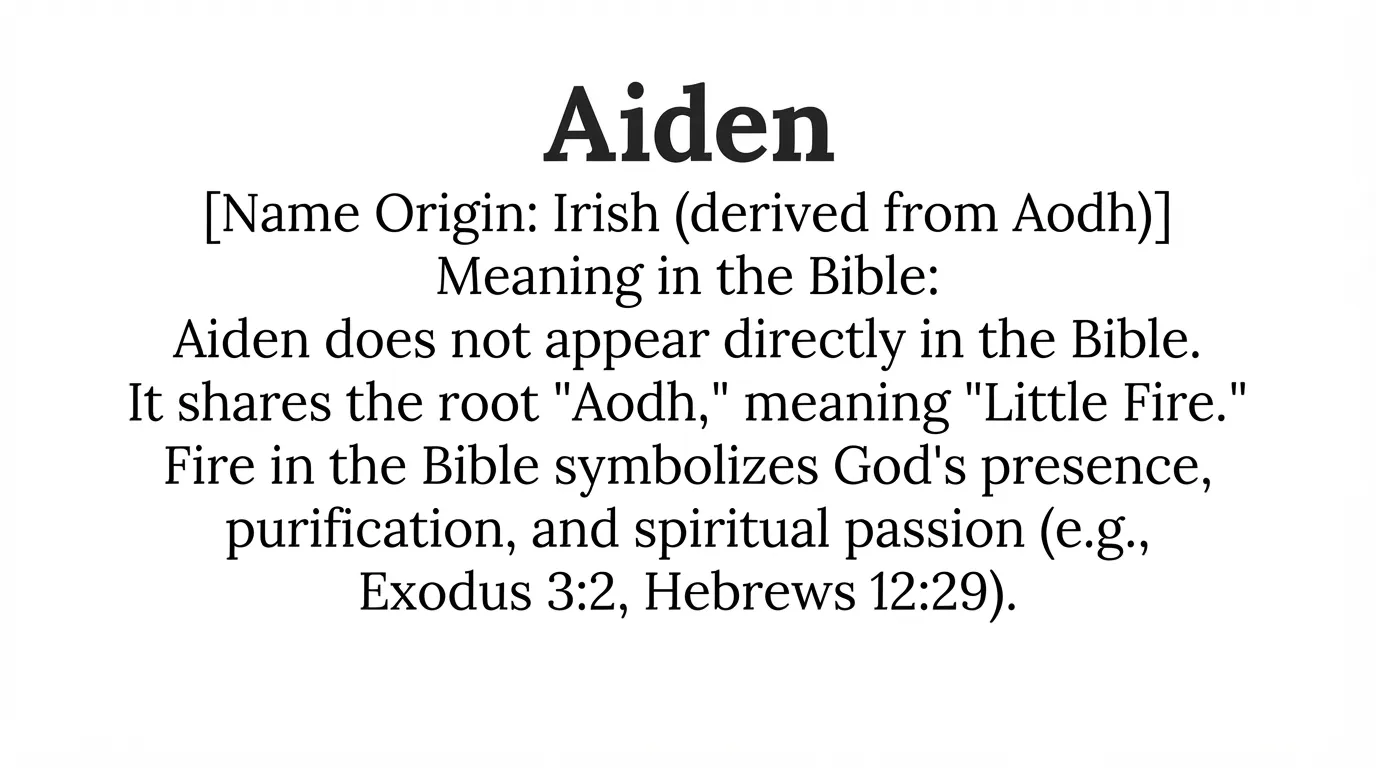
Aiden does not appear in the Bible. It comes from Irish Gaelic, meaning “little fire,” and while it holds no direct scriptural origin, its imagery connects naturally to fire symbolism found throughout Scripture.
Did You Know? 🔍
Aiden traces back to the Irish Gaelic name Aodhán, a diminutive of Aodh, the name of the Celtic god of sun and fire in pre-Christian Irish mythology, later carried forward into Christian Ireland through figures like Saint Aidan of Lindisfarne.
Quick Answer 📖
What Does Aiden Mean in the Bible?
Aiden has no direct biblical meaning because it isn’t a Hebrew, Aramaic, or Greek name found in Scripture. It comes from Irish Gaelic, from the name Aodhán, meaning “little fire.” While not scriptural in origin, its fire imagery echoes biblical themes like God’s presence, purification, and the Holy Spirit.
Aiden Name Meaning and Origin at a Glance 🌍
What Does the Name Aiden Mean?
Aiden means “little fire” or “fiery one.”
That is the short definition of the name, and it matches the Irish Gaelic roots described above.
Aiden Name Origin and Etymology
The origin of the name Aiden is Irish Gaelic. It is an Anglicized form of Aodhán.
In etymology terms, Aodhán is a small, affectionate form of Aodh, a name linked to fire.
Aiden Meaning in the Bible: Fire, Faith and Verse
Aiden isn’t in the Bible, but its meaning of fire connects to many verses.
The most common pairing is Hebrews 12:29, “For our God is a consuming fire.”
Faith is where the name gets its spiritual weight, even though the origin is Irish, not biblical.
What Does Aiden Stand For?
Aiden doesn’t stand for a phrase or an abbreviation. It is a full given name meaning “little fire.”
Is Aiden a Word?
Aiden is not a standard dictionary word. It is a given name, so its meaning comes from its Irish origin.
How Do You Pronounce Aiden?
In English, Aiden is pronounced “AY-den.”
The Irish form Aodhán sounds closer to “AY-awn.”
How Do You Spell Aiden?
Aiden, Aidan, Ayden, and Aden are all common spellings.
Aidan is the older, more traditional form. Aiden is the more modern version, and the meaning is the same.
Biblical Meaning of Aiden 🔥
Hebrew Meaning
Aiden has no genuine Hebrew root or meaning. It cannot be meaningfully translated into Hebrew; it can only be transliterated phonetically for use in Hebrew-speaking contexts. Parents seeking an actual Hebrew name with similar “fire” imagery sometimes consider names like Uri (“my light” or “my fire”) or Ner (“candle” or “lamp”).
Aiden Meaning in Greek
Like Hebrew, Greek has no genuine word or name that translates to “Aiden.” The name cannot be found in the Greek New Testament or the Greek Septuagint, since its origin is Irish Gaelic, centuries removed from either language.
Parents interested in a Greek word tied to fire imagery sometimes point to pyr (πῦρ), the Greek word for fire, used in passages like Acts 2:3’s description of tongues of fire at Pentecost. This is a thematic connection only, not a linguistic one.
Literal Meaning
Literally, Aiden means “little fire” or “fiery one.” It’s the Anglicized form of the Irish Gaelic Aodhán, itself a diminutive of Aodh, tied to the ancient Celtic deity associated with sun and fire, long before Christianity reached Ireland.
Spiritual Meaning
While Aiden’s origin is not biblical, many Christian families find genuine spiritual resonance in its fire symbolism. Throughout Scripture, fire consistently represents God’s presence, purification, and the empowering work of the Holy Spirit, themes that pair naturally, if symbolically, with Aiden’s literal meaning.
Biblical Significance
Aiden’s significance in a Christian context is entirely symbolic rather than textual. It doesn’t carry inherited scriptural weight the way names like David or Caleb do; instead, its meaning offers an opportunity for parents to connect a name’s imagery to biblical themes intentionally.
Key Scripture Reference
Hebrews 12:29, “For our God is a consuming fire.” This verse is often paired with the name Aiden for its fire symbolism, though it should be understood as thematic connection, not a direct scriptural reference to the name itself.
Aiden in Hebrew, Greek, Islam and Other Faiths 🌐
What Does Aiden Mean in Hebrew?
Aiden has no meaning in Hebrew. The name is Irish, so there is no Hebrew word behind it.
The same is true for the spellings Aidan and Ayden. Hebrew speakers can only write the sound of the name.
Aidan in Greek
Aidan has no Greek meaning either. The only link to Greek is the thematic word pyr, meaning fire.
Aiden Meaning in Islam
Aiden is not an Arabic or Islamic name. It does not appear in the Quran.
Some Muslim families in Western countries use it as an everyday given name. Its origin stays Irish.
Is Aiden a Christian Name?
Aiden is not a biblical name, but it has real Christian history.
Saint Aidan, a seventh-century Irish monk, helped spread Christianity in northern England. Many Christian families choose the name for that reason.
Is Aiden a Catholic Name?
Yes, it can be. Saint Aidan of Lindisfarne is honored in the Catholic Church, and his feast day is August 31.
The Catholic Bible doesn’t include the name Aiden, so the answer to “is it in the Bible” stays the same.
Historical & Biblical Context 🍀
Old Testament Usage
Aiden does not appear anywhere in the Old Testament. As an Irish Gaelic name, it belongs entirely to a Celtic linguistic and cultural tradition, separate from Hebrew scripture.
New Testament Relevance
Aiden likewise does not appear in the New Testament. However, fire imagery appears prominently in New Testament passages like Acts 2:3, describing “tongues of fire” resting on believers at Pentecost, a passage frequently cited when explaining Aiden’s symbolic, rather than literal, connection to Scripture.
Cultural Understanding in Biblical Times
Since Aiden originates from post-biblical Irish Gaelic culture, it has no cultural footing in the ancient Near Eastern world of Scripture. Its historical significance instead comes through early medieval Christian Ireland, particularly through Saint Aidan of Lindisfarne, a seventh-century Irish monk known for his gentle evangelism.
Is Aiden Mentioned in the Bible? 📜
No, Aiden is not mentioned anywhere in the Bible.
Why it matters: being honest about this distinction matters more than forcing a false scriptural connection, since accuracy protects trust between a resource and the families relying on it.
What it teaches: a name doesn’t need direct scriptural origin to carry genuine spiritual meaning for a Christian family. Symbolic resonance, chosen intentionally, can still be meaningful without being misrepresented as biblical fact.
Is There an Aiden in the Bible?
No. There is no person named Aiden, Aidan, or Ayden in Scripture.
Is Aiden a Biblical Name?
No. Aiden is not a biblical name, and the same goes for Aidan and Ayden.
Are There Irish Names in the Bible?
No. The Bible was written in Hebrew, Aramaic, and Greek, so it contains no Irish Gaelic names.
Aiden’s Irish meaning of “little fire” comes from a later culture.
Aiden vs. Eden
Eden is a sound-alike that is in the Bible. It names the garden in Genesis 2:8 and is often explained as “delight.”
Eden and Aiden have different origins, and the two names are not related.
Spiritual Meaning & Symbolism 🕯️
Literal Fire vs. Spiritual Fire
Scripture uses fire in two distinct ways: as literal, physical fire (like the burning bush in Exodus 3) and as symbolic representation of God’s presence, judgment, or the Holy Spirit’s work. Aiden’s meaning connects more naturally to the symbolic uses of fire found throughout the Bible.
God’s Perspective
Fire in Scripture often signals something significant is happening in God’s presence, purification, calling, or empowerment. While Aiden itself isn’t biblical, parents drawn to this symbolism are tapping into a genuinely rich scriptural theme, even without a direct textual link.
Lessons for Today
Believers can appreciate Aiden’s fire imagery as an invitation toward spiritual passion and devotion, understanding clearly that this connection is thematic and intentional, not an inherited biblical meaning.
Comparison Table: Aiden vs. Genuinely Biblical Fire-Related Names 📊
| Name | Origin | Meaning | Appears in the Bible? |
|---|---|---|---|
| Aiden | Irish Gaelic | Little fire | No |
| Uri | Hebrew | My light / my fire | Yes (Exodus 31:2) |
| Ner | Hebrew | Candle / lamp | Yes (1 Samuel 14:50) |
| Elijah | Hebrew | The Lord is my God | Yes (1 Kings 17:1) |
Aiden vs. Aidan, Ayden, Eiden, Aedan, and Alden: Are These the Same Name? 🔤
Aiden, Aidan, Ayden, Eiden, and Aedan are all spelling variations of the same underlying Irish Gaelic name, Aodhán. None of them carry any more or less biblical weight than the others; they’re pronunciation-driven spelling choices, not different names with different origins.
Alden is different. It’s an unrelated English surname-turned-first-name, from Old English words meaning “old friend” or “old wise protector.” It sounds similar to Aiden but has no connection to the Irish Aodh or to fire symbolism at all.
For Christian parents comparing spellings, the honest answer is simple: choose whichever spelling you like, since all Aiden variants share the same non-biblical Irish origin and the same fire-related meaning.
More Spellings and Sound-Alike Names People Search 🔍
Ayden Meaning in the Bible and in Hebrew
Ayden is another spelling of Aiden.
The Ayden is not in the Bible and has no Hebrew meaning.
Its meaning is the same: “little fire.”
Eiden, Iden, Adien, Aeden and Aedan
These are spelling variations of Aiden, and most are just typing or pronunciation differences.
None of them is biblical.
Aden
Aden is often used as a spelling of Aiden. It is also the name of a city in Yemen.
Aden is not a biblical name.
Alden in the Bible
Alden is not in the Bible. It is an English name, and its meaning has nothing to do with fire.
Hayden
Hayden is an English surname from an Old English place name, often explained as “hay valley” or “hedged valley.”
It is not in the Bible, and it has no connection to Aiden’s Irish origin.
Ayan and Ayaan
Ayan and Ayaan are used in South Asia, Somalia, and the Middle East, with different meanings in each language.
Neither is a biblical name.
Afeni
Afeni is an African name, often explained as “lover of people.”
It does not appear in the Bible.
Adlin
Adlin has several possible origins, depending on the family tradition.
It is not found in Scripture.
Aegon
Aegon is a fantasy name made famous by the series Game of Thrones.
It is not a Bible name.
Biblical Verses About Fire 📖
Exodus 3:2
God appears to Moses in a burning bush that is “not consumed,” marking one of Scripture’s most iconic literal appearances of fire representing God’s holy presence.
Acts 2:3
At Pentecost, “divided tongues as of fire” rest on each believer, symbolizing the outpouring and empowering presence of the Holy Spirit on the early church.
Hebrews 12:29
“For our God is a consuming fire.” This verse describes God’s holiness and purifying nature using direct fire imagery, often cited alongside names like Aiden for symbolic connection.
Malachi 3:2-3
God is compared to a “refiner’s fire,” purifying His people the way fire purifies precious metal, a common image for spiritual refinement and growth.
Matthew 3:11
John the Baptist describes Jesus as one who will baptize “with the Holy Spirit and fire,” connecting fire directly to spiritual transformation and empowerment.
Revelation 1:14
Christ’s eyes are described as “a flame of fire” in this vision, portraying His penetrating awareness and holiness.
Bible Verse and Spiritual Meaning of Aiden 🕊️
Is There a Bible Verse for the Name Aiden?
No verse mentions Aiden by name.
The verses about fire above are the closest thematic match, especially Hebrews 12:29.
What Is the Spiritual Meaning of the Name Aiden?
Spiritually, Aiden’s “little fire” can point to passion, devotion, and the Holy Spirit.
This is a personal, symbolic reflection, not a biblical meaning.
Names That Aren’t in the Bible but Still Carry Meaning
Many good names are not in the Bible. Aiden is one of them.
A name can still carry faith, history, and purpose without a scriptural origin.
Real-Life Historical Case Study 🕊️
While Aiden has no biblical case study, its most notable Christian historical bearer offers a meaningful parallel. Saint Aidan of Lindisfarne, a seventh-century Irish monk, was sent from the island monastery of Iona to reintroduce Christianity to Northumbria in northern England.
His approach reflected exactly what his name’s fire imagery suggests: not a destructive blaze, but a small, steady flame capable of gradually spreading warmth and light across an entire region.
Life Lessons for Christians ✝️
A name’s spiritual meaning doesn’t require biblical origin. Aiden shows that symbolic connections to Scripture can be genuine without claiming false scriptural roots.
Honesty matters more than a compelling narrative. Overstating a name’s biblical connection, even with good intentions, isn’t the same as genuine scriptural teaching.
Fire imagery calls believers toward passionate, purified faith. Whatever a name’s origin, Scripture’s fire imagery consistently points toward devotion and spiritual refinement.
Small, steady faithfulness can have lasting impact. Saint Aidan’s quiet, patient ministry mirrors the “little fire” meaning of his name.
Symbolic meaning can still shape identity intentionally.
Common Misunderstandings ⚠️
A common misunderstanding claims Aiden has a “hidden” biblical meaning or direct scriptural translation.
Another misunderstanding assumes Aiden’s association with the ancient Celtic fire god Aodh makes the name spiritually problematic for Christians.
Expert Insight 💡
When researching any name’s “biblical meaning,” always check whether the name actually appears in Hebrew, Aramaic, or Greek scriptural texts before accepting claims of direct biblical origin. Many popular baby-name sites blur this distinction between genuine scriptural names and names with only symbolic or thematic connections.
Aiden Meaning in Other Languages 🌐
Readers search for this name in many languages. The answer is the same in all of them: it is an Irish name, not a biblical one.
Aiden en Español
¿Qué significa Aidan en la Biblia? Aidan no aparece en la Biblia. Es un nombre irlandés que significa “pequeño fuego.”
Aiden en français
Aiden signification biblique : le prénom Aiden n’est pas biblique. Il vient de l’irlandais et signifie “petit feu.”
ایڈن کا مطلب
معنی Aiden: ایڈن آئرش نام ہے جس کا مطلب “چھوٹی آگ” ہے۔
یہ نام بائبل میں نہیں آتا اور نہ ہی قرآن میں۔
FAQs
Does the name Aiden appear in the Bible?
No, Aiden does not appear anywhere in the Bible. It originates from Irish Gaelic, not from Hebrew, Aramaic, or Greek scripture.
What does the name Aiden mean?
Aiden means “little fire” or “fiery one,” coming from the Irish Gaelic name Aodhán, a diminutive of Aodh, the Celtic god of sun and fire.
Can Aiden still be a meaningful name for a Christian child?
Yes, many Christian families choose it for its fire symbolism, which connects thematically to biblical concepts like God’s presence and the Holy Spirit, even without direct scriptural origin.
Who was Saint Aidan of Lindisfarne?
He was a seventh-century Irish monk known for his humble, patient evangelism in reintroducing Christianity to northern England, often cited as a notable Christian bearer of the name.
Is there a Hebrew name similar to Aiden’s meaning?
Yes, names like Uri (“my light” or “my fire”) or Ner (“candle” or “lamp”) carry similar fire-related imagery and do have genuine Hebrew biblical roots.
What is the difference between Aiden and Aidan?
There is no meaningful difference. Both are spelling variations of the same Irish Gaelic name, Aodhán, and share the same “little fire” meaning and non-biblical origin.
Is Aiden a Jewish name?
No, Aiden is not a Jewish name. It has no Hebrew root and doesn’t appear in Jewish scripture; its origin is Irish Gaelic, entirely separate from Hebrew naming traditions.
What does Aiden mean in Greek?
Aiden has no Greek meaning or origin. It doesn’t appear in Greek scripture; any connection to Greek is limited to the thematic link between “fire” (pyr) and Aiden’s Irish meaning.
Is Alden the same name as Aiden?
No. Despite sounding similar, Alden is an unrelated English name meaning “old friend,” while Aiden comes from Irish Gaelic and means “little fire.” They have entirely different origins.
Is there an Aiden in the Bible?
No. There is no Aiden, Aidan, or Ayden in the Bible.
Is Aiden a biblical name?
No. Aiden is an Irish name, so it is not a biblical name.
What does Aiden mean in Hebrew?
Aiden has no Hebrew meaning. Its meaning of “little fire” comes from Irish Gaelic.
What does Aiden mean in the Bible?
Aiden has no meaning in the Bible because the name isn’t in it. Its fire imagery only connects to biblical themes.
Is Aiden a Christian name?
Aiden is widely used by Christian families, and Saint Aidan gives it Christian history. It is not a biblical name.
Is Aiden a Catholic name?
Yes, it can be. Saint Aidan of Lindisfarne is honored in the Catholic Church, with a feast day on August 31.
What does Aiden mean in Islam?
Aiden has no meaning in Islam. It is an Irish name that is not found in the Quran.
What is the spiritual meaning of the name Aiden?
Spiritually, Aiden’s “little fire” can symbolize devotion and the Holy Spirit. This is a symbolic meaning, not a biblical one.
Is there a Bible verse for the name Aiden?
No verse names Aiden. Hebrews 12:29 is the verse most often paired with it for the fire theme.
Is Ayden a biblical name?
No. Ayden is a spelling of Aiden and shares its Irish origin.
Is Alden in the Bible?
No. Alden is an English name, and it does not appear in the Bible.
Is Hayden in the Bible?
No. Hayden is an English name from an Old English place name.
Is Jennifer a biblical name?
No. Jennifer is a Cornish name and is not found in the Bible.
How do you pronounce Aiden?
Aiden is pronounced “AY-den” in English.
What does Aiden stand for?
It doesn’t stand for anything. Aiden is a full given name meaning “little fire.”
Is Aiden an Irish name?
Yes. Aiden is an Anglicized form of the Irish name Aodhán.
Conclusion
Aiden isn’t a biblical name, and no amount of symbolic connection changes that fact, but that doesn’t make it meaningless for Christian families.
Its Irish Gaelic meaning, “little fire,” genuinely echoes themes of God’s presence and the Holy Spirit found throughout Scripture, even without a direct textual link.
Choosing Aiden isn’t claiming a biblical name; it’s choosing a name whose imagery can meaningfully point toward faith, as long as that connection is understood honestly.
Meta Description: Is Aiden in the Bible? Discover its true Hebrew and Greek meaning, how it compares to Aidan, Ayden, and Alden, and its biblical fire symbolism.

Hello, I’m Jonathan Reed. I have a strong interest in biblical interpretation and Christian education. Over the years, I have spent significant time studying Scripture and researching its historical context to better understand its teachings and messages.