You’re drawn to the name Avery, then find yourself wondering if it holds any real biblical connection.
It has a strong, modern sound, gender-neutral and increasingly popular for both kids.
The honest answer is straightforward: Avery isn’t found in Scripture, and its actual roots are far from biblical.
This article traces Avery’s real Old English and Germanic origins, its meaning, and how it can still connect honestly to Christian reflection.
Did You Know? 🔍
Avery’s meaning, “ruler of elves,” traces back to medieval European folklore, where elves were viewed not as playful creatures but as beings of hidden wisdom and foresight, making the name a compliment about someone’s judgment and counsel.
Quick Answer 🎯
What Does Avery Mean in the Bible?
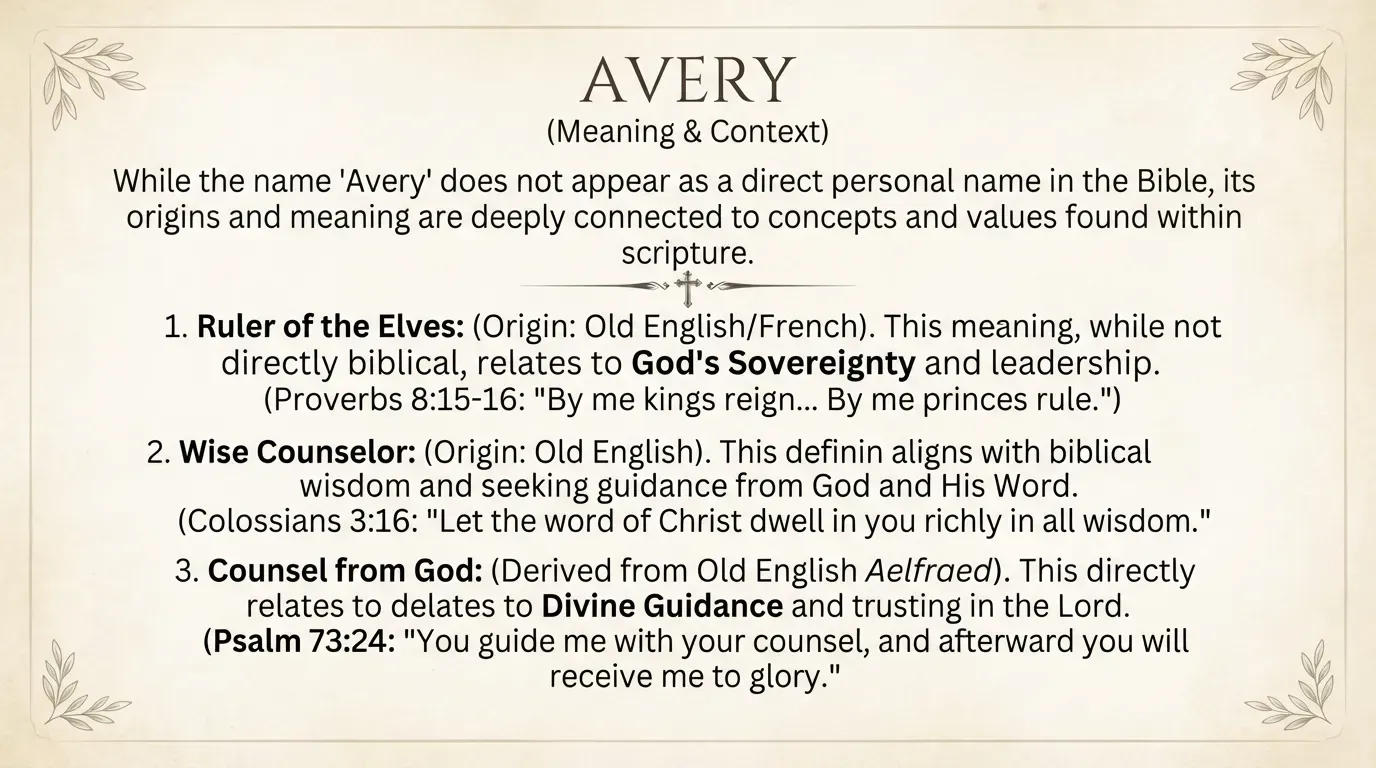
Avery is not a name that appears in Scripture. It comes from the Old English and Germanic names Ælfric and Alberich, meaning “elf ruler” or “elf counsel,” often interpreted as “wise counselor.” While not biblical, its meaning of wisdom and counsel echoes themes Scripture consistently celebrates.
Biblical Meaning of Avery 📖
Understanding Avery’s connection to Christian themes starts with honestly tracing its Germanic, not biblical, roots.
Old English and Germanic Meaning
Avery descends from two related names: the Old English Ælfred (Alfred), built from ælf (“elf”) and ræd (“counsel”), and the Germanic Alberich, from alb (“elf”) and rih (“ruler”).
Together, these roots produce meanings like “elf counsel” or “ruler of elves,” later softened in interpretation to “wise counselor.”
Avery Meaning in Hebrew
Avery has no Hebrew root or origin. It cannot be found in the Hebrew Bible, since its actual history traces to Old English and Germanic sources, entirely separate from the Hebrew language. Any “Hebrew meaning” claimed for Avery online should be treated with caution, since no genuine Hebrew word or name corresponds to it.
Avery Meaning in Greek
Avery likewise has no Greek origin or meaning. It doesn’t appear in the Greek New Testament or Septuagint. Like its Hebrew connection, any claimed Greek meaning for Avery is not linguistically accurate; the name simply postdates biblical Greek by many centuries.
Literal Meaning
Literally, Avery describes someone associated with elvish wisdom, a name that carried genuine respect in medieval European culture.
Spiritual Meaning
Spiritually, many Christians connect Avery’s “wise counselor” meaning to Scripture’s frequent praise of godly wisdom and sound counsel.
This connection is symbolic rather than textual, since the name itself never appears in Hebrew or Greek Scripture.
Biblical Significance
The name carries no direct biblical significance, but the wisdom theme behind it aligns naturally with Scripture’s teaching on counsel.
Key Scripture Reference
Proverbs 2:6 says, “For the Lord gives wisdom; from his mouth come knowledge and understanding.”
Avery Meaning: Birds? Where That Idea Comes From
Some searches ask whether Avery has a connection to birds, and it’s worth addressing directly.
Avery has no genuine etymological link to birds. Its real roots, Old English and Germanic, point to “elf” and “counsel” or “ruler,” nothing related to birds at all.
The confusion likely comes from how the name sounds, similar to “aviary” (a bird enclosure) or the Latin root “avis,” meaning bird. That’s a plausible explanation for the association, not a documented origin.
So while the sound-alike connection is understandable, Avery’s real, verified meaning stays entirely separate from birds.
How to Pronounce Avery
Avery is typically pronounced AY-vuh-ree, with the stress on the first syllable.
Pronunciation stays the same regardless of the spelling variation used, whether Avery, Averie, Averi, or Averly.
Historical & Biblical Context 🏛️
Understanding Avery’s honest relationship to Christian faith requires tracing its medieval English surname history.
Old Testament and New Testament Usage
Avery does not appear anywhere in either the Old or New Testament; it is a post-biblical English and Germanic name.
Scripture does, however, discuss wisdom and counsel extensively, the very themes Avery’s meaning evokes.
Surname to Given Name History
Avery began as an English surname, itself derived from the Norman French pronunciation of the older names Alberich or Alfred.
It later transitioned into a given name, first common for boys before becoming increasingly popular for girls in recent decades.
Cultural Understanding of the Name’s Popularity
Avery ranked 13th among girls’ names in the United States by 2012, reflecting a dramatic modern rise from relative obscurity decades earlier.
Its gender-neutral appeal and strong, clean sound have made it one of the most popular “A” names for American children today.
Is Avery Mentioned in the Bible? 📜
No, the name Avery does not appear anywhere in the biblical text.
Where the Name Comes From Instead
Avery’s roots trace to Old English and ancient Germanic languages, entirely separate from Hebrew or Greek biblical sources.
Why It Matters
Being clear about this distinction matters for trustworthy content: Avery is a medieval English surname, not a scriptural name.
What It Teaches
It teaches that a name’s meaning can still resonate with biblical values, wisdom and counsel, without needing biblical origin.
Is Avery a Jewish Name?
No. Avery isn’t Hebrew in origin, and it has no documented connection to Jewish naming tradition.
As with many modern Western names, Jewish families in Europe and America have still used Avery as an everyday given name, separate from any Hebrew religious name used in faith life.
Is Avery an Islamic Name?
No. Avery has no root in Arabic and no connection to the Quran.
Some Muslim families in Western countries do use Avery as a modern given name, the same way it’s used across many different faith backgrounds, without any specific Islamic religious meaning attached.
Spiritual Meaning & Symbolism 🕊️
Avery’s “wise counselor” imagery offers genuine spiritual reflection, even without direct biblical roots.
Human Wisdom vs. Divine Wisdom
Medieval folklore attributed wisdom to elves as mystical, otherworldly beings with hidden knowledge.
Scripture instead locates true wisdom in God alone, offered freely to those who genuinely seek it.
Folklore vs. Scripture
It’s worth separating appreciation for a name’s meaning and history from any claim that Scripture itself addresses elvish folklore.
Some online sources stretch this connection further than the evidence supports, worth approaching with healthy discernment.
God’s Perspective
While Scripture never addresses the name Avery directly, it consistently celebrates the wisdom and sound counsel the name’s meaning suggests.
Lessons for Today
Someone named Avery can find genuine encouragement in Scripture’s promise that true wisdom comes from seeking God directly.
📊 Quick Comparison: Name vs. Symbol
| The Name “Avery” | Wisdom Themes in Scripture |
|---|---|
| Old English/Germanic, from Ælfric and Alberich | Hebrew chokmah, wisdom as a gift from God |
| Meaning: “elf ruler,” “wise counselor” | Proverbs 2:6, James 1:5, Colossians 2:3 |
| Rooted in medieval European folklore | Rooted throughout Old and New Testament teaching |
| Not found in biblical text | A consistent, repeated biblical theme |
Avery, Averly, Averie, and Averi: Are These Different Names? 🔤
Averly, Averie, and Averi are modern spelling variations of Avery, not separate names with their own origins. All of them trace back to the same Old English and Germanic roots, Ælfric and Alberich, and share the identical “wise counselor” meaning.
None of these spellings carry any more biblical weight than the others, since the underlying name itself remains outside Scripture regardless of how it’s spelled.
Similar Names People Also Search 🔎
People looking into Avery’s meaning often search for a few similar-sounding names too. None of these trace to Avery’s own Old English root, and none appear in Scripture either.
| Name | Actual Origin | Biblical? |
|---|---|---|
| Ava | Possibly Latin (“avis,” bird) or Germanic, origin debated | No |
| Amelia | Germanic (work, industriousness) | No |
| Aubrey | Old French/Germanic, related to Alberich, similar root to Avery | No |
| Audrey | Old English (“æthel” + “thryth,” noble strength) | No |
| Arie / Aryah | Hebrew-adjacent spelling, sometimes linked to “Ari” (lion), origin debated | Debated |
Aubrey is the closest relative here, sharing the same Germanic root, Alberich, that Avery itself comes from.
Biblical Verses About Wisdom and Counsel ✝️
These verses trace Scripture’s teaching on the wisdom theme connected to Avery’s meaning.
Proverbs 2:6
“For the Lord gives wisdom; from his mouth come knowledge and understanding.”
This verse locates the true source of wisdom directly in God, rather than in human cleverness or hidden knowledge.
It sets up wisdom as a gift received, not a trait people generate purely through their own effort or cunning.
The lesson redirects Avery’s “wise counselor” theme toward its proper biblical source: God’s generous giving.
This remains one of Scripture’s clearest statements on where genuine wisdom actually originates.
James 1:5
“If any of you lacks wisdom, let him ask God, who gives generously to all without reproach, and it will be given him.”
James offers a direct, practical invitation: wisdom is available simply by asking God for it honestly.
This verse emphasizes God’s generous, non-judgmental willingness to provide wisdom to anyone who genuinely seeks it.
The lesson encourages believers to actively pray for wisdom rather than relying solely on personal experience or intuition.
Proverbs 15:22
“Without counsel plans fail, but with many advisers they succeed.”
This proverb emphasizes the practical value of seeking wise counsel from multiple trusted sources before major decisions.
It connects directly to the “counsel” half of Avery’s Old English meaning, though from a biblical rather than folkloric angle.
The lesson encourages humility in decision-making, valuing community wisdom over isolated self-reliance.
Colossians 2:2-3
“In whom are hidden all the treasures of wisdom and knowledge.”
Paul locates the deepest possible wisdom not in mystical folklore, but specifically in Christ Himself.
This verse reframes the entire search for “hidden wisdom” that ancient elf-folklore once represented, pointing believers toward Christ instead.
The lesson offers a fitting redirection: whatever wisdom Avery’s name folklore once symbolized, Scripture locates its true source in Jesus.
1 Kings 3:9
“Give your servant therefore an understanding mind to govern your people, that I may discern between good and evil.”
Solomon’s prayer for wisdom, rather than wealth or long life, became the model for godly leadership throughout Scripture.
God’s positive response to this request shows His pleasure when people seek wisdom above other, more self-serving gifts.
The lesson connects directly to Avery’s “ruler” meaning, offering Solomon’s humble request as a better model of godly leadership.
Proverbs 12:15
“The way of a fool is right in his own eyes, but a wise man listens to advice.”
This proverb contrasts foolish self-confidence with genuine wisdom’s willingness to receive correction and counsel.
It reinforces the value Avery’s name places on “counsel,” reframed through a biblical lens of humility rather than mystique.
The lesson challenges readers to actively welcome advice rather than assuming their own judgment is always sufficient.
Isaiah 9:6
“His name shall be called Wonderful Counselor, Mighty God, Everlasting Father, Prince of Peace.”
This prophecy about Christ includes the title “Wonderful Counselor,” the ultimate source of wise guidance.
Christians see this fulfilled in Jesus, whose counsel and wisdom surpass any folklore tradition of elvish wisdom.
The lesson points directly to Christ as the true “wise counselor” behind every good and godly decision.
Real-Life Biblical Case Study: Solomon’s Prayer for Wisdom 🌟
1 Kings 3 records a pivotal moment early in Solomon’s reign as king over Israel.
God appeared to Solomon in a dream and made a remarkable offer: “Ask what I shall give you” (1 Kings 3:5).
Rather than requesting wealth, long life, or victory over his enemies, Solomon asked for wisdom to govern well.
“Give your servant therefore an understanding mind,” he prayed, “that I may discern between good and evil” (3:9).
God was pleased with this request precisely because Solomon hadn’t asked for self-serving gifts.
He granted Solomon “a wise and discerning mind, so that none like you has been before you” (3:12).
This wisdom became legendary, demonstrated famously when Solomon discerned the true mother in a difficult custody dispute.
Solomon’s story offers a fitting biblical picture connected to Avery’s meaning: true counsel and rulership flow from humbly seeking God’s wisdom.
Life Lessons for Christians 🙏
While Avery isn’t a biblical name, its “wise counselor” meaning offers genuine, practical lessons for believers today.
True wisdom comes from God. Proverbs 2:6 redirects any search for hidden wisdom back to its actual, biblical source.
Ask directly for wisdom. James 1:5 offers a simple, practical invitation to pray honestly when facing difficult decisions.
Seek counsel humbly. Proverbs 15:22 and 12:15 both emphasize the value of receiving advice rather than relying solely on self.
Christ is the ultimate counselor. Isaiah 9:6 and Colossians 2:3 both point to Jesus as wisdom’s truest, deepest source.
Godly leadership starts with humility. Solomon’s example shows that requesting wisdom, not power, is what God delights to honor.
Common Misunderstandings ⚠️
Several points of confusion surround Avery’s connection to the Bible online.
Modern misuse: Some websites claim Avery is a “biblical name,” which isn’t accurate; it’s a Germanic and Old English name with folklore, not scriptural, roots.
Cultural confusion: A few sources fabricate direct biblical genealogy connections that don’t hold up under verification; treat such claims with caution.
Wrong interpretations online: Certain articles attach elaborate spiritual narratives to Avery that Scripture never actually contains.
Correct biblical explanation: Avery is a medieval English name meaning “wise counselor,” symbolically connected to Scripture’s wisdom teaching, but not itself a biblical name.
💡 Expert Insight
When researching a modern name’s “biblical meaning,” be especially cautious of sites that claim specific, uncommon verse references without providing the exact citation. Cross-check any surprising claim against a reliable source like BibleHub before trusting it.
FAQs ❓
Is Avery a biblical name?
No, Avery doesn’t appear in Scripture. It’s an Old English and Germanic name meaning “elf ruler” or “wise counselor.”
What does the name Avery actually mean?
Avery means “ruler of elves” or “elf counsel,” derived from the names Ælfric and Alberich, often interpreted as “wise counselor.”
Where does the name Avery come from?
Avery began as an English surname derived from Norman French pronunciations of the older Germanic names Alberich and Alfred.
Does Avery have spiritual meaning for Christians?
While not a scriptural name, many Christians find encouragement in its “wise counselor” meaning, connecting to Scripture’s wisdom teaching.
Is Avery used for both kids?
Yes, Avery is a gender-neutral name in modern usage, though historically it was used primarily as a name and surname for boys.
What does Avery mean in Hebrew?
Avery has no Hebrew meaning or origin. It comes from Old English and Germanic roots, not Hebrew, so it cannot be genuinely translated into or traced through Hebrew Scripture.
What does Avery mean in Greek?
Avery has no Greek meaning or origin either. It doesn’t appear in the Greek New Testament or Septuagint, since its roots are entirely Old English and Germanic.
Is Averly or Averie the same name as Avery?
Yes. Averly and Averie are modern spelling variations of Avery, sharing the same Old English and Germanic origin and the same “wise counselor” meaning.
What does Avery mean for a girl specifically?
Avery carries the same meaning regardless of gender, “wise counselor” or “elf ruler.” It became popular as a girl’s name more recently, but its meaning doesn’t change based on who’s given the name.
Is Avery a Jewish name?
No. Avery has no Hebrew origin, though Jewish families, like many others, have used it as an everyday given name.
Is Avery an Islamic name?
No. Avery has no root in Arabic and no connection to the Quran, though some Muslim families use it as a modern given name regardless.
Does Avery mean anything related to birds?
No. Avery’s real meaning is “elf ruler” or “wise counselor,” from Old English and Germanic roots. The bird association likely comes from its sound resembling “aviary” or the Latin “avis,” not from any real etymological link.
Tiene el nombre Avery un significado bíblico?
No, Avery no es un nombre bíblico. Viene del inglés antiguo y del germánico, con el significado “consejero sabio” o “gobernante de elfos,” sin ninguna raíz hebrea o griega real.
Conclusion 🌿
The Avery meaning in the Bible requires an honest clarification: the name itself isn’t found in Scripture at all.
Rooted in Old English and Germanic tradition, it carries a meaningful sense of “wise counsel” that echoes themes Scripture celebrates often.
Someone named Avery can hold onto that connection honestly, without needing to claim the name itself appears in the biblical text.
Wisdom, counsel, and humble leadership remain real, meaningful themes worth reflecting on, name and Scripture together.
May the same wisdom Solomon prayed for so long ago mark your own decisions and leadership today.

Hello, I’m Samuel Carter. My interest in biblical studies comes from a lifelong desire to understand the wisdom and teachings contained within Scripture. I particularly enjoy researching biblical numbers, patterns, and themes that appear throughout God’s Word.