You fall in love with the name Olivia, then wonder if it carries any real biblical weight.
It sounds classic, even timeless, and something about it feels like it should connect to Scripture.
The truth is a little more nuanced than a simple yes or no.
Olivia isn’t a name found written in the Bible, but its roots trace back to a symbol Scripture returns to again and again.
This article explains exactly what the name Olivia means, where it comes from, and how it connects honestly to biblical symbolism.
Did You Know? 🔍
The olive was one of the “Seven Species” specifically named in Deuteronomy 8:8 as a defining crop of the Promised Land.
It’s listed alongside wheat, barley, grapes, figs, pomegranates, and honey.
Quick Answer 🎯
What Does Olivia Mean in the Bible?
Olivia is not a name that appears directly in Scripture.
It comes from the Latin word oliva, meaning “olive tree,” popularized by Shakespeare’s Twelfth Night.
While the name itself isn’t biblical, the olive tree it’s rooted in is one of Scripture’s most significant symbols of peace, blessing, and renewal.
Biblical Meaning of Olivia 📖
Understanding Olivia’s connection to the Bible means separating the name itself from the powerful symbol behind it.
Latin and Greek Roots
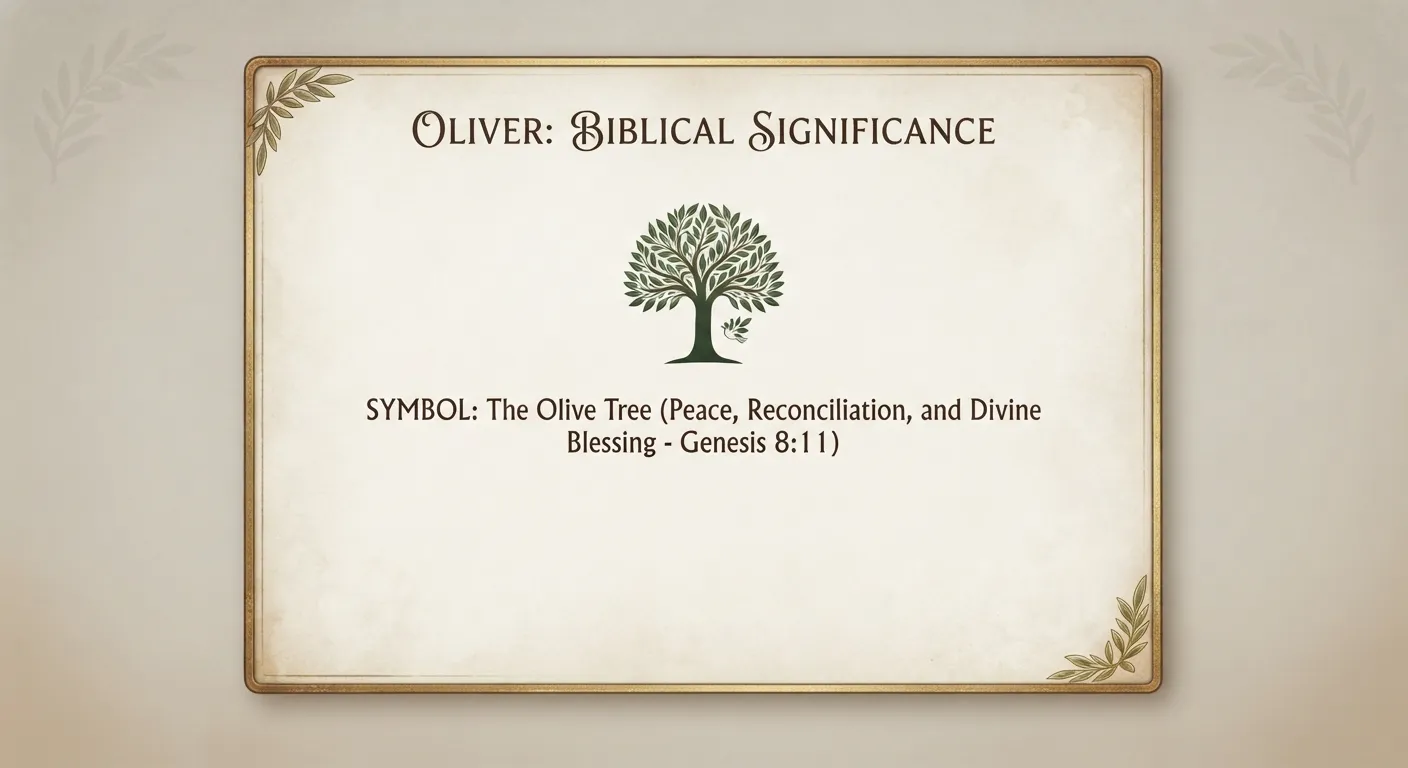
Olivia comes from the Latin oliva, meaning “olive tree,” and functions as the feminine form of Oliver.
The name doesn’t appear in Hebrew or Greek biblical manuscripts; it was popularized centuries later, most famously by Shakespeare in 1601.
Literal Meaning
Literally, Olivia means “olive tree” or “of the olive,” a direct nature-based name rather than a biblical proper noun.
Spiritual Meaning
Spiritually, many Christians connect Olivia to the olive tree’s rich biblical symbolism: peace, anointing, and steady endurance.
This connection is symbolic rather than textual, since Scripture never interprets the name Olivia specifically.
Biblical Significance
The olive tree itself carries genuine, well-documented biblical significance, appearing throughout both the Old and New Testaments.
Key Scripture Reference
Genesis 8:11 records the moment Noah’s dove returned “with a freshly plucked olive leaf,” signaling the flood’s end and a new beginning.
Historical & Biblical Context 🏛️
To understand Olivia’s connection to Scripture honestly, it helps to trace how the olive tree functioned throughout biblical history.
Old Testament Usage
The olive tree appears repeatedly in the Old Testament, from Noah’s dove to the golden lampstand’s oil in the Tabernacle.
Olive oil was used to anoint kings and priests, marking them as set apart for God’s specific purpose, as seen in 1 Samuel 16:13.
Psalm 52:8 poetically compares a trusting believer to “a green olive tree in the house of God,” an image of stability and flourishing.
New Testament Relevance
The Mount of Olives became one of the most significant locations in Jesus’s ministry, including His agonized prayer before the crucifixion (Luke 22:39-44).
Paul uses olive tree imagery in Romans 11:17-24, describing Gentile believers as branches grafted into God’s cultivated olive tree.
Cultural Understanding in Biblical Times
Olive trees grew slowly but lived remarkably long lives, sometimes centuries, making them natural symbols of endurance and lasting faithfulness.
Olive oil served practical purposes too: lighting lamps, cooking, and medicinal use, making the tree deeply woven into daily biblical-era life.
Is Olivia Mentioned in the Bible? 📜
No, the specific name Olivia does not appear anywhere in Scripture.
Where the Olive Tree Appears
While Olivia isn’t a biblical name, the olive tree appears throughout Genesis, Exodus, Psalms, Isaiah, and the New Testament Gospels.
Why It Matters
Being honest about this distinction matters for trustworthy content: the name is not biblical, though its symbolic root certainly is.
What It Teaches
It teaches that meaningful spiritual connection doesn’t always require a name to appear word-for-word in Scripture.
Olivia’s Meaning Across Languages and Traditions
What does Olivia mean in Latin?
Question: What does Olivia mean in Latin?
Answer: Olivia comes directly from the Latin word oliva, meaning “olive” or “olive tree” — its true linguistic origin.
What does Olivia mean in Greek?
Question: What does Olivia mean in Greek?
Answer: Olivia isn’t a Greek-origin name. Its root is Latin, though the olive tree itself appears in Greek New Testament passages like Romans 11.
What is Olivia’s meaning in Hebrew?
Question: What is Olivia’s meaning in Hebrew?
Answer: Olivia itself isn’t a Hebrew name. The Hebrew word for “olive tree,” zayit, is the closest biblical-language connection to its symbolism.
What does Olivia mean in Islam?
Question: What does Olivia mean in Islam?
Answer: Olivia isn’t a traditional Islamic name, but the olive holds real significance in Islamic tradition too — it’s mentioned in the Quran (Surah At-Tin) as a symbol of blessing.
Does Olivia mean anything different in Spanish or French?
Question: Does Olivia mean anything different in Spanish or French?
Answer: No — Olivia keeps the same Latin “olive tree” meaning in Spanish and French, where it’s also a popular given name.
Does Olivia have a specific meaning in Catholic tradition?
Question: Does Olivia have a specific meaning in Catholic tradition?
Answer: There’s no distinct Catholic-specific meaning. Catholic tradition shares the same olive tree symbolism of peace and blessing found throughout Scripture.
Spiritual Meaning & Symbolism 🕊️
The olive tree’s symbolism offers real spiritual substance, even though the name Olivia itself remains outside Scripture.
Judgment vs. Peace
Noah’s dove returning with an olive leaf marked the definitive end of God’s judgment through the flood.
That single image transformed the olive branch into history’s most enduring symbol of peace and restored relationship.
Ordinary vs. Anointed
Olive oil transformed ordinary people into anointed kings and priests, set apart for God’s specific calling and purpose.
This imagery invites reflection on how God calls and equips people for meaningful, purposeful lives.
God’s Perspective
While God never speaks about the name Olivia, Scripture consistently uses the olive tree to represent His faithfulness and provision.
Lessons for Today
Someone named Olivia can find genuine encouragement in these themes, understanding the honest distinction between name and symbol.
📊 Quick Comparison: Name vs. Symbol
| The Name “Olivia” | The Olive Tree in Scripture |
|---|---|
| Latin origin, from oliva | Hebrew zayit, mentioned throughout the Old Testament |
| Popularized by Shakespeare (1601) | Present from Genesis through the New Testament |
| Not found in biblical text | One of the Bible’s most repeated natural symbols |
| Modern given name | Ancient symbol of peace, anointing, and endurance |
Biblical Verses About the Olive Tree ✝️
These verses trace the olive tree’s meaning throughout Scripture, the symbol behind Olivia’s name.
Genesis 8:11 “And the dove came back to him in the evening, and behold, in her mouth was a freshly plucked olive leaf.”
This verse marks the moment Noah learned the floodwaters were finally receding after the great judgment.
The olive leaf became the very first recorded symbol of peace and restoration in all of Scripture.
The lesson shows that even after seasons of genuine hardship, God provides clear signs of renewal and hope.
This image has echoed through history ever since as the universal symbol of peace.
Psalm 52:8 “But I am like a green olive tree in the house of God. I trust in the steadfast love of God forever and ever.”
David uses this image to describe genuine spiritual stability, contrasted with the wicked man described earlier in the psalm.
A green, thriving olive tree pictures someone whose life remains rooted, fruitful, and sustained by God’s presence.
The lesson encourages believers to root their stability in God’s steadfast love rather than shifting circumstances.
This verse remains one of the most quoted in connection with olive tree symbolism today.
Exodus 27:20
“You shall command the people of Israel that they bring to you pure beaten olive oil for the light, that a lamp may regularly be set up to burn.”
This verse establishes olive oil’s essential role in keeping the Tabernacle’s lamp continually lit before the Lord.
The image of oil producing steady light connects naturally to ideas of guidance, presence, and illumination.
The lesson reflects how ordinary, practical resources were used for genuinely sacred purposes throughout Israel’s worship.
1 Samuel 16:13 “Then Samuel took the horn of oil and anointed him in the midst of his brothers. And the Spirit of the Lord rushed upon David.”
This verse records David’s anointing as king, using olive oil to mark him as God’s chosen leader.
Anointing with oil consistently symbolized being set apart for a specific, God-given calling throughout the Old Testament.
The lesson shows that being “anointed” involves genuine purpose and divine equipping, not merely ceremonial ritual.
Luke 22:39-41
“And he came out and went, as was his custom, to the Mount of Olives… and he withdrew from them about a stone’s throw, and knelt down and prayed.”
This passage describes Jesus’s agonized prayer at Gethsemane, located on the Mount of Olives, before His arrest.
The location’s name itself, tied to olive groves, sits at the center of one of Scripture’s most emotionally significant moments.
The lesson reveals that even in genuine anguish, Jesus modeled turning directly toward the Father in prayer.
Romans 11:17-18 “But if some of the branches were broken off, and you, although a wild olive shoot, were grafted in among the others…”
Paul uses olive tree imagery to describe how Gentile believers were grafted into God’s ongoing covenant story with Israel.
This metaphor emphasizes both genuine inclusion and appropriate humility for those grafted into an already-established tree.
The lesson encourages gratitude rather than pride, since grafted branches depend entirely on the tree’s own root system.
Zechariah 4:2-3
“I see a lampstand all of gold… and two olive trees by it, one on the right of the bowl and the other on its left.”
This vision connects olive trees directly to God’s ongoing provision of light and empowerment for His people.
The imagery suggests continuous supply, oil flowing naturally to keep the lamp burning without interruption.
The lesson points to God’s sustained, faithful provision for those He calls to specific purpose and ministry.
Real-Life Biblical Case Study: Noah’s Dove and the Olive Leaf 🌟
Genesis 8 records humanity’s first great symbol of hope after judgment: an olive leaf carried by a returning dove.
After months confined in the ark, Noah sent out a dove to test whether the floodwaters had receded.
The first time, the dove found nowhere to land and returned to the ark, showing the waters hadn’t yet subsided.
Noah waited seven more days and sent the dove out again, this time watching closely for any sign of hope.
That evening, the dove returned carrying “a freshly plucked olive leaf,” proof that dry land and new growth had emerged.
Genesis 8:11 records this exact detail, marking one of Scripture’s most quietly powerful moments of relief and renewal.
This single olive leaf became the foundation for one of history’s most enduring symbols: peace after judgment, hope after hardship.
It shows that even after seasons that feel endless, God provides clear, tangible signs that restoration has begun.
Life Lessons for Christians 🙏
While Olivia isn’t a biblical name, its olive tree roots offer genuine, practical lessons for believers today.
- Peace follows judgment. Noah’s dove reminds believers that God’s story consistently moves toward restoration, not permanent judgment.
- Rootedness produces flourishing. Psalm 52:8 pictures spiritual stability as staying rooted in God’s steadfast love, not shifting circumstances.
- Calling comes with purpose. David’s anointing shows that being set apart by God always connects to genuine, meaningful purpose.
- Prayer belongs in anguish. Jesus’s example at the Mount of Olives shows turning toward God even during life’s hardest moments.
- Inclusion invites humility. Paul’s grafted-branch imagery in Romans 11 reminds believers that spiritual belonging rests on grace, not merit.
Common Misunderstandings ⚠️
Several points of confusion surround Olivia’s connection to the Bible online.
Modern misuse: Some websites claim Olivia is a “biblical name,” which isn’t technically accurate; it’s a name with biblical symbolic roots, not a scriptural name itself.
Cultural confusion: A few sources exaggerate direct connections, implying Scripture specifically discusses the name, when it discusses only the olive tree.
Wrong interpretations online: Certain articles attach elaborate, specific spiritual meanings to the name itself that Scripture never actually states.
Correct biblical explanation: Olivia is a Latin-origin name symbolically connected to the olive tree, one of the Bible’s most significant and consistent natural symbols.
💡 Expert Insight
When researching whether any modern name is “biblical,” always distinguish between names that appear directly in Scripture (like Sarah or David) and names symbolically connected to biblical themes (like Olivia).
Both can hold real meaning, but honesty about the distinction builds genuine trust with readers.
FAQs ❓
Question: Is Olivia a biblical name?
Answer: No, Olivia doesn’t appear directly in Scripture. It’s a Latin-origin name symbolically connected to the olive tree, a significant biblical symbol of peace and blessing.
Question: What does the olive tree symbolize in the Bible?
Answer: The olive tree symbolizes peace, anointing, and endurance throughout Scripture, from Noah’s dove in Genesis to Paul’s grafted branches in Romans.
Question: Where does the name Olivia come from?
Answer: Olivia comes from the Latin word oliva, meaning “olive tree,” and was popularized by Shakespeare’s 1601 play Twelfth Night.
Question: Does Olivia have any spiritual meaning for Christians?
Answer: While not a scriptural name, many Christians find genuine encouragement in its connection to the olive tree’s biblical themes of peace and God’s provision.
Question: Is Oliver, the male form, connected to the Bible in the same way?
Answer: Yes, Oliver shares the same Latin oliva root as Olivia, carrying the same symbolic, though not directly scriptural, connection to olive tree imagery.
Conclusion 🌿
The Olivia meaning in the Bible requires an honest distinction: the name itself isn’t found in Scripture, but its root symbol certainly is.
From Noah’s dove to David’s psalm to Jesus’s prayer at the Mount of Olives, the olive tree carries genuine, consistent biblical weight.
Someone named Olivia can hold onto these themes honestly, without needing an exaggerated claim that the name itself appears in Scripture.
Peace, steady faithfulness, and God’s provision remain real, meaningful themes worth reflecting on, symbol and name together.
May that same peace, first pictured by an olive leaf long ago, mark your own life today.

Hello, I’m Samuel Carter. My interest in biblical studies comes from a lifelong desire to understand the wisdom and teachings contained within Scripture. I particularly enjoy researching biblical numbers, patterns, and themes that appear throughout God’s Word.