A man wrestles all night in the dark, refusing to let go of a stranger until he receives a blessing.
By morning, he isn’t just exhausted. He has a brand new name.
That man was Jacob, and the name he received was Israel.
It’s a name that would go on to define a people, a promise, and a nation still standing today.
But what does Israel actually mean in the Bible, and why did God choose this exact name for Jacob?
This article walks through the Hebrew meaning, the biblical story behind it, and why it still matters for readers today.
Did You Know? 🔍
The name Israel appears roughly 2,565 times across the entire Bible, making it one of the most frequently used proper names in all of Scripture.
Quick Answer 🎯
What Does Israel Mean in the Bible?
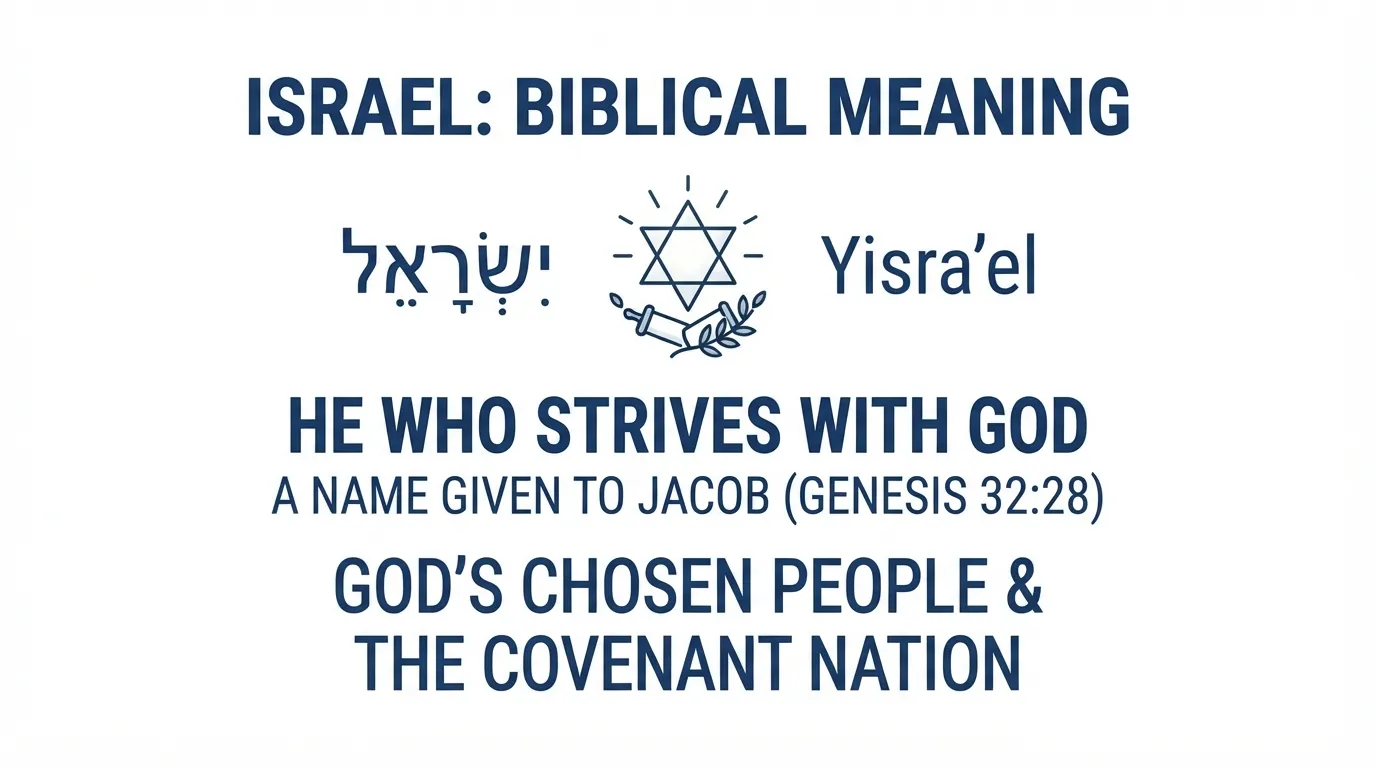
Israel means “he struggles with God” or “God contends,” from the Hebrew roots sarah (to struggle, contend, or prevail) and El (God). God gave this name to Jacob in Genesis 32:28 after he wrestled all night with a divine figure, and it later became the name of his twelve sons’ descendants, the nation of Israel.
Biblical Meaning of Israel 📖
Understanding the biblical meaning of Israel starts with looking closely at its two Hebrew building blocks.
Hebrew Meaning
The Hebrew name is יִשְׂרָאֵל (Yisra’el), built from sarah (שָׂרָה), meaning “to struggle, strive, or contend,” and El (אֵל), one of the Hebrew words for God.
Put together, most Hebrew scholars translate this as “he struggles with God” or “God contends.”
Literal Meaning
Literally, the name describes exactly what happened the night it was given: Jacob wrestled, and God was present in that struggle.
Some scholars also connect the root to sar, meaning “prince” or “ruler,” giving the name a secondary sense of “prince with God.”
Spiritual Meaning
Spiritually, Israel represents a person or people who wrestle honestly with God rather than walking away from Him.
It’s not a name given for perfection. It’s a name given for perseverance.
Biblical Significance
The name marked a genuine turning point in Jacob’s character, from a schemer who once deceived his own father into someone who clung to God for a blessing.
Key Scripture Reference
Genesis 32:28 records God’s words directly: “Your name shall no longer be called Jacob, but Israel, for you have striven with God and with men, and have prevailed.”
Historical & Biblical Context 🏛️
To understand Israel’s full meaning, it helps to trace how the name grew from one man into an entire nation.
Old Testament Usage
Jacob’s twelve sons became the twelve groups of Israel, and the name expanded from a personal identity into a national one.
Exodus 3:16 shows God referring to “the elders of Israel” as He prepares to rescue His people from slavery in Egypt.
After the united kingdom split under Solomon’s son Rehoboam, the name “Israel” specifically referred to the ten northern groups, while “Judah” named the southern kingdom.
New Testament Relevance
The name Israel appears roughly 78 times in the New Testament, carrying forward its Old Testament weight and promise.
Paul references Israel repeatedly in Romans 9-11, wrestling with questions about God’s ongoing covenant faithfulness to His people.
The New Testament writers consistently viewed Jesus as fulfilling promises originally made to Israel through Abraham, Isaac, and Jacob.
Cultural Understanding in Biblical Times
In the ancient Near East, a name change often marked a significant shift in identity, destiny, or covenant standing before God.
Abram becoming Abraham and Sarai becoming Sarah follow this same pattern earlier in Genesis, each name pointing toward a larger promise.
Jacob’s transformation into Israel followed this same tradition, marking him as the father of an entirely new nation under God’s covenant.
Where Does the Name Israel Appear in the Bible? 📜
The name Israel appears constantly throughout Scripture, from Genesis all the way through Revelation.
Where It Appears
Genesis 32:28 and 35:10 record the actual naming events, while Exodus, Numbers, and Joshua describe the twelve groups collectively bearing this name.
The prophetic books, especially Isaiah, Jeremiah, and Hosea, use “Israel” constantly when addressing God’s covenant people, both in blessing and correction.
Why It Matters
Its sheer frequency, over 2,500 times, shows just how central this identity became to the entire biblical narrative of God’s relationship with His people.
What It Teaches
The name teaches that God’s covenant people are defined not by perfection, but by their ongoing relationship with Him, struggles included.
Spiritual Meaning & Symbolism 🕊️
Israel’s meaning carries symbolism that stretches far beyond one man’s midnight wrestling match.
Struggle vs. Surrender
Jacob’s wrestling match pictures something true about faith itself: genuine relationship with God often involves real struggle, not passive ease.
Yet Jacob didn’t walk away from the struggle. He held on until he received a blessing, and that persistence defined his new identity.
Old Identity vs. New Identity
Jacob’s old name meant “heel-grabber” or “supplanter,” tied to how he grasped his twin brother’s heel at birth and later deceived his way into a blessing.
Israel represents a complete reversal, from someone who took by trickery to someone who received a blessing through honest, persistent faith.
God’s Perspective
God doesn’t rename Jacob because he finally became flawless. He renames him because he finally stopped running and started wrestling honestly with God.
Lessons for Today
Believers today can find real comfort in a name that celebrates persistence in faith rather than demanding perfection before blessing.
📊 Quick Comparison: Jacob vs. Israel
| Jacob (Old Identity) | Israel (New Identity) |
|---|---|
| Means “heel-grabber” or “supplanter” | Means “he struggles with God” |
| Deceived his father and brother | Wrestled honestly with God |
| Fled from conflict with Esau | Faced God directly, refusing to let go |
| Individual identity | Becomes the name of a nation |
Biblical Verses About Israel ✝️
These verses trace Israel’s meaning across Scripture, from its origin to its lasting promise.
Genesis 32:28
“Your name shall no longer be called Jacob, but Israel, for you have striven with God and with men, and have prevailed.”
This verse records the exact moment God renames Jacob after their all-night wrestling match at Peniel.
It directly explains the meaning of the name, tying it to struggle, contention, and ultimately, prevailing through persistence.
The lesson here centers on honest wrestling with God rather than avoiding Him out of fear or shame.
Jacob’s new name became a defining marker not just for him, but for every generation that followed him.
Genesis 35:10
“And God said to him, ‘Your name is Jacob; no longer shall your name be called Jacob, but Israel shall be your name.’ So he called his name Israel.”
This verse confirms the name change a second time, reinforcing that it was permanent and divinely established.
Some scholars note this reaffirmation strengthens the covenant weight behind the new identity God had given him.
The lesson shows that God’s promises and identity-shifts are consistent, not fleeting or accidental moments.
It also marks Jacob’s return to Bethel, the very place where God first appeared to him decades earlier.
Exodus 3:16
“Go and gather the elders of Israel together and say to them, ‘The Lord, the God of your fathers… has appeared to me.'”
Here, God instructs Moses to identify His covenant people specifically as Israel before their deliverance from Egypt begins.
This shows the name had already become the standard way God’s people identified themselves as a unified community.
The lesson highlights God’s faithfulness to the covenant made generations earlier with Jacob and his descendants.
It also connects Israel’s identity directly to God’s ongoing plan of rescue and redemption.
Hosea 12:4
“He strove with the angel and prevailed; he wept and sought his favor.”
This verse recaps Jacob’s wrestling match, confirming the same event recorded much earlier in Genesis.
Hosea uses Jacob’s story to call the northern kingdom of Israel back toward genuine covenant faithfulness in his own time.
The lesson reminds readers that Israel’s name was meant to be lived out, not just remembered as ancient history.
Weeping and seeking favor also shows that genuine humility accompanied Jacob’s wrestling and eventual blessing.
Isaiah 41:8-10
“But you, Israel, my servant, Jacob, whom I have chosen… fear not, for I am with you.”
God addresses His people directly here, using both names, Israel and Jacob, in the same breath of comfort.
This passage promises God’s continued presence and strength to Israel despite the surrounding threats they faced.
The lesson offers real encouragement: the name Israel always carried a promise of God’s presence, not abandonment.
It’s one of the clearest Old Testament expressions of God’s covenant loyalty toward His people.
Romans 9:6
“For not all who are descended from Israel belong to Israel.”
Paul makes a careful theological distinction here between physical descent and genuine covenant faith.
This verse opens a broader discussion about who truly belongs to God’s people in the fullest spiritual sense.
The lesson challenges readers to consider that the name Israel carries spiritual weight beyond bloodline alone.
Paul continues this argument through Romans 9-11, wrestling with God’s faithfulness to His covenant promises.
Romans 11:26
“And in this way all Israel will be saved, as it is written, ‘The Deliverer will come from Zion.'”
Paul points toward God’s ultimate faithfulness to Israel, even amid the complicated history his letter addresses.
This verse remains widely discussed among theologians regarding God’s future plans for His covenant people.
The lesson emphasizes that God’s promises to Israel were never abandoned, even through seasons of struggle.
It reflects the same persistent, covenant-keeping character God showed Jacob back at Peniel.
Psalm 121:4
“Behold, he who keeps Israel will neither slumber nor sleep.”
This verse offers comfort by picturing God as continually watchful over His covenant people, without exception.
It reflects the same personal, attentive care first shown to Jacob during his most vulnerable, wrestling night.
The lesson reassures believers that the God who renamed Jacob remains actively present with His people today.
This psalm was likely sung by pilgrims traveling toward Jerusalem, reinforcing communal trust in God’s protection.
1 Kings 12:16
“What portion have we in David? We have no inheritance in the son of Jesse. To your tents, O Israel!”
This verse marks the dramatic split between the northern kingdom of Israel and the southern kingdom of Judah.
It shows how the name Israel came to specifically identify the ten northern groups after this political division.
The lesson reveals how national identity and covenant identity sometimes became complicated through human conflict and rebellion.
Even amid division, God’s promises to the descendants of Jacob continued through both kingdoms.
Real-Life Biblical Case Study: Jacob’s Night at Peniel 🌟
Genesis 32 records one of the most dramatic personal encounters in all of Scripture.
Jacob was returning home after twenty years away, terrified of facing his brother Esau, whom he had once deceived.
Alone at night beside the Jabbok River, a mysterious man appeared and wrestled with him until daybreak.
Jacob refused to let go, even after his hip was wrenched out of joint during the struggle.
“I will not let you go unless you bless me,” Jacob insisted, holding on despite real physical pain.
It was then that his name changed from Jacob to Israel, marking a permanent shift in his identity and character.
He named the place Peniel, meaning “face of God,” saying he had seen God face to face and survived.
The very next day, Jacob’s reunion with Esau went far better than his fear had predicted, ending in reconciliation rather than revenge.
This story shows that genuine transformation often comes through honest struggle, not through avoiding hard moments with God.
Life Lessons for Christians 🙏
Israel’s meaning offers several practical, encouraging lessons for believers navigating their own faith journey.
Wrestling with God isn’t failure. Jacob’s honest struggle led directly to blessing, not punishment or rejection.
Identity can change through encounter. A real meeting with God can reshape how you see yourself, just as it did for Jacob.
Persistence matters in prayer. Jacob’s refusal to let go until he received a blessing models genuine, determined faith.
God keeps covenant promises. From Jacob to the New Testament, Israel’s story shows God’s consistent faithfulness across generations.
New names reflect new callings. Just as Jacob became Israel, believers are invited into new identity through relationship with God.
Common Misunderstandings ⚠️
Several confusions surround the name Israel, both online and in casual conversation.
Modern misuse: Some assume “Israel” only refers to the modern political nation-state, missing its much deeper biblical and covenantal roots.
Cultural confusion: Others assume Jacob’s new name erased his old identity entirely, when Scripture continues using both names interchangeably afterward.
Wrong interpretations online: A few sources oversimplify the meaning to just “prince,” missing the fuller “struggles with God” nuance most Hebrew scholars affirm.
Correct biblical explanation: Israel describes a person, and later a people, defined by an ongoing, honest relationship with God, struggles and all.
💡 Expert Insight: When studying this name further, compare Genesis 32:28 across multiple translations (ESV, NIV, KJV) side by side. The subtle wording differences around “striven,” “struggled,” and “wrestled” each highlight a slightly different shade of the same Hebrew root, sarah.
FAQs ❓
What does the name Israel literally mean?
Israel literally means “he struggles with God” or “God contends,” from the Hebrew roots sarah (to struggle) and El (God), given to Jacob in Genesis 32:28.
Why did God change Jacob’s name to Israel?
God changed Jacob’s name after he wrestled all night with a divine figure and refused to let go without receiving a blessing, marking a shift in his character.
Is Israel the same as Jacob in the Bible?
Yes, they refer to the same person. Scripture continues using both names afterward, sometimes interchangeably, referring to Jacob and his descendants.
How many times does Israel appear in the Bible?
The name Israel appears roughly 2,565 times throughout Scripture, making it one of the most frequently used names in the entire Bible.
What is the difference between Israel and Judah in the Old Testament?
After the kingdom split under Rehoboam, “Israel” referred to the ten northern groups, while “Judah” named the southern kingdom, though both descended from Jacob.
Conclusion 🌿
Israel’s meaning in the Bible traces back to one unforgettable night beside a river, where a fearful man refused to let go of God.
The name, “he struggles with God,” captures something deeply true about genuine faith: it isn’t always easy, but it’s always worth holding onto.
From Jacob’s twelve sons to the nation described throughout Scripture, this name carries a promise of God’s continued presence and faithfulness.
Whatever struggle you’re currently facing, Jacob’s story offers a powerful reminder that wrestling honestly with God often leads to blessing.
May that same persistent faith mark your own journey, just as it marked the man who became Israel.

Hello, I’m Jonathan Reed. I have a strong interest in biblical interpretation and Christian education. Over the years, I have spent significant time studying Scripture and researching its historical context to better understand its teachings and messages.