You’ve messed up, badly, and you’re bracing for the consequences you know you deserve.
Then, instead of punishment, you receive kindness you never earned.
That gap between what you deserve and what you actually receive is exactly what the Bible means by mercy.
This article defines mercy in the Bible clearly, tracing its Hebrew and Greek roots, and showing how it shapes the entire biblical story.
Did You Know? 🔍
The Hebrew word most associated with God’s mercy, hesed, has no single English equivalent. Bible translators have rendered it as “mercy,” “lovingkindness,” “steadfast love,” and “covenant faithfulness,” depending on context.
Quick Answer 🎯
How Is Mercy Defined in the Bible?
Mercy in the Bible is God’s compassion shown to those in distress, especially compassion that withholds deserved punishment and actively works to help the suffering. It comes from the Hebrew hesed (covenant lovingkindness) and racham (tender, motherly compassion), and the Greek eleos (active, compassionate mercy).
Biblical Meaning of Mercy 📖
Mercy in Scripture is richer and more layered than its common modern usage suggests.
Hebrew Meaning
Two primary Hebrew words lie behind “mercy”: hesed (חֶסֶד), meaning covenant loyalty or steadfast love, and racham (רַחַם), meaning tender compassion.
Racham shares its root with rechem, the Hebrew word for “womb,” picturing the protective, nurturing love a mother feels for her child.
Hesed carries a different weight: a loyal, committed love tied to covenant relationship, not just fleeting emotion.
Greek Meaning
The New Testament’s Greek word is eleos (ἔλεος), which the Septuagint translators consistently used to render the Hebrew hesed.
Eleos isn’t a passive feeling; it describes an active response that moves someone to genuinely help another person in need.
Literal Meaning
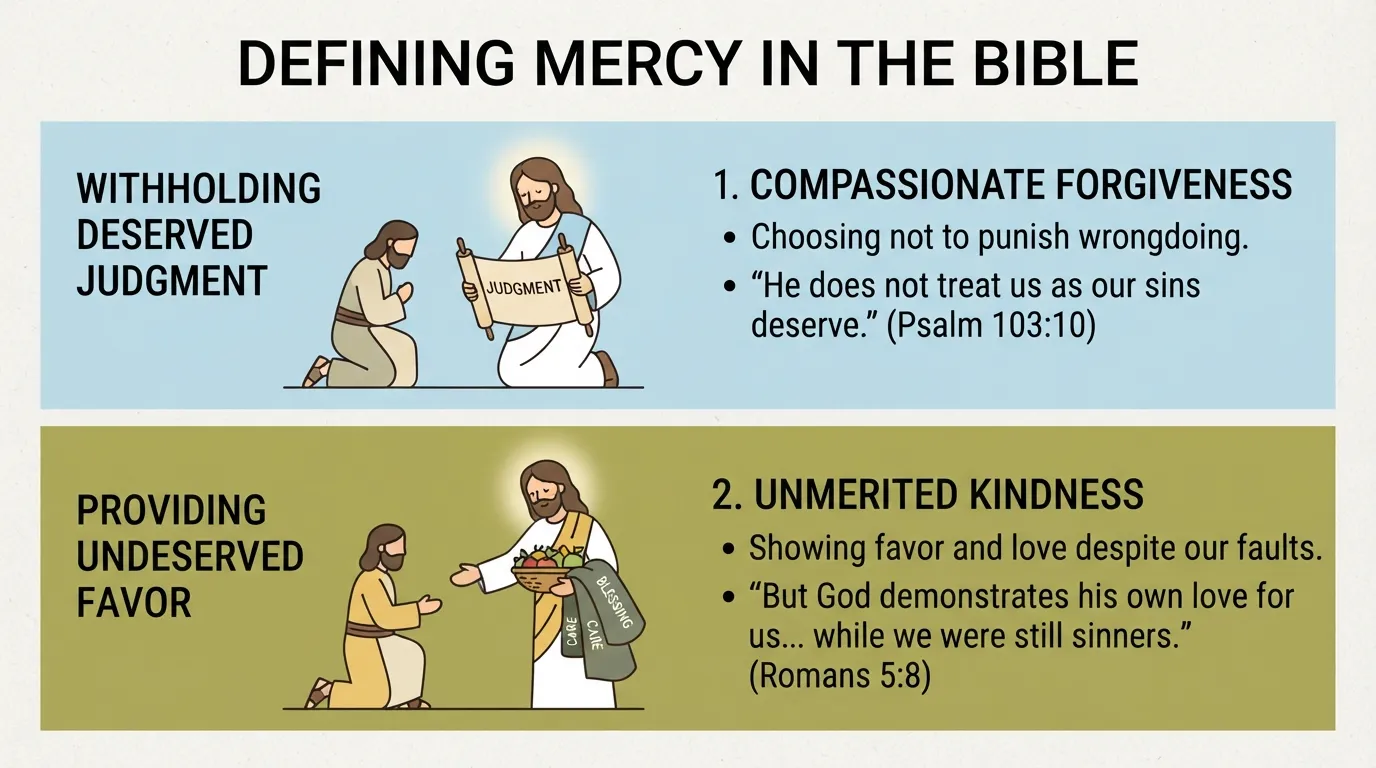
Literally, mercy means withholding deserved punishment and actively extending help to someone in distress.
Spiritual Meaning
Spiritually, mercy reflects one of God’s core attributes, His consistent choice to relieve suffering rather than simply observe it.
Biblical Significance
Mercy runs through Scripture’s entire narrative, from God’s patience with rebellious Israel to Christ’s sacrifice for humanity’s sin.
Key Scripture Reference
Lamentations 3:22-23 declares, “The steadfast love of the Lord never ceases; his mercies never come to an end; they are new every morning.”
Historical & Biblical Context 🏛️
Understanding mercy’s biblical meaning requires tracing how it shaped Israel’s relationship with God across the Testaments.
Old Testament Usage
God’s mercy is described as intrinsic to His nature throughout the Old Testament, driving Him to establish and maintain covenant with Israel despite their repeated failures.
Exodus 34:6-7 records God revealing Himself to Moses as “merciful and gracious, slow to anger, and abounding in steadfast love.”
This self-revelation became the foundation Israel returned to repeatedly, especially in the Psalms, when pleading for restoration after sin.
New Testament Relevance
Jesus repeatedly emphasizes mercy over ritual, quoting Hosea 6:6 twice: “I desire mercy, and not sacrifice” (Matthew 9:13; 12:7).
Mary’s Magnificat in Luke 1:50 and 54 celebrates God’s mercy extending “from generation to generation” to those who fear Him.
The Beatitudes include mercy directly: “Blessed are the merciful, for they shall receive mercy” (Matthew 5:7).
Cultural Understanding in Biblical Times
In the ancient Near East, mercy from a king or ruler toward a defeated enemy was rare and calculated, often serving strategic purposes.
Israel’s understanding of God’s mercy stood in sharp contrast: freely given, undeserved, and rooted in covenant faithfulness rather than political advantage.
Is Mercy Mentioned in the Bible? 📜
Yes, extensively, appearing hundreds of times across both the Old and New Testaments.
Where It Appears
Key passages include Exodus 34:6-7, Psalm 23:6, Lamentations 3:22-23, Micah 6:8, Matthew 5:7, and Ephesians 2:4.
Why It Matters
Its frequent appearance shows mercy as one of Scripture’s most consistently emphasized attributes of God’s character.
What It Teaches
Mercy teaches that God relates to His people not primarily through strict justice, but through compassionate, active love toward the undeserving.
Spiritual Meaning & Symbolism 🕊️
Mercy’s symbolism centers on the contrast between what is deserved and what is graciously given instead.
Justice vs. Mercy vs. Grace
A helpful biblical distinction: justice is getting what you deserve, mercy is not getting the punishment you deserve, and grace is receiving blessing you don’t deserve.
These three concepts work together throughout Scripture, showing different facets of how God relates to sinful humanity.
Deserved Punishment vs. Undeserved Compassion
Throughout Israel’s history, mercy repeatedly interrupts deserved judgment, from the wilderness generation to the exile and eventual return.
This pattern culminates in Christ’s sacrifice, where deserved judgment falls on Him instead of on those who trust in Him.
God’s Perspective
Mercy isn’t an occasional mood for God; Scripture presents it as central, unchanging, and “new every morning” (Lamentations 3:23).
Lessons for Today
Believers are consistently called to extend the same mercy they’ve received, not merely receive it passively.
📊 Quick Comparison: Hesed, Racham, and Eleos
| Term | Language | Core Meaning |
|---|---|---|
| Hesed | Hebrew | Covenant loyalty, steadfast love |
| Racham | Hebrew | Tender, motherly compassion |
| Eleos | Greek | Active, compassionate mercy |
Biblical Verses About Mercy ✝️
These verses trace mercy’s meaning from God’s self-revelation through Christ’s teaching.
Exodus 34:6-7
“The Lord passed before him and proclaimed, ‘The Lord, the Lord, a God merciful and gracious, slow to anger, and abounding in steadfast love and faithfulness.'”
This is God’s own self-description, given directly to Moses after Israel’s failure with the golden calf.
It became the most-quoted description of God’s character throughout the rest of the Old Testament.
The lesson shows mercy isn’t a peripheral trait; it’s central to how God identifies Himself to His people.
Israel would return to this exact passage repeatedly during seasons of repentance and restoration.
Psalm 23:6
“Surely goodness and mercy shall follow me all the days of my life, and I shall dwell in the house of the Lord forever.”
David pictures God’s mercy as a constant companion, actively following him throughout every season of life.
This isn’t mercy as an isolated event, but as an ongoing, pursuing presence woven through daily experience.
The lesson offers comfort that God’s mercy isn’t limited to crisis moments; it accompanies believers continually.
This verse remains one of Scripture’s most beloved expressions of trust in God’s faithful care.
Lamentations 3:22-23
“The steadfast love of the Lord never ceases; his mercies never come to an end; they are new every morning; great is your faithfulness.”
Written amid the devastation of Jerusalem’s destruction, this verse offers hope precisely where despair would seem justified.
The imagery of mercy being “new every morning” suggests fresh, renewed compassion rather than a depleting resource.
The lesson shows that even in genuine devastation, God’s mercy remains constant and freshly available.
This passage has comforted believers facing loss and grief for centuries.
Micah 6:8
“He has told you, O man, what is good; and what does the Lord require of you but to do justice, and to love kindness, and to walk humbly with your God?”
Micah summarizes what God genuinely desires from His people, placing mercy (translated “kindness” here) alongside justice and humility.
This verse challenges the idea that religious ritual alone satisfies God, emphasizing lived character instead.
The lesson calls believers to actively love mercy, not merely receive it or acknowledge it intellectually.
This verse remains one of the most quoted summaries of biblical ethics.
Matthew 5:7
“Blessed are the merciful, for they shall receive mercy.”
Jesus includes mercy directly among the Beatitudes, His foundational teaching on kingdom character.
The structure suggests a genuine connection: those who extend mercy position themselves to receive it in return.
The lesson challenges believers to actively practice mercy toward others, not simply hope to receive it from God.
This teaching set a countercultural standard in a world that often prized strength over compassion.
Ephesians 2:4-5
“But God, being rich in mercy, because of the great love with which he loved us, even when we were dead in our trespasses, made us alive together with Christ.”
Paul roots believers’ entire salvation in God’s mercy, extended while they were spiritually dead and unresponsive.
The phrase “rich in mercy” suggests abundance, not scarcity, in how God extends compassion toward sinners.
The lesson emphasizes that mercy precedes any human response; it’s the very reason a response becomes possible at all.
This passage stands as one of the New Testament’s clearest statements on grace-driven salvation.
James 2:13
“Judgment is without mercy to one who has shown no mercy. Mercy triumphs over judgment.”
James connects receiving mercy directly to extending it, warning against a mercy-receiving, mercy-withholding contradiction.
The phrase “mercy triumphs over judgment” suggests mercy’s ultimate priority in how believers should relate to others.
The lesson challenges any tendency to accept God’s mercy while remaining harsh or judgmental toward others.
This verse reinforces Jesus’s own teaching on the connection between receiving and extending compassion.
Real-Life Biblical Case Study: David and Mephibosheth 🌟
2 Samuel 9 records one of Scripture’s most vivid pictures of mercy in action.
Mephibosheth was the son of Jonathan and grandson of Saul, David’s former enemy and predecessor as king.
Ancient custom often meant a new king would eliminate any remaining heirs of the previous royal line, out of fear of rebellion.
Instead, David asked, “Is there still anyone left of the house of Saul, that I may show him kindness for Jonathan’s sake?” (2 Samuel 9:1).
Mephibosheth, disabled in both feet, was brought before David, likely expecting execution rather than favor.
David instead restored his grandfather’s land to him and invited him to eat permanently at the king’s own table, “as one of the king’s sons” (9:11).
This wasn’t merit-based; Mephibosheth had done nothing to earn this treatment, and his family history included active opposition to David.
David’s mercy flowed entirely from his covenant loyalty to Jonathan, not from anything Mephibosheth himself had accomplished.
Life Lessons for Christians 🙏
Mercy’s biblical meaning offers several practical, transformative lessons for believers today.
Mercy defines God’s character. Exodus 34:6-7 shows mercy isn’t occasional for God; it’s central to who He is.
Mercy is renewed daily. Lamentations 3:22-23 offers hope that God’s compassion doesn’t run out, even in genuine devastation.
Mercy requires action, not just feeling. Micah 6:8 calls believers to actively love mercy, not merely acknowledge it.
Receiving mercy calls for extending it. Matthew 5:7 and James 2:13 both connect receiving God’s mercy to showing it toward others.
Mercy precedes worthiness. Ephesians 2:4-5 reminds believers that mercy was extended while they were still spiritually unresponsive.
Common Misunderstandings ⚠️
Several points of confusion surround this word in casual conversation and online discussion.
Modern misuse: People often reduce “mercy” to simple pity or feeling sorry for someone, missing its biblical emphasis on active, compassionate help.
Cultural confusion: Some conflate mercy entirely with grace; while related, mercy specifically involves withholding deserved punishment, while grace involves giving undeserved blessing.
Wrong interpretations online: A few sources treat mercy as weakness or softness; Scripture instead presents it as a deliberate, powerful choice.
Correct biblical explanation: Mercy is God’s active compassion toward those who deserve judgment, rooted in His covenant character and ultimately expressed through Christ.
💡 Expert Insight: When studying mercy further, compare how hesed is translated across different English versions. The KJV often renders it “lovingkindness,” while modern translations frequently use “steadfast love,” each capturing a slightly different shade of this rich, covenant-rooted Hebrew word.
FAQs ❓
How does the Bible define mercy?
The Bible defines mercy as God’s compassion toward those in distress, especially compassion that withholds deserved punishment and actively helps the suffering.
What is the Hebrew word for mercy?
Two main Hebrew words are translated “mercy”: hesed (covenant lovingkindness) and racham (tender, motherly compassion).
What is the difference between mercy and grace?
Mercy is not receiving the punishment you deserve; grace is receiving blessing you don’t deserve. They work together but describe different aspects of God’s kindness.
What does “blessed are the merciful” mean?
In Matthew 5:7, Jesus teaches that those who show genuine mercy toward others position themselves to receive mercy in return, both from God and others.
How can Christians practice mercy today?
Christians can practice mercy by forgiving those who’ve wronged them, helping those in genuine need, and extending compassion rather than harsh judgment toward others’ failures.
Conclusion 🌿
To define mercy in the Bible is to describe one of God’s most central, consistent attributes: active compassion toward those who deserve judgment instead.
From His self-revelation to Moses to Christ’s sacrifice on the cross, mercy shapes the entire arc of Scripture’s story.
David’s kindness toward Mephibosheth offers a vivid, human picture of what this mercy looks like lived out.
Whatever judgment you feel you deserve, Scripture consistently points to a God whose mercies are new every single morning.
May that same mercy you’ve received become the mercy you freely extend to others today.

Hello, I’m Samuel Carter. My interest in biblical studies comes from a lifelong desire to understand the wisdom and teachings contained within Scripture. I particularly enjoy researching biblical numbers, patterns, and themes that appear throughout God’s Word.