This pairing echoes throughout Scripture, especially in moments of great uncertainty.
The dismayed meaning in the Bible goes beyond simple fear. It describes being shattered, discouraged, or paralyzed by circumstances.
Joshua heard this command as he prepared to lead Israel into unknown territory.
David encouraged himself in the Lord when everything seemed to be falling apart.
Again and again, God meets dismay with a promise of His presence.
This article explores what dismay meant biblically, and how God consistently answers it.
Quick Answer 🎯
What Does Dismayed Mean in the Bible?
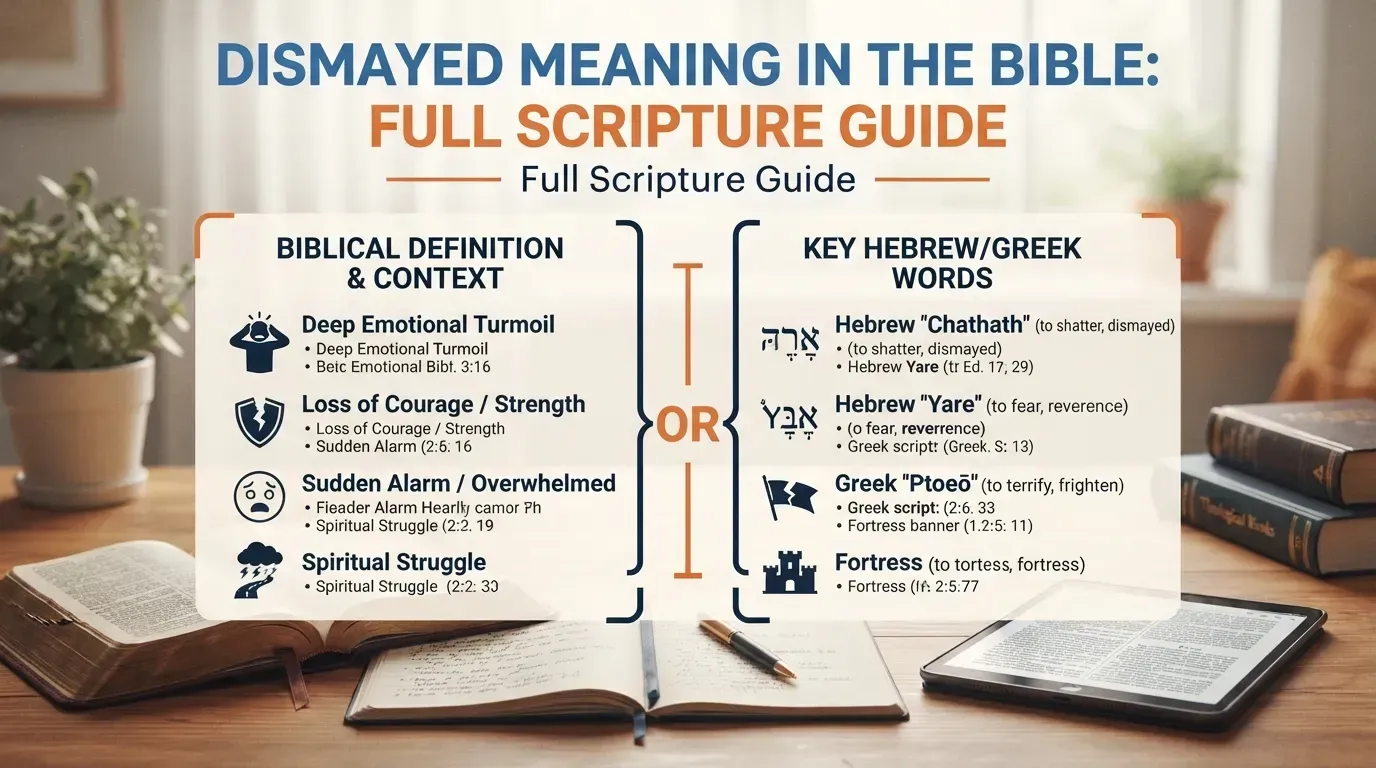
Dismayed in the Bible describes being deeply discouraged, terrified, or shattered by fear, often in the face of overwhelming circumstances. Scripture repeatedly commands God’s people not to be dismayed, promising His presence and strength instead.
Biblical Meaning of Dismayed 📖
Dismay describes more than passing worry. It’s a deep, often paralyzing discouragement.
Hebrew and Greek Meaning
The Hebrew word chathath means to be shattered, broken, or terrified.
It conveys a sense of being undone by fear, not merely nervous or concerned.
Dismayed Meaning in Greek
The Old Testament’s Hebrew word for dismayed, chathath, was translated into Greek in the Septuagint (the ancient Greek Old Testament) using words like ptoeo, meaning to terrify or alarm.
This same Greek word appears in the New Testament. In Luke 21:9 and Luke 24:37, it’s translated “do not be terrified” and “startled and frightened.”
This shows a thread of continuity. The same fear God’s people wrestled with in the Old Testament shows up again when the disciples are startled by the resurrected Jesus, and He responds with the same reassurance: don’t be afraid.
Literal Meaning
Literally, dismayed describes being overwhelmed with fear to the point of losing courage or resolve.
Spiritual Meaning
Spiritually, dismay often signals a moment where trust in God is being tested.
Biblical Significance
God’s repeated command not to be dismayed shows His awareness of human fear and His desire to strengthen His people.
Key Scripture Reference
“Have I not commanded you? Be strong and courageous. Do not be frightened, and do not be dismayed, for the Lord your God is with you wherever you go” (Joshua 1:9, ESV).
Historical & Biblical Context 🏛️
Understanding dismayed meaning in the Bible requires looking at the challenging circumstances surrounding its use.
Old Testament Usage
Dismay appears frequently in the Old Testament, especially during moments of military threat or leadership transition.
Joshua 1:9 is perhaps the most famous instance, spoken as Israel prepared to enter the promised land.
New Testament Relevance
While the specific word appears less frequently in the New Testament, similar themes of overcoming fear continue.
Jesus repeatedly tells His disciples “do not be afraid,” echoing the same reassurance found in dismay passages.
Cultural Understanding in Biblical Times
Ancient Israel faced constant threats from surrounding nations, making dismay a very real, practical concern.
Leaders needed courage to guide their people through genuine danger and uncertainty.
Is Dismayed Mentioned in the Bible? 📜
Yes, it appears numerous times across the Old Testament.
Where It Appears
Key passages include Joshua 1:9, Deuteronomy 31:8, Isaiah 41:10, and 1 Chronicles 22:13.
Why It Matters
Its frequent appearance shows how central overcoming fear was to Israel’s covenant relationship with God.
What It Teaches
It teaches that God’s presence is the consistent answer to human dismay and discouragement.
Related Words: Disquieted and Discomfited in the Bible 🔍
Two other older biblical words often get searched alongside “dismayed,” since they describe similar or related experiences. It’s worth understanding how each one differs.
Disquieted
“Disquieted” comes from the Hebrew hamah (הָמָה), meaning to be in commotion, to moan, or to be in an inner uproar, like waves tossing on the sea.
Its most famous use appears in Psalm 42:5 and 42:11: “Why are you cast down, O my soul, and why are you disquieted within me? Hope in God.”
Unlike chathath (dismayed), which describes being shattered by external threat, hamah pictures internal turmoil, an unsettled, restless soul talking to itself.
The psalmist’s response to being disquieted mirrors the response to dismay: turning toward hope in God rather than staying stuck in the feeling.
Discomfited
“Discomfited” is a King James-era word that actually carries a different primary meaning than dismayed. It most often describes being routed or defeated in battle, not simply feeling afraid.
Exodus 17:13 uses this word from the Hebrew chalash (חָלַשׁ): “And Joshua discomfited Amalek and his people with the edge of the sword.” Modern translations render this as “overwhelmed,” “defeated,” or “overcame.”
Elsewhere, discomfited translates a different Hebrew word, hamam (הָמַם), used when Scripture says the Lord Himself discomfited an enemy army, such as Sisera’s forces in Judges 4:15.
So while “dismayed” describes an inner emotional state, “discomfited” more often describes an outward, physical defeat, sometimes the very thing that causes an enemy to become dismayed.
Is “Be Not Dismayed, Whate’er Betide” a Bible Verse? 🎵
Many people search this exact phrase expecting to find it in the KJV Bible. It isn’t there.
This line comes from the classic hymn “God Will Take Care of You,” written by Civilla D. Martin in 1904.
The hymn draws on biblical promises, especially Isaiah 41:10 and Deuteronomy 31:6, but the exact wording “whate’er betide” is hymn language, not scripture.
Understanding this distinction matters. The hymn’s comfort is real, but it’s built on Bible verses rather than being one itself.
If you’re looking for the actual scriptural source behind this hymn’s message, Isaiah 41:10 and Joshua 1:9 are the closest biblical roots.
Spiritual Meaning & Symbolism ⚖️
Dismay symbolizes the human tendency toward fear when facing uncertainty without God.
Fear vs. Faith
Scripture consistently contrasts dismay with faith-filled courage rooted in God’s presence.
Self-Reliance vs. Trust in God
Dismay often surfaces when we rely on our own strength instead of trusting God’s promises.
God’s Perspective
God doesn’t dismiss human fear. He meets it directly with reassurance and strength.
Lessons for Today
In uncertain seasons, these ancient words of encouragement remain deeply relevant.
Biblical Verses About Dismayed 📚
Here are key verses that shape the dismayed meaning in the Bible.
Joshua 1:9
“Have I not commanded you? Be strong and courageous. Do not be frightened, and do not be dismayed, for the Lord your God is with you wherever you go.”
God speaks directly to Joshua as he prepares to lead Israel into the promised land.
This command isn’t based on Joshua’s ability, but on God’s constant presence with him.
The lesson reminds believers that courage flows from trusting God’s presence, not self-confidence.
Deuteronomy 31:8
“It is the Lord who goes before you. He will be with you; he will not leave you or forsake you. Do not fear or be dismayed.”
Moses encourages Joshua before his leadership transition, echoing the same promise.
This verse pairs God’s active presence with the command against dismay.
The lesson emphasizes that God’s faithfulness precedes and surrounds every difficult calling.
Isaiah 41:10
“Fear not, for I am with you; be not dismayed, for I am your God; I will strengthen you, I will help you.”
This beautiful promise combines presence, strength, and help into one reassurance.
It addresses dismay directly by pointing to God’s active involvement in our struggles.
The lesson offers comfort that God doesn’t merely observe our fear, but actively strengthens us.
1 Chronicles 22:13
“Then you will prosper if you are careful to observe the statutes and the rules that the Lord commanded Moses… Be strong and courageous. Fear not; do not be dismayed.”
David encourages his son Solomon before the immense task of building the temple.
This pairs obedience to God’s commands with the promise of courage against dismay.
The lesson connects faithfulness with the confidence needed to face overwhelming responsibility.
2 Chronicles 20:15
“Thus says the Lord to you: ‘Do not be afraid and do not be dismayed at this great horde, for the battle is not yours but God’s.'”
King Jehoshaphat receives this word facing an overwhelming enemy coalition.
The reassurance shifts focus from Israel’s weakness to God’s power over the battle.
The lesson teaches that facing dismay well means remembering whose battle it truly is.
Jeremiah 1:17
“But you, dress yourself for work; arise, and say to them everything that I command you. Do not be dismayed by them, lest I dismay you before them.”
God commands Jeremiah not to let opposition intimidate him from his prophetic calling.
This shows dismay as something that could compromise faithful obedience to God’s mission.
The lesson challenges believers to remain faithful despite fear of others’ reactions.
Isaiah 41:13
“For I, the Lord your God, hold your right hand; it is I who say to you, ‘Fear not, I am the one who helps you.'”
This tender image of God holding our hand reinforces the personal nature of His comfort.
It addresses dismay with intimate reassurance rather than distant command alone.
The lesson invites believers to picture God’s active, personal support during fearful moments.
Psalm 34:4
“I sought the Lord, and he answered me and delivered me from all my fears.”
While not using the exact word dismayed, this verse captures the heart of overcoming deep fear.
David testifies to God’s faithful response when he actively sought help.
The lesson encourages turning to God directly in moments of fear rather than facing it alone.
1 Samuel 17:11
“When Saul and all Israel heard these words of the Philistine, they were dismayed and greatly afraid.”
This verse describes Israel’s army paralyzed by fear at Goliath’s taunts.
It sets up the powerful contrast with young David’s faith-filled response soon after.
The lesson shows how dismay can spread through a community when faith wavers.
“Do Not Be Dismayed” in the KJV 📜
Several searches specifically look for the King James wording of these promises. Here’s how the KJV renders the key verses already covered above.
| Verse | KJV Wording |
|---|---|
| Joshua 1:9 | “Be strong and of a good courage; be not afraid, neither be thou dismayed: for the Lord thy God is with thee whithersoever thou goest.” |
| Deuteronomy 31:8 | “Fear not, neither be dismayed.” |
| Isaiah 41:10 | “Fear thou not; for I am with thee: be not dismayed; for I am thy God: I will strengthen thee; yea, I will help thee.” |
| 1 Chronicles 22:13 | “Be strong, and of good courage; dread not, nor be dismayed.” |
| 1 Samuel 17:11 | “They were dismayed, and greatly afraid.” |
The KJV and modern translations agree closely on this word. Across every era of English Bible translation, “dismayed” has consistently meant deep fear that threatens to break a person’s courage.
Real-Life Biblical Case Study: Joshua Facing the Promised Land 🏔️
After Moses’s death, Joshua faced an overwhelming task: leading Israel into unfamiliar, hostile territory.
The challenges ahead included fortified cities, powerful enemies, and the weight of national leadership.
God’s response wasn’t to minimize the difficulty, but to repeatedly command Joshua not to be dismayed.
Three times in Joshua 1, God reassures him with the promise of His presence and strength.
Joshua’s obedience despite understandable fear became a model for facing overwhelming callings.
His story shows dismay isn’t sin itself, but something to be met with courage rooted in God’s promises.
Joshua’s later success in leading Israel demonstrates the practical power of trusting God over yielding to fear.
This case study offers encouragement for anyone facing a daunting calling or uncertain future today.
Life Lessons for Christians ✝️
The dismayed meaning in the Bible offers several practical lessons.
Remember God’s presence. Joshua 1:9 ties courage directly to the promise that God goes with us.
Recall God’s past faithfulness. Deuteronomy 31:8 encourages trust based on God’s proven track record.
Recognize whose battle it truly is. 2 Chronicles 20:15 reminds us that overwhelming situations belong ultimately to God.
Seek God actively in fear. Psalm 34:4 shows the power of turning directly to God rather than facing fear alone.
Stay faithful despite opposition. Jeremiah’s example challenges believers to remain obedient even when others intimidate.
Common Misunderstandings 🤔
Several confusions surround this word today.
Modern misuse: Some assume dismay simply means mild disappointment, missing its deeper biblical sense of paralyzing fear.
Cultural confusion: People sometimes treat all fear as sinful, though Scripture addresses dismay with compassion rather than shame.
Wrong interpretations online: A few sources claim these verses promise the absence of difficulty, rather than God’s presence within difficulty.
Correct biblical explanation: Being told not to be dismayed doesn’t deny real danger, but points toward God’s sufficient presence and strength.
FAQs ❓
What does dismayed mean in Joshua 1:9?
In Joshua 1:9, dismayed describes deep discouragement or fear, which God commands Joshua to resist by trusting His constant presence.
Is feeling dismayed considered a sin in the Bible?
Not inherently. Scripture addresses dismay with compassion and reassurance, calling believers toward courage rather than shaming their fear.
Why does the Bible repeat “do not be dismayed” so often?
This repetition emphasizes how central overcoming fear was to Israel’s faith journey and God’s covenant faithfulness.
How can Christians overcome dismay today?
Christians can overcome dismay by remembering God’s presence, recalling His past faithfulness, and actively seeking Him in prayer.
Does dismay always involve fear of enemies in the Bible?
Not always, though many instances involve military threats. It can also describe fear of leadership responsibility or uncertain futures.
What does disquieted mean in the Bible?
Disquieted comes from the Hebrew hamah, describing an inner emotional turmoil or unsettled soul, as seen in Psalm 42:5, where the psalmist commands his own soul to hope in God instead.
What does discomfited mean in the Bible?
Discomfited most often describes being routed or defeated in battle, as when Joshua discomfited Amalek in Exodus 17:13. It’s closer to “overwhelmed in combat” than to the inner fear described by “dismayed.”
Is there a “gospel of dismay” in the Bible?
No, Scripture never presents dismay itself as good news. Instead, the actual gospel message consistently answers dismay with the opposite: God’s presence, strength, and salvation offered through Christ.
What is the biblical definition of fear, and how does it relate to dismay?
Biblically, fear describes an anxious response to danger or uncertainty, while dismay describes fear so strong it shatters courage entirely. Scripture treats both the same way, meeting them with the promise of God’s presence rather than shame.
What does dismayed mean in Hebrew?
Dismayed translates the Hebrew word chathath, meaning to be shattered, broken, or terrified. It describes fear strong enough to break a person’s courage or resolve.
What does dismayed mean in Greek?
The Greek word ptoeo, meaning to terrify or alarm, is used in the Septuagint to translate the Hebrew chathath, and it appears in the New Testament in Luke 21:9 and Luke 24:37.
Is “Be not dismayed, whate’er betide” a Bible verse?
No. This line comes from the 1904 hymn “God Will Take Care of You” by Civilla D. Martin. It’s inspired by verses like Isaiah 41:10 but isn’t itself scripture.
What does the KJV say about not being dismayed?
The KJV uses “dismayed” in the same key verses as modern translations, including Joshua 1:9, Deuteronomy 31:8, and Isaiah 41:10, all promising God’s presence and strength against fear.
Conclusion
The dismayed meaning in the Bible reveals how deeply God understands human fear.
Rather than condemning it, Scripture consistently meets dismay with reassurance and promised presence.
From Joshua’s daunting calling to Jehoshaphat’s overwhelming enemy, God’s people faced real reasons for fear.
Yet time and again, the answer remained the same: God’s presence is enough.
May we remember, in our own moments of dismay, that we’re never facing them alone.
The same God who strengthened Joshua and Jehoshaphat remains present with His people today.

Hello, I’m Jonathan Reed. I have a strong interest in biblical interpretation and Christian education. Over the years, I have spent significant time studying Scripture and researching its historical context to better understand its teachings and messages.