William Meaning in Bible is a topic many readers explore when they want to understand the meaning, origin, and Christian significance of the name William.
Although William is not a name found directly in the Bible, its meaning can still be considered in light of biblical themes such as protection, strength, and faithful leadership.
William is one of the most enduring names in Western history. But if you’re hoping to find it in a Bible concordance, you won’t.
William isn’t a biblical name, it’s Germanic in origin. Still, its meaning, resolute protector, lines up closely with one of the Bible’s most repeated promises. That God Himself is a protector of His people.
Did You Know? 🔍
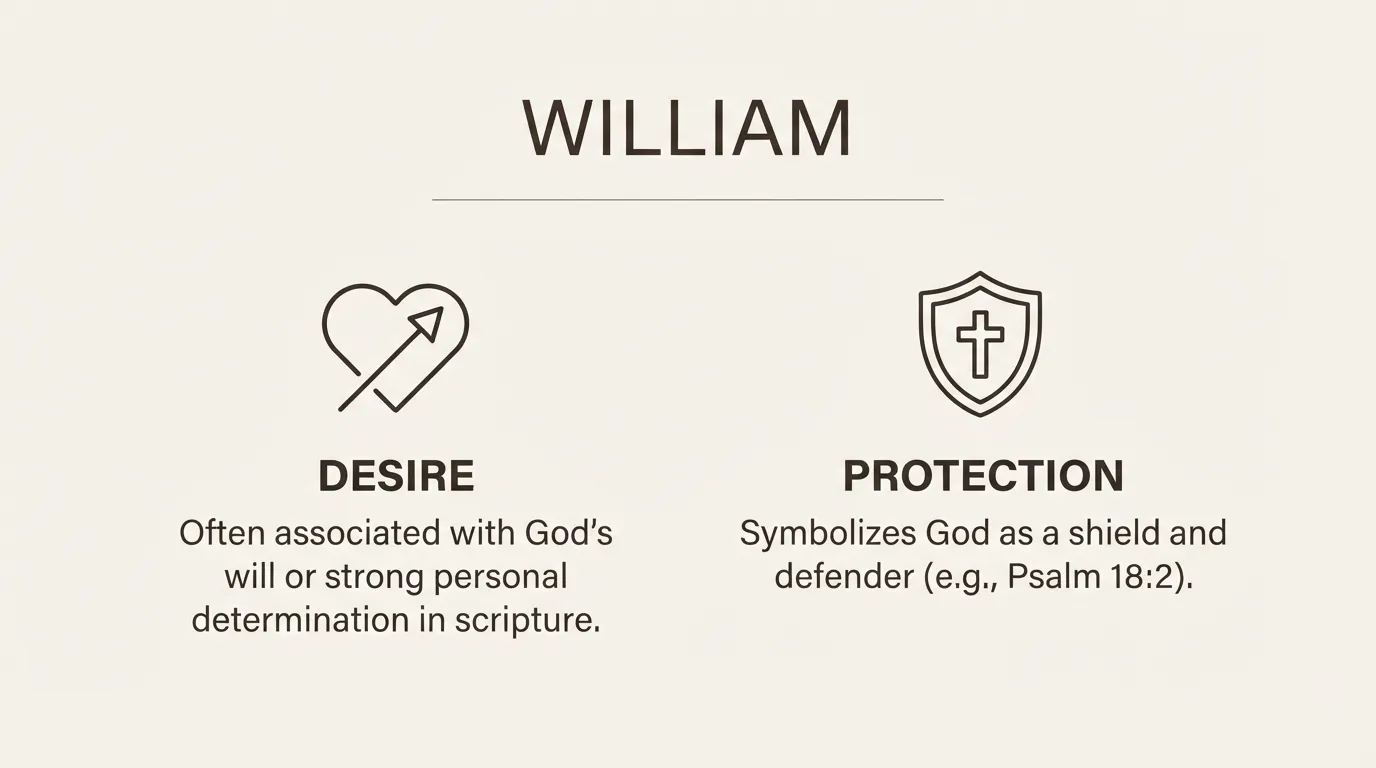
William comes from the Old Germanic name Willahelm, combining wil (will, desire) and helm (helmet, protection).
It was brought to England by William the Conqueror in 1066, which is largely why it became so widespread in English-speaking countries.
What Does William Mean in the Bible? (Quick Answer) 📖
William does not appear in the Bible. It’s a Germanic name meaning resolute protector, formed centuries after the biblical period.
While the name itself isn’t scriptural, its meaning of protection closely echoes biblical themes of God as a shield and defender of His people.
Biblical Meaning of William 🛡️
Hebrew and Greek Roots
William has no Hebrew or Greek root at all. It’s entirely Germanic, tracing to Old High German Willahelm.
This makes it linguistically unrelated to any biblical name or word.
Literal Meaning
Literally, William combines will (desire, determination) and helm (helmet).
The overall meaning is resolute protector or determined guardian.
Spiritual Meaning
Though not biblical itself, the protector theme in William’s meaning connects strongly to how Scripture describes God. As a shield (Psalm 18:2), a fortress (Psalm 91:2), and a defender of the vulnerable (Psalm 68:5).
Biblical Significance
Parents drawn to William often connect it to the biblical call for believers, especially fathers and leaders, to protect and guard those entrusted to their care (1 Timothy 5:8).
Key Scripture Reference
Psalm 18:2 describes God as my rock, my fortress and my deliverer, my shield. It offers one of Scripture’s clearest pictures of divine protection that pairs naturally with William’s meaning.
Historical & Biblical Context 🕰️
Old Testament Usage
Protection is a constant Old Testament theme. God shields Israel through the wilderness (Exodus 14:19-20), and kings like David repeatedly describe God as their defender in the Psalms.
New Testament Relevance
In the New Testament, protection shifts toward spiritual armor and guarding the heart.
This is especially true in Ephesians 6:10-17, where believers are told to put on the full armor of God.
Cultural Understanding in Biblical Times
Physical protection, walls, armor, shields, was a daily concern in the ancient world.
This is why biblical writers so naturally used protective imagery to describe God’s relationship with His people.
Is William Mentioned in the Bible? 📚
No, William never appears in any biblical text, genealogy, or narrative. It didn’t exist as a name until long after the New Testament was written.
The connection to Scripture is entirely thematic, built around the idea of protection rather than a direct name reference.
Spiritual Meaning & Symbolism ⚔️
Protection vs. Vulnerability
Scripture repeatedly contrasts human vulnerability with God’s steady protection (Psalm 121:7-8).
This theme resonates naturally with a name meaning resolute protector.
God’s Perspective
God calls His people, especially those in positions of care like fathers, shepherds, and leaders, to reflect His protective character toward others (1 Timothy 5:8, John 10:11).
Lessons for Today
Being a protector in a biblical sense isn’t about physical strength alone.
It includes spiritual vigilance, faithful presence, and standing firm for those who depend on you.
William’s Meaning vs. Biblical Protector Imagery 📊
| Concept | Represents | Key Reference |
|---|---|---|
| William (resolute protector) | Determined guardian | Germanic etymology |
| Shield | God’s defense of His people | Psalm 18:2 |
| Armor of God | Spiritual protection | Ephesians 6:10-17 |
| Shepherd | Protective care and guidance | John 10:11 |
Biblical Verses About Protection and Guardianship
Psalm 18:2
David calls God my rock, my fortress and my deliverer, my shield.
This verse offers one of the clearest pictures of God as an active, personal protector, closely mirroring William’s meaning.
Psalm 91:2
The psalmist declares, he is my refuge and my fortress, my God, in whom I trust.
It reinforces the theme of finding safety not in personal strength but in reliance on God.
Exodus 14:19-20
God’s angel and the pillar of cloud move to shield Israel from Pharaoh’s approaching army.
This narrative shows protection as an active, visible act of God’s care during a moment of crisis.
Psalm 121:7-8
This psalm promises that the Lord will keep you from all harm, both now and forevermore.
It’s a comforting reminder of ongoing, lifelong divine protection.
Ephesians 6:10-17
Paul describes the full armor of God, including a shield of faith and helmet of salvation.
This imagery is strikingly similar to William’s Germanic helmet root, though the passage is unrelated linguistically.
1 Timothy 5:8
Paul writes that anyone who doesn’t provide for their family has denied the faith.
This verse ties directly into the protector role often associated with the name William.
John 10:11
Jesus describes Himself as the good shepherd who lays down his life for the sheep.
This offers the ultimate biblical model of sacrificial protection.
Psalm 68:5
God is described as a father to the fatherless, a defender of widows.
This verse highlights protection extended specifically to society’s most vulnerable.
Real-Life Biblical Case Study: David Protecting His Flock
Before facing Goliath, young David explains to King Saul that he had already fought off a lion and a bear to protect his father’s sheep (1 Samuel 17:34-36).
This early act of quiet, unnoticed protection prepared David for his greater calling later.
A fitting story for anyone named William, since it shows protection often starts in small, unseen moments before it’s ever recognized publicly.
Life Lessons for Christians
- True protection often starts in small, unnoticed acts of faithfulness, as with David and his father’s sheep.
- Being a protector spiritually means guarding hearts and faith, not just physical safety (Ephesians 6:10-17).
- God’s protection (Psalm 91:2) doesn’t mean the absence of hardship, but His steady presence through it.
- Caring for family (1 Timothy 5:8) is described in Scripture as a serious, faith-connected responsibility.
- A name’s meaning can inspire character growth even when the name itself isn’t found in the Bible.
Common Misunderstandings
Some sites incorrectly claim William has Hebrew origins or biblical roots. It doesn’t.
Its true origin is Old Germanic, arriving in English usage over a thousand years after the biblical period. The honest, accurate connection to Scripture is through its meaning, protector, not through any linguistic or textual link.
Expert Insight 💡
When a modern name’s meaning aligns with a biblical concept like protector, it’s worth researching that concept directly in a concordance.
Rather than assuming the name itself has ancient roots. This keeps the study accurate and avoids overstating a connection that isn’t really there.
FAQs
Is William a biblical name?
No, William is Germanic in origin, from Willahelm, meaning resolute protector.
It does not appear anywhere in the Bible and has no Hebrew or Greek root.
What is the spiritual meaning of William?
While not biblical, William’s meaning of protector connects to strong scriptural themes of God as a shield and defender (Psalm 18:2).
It also connects to believers’ call to protect those in their care.
Is there a Bible verse associated with the name William?
There’s no direct verse naming William.
But Psalm 18:2 and Ephesians 6:10-17 are commonly chosen by parents for their strong protective imagery that pairs with the name’s meaning.
Where does the name William come from?
William comes from the Old Germanic name Willahelm, combining wil (desire) and helm (helmet).
It spread widely across Europe after William the Conqueror’s reign beginning in 1066.
Can William still be a meaningful Christian name?
Yes. Though not a biblical name, many Christian families choose William specifically because its protector meaning reflects values they see modeled by God and biblical figures like David.
Conclusion
William won’t turn up in a Bible search, and that’s the honest truth up front.
But its meaning, resolute protector, connects naturally to one of Scripture’s most comforting, recurring promises. That God shields, defends, and cares for His people.
For any family drawn to this name, there’s a rich well of biblical protection imagery to grow into, even without a direct verse to point to.

Hello, I’m Samuel Carter. My interest in biblical studies comes from a lifelong desire to understand the wisdom and teachings contained within Scripture. I particularly enjoy researching biblical numbers, patterns, and themes that appear throughout God’s Word.