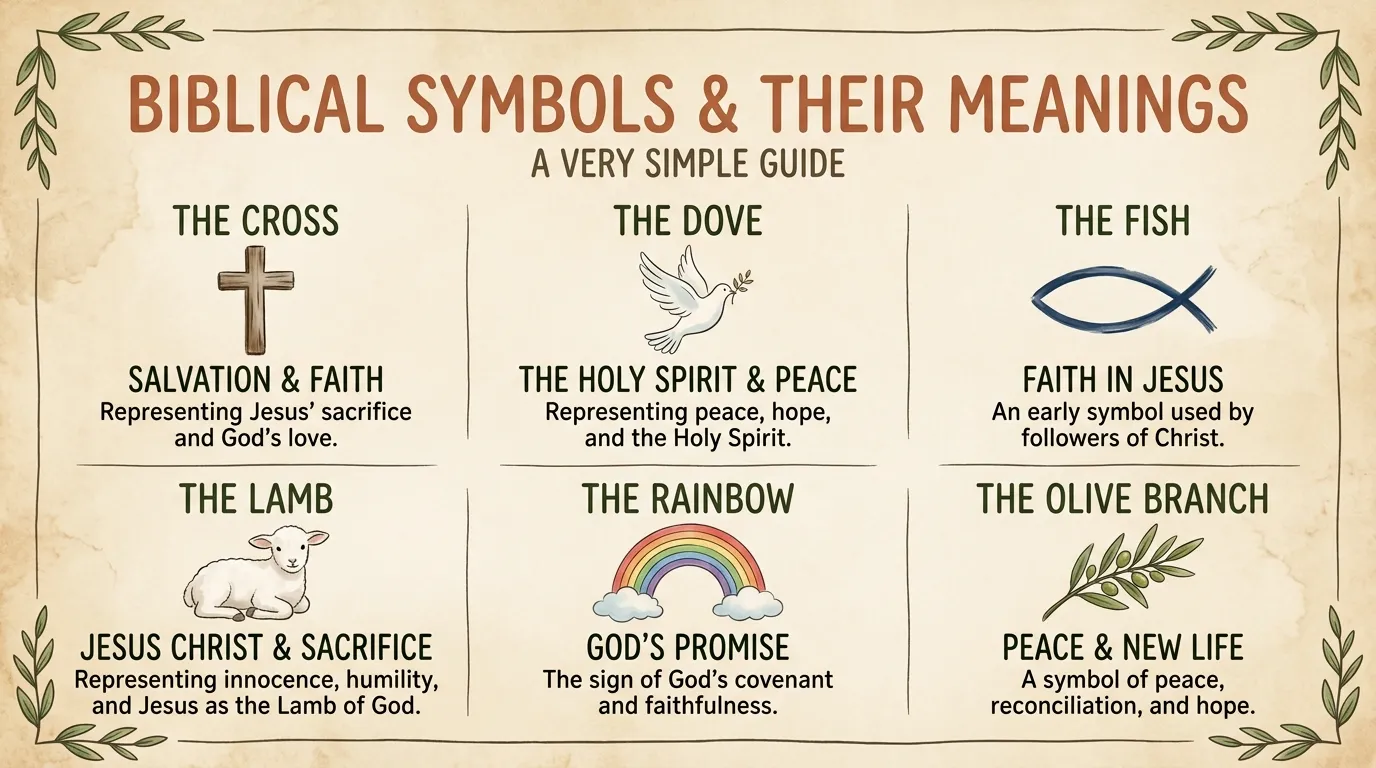
The Bible uses many symbols to communicate spiritual truths. A rainbow, a dove, a lamp, a lamb, and a crown can all carry meaning beyond their physical appearance.
These images help readers understand God’s promises, His character, the work of Jesus Christ, and the hope offered to His people.
If you have ever wondered what a particular object, animal, color, or number means in Scripture, learning about biblical symbolism can help you read the Bible with greater understanding.
However, not every symbol has one universal meaning. Its significance depends on the passage, the historical setting, and the message the biblical writer wanted to communicate.
This guide to biblical symbols and meanings explores important examples from the Old and New Testaments. It also explains how to distinguish a meaning supported by Scripture from a popular interpretation that the Bible does not clearly teach.
Whether you are new to Bible study or have read Scripture for years, these examples can help you discover deeper connections throughout God’s Word.
🔍 Did You Know?
The Bible uses ordinary things, such as light, water, bread, sheep, and trees, to communicate spiritual ideas. These images often connect passages across different books. For example, the imagery of living water appears in Jesus’ teaching in John 4:10–14 and John 7:37–39. Biblical symbols often become clearer when readers study these connections.
📖 Quick Answer: What Do Biblical Symbols and Meanings Represent?
Biblical symbols and meanings refer to the spiritual truths, ideas, or messages communicated through objects, animals, colors, numbers, actions, and images in Scripture. Depending on the passage, these symbols may point to God’s promises, holiness, judgment, wisdom, salvation, or eternal hope. Their meanings should be understood through the Bible’s context rather than personal guesses.
✨ Biblical Meaning of Symbols
Biblical symbolism is a way of communicating through images that represent something deeper than their literal appearance.
For example, Psalm 119:105 describes God’s word as a lamp for the feet and a light for the path. A lamp provides physical light, but in this passage, it also illustrates how God’s instruction guides a person’s life.
Likewise, Jesus calls Himself the Good Shepherd in John 10:11. His description draws on the familiar work of shepherds to explain His care, protection, and willingness to lay down His life for His sheep.
🕊️ What Is the Hebrew or Greek Meaning of Biblical Symbols?
The Bible was written mainly in Hebrew, with some portions in Aramaic and the New Testament written in Greek. The original languages use words for signs, images, figures, and other forms of symbolic communication.
In the Old Testament, the Hebrew word ‘ot can mean a sign or mark. One example appears in Genesis 9:13, where God identifies the rainbow as the sign of His covenant with the earth.
In the New Testament, the Greek word sēmeion often means a sign. Depending on the passage, it can refer to a miraculous sign or something that points beyond itself.
However, the English word symbol should not be treated as if it has one special Hebrew or Greek equivalent in every passage. Biblical writers used different words and literary forms to communicate meaning.
🌿 Literal Meaning and Spiritual Meaning
A symbol can have a literal meaning and a deeper meaning at the same time.
Consider these examples:
- Light: Literally, light makes things visible. In John 8:12, Jesus calls Himself the light of the world, connecting the image with spiritual life and guidance.
- Bread: Literally, bread is food. In John 6:35, Jesus calls Himself the bread of life, pointing to the life He gives.
- A shepherd: Literally, a shepherd cares for sheep. In John 10, the image illustrates Jesus’ care for His followers.
- A crown: Literally, a crown is a headpiece. In the New Testament, it can represent a promised reward, honor, or victory, as in James 1:12.
These examples show why context matters. A physical object does not automatically carry the same spiritual meaning every time it appears.
✝️ Why Are Biblical Symbols Important?
Symbols make spiritual ideas easier to understand and remember. They also connect different parts of the Bible.
For Christians, many symbols point toward God’s relationship with humanity and the work of Jesus Christ. Others communicate warnings, describe judgment, or encourage faithfulness.
Studying these images can help readers understand a passage more deeply. Still, the main purpose is to understand the biblical message, not to search for secret meanings in every detail.
🏺 Historical and Biblical Context of Symbols
The people who first read the Bible lived in cultures where farming, shepherding, family life, kingship, warfare, and religious ceremonies shaped everyday experience.
Biblical writers often used these familiar parts of life to explain spiritual truths. Understanding that background helps readers avoid interpretations that would have been unfamiliar to the original audience.
📜 Symbols in the Old Testament
The Old Testament contains many signs and symbolic images.
In Genesis 9:12–17, the rainbow is a sign of God’s covenant promise after the flood. In Exodus 13:21–22, the pillar of cloud and fire represents God’s guidance of Israel during its journey from Egypt.
The Psalms frequently use images from nature. Psalm 23 describes God as a shepherd who leads, protects, and provides for His people. Psalm 1 compares a person who delights in God’s instruction to a tree planted beside streams of water.
The prophets also used symbolic actions and visions to communicate warnings and promises. These should be read within their historical and literary settings, not treated as universal predictions about every reader’s life.
🕊️ Symbols in the New Testament
Jesus often used familiar images in His teaching.
In John 15:1–5, He describes Himself as the true vine and His followers as branches. The picture emphasizes the need to remain connected to Him to bear spiritual fruit.
In Matthew 5:14–16, Jesus calls His disciples the light of the world. He uses light to teach them to live in ways that allow others to see their good works and glorify God.
The book of Revelation also uses many symbols, including lampstands, seals, trumpets, beasts, and a Lamb. Because Revelation is apocalyptic literature, readers should pay close attention to its Old Testament background and the meaning of its visions.
BibleProject
+1
🏛️ How Ancient Culture Helps Explain Biblical Symbols
A symbol’s meaning often depends on how people understood it in the ancient world.
For example, shepherds were responsible for feeding and protecting sheep. That background helps explain why the Bible uses shepherd imagery for care and leadership.
Likewise, lamps were important sources of light before electric lighting existed. The image of a lamp guiding someone’s steps would have been easy for an ancient reader to understand.
Historical context does not replace the Bible’s message. It helps readers understand why a particular image was meaningful.
📚 Is Symbolism Mentioned in the Bible?
The Bible does not present one complete dictionary that explains every possible symbol. Instead, symbols appear throughout its stories, poetry, teachings, prophecies, and visions.
Some passages explicitly explain their symbols. For instance, Genesis 9 connects the rainbow with God’s covenant. In Daniel 7, the vision itself provides explanations for several beasts and kingdoms.
In other passages, the meaning becomes clear through the surrounding verses or through connections with earlier Scripture.
This distinction is important. When the Bible explains a symbol directly, readers have a strong basis for understanding it. When it does not, interpretations should be offered carefully and should not be presented as certain facts.
A useful rule is to let Scripture guide the interpretation rather than using a modern symbol dictionary as the final authority.
Common Biblical Symbols and Their Meanings
The following examples introduce some well-known symbols in Scripture.
Their meanings reflect important biblical passages, although the significance of a symbol can vary with its context.
1. Rainbow — God’s covenant promise
Genesis 9:12–17 identifies the rainbow as a sign of God’s covenant with Noah and every living creature.
2. Dove — associated with the Holy Spirit
Matthew 3:16 describes the Spirit of God descending like a dove at Jesus’ baptism. The passage connects the dove’s appearance with the Spirit’s presence at that moment.
It does not mean every dove sighting is a personal message from God.
3. Lamb — sacrifice and Jesus Christ
John 1:29 calls Jesus the Lamb of God who takes away the sin of the world. This image connects with biblical themes of sacrifice and redemption. Revelation also portrays a Lamb in its vision of Christ’s victory.
4. Lamp or light — guidance and truth
Psalm 119:105 compares God’s word to a lamp for one’s feet and a light for one’s path. Light can also describe Jesus’ role in bringing life and revealing truth, as seen in John 8:12.
5. Water — life, cleansing, and renewal
Water serves different purposes in Scripture. It can provide physical life, illustrate cleansing, or describe spiritual life. Jesus’ teaching about living water in John 4:10–14 is one important example.
6. Tree — growth and flourishing
Psalm 1:1–3 compares the faithful person to a tree planted beside streams of water. The image describes stability and fruitfulness. Other biblical passages use trees differently, including as images of judgment or life.
7. Crown — honor, kingship, or reward
Crowns can represent royal authority and honor. In James 1:12, the crown of life is promised to those who love God and remain faithful through trials. Its meaning depends on the passage.
8. Mountain — encounter, worship, or authority
Mountains are settings for important biblical events, including Moses receiving God’s instruction and Jesus teaching His disciples. Their symbolic significance develops through the story and should not be reduced to one fixed meaning.
Free Guide
+1
9. Bread — provision and spiritual life
Bread is a basic food in biblical life. Jesus calls Himself the bread of life in John 6:35, using this familiar image to teach about the life He offers.
10. Fire — God’s presence, testing, or judgment
Fire has several meanings in Scripture. God appears to Moses in a burning bush in Exodus 3:2, while other passages use fire to describe judgment or testing. Its meaning must be determined from the passage.
⚖️ Biblical Symbolism: A Helpful Comparison
| Symbol | Example passage | Meaning in that context |
| Rainbow | Genesis 9:12–17 | God’s covenant sign |
| Dove | Matthew 3:16 | The Spirit descends like a dove |
| Lamb | John 1:29 | Jesus as the Lamb of God |
| Light | Psalm 119:105 | God’s word provides guidance |
| Water | John 4:10–14 | Living water and spiritual life |
| Tree | Psalm 1:1–3 | Faithfulness and fruitfulness |
| Crown | James 1:12 | The crown of life |
| Fire | Exodus 3:2 | God’s presence in the burning bush |
This table gives examples, not universal definitions. The same image may carry a different meaning elsewhere in the Bible.
📖 Eight Bible Passages That Help Explain Symbols
Rather than looking for a separate meaning for every object, study the passages where Scripture uses symbolic language. These examples show how to connect an image with its intended message.
1. 🌈 Genesis 9:12–17 — The Rainbow
After the flood, God establishes a covenant with Noah and every living creature. The rainbow is identified as the sign of that covenant.
The central message is God’s promise, not a secret code about future personal events. Christians can reflect on God’s faithfulness while remembering what the passage actually promises.
2. 🕯️ Psalm 119:105 — The Lamp
The psalmist describes God’s word as a lamp for the feet and a light for the path. This image presents God’s instruction as a source of direction.
The verse encourages readers to seek wisdom from Scripture when making choices. It does not promise that every decision will become easy or that every future event will be revealed.
3. 🐑 Psalm 23:1–4 — The Shepherd
David describes the Lord as his shepherd. The picture of a shepherd caring for sheep communicates provision, guidance, and protection.
The psalm also acknowledges walking through a dark valley. Its encouragement does not depend on a life without trouble; it rests on God’s presence amid danger and fear.
4. 🕊️ Matthew 3:16–17 — The Dove
At Jesus’ baptism, the Spirit of God descends like a dove, and a voice from heaven identifies Jesus as the beloved Son.
The passage is significant because of what happens at Jesus’ baptism. It should not be used to claim that every appearance of a dove predicts a particular event in someone’s life.
5. 🍞 John 6:35 — The Bread of Life
Jesus declares that He is the bread of life. Bread was a basic part of daily nourishment, making it a meaningful image for the life Jesus offers.
The surrounding chapter is important for understanding His teaching. The verse points to coming to Jesus and believing in Him, not simply to physical food or material prosperity.
6. 💧 John 4:10–14 — Living Water
Jesus speaks with a Samaritan woman and offers living water. He contrasts ordinary water, which leaves a person thirsty again, with the gift He describes as a spring leading to eternal life.
This conversation helps readers understand the spiritual depth of the image. The passage directs attention toward Jesus’ gift of life rather than a formula for obtaining material blessings.
7. 🌿 John 15:1–5 — The Vine and Branches
Jesus describes Himself as the true vine and His followers as branches. A branch depends on the vine for nourishment and fruitfulness.
The image teaches the importance of remaining in Christ. It also helps readers understand why spiritual growth involves an ongoing relationship with Him, rather than relying only on outward activity.
8. 👑 James 1:12 — The Crown of Life
James describes a blessing for the person who perseveres under trial and loves God. The crown of life represents the promised reward described in the passage.
This image encourages endurance and faithfulness. It does not mean Christians will never struggle, nor does it give believers a reason to judge someone else’s faith based on their suffering.
🌱 A Biblical Case Study: Understanding the Rainbow
The story of Noah offers a clear example of how to interpret a biblical symbol.
In Genesis 6–9, the flood narrative describes judgment, preservation, and a new beginning. After the flood, God speaks to Noah and establishes a covenant that includes all living creatures. Genesis 9:12–17 identifies the rainbow as the sign of that covenant.
Notice how the passage itself explains the symbol. Readers do not need to invent a hidden meaning or rely on a modern list of spiritual signs. The biblical text gives the central connection: the rainbow serves as a reminder of God’s covenant promise.
This example teaches a useful method for Bible study. First, read the whole story. Next, identify what the passage says about the symbol. Finally, consider how the message fits the broader biblical account of God’s relationship with creation.
🙏 Life Lessons for Christians
Learning about biblical symbols can strengthen Bible study when it leads to a clearer understanding of Scripture.
1. Read the surrounding verses
Never interpret an image based on one word alone. Read the paragraph or chapter to understand its purpose.
2. Look for direct explanations
Some passages explain a symbol clearly. Give those explanations more weight than a modern interpretation found online.
3. Compare related passages
An image may appear in different books. Comparing those passages can reveal a repeated theme while showing how its meaning changes with context.
4. Apply the actual message
If a passage uses a lamp to describe God’s word, consider how Scripture guides your choices. Avoid inventing a separate promise that the passage does not make.
5. Stay humble about uncertain meanings
Not every detail in a vision or story is explained. It is acceptable to acknowledge uncertainty instead of claiming to know God’s hidden message.
⚠️ Common Misunderstandings About Biblical Symbols
Every symbol has one fixed meaning
This is not true. Water may describe physical life, cleansing, danger, or spiritual life, depending on the passage.
Every number carries a secret message
The Bible uses numbers in historical, practical, and sometimes symbolic ways. But it does not teach that every number sequence is a personal message from God.
A dream symbol has a guaranteed biblical interpretation
The Bible contains specific dreams and interpretations, such as those in Genesis 40–41 and Daniel 2. These accounts do not establish a universal meaning for every modern dream involving an animal, object, or number.
Modern spiritual symbolism is always biblical
Some popular interpretations come from later traditions, folklore, or modern numerology. They should not automatically be described as biblical teaching.
Revelation’s symbols can be interpreted without context
Revelation uses imagery connected to the Old Testament and its own historical setting. Reading a symbol in isolation can lead to conclusions that the text does not support.
💡 Expert Insight: How to Study a Biblical Symbol
Use a simple three-step method whenever you encounter a symbolic image.
- Read the passage: Identify the image and the main point of the surrounding text.
- Follow its biblical connections: Look for related passages and note whether the Bible explains the image directly.
- Separate evidence from interpretation: State clearly what Scripture says and what remains uncertain.
Bible dictionaries and study tools can help, but they should support careful reading rather than replace it. Resources such as Bible Gateway’s Encyclopedia of the Bible and BibleProject’s guides to biblical themes can provide helpful background.
Bible Gateway
+1
FAQs
1. What are the most common biblical symbols?
Common biblical symbols include the rainbow, dove, lamb, light, water, bread, shepherd, tree, crown, and fire. Each appears in particular passages with its own meaning. To understand a symbol correctly, read its context rather than assuming that it always means the same thing.
2. Does every object in the Bible have a spiritual meaning?
No. Some objects are mentioned simply as part of a story or historical description. Others carry symbolic meaning. Readers should look for evidence in the passage before deciding that an ordinary object represents a deeper spiritual truth.
3. What does the number seven mean in the Bible?
Seven appears in several important biblical patterns, including the creation account in Genesis 1–2 and the seventh-day Sabbath in Exodus 20:8–11. It is often associated with completeness in biblical interpretation, but its meaning still depends on the specific passage.
4. How can I know whether a symbol’s meaning is biblical?
Start with the passage itself. Check whether the text explains the symbol, compare related verses, and consult reliable Bible study resources. If an interpretation depends on a modern belief that Scripture does not teach, do not present it as an established biblical meaning.
5. Why does the Bible use so many symbols?
Symbols help biblical writers communicate spiritual truths through familiar images, stories, and comparisons. They make complex ideas easier to picture and can connect themes across different books. Understanding them requires attention to literary style, historical context, and the message of each passage.
Conclusion
Biblical symbols and meanings help readers understand how Scripture communicates God’s promises, guidance, judgment, salvation, and hope.
Images such as the rainbow, lamp, lamb, bread, and living water offer memorable ways to explore important biblical teachings.
Not every popular spiritual meaning comes from the Bible, and not every image carries one universal message.
As you continue studying God’s Word, read each passage thoughtfully, compare related verses, and remain honest about what the text does and does not say.
The goal is not to uncover secret messages everywhere. It is to understand Scripture more faithfully and apply its teachings with wisdom, humility, and love.

Hello, I’m Samuel Carter. My interest in biblical studies comes from a lifelong desire to understand the wisdom and teachings contained within Scripture. I particularly enjoy researching biblical numbers, patterns, and themes that appear throughout God’s Word.