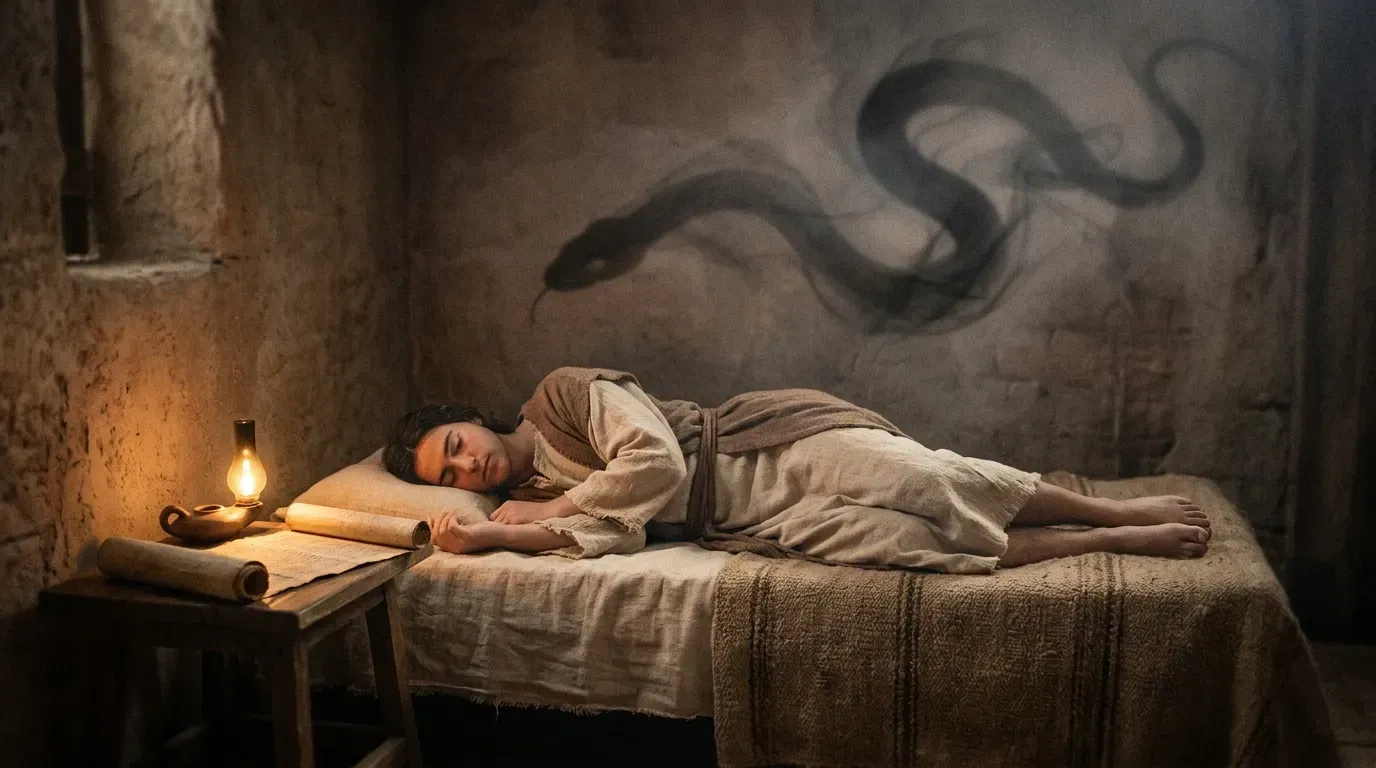
Dreaming about snakes can feel unsettling. You might see a snake chasing you, biting you, hiding inside your home, or simply moving across your path.
After waking up, you may wonder whether the dream carries a spiritual message or has a deeper meaning.
The Bible uses snakes and serpents in several important ways. In Genesis, the serpent is connected with deception and temptation.
In another passage, Jesus tells His followers to be wise as serpents and innocent as doves. Numbers also describes a bronze serpent connected with healing and God’s provision for the Israelites.
These different examples show why context matters.
The biblical meaning of snakes in a dream is not fixed, and Scripture does not teach that every snake dream predicts betrayal, danger, or a spiritual attack.
A careful Christian approach looks at what the Bible actually says, considers the dream without fear, and seeks God’s wisdom through prayer and Scripture.
This guide explores the Hebrew and Greek terms, key Bible verses, possible symbolism, and practical lessons without presenting personal interpretations as certain messages from God.
Did You Know? 🔍
The Hebrew word commonly translated as “serpent” or “snake” in the Old Testament is nachash (נָחָשׁ). In the New Testament, the Greek word ophis (ὄφις) is used for a serpent. These words can refer to an actual snake, while some passages also use serpent imagery figuratively.
Bible Hub
+1
Quick Answer: What Does Dreaming of Snakes Mean in the Bible? 📖
The Bible does not give one universal meaning to dreaming of snakes. Serpents can represent deception in some passages, while other scriptures use snake imagery to teach wisdom or describe a story of healing. A snake dream may prompt personal reflection, but it does not automatically prove that an enemy, curse, or spiritual attack is present.
Biblical Meaning of Snakes in a Dream 🕊️
Hebrew Meaning of Snakes
The Hebrew word nachash (נָחָשׁ) means “snake” or “serpent.” It appears in Old Testament passages, including Genesis 3, where the serpent speaks to Eve.
The word itself does not mean “betrayal in a dream” or “an enemy coming into your life.” Those are interpretations sometimes found in modern dream guides, not direct definitions of the Hebrew word.
When studying a Hebrew term, it is important to distinguish its basic meaning from the role it plays in a particular Bible passage.
Greek Meaning of Snakes
The Greek word ophis (ὄφις) means “snake” or “serpent.” It appears in Matthew 10:16, where Jesus tells His disciples to be wise as serpents and innocent as doves. Serpent imagery also appears in Revelation 12:9, which identifies the ancient serpent with the devil and Satan.
Strong’s Greek Lexicon (MGNT)
+1
These passages use the same general image in different ways. That is why a single symbol should not be assigned one meaning without examining its context.
Literal Meaning and Spiritual Meaning
A literal snake is a reptile. In a dream, however, it may be part of a scene that feels frightening, confusing, or meaningful to the person who sees it.
A spiritual reflection is different from a proven biblical interpretation. For example, a person who dreams about a snake might reflect on whether they feel uncertain about a relationship, are facing a difficult decision, or need to respond more wisely to a situation.
Those reflections may be useful, but they are not proof that God has sent a specific message. The Bible does not provide a universal dictionary that connects every dream image with a fixed spiritual meaning.
Biblical Significance of Serpents
Snakes appear in several kinds of biblical stories:
- Deception: The serpent in Genesis 3 challenges God’s command and misleads Eve.
- Wisdom: Jesus uses the serpent as an example of shrewdness in Matthew 10:16.
- Judgment and healing: Numbers 21 describes poisonous snakes and a bronze serpent through which the Israelites who looked at it could live.
- Evil and opposition: Revelation uses serpent imagery in its description of Satan.
These examples provide biblical themes to study. They do not establish that seeing a snake while asleep has the same meaning as any one of these passages.
A Key Scripture Reference
Genesis 3:1–5 is often the first passage people consider when they look for the biblical meaning of snakes. In this account, the serpent questions God’s words and encourages Eve to disobey.
The passage teaches about temptation, deception, and the danger of distrusting God’s instruction. It does not say that every snake in a dream represents Satan or that everyone who dreams about a serpent is under spiritual attack.
Historical and Biblical Context 🏺
Snakes in the Old Testament
Snakes were real animals in the world of the Old Testament. Some were dangerous, and their presence could create a serious threat to people traveling or living outdoors.
The Bible also uses animals in stories and images that teach spiritual lessons. In Genesis 3, the serpent plays a role in humanity’s disobedience. In Numbers 21, snakes become part of a story about Israel’s rebellion, suffering, repentance, and God’s provision.
The meaning depends on the story. A snake in one passage does not have to carry exactly the same meaning in another.
Snakes in the New Testament
The New Testament continues to use serpent imagery. Jesus warns His disciples that they will face opposition, telling them to combine the wisdom of serpents with the innocence of doves (Matthew 10:16).
In John 3:14–15, Jesus refers to Moses lifting up the serpent in the wilderness as He explains His own coming crucifixion and the promise of eternal life to those who believe in Him.
Revelation 12:9 uses the image of the ancient serpent for the devil. This is a clear example of serpent imagery connected with evil, but it belongs to a specific biblical vision and its message.
None of these passages gives a general rule for interpreting snake dreams.
Cultural Understanding in Biblical Times
People in the ancient Near East encountered snakes in everyday life, and snakes also appeared in the stories and symbols of surrounding cultures. They could inspire fear because some were venomous.
The Bible sometimes uses that familiar danger to communicate a moral or spiritual point. Yet biblical writers do not treat every appearance of a snake as a supernatural sign.
For Christians today, the most reliable starting point is the passage itself, not a modern list claiming that each snake color, location, or action predicts a particular event.
Is Dreaming of Snakes Mentioned in the Bible? 📜
The Bible records dreams and visions, and it describes snakes in several important passages. However, it does not give a specific teaching that explains what it means whenever someone dreams about a snake.
Some biblical dreams had clear meanings within their stories. For example, God gave Joseph the ability to interpret Pharaoh’s dreams in Genesis 41. The text directly explains the dreams’ meaning through Joseph’s interpretation.
That account does not mean every modern dream can be interpreted with the same certainty. Joseph’s interpretation was given within a specific biblical event; it is not a formula that allows every person to decode every image.
If you dream of snakes, you can read relevant passages and pray for wisdom. You can also consider whether stress, recent experiences, or fear may have influenced the dream. It is wise to avoid making major decisions based on an unverified interpretation.
Spiritual Meaning and Symbolism of Snakes 🧭
Snake imagery may lead Christians to reflect on several themes found in Scripture. These are possible areas for reflection, not guaranteed explanations of a dream.
Deception and Discernment
Because the serpent deceives Eve in Genesis 3, a snake dream might prompt you to reflect on honesty, trust, or discernment.
Ask yourself whether you need to examine a situation more carefully. Are you accepting claims without checking them? Are you ignoring sound advice? These questions can be useful even if the dream has no special spiritual meaning.
The dream itself does not prove that someone close to you is lying.
Fear and the Need for Peace
A snake may frighten you, especially if you already fear reptiles. If the dream leaves you anxious, it may help to reflect on what has been worrying you lately.
Psalm 4:8 speaks about resting in peace and safety through trust in God. Philippians 4:6–7 encourages believers to bring their concerns to God in prayer.
These passages offer spiritual comfort. They do not require you to treat the snake as a prediction of future danger.
Wisdom and Caution
Matthew 10:16 provides a useful contrast: Jesus tells His followers to be wise as serpents and innocent as doves. Wisdom does not mean suspicion toward everyone. It means acting with good judgment while keeping a sincere heart.
If a dream leads you to consider a difficult situation, you can respond by seeking facts, asking for wise counsel, and avoiding impulsive choices.
Healing and Hope
Numbers 21:4–9 tells of the Israelites being healed after looking at the bronze serpent Moses lifted up, according to God’s instruction. Jesus later refers to this event in John 3:14–15.
This story shows that serpent imagery is not limited to one simple theme. However, it does not establish that a snake appearing in a dream predicts healing or a miracle.
The practical lesson is to look to the meaning of the biblical story rather than assigning a promise to the dream itself.
Common Snake Dreams: A Careful Comparison
| Dream detail | Possible reflection | What Scripture does not confirm |
| A snake chasing you | Is something making you feel pressured or afraid? | That an enemy is definitely pursuing you spiritually |
| A snake biting you | Are you worried about harm, conflict, or vulnerability? | That betrayal or illness is certain to happen |
| A snake inside your house | Does home feel stressful or unsafe at the moment? | That a family member is evil or a curse is present |
| Killing a snake | Are you trying to face or overcome a fear? | That you have defeated a specific spiritual enemy |
| A black snake | What emotions did the color bring up for you? | That black snakes always mean darkness or evil |
| Many snakes | Are you feeling overwhelmed by several concerns? | That many enemies are surrounding you |
| A calm snake | Did the dream feel peaceful, strange, or threatening? | That a calm snake is always a sign of wisdom or blessing |
The feelings and circumstances surrounding a dream can help you reflect, but they cannot establish a spiritual message on their own. The Bible’s teaching should remain distinct from personal symbolism.
9 Bible Verses About Snakes and Their Lessons 📖
The following passages explain how snakes function in biblical stories and teachings. Each one should be read in context rather than treated as a direct code for interpreting dreams.
1. Genesis 3:1–5 — The Serpent and Deception
Genesis 3 introduces the serpent as crafty. The serpent questions God’s instruction and encourages Eve to doubt what God has said. The account leads to humanity’s disobedience and its consequences.
This passage is central to the biblical discussion of serpent imagery. It shows how deception can begin by distorting truth and creating doubt about God’s words.
Faith lesson: Test ideas against Scripture rather than accepting every claim. If a snake dream makes you suspicious of someone, do not treat the dream as evidence. Look at real actions and facts before reaching a conclusion.
2. Exodus 7:8–13 — Aaron’s Staff Becomes a Snake
In Exodus 7, Moses and Aaron stand before Pharaoh. Aaron’s staff becomes a serpent as part of the sign they perform, and Pharaoh’s magicians imitate the act. Aaron’s staff then swallows their staffs.
The passage belongs to the larger account of God’s confrontation with Pharaoh and the deliverance of Israel. It is not a teaching about dreams, but it shows that a serpent can appear as part of a specific sign in Scripture.
Faith lesson: Consider the purpose of a biblical event before applying it to your life. A snake in a dream does not automatically carry the same meaning as a sign in Exodus.
3. Numbers 21:4–9 — The Bronze Serpent
During Israel’s wilderness journey, the people complain against God and Moses. Poisonous snakes appear, and many people are bitten. After the people acknowledge their sin, God instructs Moses to make a bronze serpent and place it on a pole. Those who look at it live.
This unusual account connects judgment, confession, and God’s provision. The serpent is part of a specific act of deliverance, not a universal symbol with one meaning in every setting.
Faith lesson: When reading a troubling dream, turn to the wider biblical message. This passage encourages attention to God’s instruction and mercy, but it does not promise that a snake dream predicts healing.
4. Matthew 10:16 — Wise as Serpents, Innocent as Doves
Jesus tells His disciples that He is sending them out like sheep among wolves. He instructs them to be wise or shrewd as serpents and innocent as doves.
The context is opposition and the need for sound judgment. Jesus does not tell His followers to become deceptive. Instead, He pairs careful thinking with moral innocence.
Bible Gateway
+1
Faith lesson: Wisdom and kindness can work together. If your dream causes you to think about a challenging relationship, respond with discernment and honesty rather than fear or accusation.
5. John 3:14–15 — Jesus Refers to the Wilderness Serpent
Jesus compares His being lifted up to the bronze serpent Moses lifted up in the wilderness. He uses the earlier event to explain that those who believe in Him may receive eternal life.
The connection is explained in the passage itself. Christians therefore read the bronze serpent in light of Jesus’ teaching, not as a secret code for modern dream interpretation.
Faith lesson: Keep Christ and the message of the passage at the center of your reading. A snake dream cannot, by itself, prove that you will receive a miracle or that a particular event is coming.
6. Revelation 12:9 — The Ancient Serpent
Revelation 12:9 identifies the ancient serpent with the devil and Satan, the deceiver of the world. This passage uses symbolic language in an apocalyptic vision describing conflict between evil and God’s purposes.
It is an important cross-reference to Genesis 3. Still, the passage concerns the vision’s portrayal of Satan, not a rule that every snake seen in sleep represents the devil.
Faith lesson: Take biblical warnings about deception seriously, but do not let fear control your interpretation of ordinary experiences. Seek truth through Scripture, prayer, and wise counsel.
7. Ecclesiastes 5:3 — Dreams and Many Concerns
Ecclesiastes 5:3 connects dreams with many activities or concerns. The surrounding passage discusses speech, vows, and approaching God with care.
This verse reminds readers that dreams can arise in connection with the busy concerns of life. It does not claim that every dream is meaningless, but neither does it say that every dream carries a divine message.
Faith lesson: Consider what has been occupying your mind. Stress, memories, and everyday experiences may be relevant to how a dream feels. You do not need to assign a supernatural explanation to every detail.
8. James 1:5 — Ask God for Wisdom
James 1:5 teaches that anyone who lacks wisdom can ask God, who gives generously. The surrounding passage discusses trials, endurance, and the development of mature faith.
This verse is useful when a dream leaves you uncertain. Rather than searching for a frightening prediction, you can ask God to help you respond with patience, clear judgment, and trust.
Faith lesson: Prayer is a way to seek wisdom, not a guarantee that a hidden meaning will be revealed. You can ask for guidance while remaining honest about what you do not know.
9. 1 Thessalonians 5:21 — Test Everything
Paul tells believers to examine or test things carefully and hold on to what is good. The surrounding verses discuss spiritual discernment and the need to avoid evil.
This principle offers a helpful guide for evaluating online dream interpretations. A confident claim is not automatically a biblical claim. Check the cited passage and see whether it actually teaches the proposed meaning.
Faith lesson: If someone says a snake dream proves that you are cursed, betrayed, or under attack, ask where Scripture clearly teaches that conclusion. Avoid accepting claims that go beyond the text.
A Biblical Case Study: Moses and the Bronze Serpent 🐍
Numbers 21 provides a useful example of why context matters. As the Israelites travel through the wilderness, they become discouraged and speak against God and Moses. Poisonous snakes appear, and the people suffer from their bites.
The people acknowledge their wrongdoing and ask Moses to pray for them. God then gives Moses instructions to make a bronze serpent and place it on a pole. Those who have been bitten can look at it and live.
The story has a clear setting, a specific instruction, and an outcome described by Scripture. Later, Jesus refers to the event in John 3:14–15 to explain His own mission.
Notice what the text does not say: it does not tell readers how to interpret a snake appearing in a dream. Its message comes from the events and explanation provided in the passage.
For Christians today, this case study offers a valuable reading principle: understand the original biblical context before applying a symbol to a personal experience. A dream may lead you to reflect, but it should not be treated as equivalent to a direct biblical revelation.
Life Lessons for Christians 🌿
1. Seek Wisdom Instead of Giving In to Fear
A frightening dream can stay with you throughout the day. Give yourself time to settle down, pray, and consider the dream calmly.
You do not need to assume that something bad will happen because you saw a snake.
2. Read Scripture in Context
If you want to study snake symbolism, begin with the full passages in Genesis 3, Numbers 21, Matthew 10, and John 3. Read the verses around each reference to understand what the author is communicating.
This approach is more reliable than relying on a list of dream symbols.
3. Do Not Accuse People Based on a Dream
A dream about a snake biting you does not prove that a friend, relative, or partner intends to harm you.
If a relationship concerns you, consider real behavior and have an honest conversation when appropriate. Dreams should not replace evidence or fair judgment.
4. Pray for Discernment
Ask God for wisdom, peace, and the ability to respond well. James 1:5 provides a biblical basis for asking for wisdom.
You can pray without assuming that God must reveal a hidden meaning for the dream.
5. Remember God’s Care
If the dream has left you anxious, return to Scripture that encourages trust in God. Psalm 4:8 and Philippians 4:6–7 offer comfort to readers dealing with fear or worry.
If frightening dreams keep disturbing your sleep, it may also help to talk with someone you trust or a qualified health professional. Seeking practical support does not conflict with Christian faith.
Common Misunderstandings About Snake Dreams ⚠️
Misunderstanding 1: Every Snake Dream Means an Enemy Is Near
Biblical correction: Scripture does not establish this rule. The serpent in Genesis is connected with deception, but that does not mean every snake in a dream points to a person who wants to harm you.
Misunderstanding 2: A Snake Bite Predicts Betrayal
Biblical correction: The Bible does not teach that a snake bite in a dream predicts betrayal, illness, or loss. Such an interpretation may reflect personal fears, but it should not be presented as a scriptural fact.
Misunderstanding 3: The Color of the Snake Determines the Meaning
Biblical correction: Scripture does not provide a universal dream dictionary assigning fixed meanings to black, green, white, or red snakes. Color associations on modern websites should not be confused with biblical teaching.
Misunderstanding 4: Every Dream Is a Message From God
Biblical correction: The Bible records dreams that God used in particular situations, but it does not say every dream is a divine message. Ecclesiastes 5:3 even connects dreams with the many concerns of life.
Misunderstanding 5: A Snake Dream Proves a Curse or Spiritual Attack
Biblical correction: A dream alone cannot establish that a curse, spiritual attack, or demonic presence exists. If you feel afraid, seek support through prayer, Scripture, and trusted Christian counsel rather than allowing alarming claims to control you.
Expert Insight: How to Study a Snake Dream Biblically 💡
A sound Bible study begins with the text, not with a conclusion you hope to confirm. Use this simple method:
- Read the passage: Start with the biblical story involving the serpent.
- Check the context: Ask who is speaking, what is happening, and what the passage teaches.
- Compare related passages: Notice differences between Genesis 3, Matthew 10:16, and Numbers 21.
- Separate fact from interpretation: Mark which ideas come directly from Scripture and which are personal reflections.
- Apply the lesson carefully: Look for a wise and faithful response without claiming that the dream predicts a specific event.
Hebrew and Greek word studies can help, but a word’s meaning depends on how it is used. A dictionary definition cannot establish the meaning of a personal dream by itself.
FAQs
1. Is dreaming of snakes a warning from God?
Not necessarily. The Bible does not say that every snake dream is a warning from God. You can pray and reflect on the dream, but avoid treating it as a prediction without clear biblical support. Look to Scripture for wisdom and judge claims carefully.
2. Does a snake in a dream mean an enemy is near?
No Bible passage establishes that a snake dream means an enemy is near. Genesis connects a serpent with deception, but that story does not define every dream. If you have concerns about someone, evaluate their actual behavior instead of relying on a dream.
3. What does a snake bite mean spiritually?
The Bible does not give snake bites in dreams a fixed spiritual meaning. A bite may feel frightening and prompt reflection on vulnerability or conflict, but those are personal associations. It is not proof of betrayal, sickness, a curse, or future harm.
4. What does a black snake mean in a dream according to the Bible?
The Bible does not teach a special meaning for dreaming about a black snake. Online interpretations often attach specific meanings to snake colors, but these claims should not be presented as established biblical teaching. Read relevant Scripture and consider the dream calmly.
5. Should Christians pray after dreaming about snakes?
Yes, Christians can pray after any dream, especially if it causes fear or confusion. Ask God for peace, wisdom, and discernment. Prayer does not require you to assume the dream has a hidden message. You can trust God while admitting that its meaning is uncertain.
Conclusion
The biblical meaning of snakes in a dream is not a single message that applies to everyone.
Scripture uses serpents in different contexts, including the deception in Genesis 3, the wisdom Jesus describes in Matthew 10:16, and the bronze serpent in Numbers 21.
These passages can help Christians understand biblical symbolism, but they do not establish that a snake dream predicts betrayal, danger, a curse, or a spiritual attack.
If you have had this dream, take time to pray, read Scripture in context, and consider what has been happening in your life.
Seek wise counsel if you need it, and do not let frightening interpretations take away your peace.
Above all, remember that God’s guidance should be sought through a faithful understanding of Scripture, prayer, and wise discernment—not fear or unsupported predictions.
You can bring your questions to God while remaining honest about what the Bible does and does not say.

Hello, I’m Samuel Carter. My interest in biblical studies comes from a lifelong desire to understand the wisdom and teachings contained within Scripture. I particularly enjoy researching biblical numbers, patterns, and themes that appear throughout God’s Word.