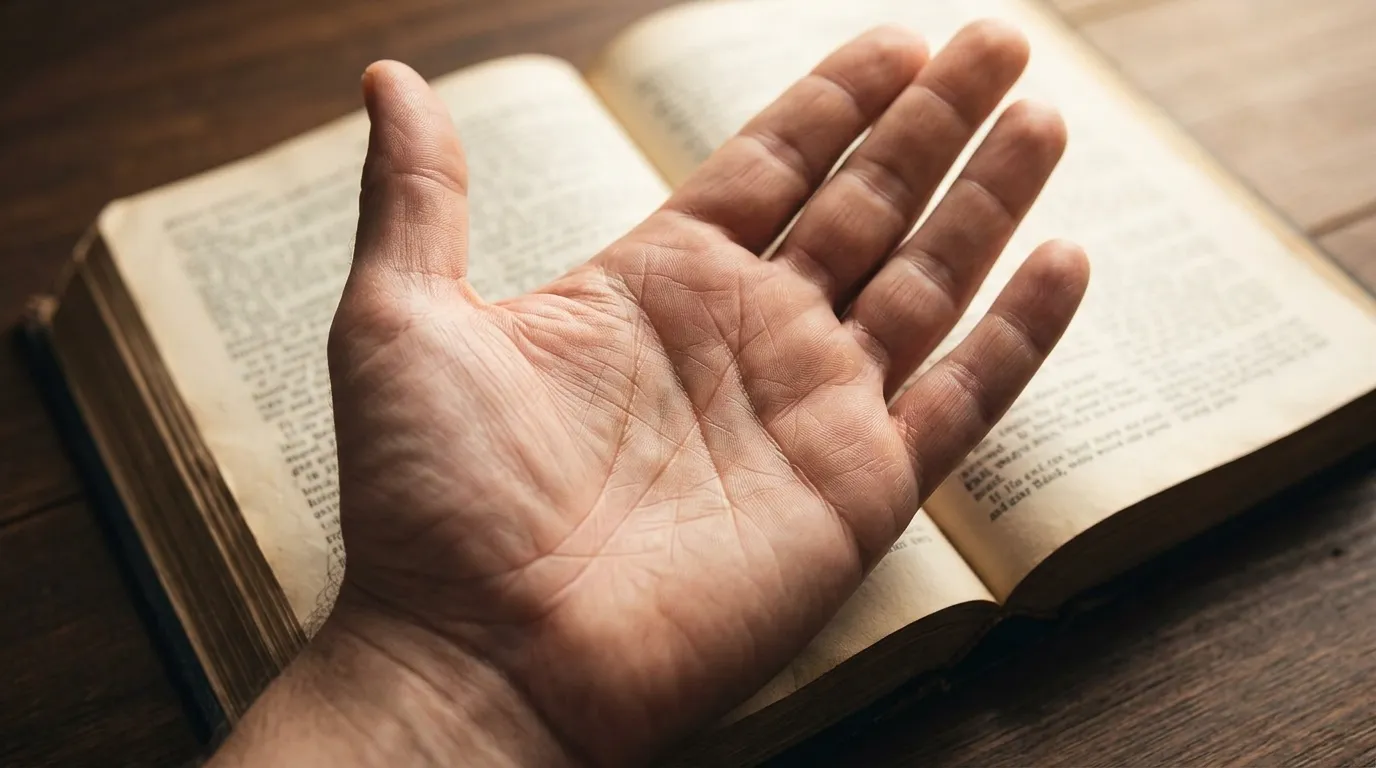
There is no Hebrew or Greek word in the Bible that identifies an “M-shaped palm mark” as a spiritual sign.
The letter M is part of the modern English alphabet, while the biblical languages used different writing systems.
The Hebrew word kaf (כַּף) can refer to the palm of the hand in biblical contexts.
The Greek word cheir (χείρ) means “hand” and appears throughout the New Testament. Neither word establishes a biblical meaning for an M-shaped pattern in a person’s palm.
This distinction matters because a word study should explain what Scripture actually says. It should not create a spiritual definition that the biblical text never gives.
What Does the M Shape Literally Mean?
The M shape is a pattern that some people notice when the creases on their palm meet in a particular way. Palmistry traditions commonly connect it with the heart line, head line, life line, and sometimes a vertical line called the fate line.
Palmists may associate this pattern with intuition, judgment, leadership, or success. These are interpretations from palmistry, not promises found in the Bible.
The pattern itself is a physical feature of the hand. Seeing it does not prove that a person has a special destiny, spiritual gift, or message from God.
What Is the Spiritual Meaning of M on the Palm?
Some online articles describe the letter M as a sign of divine favor, protection, wealth, or a special calling. These claims may sound encouraging, but Scripture does not confirm them.
A Christian can reflect on the hand as a reminder of God’s creative work and the importance of using our abilities to serve others. That is a personal devotional application, not the biblical interpretation of the M-shaped pattern.
A helpful question is not, “What secret promise does this letter reveal?” but, “How can I use the abilities God has given me to live faithfully?”
Biblical Significance of the Palm
The Bible mentions hands and palms in several meaningful ways. Hands can represent work, action, power, care, or responsibility. In some passages, the hand is also used as a picture of God’s protection or remembrance.
For example, Isaiah 49:16 uses the image of God engraving His people on the palms of His hands. The passage offers reassurance that God has not forgotten Zion. It is not describing the lines of a human palm or teaching palm reading.
The distinction is simple: the Bible uses hand imagery, but it does not assign a special meaning to the letter M formed by palm lines.
Key Scripture: Isaiah 49:16
Isaiah 49:16 says that God has engraved His people on the palms of His hands. The surrounding passage speaks to Zion, which feels forgotten and abandoned. God responds with a promise of remembrance and restoration.
This verse can comfort Christians who feel overlooked or alone. However, its imagery should not be used as evidence that an M-shaped mark on someone’s hand signals a special destiny.
The biblical message is God’s faithfulness to His people, not a hidden code in human palm lines.
Bible Gateway
+1
Historical and Biblical Context 🏺
Old Testament Teaching About Signs and Divination
The Old Testament contains instructions about how Israel should seek guidance and how the people should avoid practices used to predict the future through omens or divination.
Leviticus 19:26 warns against divination and seeking omens. Deuteronomy 18:10–12 gives further instructions against practices used to obtain hidden knowledge through prohibited spiritual methods.
These passages do not name the modern M-on-the-palm trend. Still, they provide an important principle for Christians who are considering palm reading as a way to discover destiny or predict events.
It is also important to read these verses in their historical and religious setting. They address practices that Israel was instructed to avoid; they do not say that noticing the natural creases in your hand is itself a sin.
New Testament Relevance
The New Testament encourages believers to seek wisdom, test claims, and live by faith. It does not teach Christians to determine their future by reading the lines on their hands.
James 1:5 encourages people who lack wisdom to ask God for it. Proverbs 3:5–6 calls readers to trust in the Lord rather than relying only on their own understanding.
These passages offer a different approach to guidance. Instead of searching for a hidden prediction in a palm mark, Christians can pray, study Scripture, seek wise advice, and make thoughtful decisions.
Cultural Understanding of Palm Reading
Palm reading, also known as palmistry, is a practice found in various cultural traditions. Practitioners interpret lines and shapes on the hand to make claims about personality, relationships, fortune, or future events.
The meanings assigned to an M-shaped pattern differ across modern palmistry sources. Some call it a sign of intuition or leadership; others connect it with luck, wealth, or success.
These differences are another reason not to present one interpretation as a fact about God’s plan. A cultural belief can be studied as a cultural belief without treating it as a biblical promise.
Is the M on the Palm Mentioned in the Bible? 📜
No. The Bible does not mention the letter M formed by palm lines, nor does it teach that this pattern predicts wealth, marriage, spiritual gifts, or future success.
The Bible does mention hands, palms, and signs in other contexts. Isaiah 49:16 uses the palm as an image of God’s remembrance. Psalm 139:13–16 describes God’s knowledge of human life and formation. Neither passage explains palm lines as a method for discovering a person’s destiny.
Some websites combine these verses with modern palmistry claims. This can make a popular interpretation sound biblical even when the cited passage does not support it.
To check such a claim, ask three questions:
- Does the passage actually mention an M-shaped mark?
- Does it teach that palm lines reveal a person’s future?
- Does the surrounding context support the interpretation being offered?
If the answer is no, the claim should not be presented as a biblical teaching.
A Christian may notice an M on their palm without fear or shame. The important distinction is between observing a physical feature and relying on it as a spiritual prediction.
Spiritual Meaning and Symbolism: A Christian Perspective 🕊️
Your Identity Is Not Defined by a Palm Mark
A person may feel special after reading that an M on the palm means they are chosen, gifted, or destined for greatness. But Christian identity does not depend on a physical mark.
The Bible teaches that people are made in God’s image (Genesis 1:26–27). It also calls believers to grow in faith, love, humility, and service. These truths apply regardless of the shape of someone’s palm.
You do not need an unusual mark to have value or purpose. Your worth is not measured by how rare your hand looks.
Wisdom Is Better Than Fortune-Telling
Palmistry often claims to reveal hidden facts about personality or future events. Scripture instead directs believers toward wisdom, honest judgment, and trust in God.
This does not mean Christians should avoid every discussion of cultural traditions. It means they should not treat palm reading as a reliable way to learn God’s plans.
If you are making a major decision about work, marriage, finances, or family, consider biblical principles and real evidence. Pray, ask for wise counsel, and think carefully about the likely consequences. An M-shaped palm mark cannot replace those steps.
Use Your Hands for Good
The Bible often connects hands with action and work. Ecclesiastes 9:10 encourages people to do their work diligently, while Colossians 3:23 calls believers to work wholeheartedly as serving the Lord.
These passages provide a practical way to reflect on your hands. Instead of asking whether their lines promise success, consider how you can use your time, skills, and opportunities to help others.
Your actions, choices, and character matter far more than a palmistry interpretation.
God’s Guidance Does Not Depend on Hidden Codes
Some people look for repeated numbers, unusual marks, or patterns because they want reassurance about the future. That desire is understandable, especially during uncertain times.
Yet Scripture does not teach that every unusual detail is a private message from God. Christians can seek guidance through prayer, the Bible, wise counsel, and careful judgment without needing a hidden sign on their bodies.
If you see an M on your palm, you can simply recognize it as a pattern made by the creases of your hand. It does not need to become a prediction or a source of worry.
M on the Palm: Biblical Teaching vs Palmistry Claims 📊
| Question | What Scripture supports | What palmistry may claim |
| Does the Bible mention an M on the palm? | No specific teaching about an M-shaped palm mark | It is treated as a special pattern |
| Does it guarantee wealth? | No such promise | Some sources associate it with success or money |
| Does it prove strong intuition? | No biblical link between the M pattern and intuition | Some palmists describe it this way |
| Does it reveal God’s plan? | Scripture encourages prayer, wisdom, and trust in God | Some interpretations claim to reveal destiny |
| Is noticing the mark itself sinful? | Scripture does not condemn simply noticing natural palm creases | Palmistry may invite people to interpret the mark |
| Can the hand remind us of God? | Yes, Scripture uses hands and palms as meaningful imagery | Palmistry gives its own interpretations to palm lines |
The key difference is the source of the claim. Biblical teaching should be supported by the text and its context. Palmistry interpretations belong to a separate tradition and should not be presented as direct promises from God.
9 Bible Verses to Understand Palm Marks and God’s Guidance 📖
The Bible does not contain verses specifically about the M-shaped mark. The following passages are relevant to the broader questions of palm imagery, spiritual guidance, and attempts to predict the future.
1. Leviticus 19:26 — Do Not Seek Omens
Leviticus 19:26 instructs Israel not to practice divination or seek omens. The verse appears within a larger collection of laws about worship and how the people should live as God’s holy community.
The passage does not name the M on the palm. However, it matters when someone wants to use a palm mark to predict future events or obtain hidden spiritual knowledge. Christians should distinguish observing a physical feature from treating it as an omen.
Faith lesson: Do not base major decisions on predictions that lack reliable biblical support. Seek wisdom and make choices with care.
Bible Gateway
+1
2. Deuteronomy 18:10–12 — Avoid Divination
Deuteronomy 18 warns Israel against several practices used to seek hidden knowledge or predict events, including divination and interpreting omens. The passage is part of the instructions given to Israel as it prepares to live in the promised land.
It does not specifically discuss modern palmistry or the letter M. Still, Christians who believe palm reading can reveal destiny should consider how that practice relates to the passage’s warning against seeking supernatural knowledge through divination.
Faith lesson: Seek God’s guidance through faithful study, prayer, and wise counsel instead of relying on fortune-telling.
Bible Gateway
+1
3. Isaiah 49:16 — Engraved on the Palms of God’s Hands
In Isaiah 49:16, God reassures Zion with an image of being engraved on His palms. The surrounding passage speaks to a people who fear they have been forgotten. God’s response emphasizes His continued remembrance and the hope of restoration.
The image is powerful, but its meaning should not be confused with palmistry. The verse does not say that the lines on human hands contain a prediction of their future.
Faith lesson: When you feel forgotten or uncertain, remember the message of God’s faithfulness. Your hope rests in His character, not in the shape of your palm.
Bible Gateway
+1
4. Psalm 139:13–16 — God Knows Your Life
Psalm 139 describes God’s knowledge of the psalmist, including the formation of the body before birth. The passage expresses wonder at God’s knowledge and care for human life.
It does not teach that palm lines reveal a person’s future. Instead, it points to God’s understanding of each person, even when much about life remains unknown to us.
Faith lesson: You do not need to decode your body to prove that you matter to God. Your life is known to Him, and you can seek to live faithfully with the abilities and opportunities you have.
5. Proverbs 3:5–6 — Trust the Lord for Guidance
Proverbs 3:5–6 encourages readers to trust in the Lord rather than relying only on their own understanding. It calls for acknowledging God in one’s ways and trusting Him to direct one’s path.
This passage offers a clear alternative to searching for predictions in physical signs. It does not promise that every decision will become easy, but it calls believers to place their trust in God as they choose how to act.
Faith lesson: When facing uncertainty, pray, consider Scripture, and seek wise advice. Do not let a palm mark make a decision for you.
6. James 1:5 — Ask God for Wisdom
James 1:5 tells readers who lack wisdom to ask God, who gives generously. In the surrounding chapter, James discusses trials, endurance, and the growth of mature faith.
This is a useful passage when you are looking for answers about your future. You can ask God for wisdom without assuming that an unusual mark will reveal what is going to happen.
Faith lesson: Pray for good judgment and the courage to act wisely. God’s guidance is not something you must discover through a special shape in your hand.
7. 1 Samuel 28:6–8 — Saul Seeks Forbidden Guidance
In 1 Samuel 28, King Saul faces the Philistine threat and becomes afraid. When he does not receive an answer through the means described in the passage, he seeks out a medium at Endor.
The narrative presents a troubling moment in Saul’s decline and shows him turning to a prohibited source for guidance. It is not a story about palmistry, but it illustrates the danger of seeking answers through forbidden spiritual practices when fear takes control.
Faith lesson: Fear can make uncertain answers seem attractive. Respond to uncertainty with prayer, Scripture, and wise counsel rather than seeking predictions through divination.
8. 1 Thessalonians 5:21 — Test Everything
Paul tells the Thessalonian believers to test things and hold on to what is good. The surrounding passage discusses spiritual discernment and the need to avoid evil.
This principle is valuable when reading online claims about an M on the palm. A claim may sound confident, but readers should check whether the cited Bible passage actually supports it.
Faith lesson: Examine spiritual claims carefully. Do not accept a palmistry interpretation as biblical simply because a website includes a verse beside it.
9. Colossians 3:23 — Work Wholeheartedly
Colossians 3:23 encourages believers to do their work wholeheartedly, as for the Lord rather than merely to please people. The passage concerns a believer’s attitude toward everyday responsibilities.
It provides a practical way to think about the hands and abilities God has given us. Rather than searching for a sign that guarantees success, Christians can focus on doing their work honestly and faithfully.
Faith lesson: Build your future through wise choices, effort, integrity, and service. A palm mark cannot replace the daily work of living out your faith.
A Biblical Case Study: King Saul’s Search for Answers 👑
The story of King Saul in 1 Samuel 28 offers a useful lesson about seeking guidance when the future feels uncertain.
Saul faced a serious threat from the Philistine army. He was afraid and wanted to know what would happen. The passage says he sought an answer from the Lord but did not receive one through the means described in the account. He then went to a medium at Endor, despite the restrictions against such practices.
The story is not about an M-shaped palm, and we should not pretend it is. Its relevance is the larger question: What do we do when we want answers that we cannot obtain with certainty?
Saul’s actions show the danger of allowing fear to drive us toward forbidden sources of guidance. His story encourages readers to take God’s instructions seriously instead of searching for any method that promises certainty.
When you notice an M on your palm, you do not need to turn it into a spiritual prediction. You can acknowledge the pattern, read Scripture carefully, and make decisions through prayer, wisdom, and sound judgment.
Life Lessons for Christians 🙏
1. Remember That Your Worth Comes From God
Your value does not depend on whether you have an M-shaped pattern on your palm. You do not need a rare physical mark to be loved by God or to have a meaningful life.
Focus on growing in faith, showing love, and serving others.
2. Seek Guidance Through Prayer and Scripture
When you feel uncertain about your future, take time to pray and study the Bible. James 1:5 encourages believers to ask God for wisdom.
You can also speak with a trusted Christian leader or a mature person who will help you think clearly.
3. Be Careful With Online Spiritual Claims
Websites and social media posts sometimes present palmistry as if it reveals a person’s destiny. Check the claims before accepting them.
Ask whether the Bible passage quoted actually teaches the claimed meaning. If it does not, treat the claim as a cultural interpretation rather than a biblical fact.
4. Use Your Abilities to Help Others
Your hands can represent the work you do, the care you offer, and the practical ways you serve people. Colossians 3:23 encourages wholehearted work.
Instead of wondering whether your palm promises success, consider how you can use your skills to support your family, help your community, and honor God.
5. Do Not Let Fear Control Your Decisions
If someone tells you that your palm mark predicts danger or guarantees wealth, you do not need to be frightened or excited by that claim.
Pause, consider the facts, and seek wise advice. You can trust God without needing to know every detail of your future.
Common Misunderstandings About the M on the Palm ⚠️
Misunderstanding 1: The Letter M Means God Has Chosen You for a Special Destiny
Biblical clarification: Scripture does not identify the M-shaped palm pattern as a mark of divine selection. Christians can find purpose in following God, but that purpose is not proved by a palm line.
Misunderstanding 2: An M on the Palm Guarantees Wealth
Biblical clarification: No Bible verse promises financial success to people with this pattern. Financial decisions should be based on careful planning, honesty, sound judgment, and appropriate advice—not a palmistry prediction.
Misunderstanding 3: The M Proves You Have Strong Intuition
Biblical clarification: Some palmistry traditions connect the M with intuition or judgment, but the Bible does not make that connection. Good judgment develops through wisdom, experience, learning, and thoughtful choices.
Misunderstanding 4: Isaiah 49:16 Teaches Palm Reading
Biblical clarification: Isaiah 49:16 uses the image of God engraving His people on His palms to express His remembrance of Zion. It is not an instruction to read human palm lines or interpret letters formed by them.
Misunderstanding 5: Simply Having an M on Your Palm Is Sinful
Biblical clarification: The Bible does not condemn a person simply for having natural creases that resemble a letter. The important issue is whether someone treats the mark as a supernatural prediction or relies on divination for guidance.
Expert Insight: How to Check a Biblical Claim 💡
When an article claims that a physical mark has a special biblical meaning, use this simple method:
- Find the cited verse. Read it in a reliable Bible translation.
- Read the surrounding passage. Identify the original subject and purpose.
- Check the claim against the text. Does the passage actually mention the mark or teach the proposed meaning?
- Separate Scripture from tradition. A palmistry belief may be culturally interesting without being biblical doctrine.
- Apply the lesson wisely. Use Scripture to guide your choices instead of treating a physical pattern as a prediction.
This method helps you study the Bible honestly. It also protects you from claims that sound spiritual but lack support from the passages being quoted.
FAQs
1. What is the biblical meaning of M on the palm?
The Bible does not assign a special meaning to the letter M formed by palm lines. Some palmistry traditions associate the pattern with intuition or success, but these are not biblical promises. Christians can study hand imagery in Scripture without treating palm lines as spiritual predictions.
2. Does the M on the palm mean God has chosen me?
No Bible passage identifies an M-shaped palm mark as proof that God has chosen someone for a special destiny. Christian faith teaches that people have worth before God, regardless of their physical features. A person’s calling should be considered through Scripture, prayer, wisdom, and faithful action.
3. Does an M on the palm mean wealth or good luck?
The Bible does not promise wealth or good luck to people with an M-shaped palm pattern. Some palmistry websites make such claims, but they should not be presented as biblical teaching. Financial choices are better guided by careful planning, honest work, and sound advice.
4. Is palm reading forbidden in the Bible?
The Bible warns against divination and seeking omens in passages such as Leviticus 19:26 and Deuteronomy 18:10–12. These passages do not specifically mention the M-shaped palm pattern. Christians who use palmistry to predict the future should consider these warnings carefully.
5. What should Christians do if they notice an M on their palm?
You can simply recognize it as a pattern formed by your palm creases. You do not need to fear it or assume it predicts your future. If you want spiritual guidance, pray, study Scripture, seek wise counsel, and make thoughtful decisions based on your circumstances.
Conclusion
The biblical meaning of M on the palm is straightforward: the Bible does not assign a special spiritual meaning to this pattern.
While some palmistry traditions associate it with intuition, success, or destiny, those claims are not established biblical teachings.
Scripture does use the image of the hand and palm to express ideas such as God’s remembrance, human work, and responsibility. Isaiah 49:16, for example, offers a comforting picture of God’s faithfulness to His people.
It does not teach palm reading.
If you have an M on your palm, you do not need to feel afraid or believe that it guarantees a special future.
Seek God’s guidance through prayer, Scripture, wisdom, and faithful action. Your value and purpose are not determined by the lines on your hand.

Hello, I’m Jonathan Reed. I have a strong interest in biblical interpretation and Christian education. Over the years, I have spent significant time studying Scripture and researching its historical context to better understand its teachings and messages.