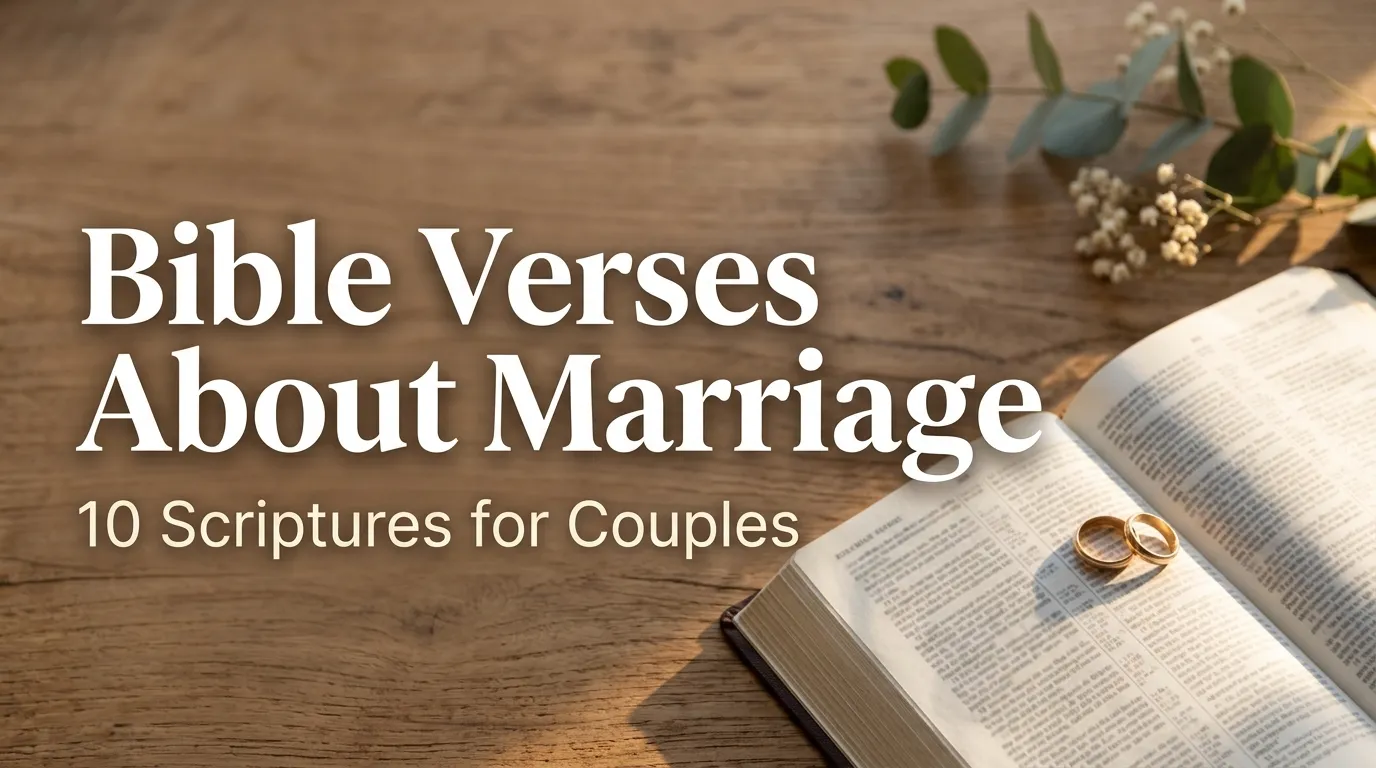
Marriage can be a source of joy, friendship, growth, and deep love.
It can also bring challenges as two people learn to share decisions, handle disagreements, and care for each other through changing seasons of life.
The Bible offers wisdom for both the joyful moments and the difficult ones.
These Bible verses about marriage explain how Scripture describes commitment, unity, love, faithfulness, and the responsibilities of partners.
They point readers toward God’s design for marriage and show how Christian couples can build a relationship shaped by patience, kindness, respect, and faith.
The Bible does not promise that every marriage will be easy. Instead, it gives principles for living faithfully, seeking wisdom, and treating one another with care.
Whether you are preparing for your wedding, celebrating many years together, or hoping to strengthen a struggling relationship, these passages can help you reflect on the meaning of marriage from a Christian perspective.
Read each verse in context, consider its message, and think about one practical way to apply its wisdom in your relationship.
Did You Know? 🔍
Jesus directly referred to Genesis 2:24 when teaching about marriage in Matthew 19:4–6. Paul also quoted the same passage in Ephesians 5:31. This connection shows how the New Testament returns to the creation account when explaining the unity and commitment of marriage.
Quick Answer: What Does the Bible Say About Marriage? 📖
The Bible presents marriage as a committed union marked by faithfulness, unity, love, and mutual care. Genesis 2:24 describes a partners becoming one flesh, while Jesus and the apostles connect marriage with lasting commitment, self-giving love, and responsibility toward one another.
Biblical Meaning of Marriage 💍
What Is the Biblical Meaning of Marriage?
In the Bible, marriage is more than a public celebration or a romantic feeling. It is a committed relationship in which partners build a shared life, remain faithful, and care for one another.
Genesis 2:18 describes the need for human companionship, while Genesis 2:24 describes a man leaving his parents, joining his wife, and becoming one flesh with her. Together, these passages provide an important foundation for the biblical view of marriage.
Christian traditions differ on some questions about marriage, divorce, and remarriage. Still, many share a central understanding: marriage calls for faithfulness, love, honesty, and responsibility rather than selfishness or neglect.
The Hebrew Meaning of Marriage
The Old Testament uses several Hebrew words related to marriage and marital relationships. One important term is ishshah, which can mean “woman” or “wife,” depending on the context. The word ba’al can mean “master” or “owner” in some contexts and can also be used in expressions related to marrying. Its meaning depends on how it is used.
Genesis 2:24 uses language often translated as “be joined,” “hold fast,” or “cling.” The Hebrew verb is dabaq, which carries the sense of holding firmly or staying close. In this passage, it describes the man’s close bond with his wife.
This wording helps explain why marriage in Scripture is connected with commitment. The relationship is not meant to be a casual promise that disappears when life becomes difficult.
The Greek Meaning of Marriage
The New Testament uses the Greek noun gamos for marriage or a wedding, depending on the context. It appears in passages such as Hebrews 13:4, which calls for marriage to be honored, and Matthew 22, where Jesus uses a wedding feast in a parable.
The Greek word agapē, often translated “love,” is also important when studying Christian marriage. In the New Testament, love is shown through action, care, and a willingness to seek another person’s good. Ephesians 5:25 calls husbands to love their wives as Christ loved the church.
The point is not that every use of agapē refers to marriage. Rather, the wider teaching of Christian love helps explain how spouses are called to treat one another.
The Spiritual Meaning of Marriage
From a Christian perspective, marriage can be a setting in which two people practice faithfulness, patience, forgiveness, humility, and service. It brings everyday choices into focus: how spouses speak during conflict, share responsibilities, care for each other, and respond when one person is struggling.
Ephesians 5:21–33 connects marriage with Christian conduct and uses Christ’s relationship with the church as an important picture. Christians differ in how they interpret some details of this passage, but the call for husbands to love sacrificially is explicit.
Marriage should not be used as a tool for control. Biblical love does not excuse cruelty, threats, or abuse. A Christian understanding of marriage must take human dignity, safety, and responsible care seriously.
Key Scripture: Genesis 2:24
Genesis 2:24 describes a man leaving his father and mother, joining his wife, and the two becoming one flesh. Jesus repeats this teaching in Matthew 19:5–6 when discussing marriage.
The verse emphasizes a new and serious bond. Marriage creates a shared life in which spouses are called to loyalty and unity. Becoming “one flesh” does not mean that spouses lose their individual identities. It describes a deep union that affects their relationship, responsibilities, and future together.
Historical and Biblical Context 🕊️
Marriage in the Old Testament
Marriage in the Old Testament existed within family, community, economic, and covenant settings. Families often played a role in marriage arrangements, and marriage could affect inheritance, household life, and social responsibilities.
The Old Testament includes many different marriage stories. Some show faithfulness and care; others reveal jealousy, favoritism, conflict, or serious harm. The fact that a practice appears in a biblical story does not automatically mean God commands people to repeat it.
Genesis 2:24 offers a foundational picture of a man and woman forming a new family bond. Proverbs 31 describes a capable wife, while Ecclesiastes 4:9–12 highlights the value of companionship and mutual support. These passages offer different but related insights into shared life and responsibility.
Marriage in the New Testament
Jesus refers to the creation account in Matthew 19:4–6 and stresses the seriousness of the marriage bond. His teaching appears in a discussion about divorce, so it should be read within that setting rather than treated as an isolated slogan.
Paul addresses marriage in 1 Corinthians 7 and Ephesians 5. In 1 Corinthians 7, he discusses marital responsibilities, singleness, and difficult circumstances. Ephesians 5 places instructions for spouses within a larger discussion of Christian conduct, beginning with a call to submit to one another out of reverence for Christ in verse 21.
The New Testament therefore discusses both the value of marriage and the responsibilities involved in it. It does not suggest that every couple will have the same experience or face the same challenges.
Cultural Understanding in Biblical Times
In the ancient world, marriage was closely linked with family and community life. Women often had fewer social and economic choices than men, and household structures differed from those common in many societies today.
Understanding this background helps readers distinguish between a biblical principle and a cultural detail in a particular passage. For example, the Bible’s call to faithfulness and care can guide Christian couples today, while the exact social arrangements of an ancient household may not apply in the same way.
A careful Bible interpretation asks what a passage meant in its original setting and how its lasting moral teaching can be applied faithfully today.
Is Marriage Mentioned in the Bible? 📚
Yes. Marriage appears throughout the Bible, from Genesis to the New Testament. Scripture describes marriage through creation, family life, wisdom, the teachings of Jesus, and instructions to Christian communities.
Important passages include:
- Genesis 2:18–24: Companionship and the creation account’s description of marriage.
- Proverbs 18:22: A saying about finding a wife and receiving favor from the Lord.
- Ecclesiastes 4:9–12: The value of companionship and mutual support.
- Matthew 19:4–6: Jesus refers to the creation account and the unity of marriage.
- 1 Corinthians 7:1–16: Paul discusses marriage, mutual responsibilities, and separation.
- Ephesians 5:21–33: Christian conduct in marriage, including love and respect.
- Hebrews 13:4: A call to honor marriage and maintain sexual faithfulness.
These passages do not all serve the same purpose. Some describe marriage, some offer wisdom, and others address specific questions or challenges. Reading them together gives a fuller picture than relying on one verse alone.
Spiritual Meaning and Symbolism of Marriage ❤️
Marriage Represents Unity
The “one flesh” language in Genesis 2:24 expresses the close union of partners. A married couple shares decisions, plans, responsibilities, and experiences. They remain two distinct people, but they build a life together.
Unity does not require agreement about every detail. Healthy unity allows honest conversation and different viewpoints while keeping faithfulness and mutual care at the center.
Marriage Calls for Faithful Love
Biblical love is more than a feeling that appears during happy moments. First Corinthians 13:4–7 describes love as patient and kind, not proud or self-seeking. Although this passage is not only about marriage, its description gives couples useful principles for daily life.
Faithful love is seen in ordinary choices: listening carefully, keeping promises, telling the truth, offering help, and seeking repair after a disagreement.
Marriage Requires Mutual Responsibility
Ephesians 5 includes instructions to wives and husbands, with a strong call for husbands to love their wives as Christ loved the church. The surrounding passage begins in verse 21 with a call to mutual submission among believers.
Christian traditions interpret the roles described in this passage in different ways. Whatever a couple’s tradition, these verses should not be used to excuse abuse or demand that one spouse endure danger. Love, dignity, accountability, and safety remain essential.
Marriage Can Reflect God’s Faithfulness
The Bible sometimes uses marriage as an image of God’s relationship with His people. The prophets use marital imagery to describe covenant faithfulness, and Ephesians 5:31–32 connects the “one flesh” passage with Christ and the church.
This symbolism does not mean that every marriage will perfectly reflect God’s love. Rather, it gives Christian couples a picture of faithfulness and self-giving love to pursue.
Biblical Principles for a Strong Marriage ⚖️
| Biblical principle | Scripture | Practical meaning |
| Unity | Genesis 2:24 | Build a shared life while respecting each person’s individuality. |
| Faithfulness | Hebrews 13:4 | Honor marital commitments and protect trust. |
| Sacrificial love | Ephesians 5:25 | Put care into action instead of focusing only on personal comfort. |
| Kindness | 1 Corinthians 13:4–7 | Speak and act with patience, honesty, and care. |
| Forgiveness | Colossians 3:13 | Be willing to forgive while still addressing harmful behavior. |
| Wise communication | James 1:19 | Listen carefully and avoid reacting in anger. |
| Mutual support | Ecclesiastes 4:9–12 | Help one another through work, loss, and difficult seasons. |
These principles are not a guarantee that a marriage will never face trouble. They are a guide for how couples can respond to life together with faith and responsibility.
10 Bible Verses About Marriage 📖
1. Genesis 2:24 — The Two Become One Flesh
Genesis 2:24 gives one of the Bible’s central descriptions of marriage. A man leaves his father and mother, joins his wife, and the two become one flesh. Jesus refers to this passage in Matthew 19:5–6, showing its importance in His teaching about marriage.
The verse highlights a new family bond and a deep commitment between spouses. It does not mean a couple must cut off their parents or lose their personal identity. Instead, marriage creates a new primary partnership that needs care, loyalty, and shared responsibility.
Practical lesson: Make time for your relationship, discuss important decisions together, and build healthy boundaries with extended family.
2. Matthew 19:4–6 — Honor the Marriage Bond
In Matthew 19, Jesus answers a question about divorce by referring to God’s creation of humanity and the words of Genesis 2:24. He emphasizes that partners are no longer two but one flesh, and He warns against treating the marriage bond lightly.
The passage presents marriage as a serious commitment. It should not be used carelessly to shame people facing painful or complex situations. Christians differ on how to apply Jesus’ teaching to every case of divorce and remarriage, so the wider passage and responsible pastoral guidance matter.
Practical lesson: Treat marriage commitments seriously, and seek wise, compassionate help when a relationship is in crisis.
3. Ephesians 5:21–25 — Love With Humility and Sacrifice
Ephesians 5 places marriage within a larger discussion of Christian life. Verse 21 calls believers to submit to one another out of reverence for Christ. The following verses address wives and husbands, and verse 25 calls husbands to love their wives as Christ loved the church and gave Himself for her.
This picture makes love a matter of action and sacrifice, not merely words. It calls a husband to consider his wife’s well-being rather than using authority for selfish gain.
Practical lesson: Ask what loving action would help your spouse feel cared for, heard, and respected today.
4. 1 Corinthians 13:4–7 — Love Is Patient and Kind
First Corinthians 13 describes the nature of love. Paul wrote this passage in a letter addressing problems within the church, not only marriage. Still, its teaching offers strong guidance for couples.
Patience, kindness, humility, and truth help a relationship grow. Love does not celebrate wrongdoing or demand that a person tolerate mistreatment. Instead, it seeks what is good and refuses to make selfishness the center of the relationship.
Practical lesson: During disagreement, avoid insults and contempt. Speak honestly while treating your spouse as a person worthy of dignity.
5. Proverbs 18:22 — Appreciate Your Spouse
Proverbs 18:22 speaks positively about finding a wife and receiving favor from the Lord. As a proverb, it offers a wisdom statement rather than a guarantee that every marriage will always be easy or that every person’s life must follow the same path.
The verse invites readers to value marriage and appreciate a spouse as a meaningful gift. Appreciation is more than assuming someone knows they are loved. It includes noticing their efforts and expressing gratitude for the ways they contribute to shared life.
Practical lesson: Thank your spouse for something specific they did, and do not let daily routines make kindness feel optional.
6. Ecclesiastes 4:9–12 — Two Are Better Than One
Ecclesiastes 4:9–12 explains the strength of companionship. Two people can help each other when one falls, share the benefits of their labor, and provide warmth and support. The passage is not limited to marriage, but its wisdom can apply to married couples.
Marriage should be a partnership in which each person offers help and receives support. One spouse should not have to carry every burden alone. At the same time, each person may need support from friends, family, professionals, or a faith community during difficult seasons.
Practical lesson: Talk about the burdens each of you is carrying, then choose one practical way to help each other this week.
7. Colossians 3:12–14 — Put On Compassion and Forgiveness
Colossians 3 calls believers to put on compassion, kindness, humility, gentleness, and patience. It also urges them to bear with one another and forgive as the Lord has forgiven them. These instructions address Christian community life, but they are valuable in marriage as well.
Spouses will sometimes disappoint each other. Repair takes honesty, a willingness to listen, and changed behavior where harm has occurred. Forgiveness is not the same as pretending that nothing happened or removing every consequence.
Practical lesson: When you hurt your spouse, take responsibility without making excuses. When seeking forgiveness, focus on sincere repair and safer patterns.
8. Hebrews 13:4 — Honor Marriage
Hebrews 13:4 calls for marriage to be honored and for the marriage bed to be kept pure. The verse connects marital faithfulness with moral responsibility and respect for the marriage bond.
Trust is a key part of a committed relationship. Deception, betrayal, and sexual unfaithfulness can cause deep harm. Rebuilding trust may require honest accountability, clear boundaries, and time. Couples dealing with serious betrayal may benefit from qualified counseling and support.
Practical lesson: Protect trust through honesty, faithfulness, and clear boundaries in your relationships with others.
9. James 1:19 — Listen Before You React
James 1:19 encourages readers to be quick to listen, slow to speak, and slow to become angry. The verse is written as general Christian guidance, not as a marriage-specific rule. Yet it is especially useful when spouses disagree.
Arguments often become worse when people interrupt, assume the other person’s motives, or respond before understanding the issue. Listening does not require agreement with everything said. It means giving the other person a fair chance to explain what they think and feel.
Practical lesson: Before responding in a difficult conversation, summarize what you heard and ask whether you understood correctly.
10. Mark 10:6–9 — Jesus Teaches About Marriage
In Mark 10:6–9, Jesus refers to creation and repeats the teaching that the two become one flesh. He then emphasizes the seriousness of the bond God joins together.
This passage supports the Bible’s strong view of marriage commitment. It should be read alongside the whole conversation, which concerns a question about divorce. Christians have different interpretations about how this teaching applies to every difficult situation, but the text clearly warns against treating marriage as disposable.
Practical lesson: Invest in the relationship through honesty, commitment, and care. If serious harm is present, seek appropriate help rather than interpreting commitment as a demand to remain in danger.
A Biblical Case Study: Isaac and Rebekah 🤝
Genesis 24 tells the story of how Rebekah became Isaac’s wife. Abraham sent a servant to find a wife for Isaac from his wider family. The servant prayed for guidance, met Rebekah at a well, and learned about her family. Rebekah’s family was consulted, and she was asked whether she would go with the servant. She agreed to go.
When Rebekah arrived, Isaac received her as his wife, and Genesis 24:67 says that he loved her. The story belongs to an ancient family and cultural setting, so modern couples should not treat every detail as a rule for arranging marriage today.
Still, the account includes themes of prayer, family involvement, willingness, and love. It also reminds readers that biblical stories describe real people within their own settings; they do not present every relationship as perfect or simple.
What this teaches: Seek wisdom when making important relationship decisions. Consider character, shared values, honest communication, and the freedom of both people to make a choice. Prayer can be part of discernment, but it should not replace thoughtful judgment or mutual consent.
5 Life Lessons for Christian Couples 🌱
1. Make Love Visible Through Actions
Words of love matter, but daily actions help make them real. Offer support, share responsibilities, show affection in ways your spouse welcomes, and keep the promises you make.
2. Communicate With Patience
James 1:19 offers a simple guide: listen first, speak carefully, and slow down anger. If a conversation becomes heated, a respectful pause may help both people return to it more calmly.
3. Practice Forgiveness With Accountability
Every couple needs ways to repair hurt. A sincere apology names the harm, accepts responsibility, and seeks change. Forgiveness does not require ignoring repeated abuse, deception, or danger.
4. Protect Trust and Faithfulness
Trust grows through honesty, reliability, and respect for agreed boundaries. Discuss expectations about money, family, privacy, friendships, and responsibilities before small misunderstandings become lasting conflicts.
5. Keep Growing Together
Couples change over time. Prayer, Scripture, shared goals, and honest conversations can help them keep learning about each other. Seeking help from a qualified counselor or trusted pastor can also be wise when problems become difficult to resolve alone.
Common Misunderstandings About Marriage in the Bible ⚠️
“A Christian Marriage Should Never Have Problems”
The Bible offers wisdom for conflict, patience, and forgiveness because relationships need these things. Having a disagreement does not automatically mean a marriage has failed. What matters is how each person responds and whether both are willing to work toward a healthier relationship.
“Submission Means One Spouse Can Control the Other”
Ephesians 5 is interpreted differently across Christian traditions, but it does not give permission for cruelty, threats, or abuse. The passage also calls husbands to love sacrificially, and verse 21 introduces mutual submission among believers. No one should use a Bible verse to justify violence or coercive control.
“Forgiveness Means Trust Must Return Immediately”
Forgiveness and trust are related, but they are not identical. Trust may need to be rebuilt through honest actions over time. A person can choose to forgive while still setting boundaries or seeking outside support.
“The Bible Says Everyone Must Marry”
The Bible honors marriage, but it also recognizes singleness. In 1 Corinthians 7, Paul discusses both marriage and singleness as possible ways of life. Christians should not shame unmarried people or assume that every person must marry to live a faithful life.
“Staying Married Always Means Staying in Danger”
The Bible values marriage, but it must not be used to silence someone facing abuse or threats. A person in danger should seek safety and support from trusted people and appropriate local services. Pastoral counsel can be helpful, but it should never require someone to remain exposed to violence.
Expert Insight 💡
When studying a marriage passage, read the full paragraph and identify its purpose. Ask whether it is describing a story, giving wisdom, addressing a specific church problem, or teaching about marriage directly. Compare related passages such as Genesis 2:24, Matthew 19:4–6, and Ephesians 5:21–33. This approach helps you understand the Bible’s message without building a whole teaching on one line taken out of context.
FAQs
1. What is the best Bible verse about marriage?
Genesis 2:24 is a foundational passage because it describes the union of partners as becoming one flesh. Matthew 19:4–6 repeats this teaching, while Ephesians 5:21–33 explains marriage in connection with love, responsibility, and Christian conduct.
2. What does God say about love in marriage?
The Bible calls spouses to faithfulness, care, patience, and love. Ephesians 5:25 calls husbands to love their wives as Christ loved the church, while 1 Corinthians 13:4–7 describes love as patient, kind, and not self-seeking.
3. Which Bible verse says God joins partners together?
Matthew 19:6 records Jesus saying that what God has joined together should not be separated. He says this while teaching about marriage and divorce. Read Matthew 19:3–9 as a whole, especially when considering difficult questions about separation or divorce.
4. Does the Bible say marriage is required for everyone?
No. The Bible honors marriage but also recognizes singleness. In 1 Corinthians 7, Paul discusses both life within marriage and life as a single person. Christian teaching should not treat unmarried people as less faithful or less valuable.
5. What Bible verses can help a marriage in difficult times?
James 1:19 encourages careful listening and restraint in anger. Colossians 3:12–14 teaches compassion, patience, and forgiveness, while Ecclesiastes 4:9–12 highlights mutual support. These verses offer wisdom, but serious or unsafe situations may also require professional and practical help.
Conclusion: Build Your Marriage on Biblical Wisdom ❤️
The Bible presents marriage as a meaningful commitment built on unity, faithfulness, love, and responsibility.
From Genesis 2:24 to Jesus’ teaching in Matthew 19 and Paul’s guidance in Ephesians 5, Scripture encourages couples to take their promises seriously and care for one another with humility.
These Bible verses about marriage are not a promise that every relationship will be free from pain or conflict.
They offer wisdom for the choices that shape a shared life: listening, speaking with kindness, keeping trust, practicing forgiveness, and seeking help when needed.
If you are married, choose one verse to reflect on with your spouse and discuss how you can put its teaching into practice.
If you are preparing for marriage, use these as a starting point for honest conversations about faith, commitment, and shared responsibilities.
May God guide you toward wisdom, strengthen your love, and help you treat one another with patience, dignity, and grace.

Hello, I’m Michael Bennett. I am passionate about exploring the symbolism, dreams, and spiritual messages found throughout the Bible. My research focuses on understanding how biblical themes connect with faith, personal growth, and everyday life.