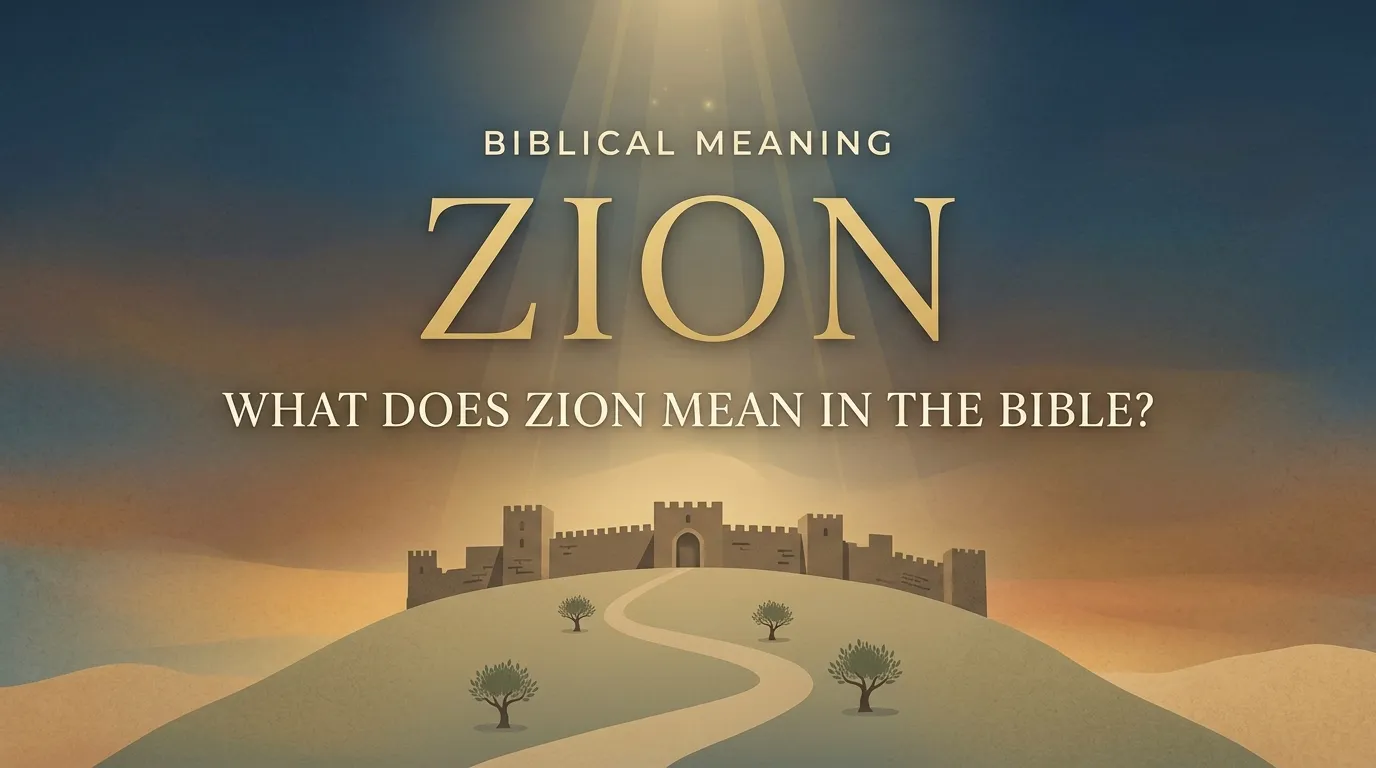
The word Zion appears throughout the Bible and carries deep meaning for Jewish and Christian readers.
You may see it in the Psalms, in the words of the prophets, or in New Testament passages that speak about God’s heavenly city.
But what does Zion really mean?
In Scripture, Zion first refers to a specific stronghold in Jerusalem.
Over time, the name came to represent Jerusalem more broadly, God’s people, and the place associated with His presence and rule.
The New Testament also uses Zion in a heavenly sense.
Understanding this word helps us see how the Bible connects God’s promises, worship, justice, and hope.
It also reminds us that biblical names should be understood in their original context rather than through popular claims alone.
In this guide, we’ll explore the Hebrew meaning of Zion, its history, important Bible verses, and its spiritual significance for Christians today.
Did You Know? 🔍
In 2 Samuel 5:7, Zion is identified as the stronghold captured by King David, also called the City of David. Later biblical writers use the name more broadly for Jerusalem and, in some passages, God’s people. Its meaning depends on the passage in which it appears.
Bible Gateway
+1
Quick Answer: What Does Zion Mean in the Bible? 📖
The biblical meaning of Zion begins with a stronghold in Jerusalem captured by King David. In later Scripture, Zion can mean Jerusalem, the people of God, or God’s heavenly city. It is closely linked with worship, God’s presence, His promises, and the hope of restoration.
Biblical Meaning of Zion ✨
Hebrew meaning of Zion
The Hebrew name is written צִיּוֹן and commonly transliterated as Tsiyyon or Tziyon. English Bibles generally spell it Zion.
The exact origin of the Hebrew name is uncertain. Some older Bible dictionaries suggest meanings such as “height” or “sunny,” while other proposed explanations connect it with a dry place or a hill. These suggestions are not certain enough to present as a settled definition.
Bible Gateway
+1
The safest approach is to begin with how Scripture uses the name. Zion is a real place in the story of Jerusalem, but it also gains wider meaning through poetry, prophecy, and New Testament teaching.
Greek meaning of Zion
The New Testament uses the Greek form Siōn (Σιών), which comes from the Hebrew name.
For example, Hebrews 12:22 speaks of “Mount Zion” and identifies it with the city of the living God, the heavenly Jerusalem. The Greek name itself does not create a separate spiritual meaning. Instead, the surrounding passage tells readers how Zion is being used.
Literal meaning of Zion
In its early biblical setting, Zion refers to a stronghold in Jerusalem that King David captured. Second Samuel 5:7 directly connects Zion with the City of David.
As Jerusalem grew in importance, the name became associated with more than that original stronghold. Biblical writers sometimes use Zion to refer to the city as a whole, the community living there, or the place where God was worshiped.
Spiritual meaning of Zion
The spiritual meaning of Zion develops through its use in Scripture. It can point to:
- God’s presence: Zion is linked with the place where God is praised and worshiped.
- God’s people: The name can represent the community that belongs to Him.
- Hope and restoration: Prophets describe Zion as a place that God will renew and bless.
- God’s rule: Zion appears in passages about God’s chosen king and authority.
- Heavenly hope: Hebrews uses Mount Zion to describe the heavenly Jerusalem and the community gathered before God.
These themes are related, but they are not interchangeable in every verse. A passage about the historic city may have a different focus from a passage about the heavenly city.
Biblical significance of Zion
Zion matters because it connects several major themes in the Bible. It begins as a location in Jerusalem and becomes a powerful image in songs, prophecies, and Christian teaching.
Psalm 48 celebrates Zion as the city of God. Isaiah 2:2–3 pictures the nations coming to the mountain of the Lord to learn His ways. Hebrews 12:22 applies the image of Mount Zion to the heavenly Jerusalem.
Together, these passages show that Zion is not simply a name for a hill. It carries a story about God’s relationship with His people and His purpose for the future.
A key Scripture reference
Psalm 87:2 says that the Lord loves the gates of Zion more than all the dwellings of Jacob.
This verse presents Zion as a place of special importance in Israel’s worship and identity. It does not mean that God lacks love for people outside Jerusalem. The wider biblical message also calls the nations to know and worship Him.
Historical and Biblical Context 🏛️
Zion in the Old Testament
Zion first appears in the biblical history of Jerusalem. Before David’s capture of the stronghold, the area was associated with the Jebusites. Second Samuel 5:6–9 describes David taking the stronghold and making it his city.
The name later became closely tied to Jerusalem’s role as the center of Israel’s royal life and worship. The city became associated with the temple, where the people gathered to worship God.
The Psalms often celebrate Zion as a place of security, praise, and God’s presence. Prophets also use the name when speaking about sin, judgment, renewal, and future hope. Zion could be celebrated, but it could also be warned against when its people acted unjustly.
This balance matters. Zion’s importance did not give its inhabitants permission to ignore God’s commands.
Zion in the New Testament
The New Testament uses Zion in a way that builds on its Old Testament background.
In Romans 9:33, Paul quotes the prophecy about a stone in Zion that causes some to stumble, while those who trust in it will not be put to shame. In 1 Peter 2:6, this passage is applied to Jesus Christ as the chosen cornerstone.
Hebrews 12:22 uses the image of Mount Zion to describe the heavenly Jerusalem and the worshiping community gathered before God. Revelation 14:1 describes the Lamb standing on Mount Zion with the 144,000.
These passages do not all use Zion in precisely the same way. Some draw on the image of God’s chosen place and king, while others point toward heavenly hope and Christ’s role in God’s plan.
Zion in biblical culture
For ancient Israel, Jerusalem was more than a political capital. It was a center of worship, national memory, and religious identity.
Pilgrims traveled to Jerusalem for important festivals. Songs celebrated the city, and prophets used its name when speaking about God’s judgment or promised renewal.
Because of this history, Zion became a strong symbol in biblical poetry. It could represent the city itself, the people connected with it, or the hope that God would restore what had been broken.
Understanding this background helps readers avoid treating every mention of Zion as a simple reference to the same physical location.
Is Zion Mentioned in the Bible? 📚
Yes. Zion is mentioned many times in the Bible, especially in the Psalms and prophetic books. It also appears in the New Testament, where its meaning may refer to the historic city or carry a wider spiritual meaning.
Here are some important examples:
- 2 Samuel 5:7: Zion is identified as the stronghold captured by David.
- Psalm 48:1–2: Zion is praised as God’s holy mountain and the city of the great King.
- Psalm 87:2: The Lord’s love for Zion is celebrated.
- Isaiah 2:2–3: The nations are pictured coming to the mountain of the Lord to learn His ways.
- Isaiah 62:11: Zion hears a proclamation about the coming of salvation.
- Romans 9:33: Paul uses a prophecy about the stone in Zion in his discussion of faith and stumbling.
- Hebrews 12:22: Zion is linked with the heavenly Jerusalem.
- Revelation 14:1: The Lamb stands on Mount Zion.
These references show that Zion has both historical and theological importance. The location provides the starting point, while later passages develop its meaning through worship, prophecy, and hope.
Spiritual Meaning and Symbolism of Zion 🙏
1. Zion represents God’s presence
Several biblical passages connect Zion with God’s dwelling among His people. Psalm 9:11 calls the people to sing praises to the Lord who dwells in Zion.
For ancient Israel, this language was closely connected with Jerusalem and worship. It expressed trust in God’s nearness and His care for His people.
Christians can draw a lesson from this theme: worship is not merely about a building or location. It is about honoring God, seeking His truth, and living in faithful relationship with Him.
2. Zion represents worship and praise
The Psalms often speak about Zion with joy. Psalm 48 celebrates God’s greatness and the beauty of His city.
Zion became a place associated with gathered worship, songs, and remembrance of God’s works. This helps explain why the name appears in many prayers and hymns.
The practical lesson is to make worship more than a routine. Christians can praise God with gratitude, reflect on Scripture, and let worship shape their choices throughout the week.
3. Zion points toward restoration
The prophets sometimes describe Zion during times of failure, suffering, or judgment. Yet they also speak of God restoring His people.
Isaiah 51:3, for example, describes the Lord comforting Zion and bringing joy to its ruined places. This picture offers hope, but it must be read in its original setting and alongside the wider message of the prophet.
For Christians, these passages can encourage trust in God’s power to renew what is broken. They should not be used to promise that every personal problem will disappear quickly or in a specific way.
4. Zion is connected with God’s justice
The prophets did not praise Zion without question. Isaiah 1:21–23 condemns corruption and injustice in Jerusalem.
This is a vital part of the biblical picture. Being connected with a holy city did not make the people’s actions automatically right. God called them to justice, faithfulness, and care for those who were vulnerable.
The Christian lesson is clear: faith should be visible in how we treat others. Worship and spiritual language cannot replace honesty, mercy, and justice.
5. Zion points to hope in Christ
The New Testament connects Zion with Jesus in passages such as Romans 9:33 and 1 Peter 2:6. Jesus is described as the chosen stone, the foundation on which believers are called to place their trust.
Hebrews 12:22 also points readers toward the heavenly Jerusalem. In this passage, Zion becomes part of a larger picture of God’s kingdom and the community that comes before Him.
For Christians, Zion can therefore remind us of hope rooted in God’s promises and fulfilled through Christ. The exact meaning still depends on the passage being studied.
Zion vs Jerusalem vs Mount Zion: What’s the Difference? 🗺️
These terms are closely related, but they do not always mean exactly the same thing.
| Term | Meaning in biblical context | Main emphasis |
| Zion | Originally a stronghold; later a broader name for Jerusalem and, in some passages, God’s people | God’s city, worship, and hope |
| Jerusalem | The historic city central to Israel’s royal and religious life | City, people, temple, and history |
| Mount Zion | A mountain or hill associated with Jerusalem; also used symbolically in Scripture | God’s rule, worship, or heavenly hope |
| Daughter of Zion | A poetic expression for Zion’s inhabitants or community | The people of Jerusalem and God’s message to them |
| Heavenly Jerusalem | The heavenly city described in New Testament passages | God’s kingdom and the hope of His people |
The context is essential. For example, Zion in 2 Samuel 5:7 refers to the stronghold captured by David. In Hebrews 12:22, Mount Zion is associated with the heavenly Jerusalem.
10 Biblical Verses About Zion 📖
The following passages show how the meaning of Zion develops across the Bible. Read each verse in its wider chapter to understand its original message.
1. 2 Samuel 5:7 — David captures Zion
This verse says that David captured the stronghold of Zion, identified as the City of David. It gives the historical starting point for understanding the name.
Zion was not first introduced as an abstract idea or a symbol of personal success. It was a real stronghold connected with Jerusalem’s history. Later biblical writers built on this background when using the name in poetry and prophecy.
Faith lesson: Begin Bible study with the plain meaning of a passage. Understanding the history helps us recognize the spiritual themes that develop later.
2. Psalm 48:1–2 — Zion, the city of God
Psalm 48 praises the Lord and describes His holy mountain, Mount Zion, as the city of the great King. The focus is not simply on the beauty of the landscape. The psalm celebrates God’s greatness and the security His people find in Him.
The passage reflects the importance of Jerusalem in Israel’s worship and identity. It also shows how a real place can become a powerful image in a song of praise.
Faith lesson: Let the beauty of creation and the history of faith lead you toward worship of God, rather than treating a place as the source of divine power.
3. Psalm 87:2 — The Lord loves Zion
Psalm 87:2 speaks of the Lord’s love for the gates of Zion. The verse expresses the city’s special place in the story of God’s people.
The psalm later speaks about people from other nations being counted among those who know God. This broadens the picture beyond a narrow idea of belonging based only on birthplace.
Faith lesson: God’s purposes reach beyond the limits people often create. Read this psalm alongside the Bible’s wider message about God’s concern for the nations.
4. Psalm 9:11 — Sing praises to the Lord
Psalm 9:11 calls the people to sing praises to the Lord who dwells in Zion and to tell the nations what He has done.
This verse connects Zion with worship and public testimony. God’s people are not only called to remember His works privately; they are also invited to speak about His goodness.
The verse does not suggest that praise must happen in one location only. Its central focus is the Lord and the works He has done.
Faith lesson: Make gratitude part of daily life. Remember God’s faithfulness, and share your faith in a sincere and respectful way.
5. Isaiah 2:2–3 — The nations come to Zion
Isaiah describes a future vision in which the mountain of the Lord’s house is established and nations come to learn God’s ways. The passage presents Zion as a place connected with divine instruction and peace.
The following verses speak of God’s teaching going out from Jerusalem. The emphasis is on learning His ways, walking in His paths, and moving toward peace rather than conflict.
Faith lesson: Genuine worship should shape how we live. Seek God’s instruction and practice peace, justice, and humility in your relationships.
6. Isaiah 51:3 — God comforts Zion
Isaiah 51:3 pictures the Lord comforting Zion and bringing joy to its ruined places. The verse speaks into a wider passage of encouragement and hope for God’s people.
Its original message is tied to God’s promise of restoration. It is not a guarantee that every believer’s suffering will end immediately or that every ruined situation will be restored in the same way.
Still, the passage offers a meaningful reminder of God’s power to bring hope where people see only loss.
Faith lesson: In hard seasons, turn to Scripture for grounded hope. Trust God while also seeking wise support and taking faithful steps forward.
7. Isaiah 62:11 — Salvation proclaimed to Zion
Isaiah 62 speaks about Zion and Jerusalem in a message of future hope. Verse 11 announces that salvation is coming and describes God’s people in relation to His reward.
This passage belongs to a larger vision of restoration and God’s public vindication of His people. Christians may connect its language with the Bible’s wider message of salvation, but interpretation should respect the original prophetic setting.
Faith lesson: Let hope encourage faithfulness rather than passivity. God’s promises call His people to trust Him and live in ways that reflect His character.
8. Romans 9:33 — The stone in Zion
Romans 9:33 quotes Scripture about a stone in Zion that becomes a stumbling block to some, while those who believe will not be put to shame. Paul uses the image in a discussion about faith, righteousness, and the response to Christ.
The stone imagery points to the importance of Jesus in God’s saving purpose. The verse also shows how New Testament writers draw on Israel’s Scriptures to explain the meaning of Christ.
Faith lesson: Consider how you respond to Jesus and His teaching. Faith is not simply familiarity with religious words; it involves trusting Him.
9. Hebrews 12:22 — Mount Zion and the heavenly Jerusalem
Hebrews 12:22 tells its readers that they have come to Mount Zion, the city of the living God, the heavenly Jerusalem. The surrounding verses contrast this joyful gathering with the fearful scene at Mount Sinai.
The passage encourages believers to recognize the privileges and responsibilities of their relationship with God through Jesus, the mediator of the new covenant.
Faith lesson: Remember that Christian hope is larger than earthly circumstances. Live with reverence, gratitude, and a sense of belonging to God’s people.
10. Revelation 14:1 — The Lamb stands on Mount Zion
Revelation 14:1 describes the Lamb standing on Mount Zion with 144,000 people who have His name and His Father’s name written on their foreheads.
This is part of Revelation’s symbolic vision, so the details should be read in the context of the book rather than turned into unsupported predictions. The Lamb represents Jesus, and the scene highlights His authority and the identity of those who belong to Him.
Faith lesson: Stay faithful to Christ amid pressure. Read Revelation carefully, paying attention to its imagery and its central call to worship God and remain faithful.
A Biblical Case Study: David and Zion 👑
The story of David capturing Zion in 2 Samuel 5:6–9 helps explain why the name became so important.
David had become king, but Jerusalem’s stronghold was still held by the Jebusites. The biblical account describes David taking the stronghold and making it his city. It became known as the City of David.
This event gave Zion a clear place in Israel’s royal history. In later generations, the name was used in songs and prophecies about Jerusalem, worship, God’s rule, and restoration.
The story also reminds readers that biblical meaning often develops over time. The original place matters, but later passages may use its name to express wider truths.
What can Christians learn from this account?
- Read the story in context. Zion’s earliest meaning is connected with a historical event.
- Notice how Scripture develops themes. Later writers use Zion in ways that build on its history.
- Avoid unsupported symbolism. The Bible gives Zion spiritual significance, but that does not mean every modern use of the word carries a special message from God.
Life Lessons for Christians 🌱
The biblical meaning of Zion offers several practical lessons when we read it in context.
1. Make worship about God
Zion’s connection with praise reminds Christians that worship centers on God, not on a building or a sacred object. Gather with other believers, pray, and reflect on Scripture with a sincere heart.
2. Seek justice as well as devotion
The prophets challenged the people of Jerusalem when their actions contradicted God’s commands. Faith should lead to honesty, compassion, and care for people who are treated unfairly.
3. Hold on to hope
Prophecies about Zion’s restoration show that hardship is not the only part of God’s people’s story. Christians can face difficulty with hope while remaining honest about pain and uncertainty.
4. Study Scripture carefully
Zion can refer to a stronghold, Jerusalem, God’s people, or the heavenly city. Ask what the author is discussing before deciding what the name means in a particular verse.
5. Keep Christ central
New Testament passages connect Zion with Jesus and God’s kingdom. For Christians, these passages encourage trust in Christ rather than fascination with a place name by itself.
Common Misunderstandings About Zion ⚠️
Misunderstanding 1: Zion always means heaven
Not every reference to Zion means heaven. In 2 Samuel 5:7, Zion refers to the stronghold captured by David. Hebrews 12:22 uses Mount Zion in connection with the heavenly Jerusalem.
Correction: Read the surrounding verses to determine whether the passage is historical, poetic, prophetic, or focused on heavenly hope.
Misunderstanding 2: Zion’s Hebrew meaning is definitely “height”
Some older reference works suggest “height” or “sunny,” while other explanations have been proposed. The exact origin of the name is uncertain.
Correction: Explain the uncertainty and give priority to Zion’s clear use in Scripture rather than presenting a debated etymology as fact.
Misunderstanding 3: Zion is only a physical location
Zion began as a place name, but biblical writers use it more broadly. It can refer to Jerusalem, God’s people, or the heavenly city.
Correction: Recognize both its historical setting and its wider use in biblical poetry and theology.
Misunderstanding 4: Every mention of Zion is a personal sign
Some online explanations treat Zion as a special message about an individual’s future. Scripture does not teach that every encounter with the word is a personal prophecy.
Correction: You can reflect on what Zion teaches about God, worship, hope, and faith without claiming certainty about a message the Bible does not promise.
Misunderstanding 5: Zion has no connection with the nations beyond Israel
Several prophetic passages picture nations coming to learn God’s ways, and the New Testament uses Zion in a wider picture of God’s kingdom.
Correction: Read passages such as Isaiah 2:2–4 alongside the wider biblical story. Zion has a particular history, but Scripture also speaks of God’s purposes reaching beyond one city.
Expert Insight: How to Study Zion Correctly 💡
When you encounter Zion in a Bible verse, ask three questions:
- What does the passage describe? Is it a historical event, a song of praise, a prophecy, or a New Testament teaching?
- Who is being addressed? The original audience may be Jerusalem’s inhabitants, Israel as a people, or a Christian community.
- How is the name used elsewhere? Compare passages such as 2 Samuel 5:7, Psalm 48, Isaiah 2:2–3, and Hebrews 12:22.
This method helps separate the plain meaning of a text from later applications. It also makes Bible study more reliable than relying on a single dictionary definition or a popular online claim.
FAQs
1. What does Zion mean spiritually?
Spiritually, Zion can represent God’s presence, worship, His people, and the hope of restoration. In the New Testament, Mount Zion is also associated with the heavenly Jerusalem. The exact meaning depends on the passage, so not every reference should be interpreted in the same way.
2. Is Zion another name for Jerusalem?
Yes, in many biblical passages Zion is used as another name for Jerusalem. However, the name originally referred to a particular stronghold captured by David. Its meaning later expanded to include the city more broadly and, in some passages, God’s people.
3. What is Mount Zion in the Bible?
Mount Zion is a hill or mountain associated with Jerusalem and the history of David’s stronghold. The Bible also uses the name symbolically. For example, Hebrews 12:22 connects Mount Zion with the heavenly Jerusalem and the community gathered before God.
4. What does Daughter of Zion mean?
“Daughter of Zion” is a poetic biblical expression often used for the people of Jerusalem or the community associated with Zion. Prophets use it in messages of warning, judgment, comfort, and hope. The surrounding passage explains which aspect of the expression is most important.
5. What does Zion represent for Christians today?
For Christians, Zion can point to worship, God’s faithfulness, hope in His promises, and the heavenly Jerusalem described in Hebrews 12:22. It also encourages believers to live with justice and faith. It should not be treated as a guaranteed personal prophecy or a magical word.
Conclusion
The biblical meaning of Zion begins with a real stronghold in Jerusalem, but its importance grows throughout Scripture.
The name becomes connected with Jerusalem, worship, God’s people, justice, restoration, and the hope of His kingdom.
The Old Testament celebrates Zion while also calling its people to faithfulness.
The New Testament uses the image in passages about Jesus Christ and the heavenly Jerusalem. Together, these teachings show why Zion is much more than a place name.
For Christians, the most helpful response is to study Zion in context and consider what each passage reveals about God.
Let its themes encourage worship, strengthen hope, and inspire a life marked by faith and justice.
Above all, remember that biblical understanding grows through careful reading, prayer, and trust in God’s Word—not through unsupported claims about hidden meanings.

Hello, I’m Jonathan Reed. I have a strong interest in biblical interpretation and Christian education. Over the years, I have spent significant time studying Scripture and researching its historical context to better understand its teachings and messages.