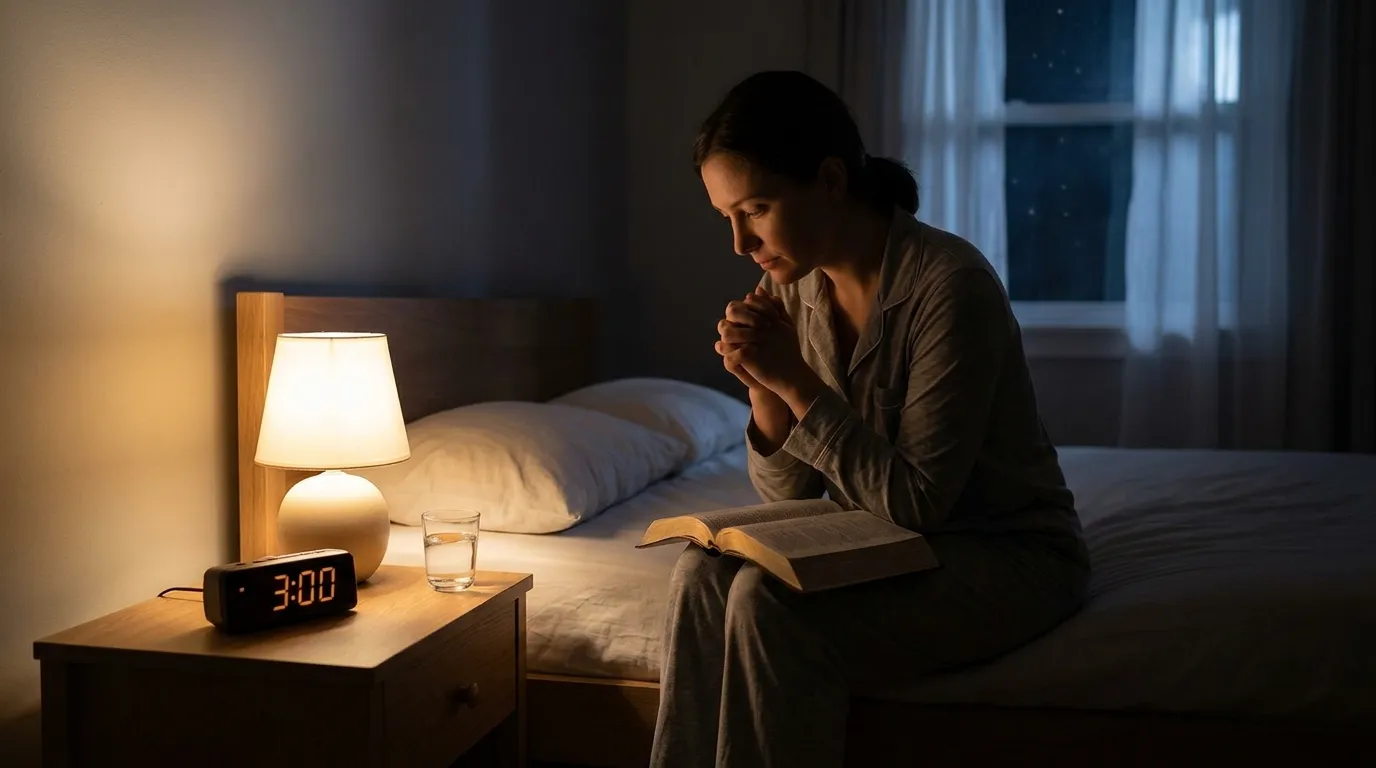
Waking up in the middle of the night can feel unusual, especially when you keep opening your eyes and seeing 3:00 a.m.
You may wonder whether God is calling you to pray, trying to get your attention, or showing you something about your spiritual life.
biblical meaning of waking up at 3am is best understood by looking at what Scripture actually teaches about night prayer, God’s presence, and spiritual watchfulness.
The Bible records people praying at night and describes Jesus meeting His disciples during the fourth watch.
You do not need to be afraid of this hour. A nighttime awakening may become a peaceful opportunity to pray, reflect, or read Scripture.
It may also have an ordinary explanation, such as stress or disrupted sleep. A balanced Christian response makes room for prayer without turning the clock into a rule that the Bible never gives.
Did You Know? 🔍
Matthew 14:25 says Jesus came to His disciples during the “fourth watch of the night.” Some modern Bible translations explain this period as approximately 3 a.m. to 6 a.m. This gives early-morning waking a biblical point of comparison, but the passage does not say that waking at exactly 3 a.m. always carries a special spiritual message.
Bible Gateway
+1
Quick Answer: What Does Waking Up at 3AM Mean Spiritually? 🙏
Waking up at 3 a.m. has no single, guaranteed biblical meaning. Scripture shows that nighttime can be a time for prayer, worship, reflection, and watchfulness, but it does not teach that this exact clock time always signals a message from God. Christians can use the moment to pray peacefully while avoiding fear and unsupported predictions.
The Biblical Meaning of Waking Up at 3AM 📖
Hebrew and Greek Meaning
The Bible was written before modern digital clocks and the everyday use of time expressions such as “3 a.m.” as we know them today. Biblical writers often described time through watches of the night, the evening, midnight, the rooster’s crow, or the morning.
In the Old Testament, Hebrew words and phrases for night and watches describe periods of darkness and the practice of keeping watch. Psalm 63:6, for example, describes remembering God while lying in bed and meditating on Him during the night watches.
The New Testament uses the Greek term phylakē in expressions about a watch or period of watching. Matthew 14:25 uses it when describing the fourth watch of the night.
These words help us understand biblical timekeeping. They do not give the modern clock time of 3:00 a.m. a special meaning by themselves.
Literal Meaning of Waking at 3AM
Literally, waking at 3 a.m. means that you become awake at that time during the night. It does not automatically mean that something supernatural has happened.
You may wake because of a noise, a dream, a change in your sleep pattern, stress, or no obvious reason. If you wake and feel drawn to pray, you can do so. Yet the fact that you woke up does not prove that God caused it for a particular purpose.
The Christian approach is to respond with wisdom rather than fear. You can ask God for peace and guidance without feeling pressured to discover a hidden message in the time on your clock.
Spiritual Meaning of Waking Up at 3AM
Some Christians view an unexpected nighttime awakening as an opportunity to seek God in quiet prayer. This can be a helpful personal response, especially if prayer brings peace, gratitude, or a clearer focus on Scripture.
However, it is important to distinguish a personal spiritual response from a universal biblical rule. The Bible contains examples of prayer and divine encounters at night, but it does not say that every person who wakes at 3 a.m. has been specially called, warned, or chosen.
If you feel led to pray, pray simply. If you feel tired or anxious, it is also reasonable to settle down and return to sleep. You do not have to interpret every waking moment as a sign.
Biblical Significance of Nighttime Prayer
Nighttime prayer appears in several parts of Scripture. The psalmists speak about remembering God in bed and rising during the night to give thanks. Jesus also made time for prayer away from crowds and daily demands.
These examples show that prayer is not limited to one hour. You can speak to God in the morning, during the day, in the evening, or when you wake during the night.
The spiritual value lies in sincere prayer and trust in God, not in the exact time displayed on a clock.
Key Scripture Reference: Matthew 14:25
Matthew 14:25 describes Jesus coming to His disciples while they are struggling on the sea during the fourth watch of the night. The disciples are tired and facing difficult conditions, yet Jesus comes toward them.
The scene offers a strong picture of Christ’s care in a frightening situation. Still, the passage is not a promise that every 3 a.m. awakening is a supernatural event. Its central message is about Jesus and His disciples, not about assigning a fixed meaning to a modern clock time.
Historical and Biblical Context of Night Watches 🌙
Old Testament Usage
In the Old Testament, night was divided into periods of watching. These watches mattered for people who guarded cities, tended animals, or carried out duties during the hours of darkness.
The Bible also describes nighttime as a setting for reflection and prayer. Psalm 119:62 says the psalmist rises at midnight to give thanks to God. Psalm 63:6 describes remembering God while lying in bed and meditating during the night watches.
These passages present nighttime prayer as one way to express devotion. They do not establish 3 a.m. as a required prayer time or a universal sign of divine communication.
New Testament Relevance
The New Testament includes several events that occur during the night or before sunrise. In Matthew 14:25 and Mark 6:48, Jesus approaches His disciples during the fourth watch while they struggle against the wind.
Mark 1:35 says Jesus got up very early, while it was still dark, and went to a quiet place to pray. Acts 16:25 describes Paul and Silas praying and singing hymns at midnight while in prison.
These examples show that people can pray and trust God during difficult or quiet hours. They do not prove that God always chooses a particular time to communicate with someone.
Understanding the Fourth Watch
In the Roman system used in the New Testament period, the night was commonly divided into four watches. The fourth watch is generally understood as the period from about 3 a.m. until 6 a.m. This is why some Christians connect waking at 3 a.m. with Matthew 14:25.
That connection should be handled carefully. Matthew records when Jesus approached the disciples; it does not command believers to wake during that watch or say that the hour carries the same message for everyone.
The passage can encourage faith when you are struggling, but it should not be turned into a guaranteed prophecy about your personal life.
Is Waking Up at 3AM Mentioned in the Bible? 📜
The Bible does not directly mention the modern phrase “waking up at 3 a.m. spiritual meaning.” It does describe night watches, prayer during the night, early-morning prayer, and events in which God meets people during the night.
Here are some of the most relevant passages:
- Matthew 14:25: Jesus approaches the disciples during the fourth watch.
- Psalm 63:6: David remembers God while lying in bed and meditates during the night watches.
- Psalm 119:62: The psalmist rises at midnight to give thanks.
- Mark 1:35: Jesus gets up early to pray in a quiet place.
- Acts 16:25: Paul and Silas pray and sing hymns at midnight.
These passages provide a biblical foundation for prayer at night. They do not establish a doctrine that 3 a.m. is a holy hour, a dangerous hour, or a time when every person must expect a revelation.
A useful question is not simply, “Why did I wake up at 3 a.m.?” It is also, “How can I respond to this moment with faith, wisdom, and peace?”
Spiritual Meaning and Symbolism of Waking at 3AM 🕊️
1. An Opportunity for Quiet Prayer
If you wake up and feel calm enough to pray, you can use a few minutes to thank God, ask for wisdom, or pray for someone you love. The quiet may help you focus without the distractions of the day.
This does not prove that God woke you for that purpose. It simply means you can turn an unexpected moment into a meaningful act of faith.
2. A Reminder to Seek God’s Guidance
You may be facing a decision, a family concern, or a difficult season. Waking in the night can remind you to bring those worries to God.
James 1:5 encourages believers to ask God for wisdom. You can use that teaching at any time of day. The time on the clock does not make your prayer more powerful or less valuable.
3. A Call to Spiritual Watchfulness
Jesus often taught His followers to stay watchful and ready. In Mark 13:35, He uses different periods of the night to remind His listeners that they do not know when the master will return.
In this context, watchfulness means living faithfully and staying prepared in your relationship with God. It does not mean staying awake all night or becoming afraid of a particular hour.
4. A Chance to Find Comfort in God’s Presence
Nighttime can make worries feel larger because everything around you is quiet. Reading a familiar psalm or offering a simple prayer may help you feel grounded.
Psalm 121:3–4 describes God as the One who watches over His people without sleeping. This image can offer comfort when you feel alone or unsettled during the night.
5. A Reminder to Care for Your Body
Faith and practical care are not enemies. If you wake repeatedly and feel exhausted during the day, consider whether stress, sleep habits, medication, or another health concern might be affecting your rest.
You can pray and also take practical steps to improve your sleep. If the problem continues or affects your daily life, speak with a qualified healthcare professional. You do not need to assume that repeated waking is a spiritual warning.
Biblical Prayer vs. Modern Claims About 3AM ⚖️
| Question | Biblical perspective | What to avoid |
| Is 3 a.m. a special spiritual hour? | Scripture describes night watches but gives no universal meaning to 3 a.m. | Treating the clock time as a guaranteed sign. |
| Can I pray when I wake up? | Yes. Biblical figures prayed at night and in the early morning. | Believing prayer only counts at this hour. |
| Is God definitely waking me? | The Bible does not give enough information to conclude that from timing alone. | Declaring a supernatural cause without evidence. |
| Does waking at 3 a.m. mean spiritual attack? | No biblical passage establishes that conclusion. | Becoming afraid of darkness or expecting evil. |
| Could there be an ordinary explanation? | Yes. Night waking can happen for many everyday reasons. | Ignoring ongoing sleep problems or distress. |
The key difference is between a practice that may help your faith and a claim that everyone must believe. Prayer can be a healthy response to waking at night, but a specific time does not prove a hidden spiritual message.
Bible Verses About Waking Up at 3AM 📖
The following verses do not assign a fixed spiritual meaning to 3 a.m. Instead, they show how Scripture speaks about nighttime prayer, God’s care, wisdom, and readiness.
1. Psalm 63:6 — Remembering God During the Night
David describes remembering God while lying on his bed and meditating on Him during the night watches. This verse shows that quiet hours can become a time for reflection and worship. David is not teaching that a certain hour has magical power. He is expressing his desire to keep God in his thoughts, even at night.
Practical lesson: If you wake up at 3 a.m., you can quietly remember God’s goodness or pray about what is on your heart. There is no need to force an interpretation.
2. Psalm 119:62 — Giving Thanks at Midnight
The psalmist says he rises at midnight to give thanks to God because of His righteous judgments. This is a clear example of nighttime devotion. It shows that gratitude and worship are not limited to daylight hours.
However, the verse describes the psalmist’s response; it does not instruct every believer to wake at midnight or 3 a.m. You can learn from the psalmist’s gratitude without copying his exact schedule.
Practical lesson: When you find yourself awake, name one thing you are thankful for and offer a simple prayer of thanks.
3. Mark 1:35 — Jesus Prays Before Sunrise
Mark records that Jesus got up very early, while it was still dark, and went to a quiet place to pray. This passage shows that Jesus made space for prayer amid the demands of His ministry.
It does not tell us that Jesus woke at exactly 3 a.m. or that Christians must follow the same routine. The important point is His deliberate relationship with the Father.
Practical lesson: Make regular space for prayer when your schedule allows. Early morning can work for some people, while another time may be better for others.
4. Matthew 14:25 — Jesus Comes During the Fourth Watch
Matthew describes Jesus approaching His disciples on the sea during the fourth watch of the night. They are facing difficult conditions, and the scene reminds readers that Jesus is present even when His followers struggle.
Some Bible translations explain the fourth watch as roughly 3 a.m. to 6 a.m. Still, the passage does not say that everyone who wakes during these hours will receive a special revelation.
Practical lesson: If you wake feeling worried, remember the wider message of this passage: turn toward Christ rather than allowing fear to control your thoughts.
5. Acts 16:25 — Prayer and Praise at Midnight
Paul and Silas pray and sing hymns to God while they are imprisoned. Their circumstances are painful, yet they continue worshiping. The story later describes an earthquake and the opening of the prison doors.
This is a specific event in the book of Acts, not a promise that every midnight prayer will lead to a sudden breakthrough. The passage highlights the faith of Paul and Silas amid suffering.
Practical lesson: Prayer can help you remain grounded in difficult seasons, even when you cannot control the outcome.
6. Psalm 121:3–4 — God Does Not Sleep
This psalm describes God as the One who watches over His people and does not slumber or sleep. Its message offers comfort to people who feel vulnerable or alone.
The passage does not explain why someone wakes during the night. Instead, it directs attention away from fear and toward God’s care. Your rest may be interrupted, but the psalm presents God as a faithful keeper.
Practical lesson: Read this passage when nighttime worries feel overwhelming. Let its message encourage trust rather than suspicion about the hour.
7. Philippians 4:6–7 — Bring Your Worries to God
Paul tells believers not to be consumed by anxiety but to bring their requests to God through prayer and thanksgiving. He connects this practice with the peace of God guarding their hearts and minds.
This teaching applies whether you are awake at 3 a.m., facing a challenge during the day, or preparing for a difficult conversation. It does not require you to identify a hidden spiritual reason for your waking.
Practical lesson: Name your concern honestly, ask God for help, and take a slow breath. You can then return to rest if you are ready.
8. James 1:5 — Ask God for Wisdom
James encourages anyone who lacks wisdom to ask God, who gives generously. The verse is useful when nighttime waking brings a difficult question to mind.
It does not promise that an answer will arrive at a certain hour or through a dream. Wisdom may come through prayer, Scripture, careful thought, trusted counsel, and time.
Practical lesson: If a decision is troubling you, ask for wisdom rather than assuming the time you woke up contains the answer.
9. Mark 13:35 — Stay Watchful
Jesus names different periods of the night when teaching His followers to remain watchful. The point is that they do not know when the master will return, so they should stay ready.
This is a call to faithful living, not an instruction to monitor a clock for a prophetic signal. Christian watchfulness means remaining devoted to Christ in ordinary life.
Practical lesson: Focus on living with honesty, love, and faithfulness today instead of trying to predict a hidden message from the hour.
10. 1 Thessalonians 5:16–18 — Pray and Give Thanks
Paul encourages believers to rejoice, pray continually, and give thanks in all circumstances. These instructions describe an ongoing attitude of faith rather than a prayer routine tied to one specific hour.
If you wake at 3 a.m., you can pray. If you sleep through the night, you can still live out this teaching when you wake in the morning. God is not presented here as measuring devotion by the time on your clock.
Practical lesson: Build a steady prayer life that fits your circumstances, protects your health, and helps you remain thankful.
A Biblical Case Study: Jesus Prays in the Early Morning 🌄
Mark 1:35–39 gives a helpful example of nighttime and early-morning prayer. Jesus gets up while it is still dark, leaves the house, and goes to a quiet place to pray. His disciples later find Him and tell Him that people are looking for Him.
Jesus then continues His ministry in other places. The story shows that prayer was part of His life, even when people needed His attention.
Notice what the passage does not say. It does not give a specific clock time, call the hour a spiritual portal, or tell every believer to follow the same schedule. It simply describes Jesus choosing a quiet time to pray.
This example can encourage you to make prayer a regular part of life. If waking at 3 a.m. gives you a calm moment to speak with God, you may use it that way. But you do not need to stay awake if you are exhausted or feel pressured to prove your faith.
The lasting lesson is the value of sincere prayer, not the power of a particular hour.
Life Lessons for Christians Today 🌱
1. Pray Without Fear
If you wake at 3 a.m., you can pray for peace, wisdom, family, or strength. You do not need to assume that a spiritual attack is taking place.
2. Test Spiritual Impressions Against Scripture
If a thought or dream seems important, do not immediately treat it as a message from God. Compare it with biblical teaching and discuss serious concerns with a trusted, mature Christian.
3. Do Not Confuse Timing With Meaning
A repeated time can catch your attention, but repetition alone does not prove that God is sending a message. Look at the broader context of your life and avoid making major decisions based only on the clock.
4. Protect Your Rest
Sleep is a normal human need. Prayer does not require you to harm your health or remain awake for hours. If waking is frequent and leaves you tired, consider practical causes and seek professional advice when needed.
5. Build a Consistent Relationship With God
You can grow in faith through daily prayer, Bible reading, worship, service, and kindness. None of these practices depends on waking at a certain time. A steady relationship with God matters more than trying to decode every unusual experience.
Common Misunderstandings About Waking at 3AM ⚠️
Misunderstanding 1: 3AM Is Always God’s Special Hour
The Bible describes people praying during the night and Jesus approaching His disciples during the fourth watch. It does not say that 3 a.m. is always a special appointment with God.
Misunderstanding 2: Waking at 3AM Means Spiritual Attack
There is no biblical rule that connects this exact clock time with demonic activity. If you feel frightened, seek comfort in Scripture and talk with someone you trust rather than assuming the worst.
Misunderstanding 3: God Is Definitely Trying to Tell Me Something
God can guide people, but the time someone wakes up does not prove that a specific message has been sent. Prayer, Scripture, wise counsel, and careful discernment are better than jumping to conclusions.
Misunderstanding 4: Everyone Must Pray at 3AM to Be Spiritually Strong
The Bible encourages prayer, but it does not command all Christians to wake at 3 a.m. People have different work schedules, health needs, and family responsibilities. Faithfulness is not measured by a single wake-up time.
Misunderstanding 5: A Nighttime Awakening Must Have a Hidden Meaning
Sometimes there is no clear spiritual meaning to discover. You may simply be awake. You can pray if you wish, then return to sleep without guilt or worry.
Expert Insight: How to Respond When You Wake at 3AM 💡
Use a simple three-step approach:
- Pause: Notice how you feel without deciding immediately that the experience is supernatural.
- Pray: If it feels helpful, say a short prayer asking for peace and wisdom.
- Discern: Consider the teaching of Scripture, ordinary explanations, and whether the experience is leading you toward calm faith or unnecessary fear.
A good Bible study practice is to separate the words of the passage from your personal application. For example, Matthew 14:25 says Jesus came during the fourth watch. Applying that story as a reminder of Christ’s care can be meaningful. Claiming that every person who wakes at 3 a.m. has received a divine assignment goes beyond what the verse says.
FAQs
1. What does waking up at 3 a.m. mean spiritually?
Some Christians use an unexpected nighttime awakening as an opportunity to pray or reflect. However, the Bible does not assign one fixed spiritual meaning to 3 a.m. You can pray peacefully without assuming that the experience is a supernatural sign.
2. Is God waking me up at 3 a.m. to pray?
It is possible to respond to a nighttime awakening with prayer, but the time alone cannot prove that God caused it. If you feel drawn to pray, do so simply. You can also consider ordinary reasons for waking and return to sleep.
3. Is 3 a.m. the devil’s hour according to the Bible?
No. The Bible does not identify 3 a.m. as the devil’s hour or teach that this time is automatically dangerous. Such claims should not be treated as biblical doctrine. If nighttime fear troubles you, seek comfort through Scripture, prayer, and trusted support.
4. What Bible verse is connected with waking up at 3 a.m.?
Matthew 14:25 describes Jesus approaching His disciples during the fourth watch of the night, commonly understood as approximately 3 a.m. to 6 a.m. Psalm 63:6 and Mark 1:35 also provide examples of nighttime reflection and early-morning prayer.
5. What should I do if I keep waking up at 3 a.m.?
You can pray briefly, read a comforting Bible passage, and settle down again. Avoid assuming that every awakening carries a hidden message. If the pattern continues, causes distress, or leaves you tired during the day, consider discussing your sleep with a healthcare professional.
Conclusion
“Ultimately, the biblical meaning of waking up at 3AM should be considered through Scripture rather than assumptions about a specific hour.”
Scripture shows that nighttime can be a time for prayer, reflection, and trust. Jesus prayed early in the morning, the psalmists remembered God during the night, and Paul and Silas worshiped while imprisoned.
These examples can encourage you to turn an unexpected waking moment into a peaceful time with God.
At the same time, the Bible does not say that 3 a.m. is always a special spiritual hour or that waking at this time means spiritual attack.
If you wake tonight, take a moment to pray if you wish, remember God’s promises, and allow yourself to rest.
You do not need to live in fear or search for a hidden meaning in every experience.
Let Scripture guide your faith, let wisdom guide your choices, and let God’s peace comfort your heart.

Hello, I’m Michael Bennett. I am passionate about exploring the symbolism, dreams, and spiritual messages found throughout the Bible. My research focuses on understanding how biblical themes connect with faith, personal growth, and everyday life.