Relationships can bring some of life’s greatest joys, but they can also bring pain, confusion, and difficult choices.
Whether you are thinking about marriage, dating, family, or friendship, you may wonder how to build relationships that honor God. The Bible offers wisdom for each of these areas.
Scripture teaches us to love others, speak truthfully, forgive when appropriate, show respect, and seek peace. It also reminds us that healthy relationships need wisdom, honesty, and responsibility.
Love does not mean agreeing with everything someone says, ignoring harmful behavior, or losing your own sense of right and wrong.
These Bible verses about relationships help us understand what God values in the way people treat one another. They cover romantic relationships, family life, friendships, and Christian community.
As we explore these passages, we will consider their biblical context and how their lessons apply today.
The goal is not to find a verse that guarantees a perfect relationship, but to learn how Scripture can guide our choices, shape our character, and help us love others faithfully.
Did You Know? 🔍
In the New Testament, the Greek word agapē is commonly used for love, including the love Christians are called to show others. First Corinthians 13 describes this love through qualities such as patience, kindness, humility, and truth. These qualities offer a practical way to examine how we treat people in our daily relationships.
Quick Answer: What Do Bible Verses About Relationships Mean? 📖
Bible verses about relationships teach us to treat others with love, respect, honesty, patience, and forgiveness. They encourage faithful commitment, wise choices, mutual care, and peace wherever possible. Scripture also teaches that love must be joined with truth and wisdom, so healthy relationships should not depend on manipulation, fear, or harmful behavior.
Biblical Meaning of Relationships ❤️
What Is the Hebrew Meaning of Relationships?
The Old Testament was written mainly in Hebrew, with some sections in Aramaic. The modern English word relationship does not correspond to one single Hebrew word that explains every kind of human connection.
Instead, the Old Testament uses different words and expressions for love, friendship, companionship, family ties, loyalty, and covenant. One important Hebrew term is chesed, often translated with ideas such as steadfast love, kindness, or loyal love.
Its precise meaning depends on the passage and relationship being described.
The Old Testament often presents relationships through actions rather than feelings alone. People show loyalty by keeping commitments, care by helping those in need, and wisdom by speaking honestly.
These themes help readers understand the biblical view of relationships without forcing every passage into one definition.
What Is the Greek Meaning of Relationships?
The New Testament was written in Greek. It uses several words related to love and human connection, including agapē, a noun commonly associated with love, and philia, a term connected with friendship or affectionate bonds.
These terms have overlapping uses, and they should not be treated as a simple ranking in which one word always means a higher kind of love. Meaning depends on the sentence, writer, and context.
For example, 1 Corinthians 13 describes love through patience, kindness, humility, and truth. John 15:12–13 connects love with Jesus’ command to care for one another and His teaching about sacrificial love. Both passages emphasize the way love is expressed, not merely the word used for it.
What Do Relationships Mean Spiritually?
From a Christian perspective, relationships are places where people can practice the values taught in Scripture. Patience, compassion, honesty, service, and forgiveness become real through everyday choices.
A healthy relationship can encourage spiritual growth, but a relationship is not automatically godly just because two people share the same faith. Their actions, attitudes, and treatment of others still matter.
God’s guidance can help Christians consider whether a relationship supports truth, care, and responsible choices. Prayer and Scripture can provide direction, while wise counsel can help someone think through a difficult situation.
Why Are Relationships Important in the Bible?
Relationships are important throughout Scripture because people are called to love God and care for others. The Bible speaks about marriage, parenting, friendship, community, hospitality, and even the way believers should treat people who oppose them.
Romans 12:9–18 describes sincere love, honor, patience, generosity, and the pursuit of peace. Colossians 3:12–14 encourages compassion, kindness, humility, patience, forgiveness, and love.
These teachings show that relationships are not only about personal happiness. They are also an opportunity to practice faith through the way we speak, act, serve, and respond to conflict.
Historical and Biblical Context 🏺
Relationships in the Old Testament
The Old Testament describes relationships within families, marriages, friendships, communities, and covenants. These connections often carried social and practical responsibilities, including care for relatives, hospitality toward visitors, and loyalty between people.
The stories of Ruth and Naomi, David and Jonathan, and Abraham and his family show different sides of human relationships.
Some stories highlight loyalty and kindness; others show conflict, jealousy, or the consequences of poor decisions.
The wisdom books offer direct guidance. Proverbs teaches readers to seek wise counsel, control their words, and choose companions carefully.
These teachings show that relationships can strengthen a person’s character, but they can also influence people toward foolish choices.
Relationships in the New Testament
Jesus places love at the center of His teaching. He commands His followers to love one another and teaches them to treat others with mercy, humility, and care.
The letters of Paul also give practical guidance for Christian communities. Romans 12 encourages sincere love and peace. Ephesians 4:25–32 addresses truthfulness, speech, anger, kindness, and forgiveness. Colossians 3:12–17 calls believers to patience, love, peace, and gratitude.
These instructions were given to real communities facing everyday challenges. They do not suggest that disagreements will never happen. Instead, they teach believers how to respond in ways that reflect Christian character.
Relationships in Biblical Culture
Family ties, marriage, friendship, hospitality, and community life had important roles in the ancient world. A person’s relationships could affect daily work, safety, social standing, and responsibilities to others.
However, biblical culture was not identical to modern society, and the Bible describes many different situations. Readers should avoid assuming that every ancient custom is a direct command for people today.
A sound interpretation considers the original passage, its purpose, and the wider message of Scripture. This helps distinguish a timeless moral principle from a cultural detail that needs careful explanation.
Are Relationships Mentioned in the Bible? 📜
Yes. Relationships are discussed throughout the Bible, although Scripture addresses different types of relationships in different ways.
Here are several important examples:
- Genesis 2:18–24: Describes companionship and the formation of the marriage relationship.
- Proverbs 17:17: Highlights a friend’s steady love during difficult times.
- Matthew 22:37–40: Jesus connects love for God and love for one’s neighbor with the heart of God’s commands.
- Romans 12:9–18: Teaches sincere love, honor, patience, generosity, and peace.
- 1 Corinthians 13:4–7: Describes qualities of love that are useful when evaluating our conduct toward others.
- Ephesians 4:25–32: Addresses truth, anger, speech, kindness, and forgiveness.
- Colossians 3:12–14: Encourages compassion, patience, forgiveness, and love.
These passages do not provide a guarantee that every relationship will succeed. They offer principles for living faithfully and treating others with dignity.
Spiritual Meaning and Symbolism of Relationships 🌿
Love Versus Selfishness
Biblical love seeks another person’s good rather than using that person for personal gain. First Corinthians 13 challenges pride, envy, rudeness, and selfishness.
This does not mean that people must ignore their own needs. Rather, healthy love considers the well-being of everyone involved. A relationship becomes unhealthy when one person consistently demands, controls, or takes without caring about the other person’s needs.
Forgiveness Versus Pretending Nothing Happened
Forgiveness is a major theme in Christian teaching. Colossians 3:13 encourages believers to forgive one another, reflecting the forgiveness they have received from the Lord.
Forgiveness, however, does not automatically restore trust or remove the consequences of harmful behavior.
Rebuilding a relationship may require honesty, accountability, changed behavior, and time. In some situations, reconciliation may not be safe or possible.
Peace Versus Avoiding Every Disagreement
Romans 12:18 tells believers to live at peace with everyone, as far as it depends on them. This wording recognizes that peace does not depend on one person’s efforts alone.
Seeking peace may involve listening, apologizing, setting limits, or addressing a problem directly. It does not mean hiding the truth to prevent someone from becoming upset.
Honest disagreement can be part of a healthy relationship when people speak respectfully.
Commitment Versus Control
Faithfulness and commitment matter in biblical relationships. Yet commitment should not be confused with controlling another person. Scripture’s call to love does not give anyone permission to threaten, manipulate, isolate, or abuse someone.
Healthy relationships respect dignity and responsibility. If someone feels unsafe, seeking help and creating distance may be necessary. Christian faith should not be used to pressure a person to remain in danger.
God’s Guidance Versus Personal Assumptions
People sometimes search for a single Bible verse to decide whether a particular person is “the one.” Scripture gives guidance about character, wisdom, love, and commitment, but it does not promise that every romantic decision will be revealed through a special sign.
Christians can seek God’s guidance through prayer, careful reading of Scripture, wise counsel, and an honest look at the relationship’s behavior and direction.
Healthy and Unhealthy Relationship Patterns ⚖️
| Pattern | Common signs | Biblical principle |
| Healthy relationship | Respect, honesty, care, accountability | Love should be sincere |
| Supportive friendship | Loyalty, encouragement, wise counsel | Help one another grow |
| Healthy romantic relationship | Mutual respect, faithfulness, responsible commitment | Love through action |
| Family relationship | Care, patience, responsibility | Treat others with kindness |
| Unhealthy relationship | Repeated manipulation, threats, humiliation | Love does not excuse harm |
| Conflict that can be addressed | Disagreement with willingness to listen | Seek truth and peace |
| One-sided relationship | One person gives while the other repeatedly takes | Consider the needs and dignity of both people |
This table is a practical summary, not a set of formal biblical categories. One difficult moment does not define an entire relationship. Look at repeated patterns, the willingness to take responsibility, and whether both people can communicate safely.
10 Bible Verses About Relationships and Their Meaning 📖
1. 1 Corinthians 13:4–7 — Love Is Patient and Kind
First Corinthians 13 describes love as patient and kind. It warns against envy, pride, rudeness, and selfishness. These verses are often read at weddings, but their message reaches beyond marriage. They describe qualities Christians should seek in their relationships with family, friends, partners, and fellow believers.
The passage does not say that love means approving of every action. It also says that love rejoices with the truth. Real care includes kindness and honesty together. A relationship shaped by this passage should help people treat each other with dignity rather than using shame, pressure, or selfish demands.
Practical lesson: Ask whether your words and actions show patience, kindness, humility, and truth. Focus on the way you treat others, not only on what you hope to receive from them.
2. Romans 12:10 — Honor One Another
Romans 12:10 calls believers to be devoted to one another in love and to honor others above themselves. Paul is writing about how Christians should live within a community, so the verse is not limited to romantic relationships.
Honor means treating people as valuable rather than using them for personal advantage. It can show through listening, keeping promises, acknowledging another person’s efforts, and speaking respectfully during disagreement.
Honoring others does not require pretending that every opinion is correct or accepting harmful behavior.
Practical lesson: Show respect in ordinary moments. Listen without interrupting, recognize other people’s contributions, and avoid using insults to win an argument.
3. Colossians 3:12–14 — Practice Kindness and Forgiveness
Colossians 3:12–14 encourages compassion, kindness, humility, gentleness, patience, forgiveness, and love. These qualities form a practical guide for handling relationships when people make mistakes or become frustrated with one another.
The passage recognizes that people may have complaints against each other. It does not pretend that relationships are free from conflict.
Instead, it calls believers to respond with the same awareness of grace that shapes their faith. Forgiveness can help prevent bitterness, although rebuilding trust may also require accountability and change.
Practical lesson: When conflict happens, pause before responding. Listen to understand the other person’s concern, admit your own mistakes, and look for a fair way forward.
4. Ephesians 4:25–32 — Speak Truthfully and Kindly
Ephesians 4:25–32 connects relationships with honesty, self-control, helpful speech, kindness, and forgiveness. The passage warns against falsehood and harmful words. It also tells readers not to let anger lead them into sin.
These instructions matter because words can build trust or damage it. Avoiding lies does not mean speaking harshly without thought.
Truth is most helpful when communicated with care, especially during a disagreement. The passage also encourages believers to replace bitterness and malice with kindness and compassion.
Practical lesson: Be honest without humiliating someone. If you are angry, take time to calm down before continuing a difficult conversation. Choose words that address the problem instead of attacking the person’s worth.
5. Matthew 22:37–40 — Love God and Love Your Neighbor
In Matthew 22:37–40, Jesus identifies love for God and love for one’s neighbor as central commands. His answer places relationships within a larger spiritual responsibility: people should not separate devotion to God from the way they treat others.
Loving a neighbor does not mean having a close relationship with everyone. It means recognizing others’ dignity and acting with care, justice, and compassion.
The teaching can shape how people treat relatives, coworkers, strangers, friends, and people with whom they disagree.
Practical lesson: Consider how your faith affects your everyday behavior. Show care through fair treatment, helpful actions, respectful speech, and concern for people who may not be able to repay you.
6. Proverbs 17:17 — A Friend Loves at All Times
Proverbs 17:17 describes a friend as someone who loves at all times and a brother as being there for adversity. The proverb praises loyalty that continues when circumstances become difficult.
A faithful friend may not have the power to solve a problem, but they can listen, offer practical support, and help someone feel less alone. This principle can also guide romantic and family relationships, where care becomes especially meaningful during illness, disappointment, or change.
Practical lesson: Do not measure a relationship only by the good times. When someone you care about faces hardship, ask what support would help and offer what you can honestly provide.
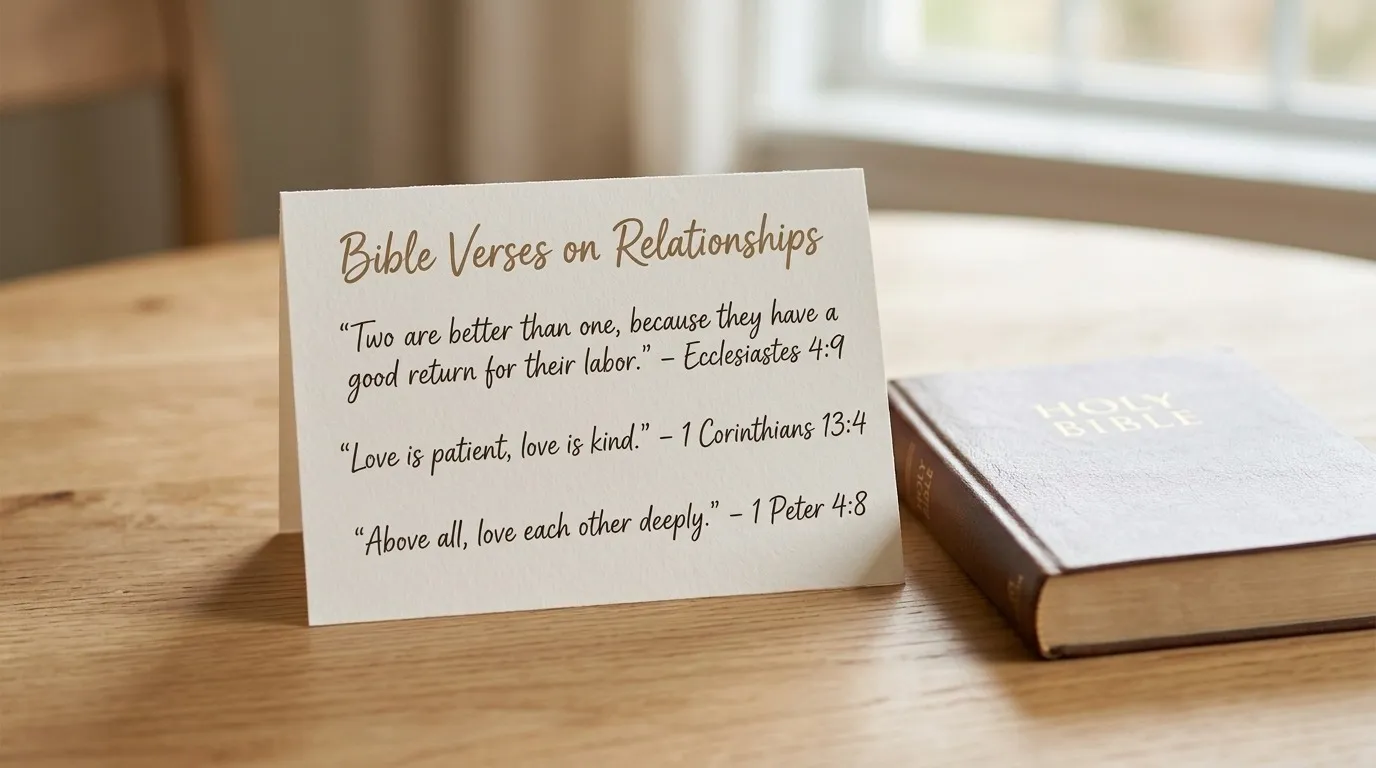
7. Ecclesiastes 4:9–10 — Support One Another
Ecclesiastes 4:9–10 explains that two are better than one because they can help each other. The image of one person helping another who has fallen shows the practical value of companionship.
Relationships can offer emotional and practical support. A family member may help during a difficult season, a friend may offer encouragement, or a partner may share responsibilities. The passage does not mean that people should depend entirely on others. It reminds us that accepting help and giving help can both be wise.
Practical lesson: Notice when someone needs support. Instead of assuming what they want, ask how you can help. Also allow trusted people to support you when you cannot manage everything alone.
8. Proverbs 13:20 — Choose Wise Companions
Proverbs 13:20 teaches that walking with wise people can lead to wisdom, while keeping company with fools can bring harm. The proverb highlights how close relationships can shape our habits, decisions, and character.
This does not mean Christians should look down on people who make mistakes. Everyone needs patience and opportunities to grow. The warning is about the influence of close companionship, especially when harmful behavior becomes normal or accepted.
Practical lesson: Think about the patterns encouraged by your closest relationships. Choose companions who respect others, take responsibility for their actions, and support wise decisions. Offer kindness to everyone, while being careful about whose behavior you allow to shape your own.
9. Galatians 6:2 — Carry One Another’s Burdens
Galatians 6:2 calls believers to carry one another’s burdens, fulfilling the law of Christ. In the surrounding passage, Paul discusses restoring someone gently and watching one’s own conduct. The verse therefore joins practical help with humility and care.
Supporting someone does not mean taking responsibility for every choice they make. It can mean listening, offering practical assistance, helping them find support, or standing beside them during a difficult time. Wise support respects both compassion and personal responsibility.
Practical lesson: Be willing to help when another person struggles, but be honest about your limits. If a problem is beyond your ability, help the person connect with trusted family members, qualified professionals, or other appropriate support.
10. Romans 12:18 — Seek Peace Where Possible
Romans 12:18 urges believers to live at peace with everyone, as far as it depends on them. The qualification matters: peace is not always possible because a relationship involves more than one person’s choices.
The passage encourages people to do their part by avoiding needless hostility, responding thoughtfully, and seeking peaceful solutions.
It does not require someone to accept abuse or remain silent about wrongdoing. Sometimes peace requires a clear boundary or help from someone outside the conflict.
Practical lesson: Take responsibility for your own words and actions. Apologize when you are wrong, listen when others raise concerns, and seek fair solutions. Remember that you cannot control another person’s response, no matter how carefully you act.
A Biblical Case Study: Ruth and Naomi’s Relationship 🌾
The story of Ruth and Naomi in the Book of Ruth offers a powerful picture of loyalty during loss and uncertainty. Naomi loses her husband and sons while living in Moab. When she decides to return to Bethlehem, Ruth chooses to go with her rather than return to her own family.
Ruth 1:16–17 records Ruth’s commitment to Naomi and her decision to share Naomi’s people and God. Her choice is not presented as an easy path. It involves leaving what is familiar and entering an uncertain future.
As the story continues, Ruth works to provide food, and Naomi offers guidance about their circumstances. Their relationship includes both loyalty and practical action. They do not solve every problem through words alone; they respond to hardship with commitment and effort.
What Christians can learn: Strong relationships often require care expressed through action. Support may mean staying present, helping with practical needs, listening to advice, or facing uncertainty together. Ruth and Naomi’s story also reminds readers that relationships can become sources of hope during grief and major life changes.
5 Life Lessons for Christians 🌱
1. Put Love Into Action
Love is more than a feeling or promise. Show it through patience, practical help, honesty, and respect. Small, consistent acts can strengthen trust over time.
2. Communicate With Care
Words can deepen conflict or help resolve it. Listen carefully, explain your concerns clearly, and avoid insults. Honest communication works best when both people have room to speak.
3. Forgive With Wisdom
Forgiveness can free people from the desire for revenge, but it does not erase the need for accountability. Trust may take time to rebuild, and some relationships may need firm boundaries.
4. Choose Relationships That Encourage Goodness
The Bible warns that close companions influence our choices. Seek relationships that support wisdom, responsibility, kindness, and spiritual growth. Be willing to notice when a repeated pattern is harming you.
5. Seek God’s Guidance Without Ignoring Reality
Prayer and Scripture can help you think through a relationship, but they should not be used to excuse harmful behavior. Look at actions, patterns, mutual respect, and honest advice. Faith and practical wisdom can work together.
Common Misunderstandings About Biblical Relationships ⚠️
“If I Love Someone, I Must Accept Everything They Do”
Love does not require approval of every action. Scripture joins love with truth and wisdom. It is possible to care about someone while disagreeing with their choices or refusing to participate in harmful behavior.
“Forgiveness Means Trust Must Return Immediately”
Forgiveness does not automatically rebuild trust. A damaged relationship may need honest apologies, changed behavior, and time. Reconciliation also requires willingness from both sides, and it may not be safe or possible in every situation.
“A God-Centered Relationship Never Has Conflict”
Even people who sincerely seek God can disagree, misunderstand one another, or make mistakes. A healthy relationship is not defined by the total absence of conflict. It is shaped by how people handle disagreements, take responsibility, and seek fair solutions.
“The Bible Says I Must Stay in Every Relationship”
The Bible encourages love, peace, and faithfulness, but those teachings should not be used to force someone to remain in an abusive or dangerous situation. Seeking safety, trusted support, and appropriate professional help can be necessary and wise.
“Every Romantic Relationship Is Meant to Lead to Marriage”
Scripture teaches about marriage and commitment, but it does not say that every relationship must end in marriage. Christians can use biblical wisdom to consider character, shared values, readiness, and the health of a relationship without assuming that a particular person is destined for them.
Expert Insight: Read Relationship Verses in Context 💡
When studying a Bible verse about relationships, read the surrounding paragraph or chapter. Ask who is speaking, whom they are addressing, and what problem or principle the passage covers.
For example, Romans 12 gives broad guidance for Christian conduct, while Ephesians 5 discusses household relationships within a wider teaching about Christian life. These passages should be read carefully rather than reduced to a single sentence that ignores the rest of the teaching.
Compare reputable translations when wording is unclear, and consult a reliable Bible dictionary or commentary for historical or language questions.
Avoid treating every modern relationship slogan as a direct biblical promise. The goal is to understand what Scripture teaches and apply its principles wisely.
FAQs
1. What is the best Bible verse about relationships?
Romans 12:10 is a helpful starting point because it teaches believers to show devotion and honor to one another. First Corinthians 13:4–7 also describes the qualities of love. The most useful passage depends on whether you are studying respect, conflict, friendship, marriage, or forgiveness.
2. What does God say about healthy relationships?
Scripture encourages relationships marked by love, honesty, kindness, patience, faithfulness, and respect. Romans 12:9–18 and Colossians 3:12–14 offer practical guidance. A healthy relationship does not require perfection, but it should allow people to act responsibly and treat each other with dignity.
3. What Bible verses help with relationship problems?
Ephesians 4:25–32 addresses truthful speech, anger, kindness, and forgiveness. Romans 12:18 encourages peace where possible, while Galatians 6:2 teaches mutual support. These passages can guide reflection, but serious or unsafe situations may also require help from trusted people or qualified professionals.
4. What does the Bible say about romantic relationships?
The Bible teaches principles that can guide romantic relationships, including love, faithfulness, wisdom, and respect. It also provides direct teaching about marriage. Dating customs vary across cultures and time, so readers should apply biblical principles carefully rather than treating every modern dating rule as a direct command from Scripture.
5. How can I put God first in a relationship?
You can put God first by seeking wisdom through Scripture and prayer, acting honestly, and considering whether the relationship encourages what is good. Also pay attention to actions, not only promises. Seek mature counsel when needed, and remember that faith should never be used to excuse manipulation or abuse.
Conclusion:
The Bible teaches that relationships should reflect love, honesty, kindness, faithfulness, patience, and respect.
From the wisdom of Proverbs to the instructions in Romans and Colossians, Scripture gives practical guidance for friendships, families, marriages, and Christian communities.
These Bible verses about relationships remind us that healthy connections require more than strong feelings.
They call for thoughtful words, responsible choices, forgiveness, and a willingness to seek peace. They also show that love and wisdom belong together.
Forgiveness does not erase accountability, and commitment does not mean accepting harm.
If you are facing a relationship challenge, take time to reflect on Scripture, pray for guidance, and seek wise support.
Focus on what you can control: your own actions, honesty, and boundaries. You cannot force another person to change, but you can choose to act with integrity.
May God give you wisdom to build relationships that honor Him and bring care, truth, and encouragement to the people around you.

Hello, I’m Michael Bennett. I am passionate about exploring the symbolism, dreams, and spiritual messages found throughout the Bible. My research focuses on understanding how biblical themes connect with faith, personal growth, and everyday life.