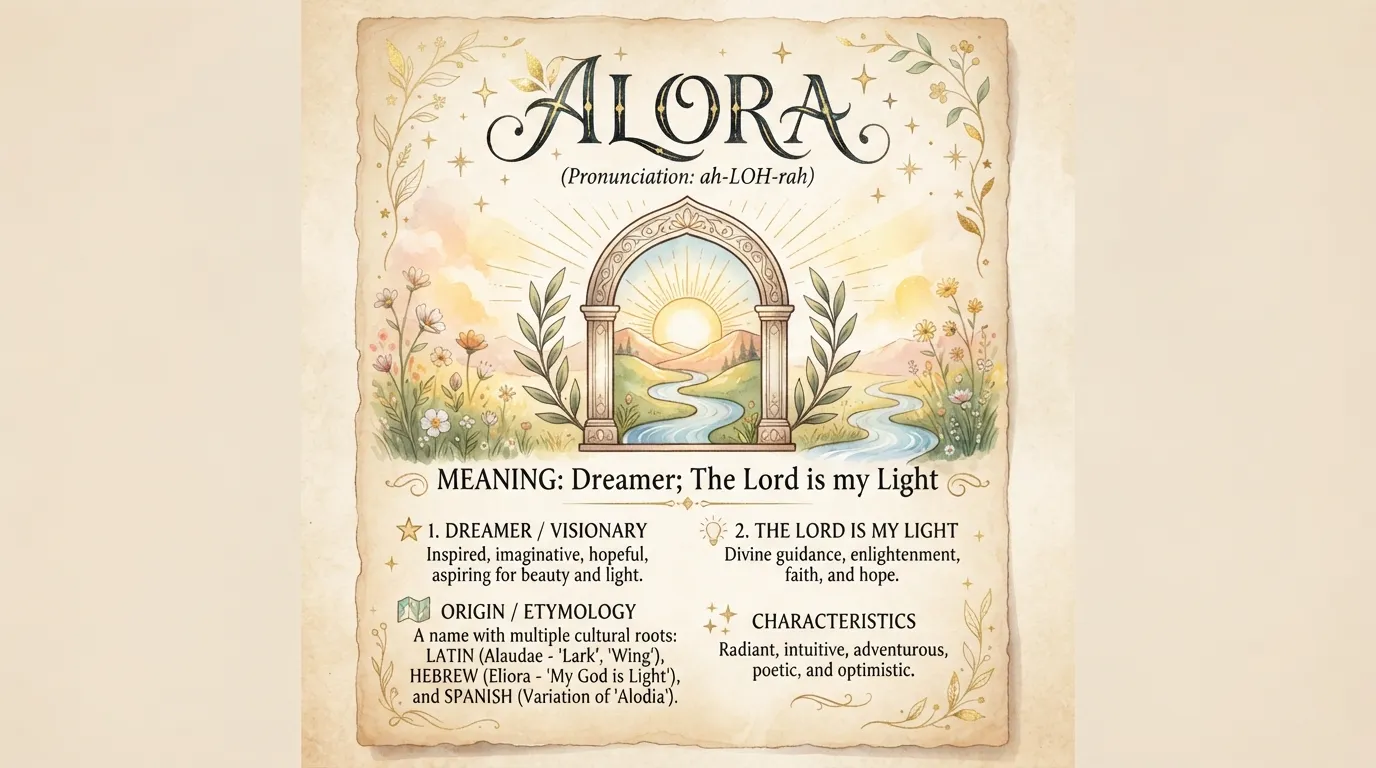
Before diving into what this name symbolizes, here’s the plain truth: Alora doesn’t have one confirmed origin, and it doesn’t appear in Scripture at all.
Alora is most commonly claimed as a Hebrew name meaning “God is my light,” though this connection is genuinely disputed. Other sources trace it to African Bantu roots meaning “dreamer,” or treat it as a modern variant of the name Elora. No single origin is confirmed.
Did You Know? 🔍
The Hebrew name most often cited as Alora’s root isn’t actually “Alora” itself, but Eliora — a genuine Hebrew name combining El (God) and ora (light). Alora appears to be a modern, invented variation of Eliora rather than an ancient biblical name in its own right.
Quick Answer 📖
What Does Alora Mean in the Bible?
Alora does not appear in the Bible and has no single confirmed origin. It’s popularly associated with the Hebrew phrase “God is my light,” likely derived from the genuine Hebrew name Eliora. Other sources trace it to African Bantu roots meaning “dreamer,” or treat it as a modern spelling variant of Elora.
Biblical Meaning of Alora 🕯️
Hebrew Meaning
Alora itself is not a documented ancient Hebrew name. Its popular “God is my light” meaning appears to be borrowed from Eliora (אֱלִיאוֹרָה), a genuine Hebrew name combining El (God) and ora (light, brilliance). Whether Alora is a deliberate variant of Eliora or simply an invented modern name that resembles it linguistically is not clearly established.
Literal Meaning
If the popular Hebrew-linked interpretation is accepted, Alora would literally suggest “God’s light” or “the Lord is my light.” However, other documented sources describe entirely different literal meanings — “dreamer” in Bantu languages, or “at that hour” as a Spanish word, unrelated to any Hebrew root at all.
Spiritual Meaning
For families drawn to the “God is my light” interpretation, Alora carries meaningful spiritual resonance tied to biblical light imagery — even though this connection rests on a disputed etymology rather than a confirmed scriptural name.
Biblical Significance
Alora holds no direct biblical significance, since it does not appear anywhere in Scripture. Its spiritual meaning, where claimed, is entirely borrowed and symbolic, drawn from the broader biblical theme of God as light rather than from the name itself.
Key Scripture Reference
Psalm 27:1 — “The Lord is my light and my salvation; whom shall I fear?” This verse is often cited alongside Alora’s popular meaning, though it should be understood as a thematic pairing, not a direct reference to the name.
Historical & Biblical Context 🌙
Old Testament Usage
Neither “Alora” nor “Eliora” appears as a named figure anywhere in the Old Testament text. Eliora exists as a documented Hebrew name in modern naming traditions, built from recognizably biblical Hebrew components, but it is not itself found within the biblical narrative as a person’s name.
New Testament Relevance
Alora does not appear in the New Testament either. Its only meaningful connection to New Testament themes comes symbolically, through passages describing God, or Christ, as light — such as John 8:12, where Jesus declares, “I am the light of the world.”
Cultural Understanding in Biblical Times
Since Alora has no documented ancient Hebrew usage, it has no cultural footing within the biblical world itself. Its modern popularity draws instead from a blend of naming trends — Hebrew-sounding constructions, African Bantu meaning, and resemblance to already-popular names like Aurora and Elora.
Is Alora Mentioned in the Bible? 📜
No, Alora is not mentioned anywhere in the Bible, and it should not be presented as a scriptural name. Why it matters: several popular baby-name sources claim Alora has a confirmed “biblical meaning,” when in fact its most credible connection is to Eliora, a separate, though related, modern Hebrew name. What it teaches: enthusiasm for a name’s meaning shouldn’t override accuracy — a genuinely honest answer serves families better than an appealing but unverified claim.
Spiritual Meaning & Symbolism 🌟
Light vs. Dreams
Interestingly, Alora’s two most commonly cited meanings — “God is my light” and “dreamer” — pull in genuinely different symbolic directions: one toward divine guidance and presence, the other toward imagination and hope. Both can be spiritually meaningful, but they come from entirely unrelated linguistic traditions.
God’s Perspective
Scripture consistently uses light as a symbol of God’s presence, truth, and guidance (Psalm 119:105, John 1:5). For families drawn to Alora’s popular “light” meaning, this broader biblical theme offers genuine spiritual substance, even without a directly named scriptural root.
Lessons for Today
Believers can appreciate Alora’s popular symbolism as an invitation to reflect on God as light and guide, while still being honest that this connection is thematic rather than a confirmed, direct biblical translation.
Comparison Table: Alora vs. Related Names
| Name | Documented Origin | Meaning | Appears in the Bible? |
|---|---|---|---|
| Alora | Disputed (possibly modern variant) | “God is my light” (claimed) or “dreamer” | No |
| Eliora | Hebrew | God is my light | No (modern Hebrew name, not biblical text) |
| Elora | Uncertain, possibly variant of Eliora | Multiple claimed meanings | No |
| Eve | Hebrew (Chavah) | Life, living one | Yes (Genesis 3:20) |
Biblical Verses About Light 📖
Genesis 1:3
“And God said, ‘Let there be light,’ and there was light.” This foundational verse establishes light as one of God’s first creative acts, underpinning the broader biblical symbolism many associate with Alora’s popular meaning.
Psalm 27:1
“The Lord is my light and my salvation; whom shall I fear?” This verse closely echoes Alora’s popularly claimed meaning, even though the name itself isn’t scriptural.
Psalm 119:105
“Your word is a lamp to my feet and a light to my path.” This verse ties the theme of light directly to guidance through Scripture, a common symbolic pairing for light-related names.
John 1:5
“The light shines in the darkness, and the darkness has not overcome it.” This verse from John’s Gospel connects light imagery directly to Christ’s presence in the world.
John 8:12
Jesus declares, “I am the light of the world. Whoever follows me will not walk in darkness, but will have the light of life.” This is among the New Testament’s clearest statements of light as a description of Christ Himself.
Real-Life Biblical Case Study 🕯️
While Alora has no direct biblical figure to draw from, the broader theme of God’s light finds a powerful real narrative in the story of Paul’s conversion in Acts 9. Traveling to Damascus with intentions to persecute Christians, Saul (later Paul) is suddenly surrounded by “a light from heaven” so intense that it strikes him blind (Acts 9:3-4).
This dramatic encounter with divine light doesn’t just startle Saul; it completely transforms him, turning history’s most zealous persecutor of the early church into one of its most influential apostles. The physical light in this account mirrors the spiritual light theme so often associated symbolically with names like Alora — a sudden, undeniable encounter with God’s presence that changes everything afterward. Though Alora itself isn’t in this story, its popular meaning finds a genuine, powerful biblical parallel here.
Life Lessons for Christians ✝️
- Honest research protects trust. Families deserve accurate information about a name’s origin, even when the truth is more complicated than a single tidy claim.
- Symbolic meaning can still be genuinely meaningful. Alora’s popular connection to “light” doesn’t need false scriptural certainty to matter spiritually to a family.
- God’s light theme runs throughout all of Scripture. Whether or not a specific name is biblical, the theme it symbolically points to often is.
- Multiple possible origins aren’t a flaw. A name shaped by Hebrew, African, and modern influences alike can still carry rich, layered meaning for a family.
- Transformation often follows an encounter with light. Paul’s story shows that divine light in Scripture isn’t just decorative imagery — it changes lives.
Common Misunderstandings ⚠️
A common misunderstanding presents Alora as a confirmed, ancient Hebrew biblical name with the settled meaning “God is my light.” In reality, its most credible connection is to the separate modern Hebrew name Eliora, and multiple sources instead point to unrelated African or Spanish origins — no single explanation is universally agreed upon.
Another misunderstanding assumes any name with a light-related meaning must have direct scriptural roots. Many modern names are built or popularized well after biblical times, drawing loosely on biblical themes without being names found within Scripture itself.
Expert Insight 💡
When a name-meaning source cites multiple, unrelated origins for the same name (Hebrew, African, Spanish, and English variant, in Alora’s case), treat that as a signal to research further rather than accepting the most appealing explanation — genuine biblical names typically have a single, well-documented linguistic root.
FAQs
Does the name Alora appear in the Bible?
No, Alora does not appear anywhere in Scripture, and no single origin for the name is definitively confirmed.
What does Alora mean?
It’s popularly claimed to mean “God is my light,” likely borrowed from the separate Hebrew name Eliora, though other sources suggest “dreamer” from African Bantu origins.
Is Eliora a biblical name?
Eliora is a modern Hebrew name built from recognizably biblical components (El, meaning God, and ora, meaning light), but it does not appear as a named figure within the biblical text itself.
Can Christian parents still meaningfully choose the name Alora?
Yes, many are drawn to its popular “light” symbolism, which connects meaningfully to biblical themes of God as light, even without the name itself being scriptural.
Why do sources disagree so much about Alora’s meaning?
Because Alora appears to be a modern name shaped by multiple naming trends and resemblances rather than a single, historically documented linguistic origin.
Conclusion
Alora’s story is really a lesson in honest research: a name with genuine emotional appeal, built on a popular but unconfirmed connection to Hebrew “light” imagery.
It isn’t found in Scripture, and its true origin remains genuinely uncertain.
Still, for families drawn to its symbolism, the broader biblical theme of God as light offers real spiritual depth as long as that connection is understood clearly for what it is.

Hello, I’m Jonathan Reed. I have a strong interest in biblical interpretation and Christian education. Over the years, I have spent significant time studying Scripture and researching its historical context to better understand its teachings and messages.