Eliana is a Hebrew name meaning “my God has answered,” with added Latin and Greek roots tied to the sun.
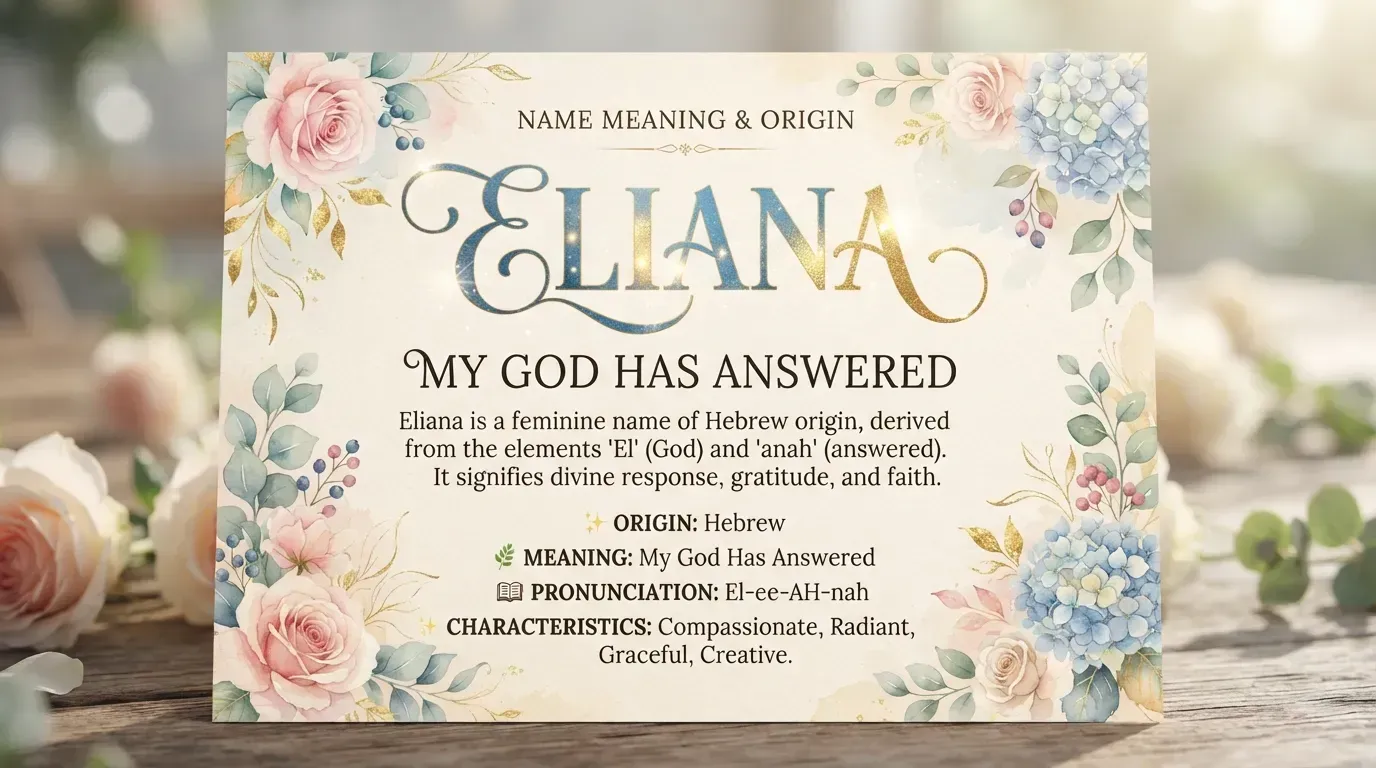
Eliana is a feminine given name of Hebrew origin, meaning “my God has answered.” It also has Latin and Greek connections, sometimes translated as “sun” or “of the sun.”
The name is popular across Hebrew, Italian, Spanish, and Portuguese-speaking communities.
You’re scrolling through baby name lists at 2 a.m., and one name keeps catching your eye: Eliana.
It sounds soft, familiar, and just a little bit ancient. There’s a reason for that.
Eliana traces back thousands of years, carrying real meaning in more than one language. Once you know what it actually means, it’s easy to see why so many parents fall for it.
Table of Contents
- Eliana Name Meaning: The Real Definition
- Origin and History
- Comparison Table
- Pronunciation and Nicknames
- Popularity Today
- Similar Names
- Common Mistakes
- Expert Tip
- Engagement Add-On
- FAQs
- Conclusion
- Key Takeaways
Eliana Name Meaning: The Real Definition
Eliana most commonly means “my God has answered” in Hebrew. It’s built from two elements: “El,” meaning God, and “ana,” meaning “he has answered” or simply “answered.”
Many parents choose this name after a long wait for a child, drawn to the meaning as a reflection of an answered prayer.
The name also carries a second layer of meaning through its Latin and Greek roots, where it connects to “Aeliana,” a feminine form of the Roman family name “Aelianus,” itself linked to the Greek word for sun, “helios.”
Origin and History
Eliana’s primary root is Hebrew, appearing as a variation of “Eliyanah,” sharing the same “God has answered” meaning. Some sources also connect it to “Eliyahu” (Elijah), meaning “my God is the Lord.”
Separately, the name has genuine Latin roots. “Aeliana” was the feminine form of the Roman family name “Aelius,” which some scholars trace to the Greek “helios,” meaning sun — connecting the name to Helios, the Greek god of the sun.
Because these two origin stories developed independently, most naming references present both as valid, rather than treating one as more “correct” than the other. The name spread widely through Hebrew, Italian, Spanish, and Portuguese-speaking communities, which explains its broad international use today.
Comparison Table
| Origin | Meaning | Language Roots |
|---|---|---|
| Hebrew | “My God has answered” | El (God) + ana (answered) |
| Latin | Feminine form of Aelianus | From the Roman family name Aelius |
| Greek | “Sun” or “of the sun” | Linked to helios, the Greek word for sun |
Pronunciation and Nicknames
Eliana is most commonly pronounced “eh-lee-AH-nah” in English. Popular nicknames include Elle, Ellie, Eli, and Ana.
Related name variations include Elianna, Elianne, Eliyana, Ileana, Iliana, and Aliana — spellings that shift slightly depending on the region or language.
Popularity Today
Eliana has climbed quickly in the United States over the past decade. It entered the national top 100 girls’ names for the first time in 2018 and has continued rising since.
The name shows particularly strong popularity in states with large Latin American populations, which lines up with its Spanish, Italian, and Portuguese usage alongside its Hebrew roots.
Similar Names
Names with a related meaning or sound include Elian, Eliane, Elianna, Liana, Ilana, Eleana, and Elijah — the male form connected to the same Hebrew root.
Common Mistakes
Assuming Eliana has only one origin. The name genuinely carries both Hebrew and Latin/Greek roots — it’s not a case of one being a modern reinterpretation of the other.
Confusing Eliana with Elena or Elina. These are separate names with different roots — Elena and Elina trace back to Helen, not to the Hebrew “God has answered” meaning.
Overlooking the biblical connection. Some naming guides skip past the tie to “Eliyahu” (Elijah), which shares the same “El” root meaning God.
💡 Expert Tip
If you’re drawn to Eliana for its Hebrew meaning specifically, pairing it with a middle name that reinforces that theme — such as Faith, Hope, or Grace — is a common and meaningful choice among parents.
Engagement Add-On: Fun Fact
Eliana ranked as the 10th most popular girls’ name by birth count in recent US data, according to Nameberry — a striking rise for a name that was barely on the radar two decades ago.
FAQs
What does the name Eliana mean?
Most commonly, “my God has answered” in Hebrew. It also carries Latin and Greek roots connected to “sun.”
Is Eliana a Hebrew or Latin name?
Both, genuinely. Its primary root is Hebrew, but it also descends from the Latin “Aeliana,” with Greek ties to “helios,” meaning sun.
How do you pronounce Eliana?
Most commonly “eh-lee-AH-nah” in English, though pronunciation can shift slightly by region and language.
What are common nicknames for Eliana?
Elle, Ellie, Eli, and Ana are all popular shortened forms.
Is Eliana a biblical name?
Yes, its Hebrew root connects it to “Eliyahu” (Elijah), sharing the same “El,” meaning God.
How popular is the name Eliana right now?
Very popular — it entered the US top 100 girls’ names in 2018 and has continued climbing since.
What are similar names to Eliana?
Elianna, Eliane, Liana, Ilana, and Eleana all share a similar sound or root.
Does Eliana have a boy’s version?
Not directly, though Elijah shares the same core Hebrew root meaning “my God is the Lord.”
Conclusion
Eliana carries a genuinely rich, layered meaning — “my God has answered” in Hebrew, with real Latin and Greek roots connected to the sun.
That combination of spiritual weight and international reach helps explain why the name has climbed so quickly in popularity over the past decade.

Hello, I’m Samuel Carter. My interest in biblical studies comes from a lifelong desire to understand the wisdom and teachings contained within Scripture. I particularly enjoy researching biblical numbers, patterns, and themes that appear throughout God’s Word.